Gen info
- Salix is a genus of around 350 species of typically deciduous trees and shrubs in the family Salicaceae. Most species are known as willow, but some narrow-leaved shrub species are called osier, and some broader-leaved species are referred to as sallow. (18)
- The genus hybridize freely, and over 160 hybrids have been named.
- The genus name Salix was given by Carl Linnaeus in 1753. The genus name derives from Latin Salix, used by the Romans for various types of willow. Alternatively, the word may be derived from a Celtic language, sal meaning 'near' and lis meaning 'water', referring to its habitat.
(18)
 Botany Botany
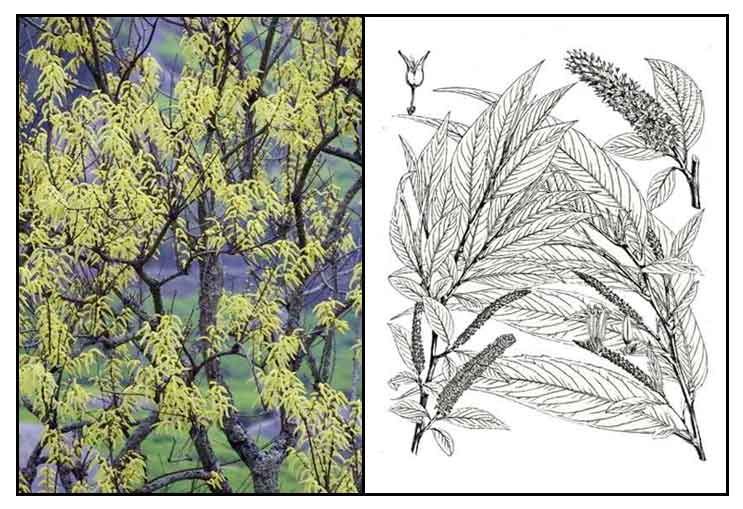
• Malatiki is a small deciduous tree, flowering after leafing. Bark is rough, with deep, vertical fissures. Young shoots and young leaves are silky. Leaves are lanceolate, 8 to 15 centimeters long, with minutely and regularly toothed margins. Male sweet-scented catkins are 5 to 10 centimeters long, and are borne on leafy branchlets. Female catkins are 8 to 12 centimeters long. Capsules are long, stipulate, in groups of 3 to 4. Seeds are 4 to 6, in a capsule.
Distribution
- Native to the Philippines.
-
In forests and swamps and near streams at low and medium altitudes.
- Found in Cagayan, Laguna, Rizal, and Bulacan Provinces in Luzon; in Bohol; and in Mindanao.
- Also native to Andaman Is., Assam, Bangladesh, Borneo, Cambodia, China North-Central, China South-Central, China Southeast, East Himalaya, Hainan, India, Jawa, Laos, Lesser Sunda Is., Malaya, Myanmar, Pakistan, Taiwan, Thailand, Tibet, Vietnam, West Himalaya. (5
 Constituents Constituents
- Phytochemical screenings yield various types of sapogenins: quinovic acid, salicortin, saligenin, phenolic glycosides and pyrocatechol from the bark and leaves.
- Bark yields salicin.
- Plant yields tannins, triterpenes, viz., ß0amyrin, lupeol and chalcinasterol, steroids viz., ß-sitosterol and stigmasterol, with very low concentrations of free salicylaldehyde.
- Study of stem bark isolated 7 compounds: friedelin, 3 β-friedelinol acetate, β- sitosterol, β-sitosteryl-3-O-D-glucopyranoside, β-sitostenone, cis-1,2- cyclohexanediol, and long chain ester.
(7)
- Aqueous extract of bark yielded flavonoids, tannins, and saponins. (see study below) (9)
- Column chromatography of light petroleum fraction from methanol extract of stem bark isolated ß-sitosterol acetate, friedelin, 3-beta-friedelinol, ß-amyrin, ß-sitosterol, ß-sitosterol-O-glucoside in addition to palmitic acid. Dichloromethane fraction of leaves isolated catechol and tremulacin. Ethyl acetate fraction of leaves isolated salicin and its derivatives tremuloidin and 2'-O-p-(E)-coumaroyl salicin.
Properties
- Bark considered febrifuge and analgesic.
- Dried leaves reported to be cardiotonic and neurotonic.
- Studies have suggested anti-inflammatory, antinociceptive, insecticidal, cardiotonic, diuretic, laxative, hypoglycemic, antimicrobial, laxative, antioxidant, antihypertensive properties.
Parts used
Bark, leaves.
 Uses Uses
Edibility
- In India, the new flowers are lightly boiled and mixed with mashed potatoes.
Folkloric
- Bark used to treat fever.
- Used in Egyptian folk medicine as antirheumatic sedative and analgesic. Leaves and bark used as remedy for aches and fever.
- Decoction of leaf and root used for whooping cough in children.
- Paste of both leaf and root used externally for scorpion stings, bug bites, sores and warts.
- Decoction of dried root taken internally for treatment of hepatitis.
- Sap of stem taken orally for dysmenorrhea.
- Hot water extract of entire plant instilled in vaginal cavity as abortifacient; rectally to treat local rectal sores.
- In Pakistan, bark used as febrifuge; leaves used to poultice wounds. In Bangladesh, used for fever. In India, bark used for epilepsy, rheumatism, bladder stones, hemorrhoids, epilepsy; roots used for diabetes. (10)
- In the Malay Peninsula, cold decoction of leaves used as lotion for ulcerated lesions of the nose.
- In Indonesia, used for wound healing and treatment of diabetes.
Others
- Fuel: Wood used as fuel.
- Agroforestry: Planted along water courses to prevent erosion.
- Craft and construction: Used for making cricket bats and light furniture.
Studies
• Anti-Inflammatory: A study of extracts of five plants abundantly growing in Egypt, including Salix tetrasperma, revealed anti-inflammatory activity of the extracts under investigation. Activity was attributed to flavonoids. (2)
• Cardiotonic: Aqueous extract of dried leaf reported to possess cardiotonic activity.
• Reverse Transcriptase Inhibition: Methanol extract of dried leaf exhibit reverse transcriptase inhibition effect.
• Diuretic / Laxative: Study of aqueous extract of Salix tetrasperma in albino rats showed significant diuretic activity as well as laxative activity in a dose-dependent manner. (3)
• Antibacterial / Insecticidal / Cytotoxicity / Roots, Leaves and Bark: Extracts of leaves, bark, and roots were evaluated for antibacterial, insecticidal, and in vivo cytotoxic activities. Bark extract was active against all tested Gr+ and Gr- organisms. Root and leaf extracts showed insecticidal activity against Tribolium castaneum. In invivo cytotoxicity study, the root and bark extract showed moderate cell growth inhibition. (6)
• Cataract Prevention: Study showed Salix tetrasperma leaves extract prevents cataract progression in naphthalene- and galactose-induced cataract in animals. Vitamin E was used as reference drug. (8)
• Hypoglycemic / Bark: Study evaluated various extracts of bark of Salix tetrasperma for hypoglycemic activity on adult Wistar rats. Among the extracts, the aqueous extract produced results comparable to the reference drug glibenclamide. (see constituents above) (9)
• Antimicrobial
/ Leaves: Study evaluated the antimicrobial activity of leaf extract of S. tetrasperma against 4 gram-negative, 4 gram-positive bacterial, and 4 seed-borne fungi by poisoned food technique. Results showed concentration dependent activity against the test bacteria, with highest susceptibility seen with S. epidermis and P. aeruginosa. Among the fungi, marked susceptibility was shown by Rhizopus sp. (11)
• Anti-Inflammatory / Antioxidant / Bark: Study investigated the antioxidant and anti-inflammatory effects of S. tetrasperma bark extracts in rats. In a carrageenan induced rat paw edema, there was significant reduction of inflammation in a dose- and time-dependent manner. A hydroalcoholic extract showed potent in vitro antioxidant activity with lower EC50 in DPPH and superoxide anion inhibition assays. (12)
• Antihypertensive Effect / Leaves: Study evaluated the effect of ethanolic and aqueous extract of leaves of S. tetrasperma on blood pressure on fructose induced hypertensive rats. Both extracts produced significant (p<0.05) dose-dependent reduction of systolic, diastolic, and mean arterial blood pressures. (13)
• Hepatoprotective
/ CCl-4 Induced Hepatotoxicity / Leaves: Study evaluated the protective effect of ethanolic and aqueous leaf extracts against carbon tetrachloride induced hepatotoxicity in rats. Results showed significant prevention of biochemical changes induced by hepatotoxins, along with histopathology findings. The ethanolic showed significantly greater effect than aqueous extracts. (14)
•
Antioxidant / Phenolic and Flavonoid Content: Study evaluated defatted methanolic extract of S. tetrasperma for total phenolic and flavonoid contents. An ethyl acetate fraction showed high phenolic and flavonoid contents, 285.48 ± 2.07 mg gallic acid equivalent / g extract and 136.13 ± 2.47 mg rutin equivalent / g extract, respectively. While all extracts showed antioxidant activity, the ethyl acetate fraction showed highest activity for DPPH, TAC, and ABTS assays. (15)
•
Alleviation of Neuropathic Pain: Neuropathic pain can manifest as chronic painful tingling, burning, and prickling sensations accompanied with hyperalgesia and/or allodynia. Liquid chromatograph-mass spectromety (HPLC-MS/MS) identified 38 secondary metabolites from a methanol extract of flowers. The extract showed substantial anti-inflammatory, central and peripheral anti-nociceptive, antipyretic, and antioxidant activities invitro and different animal models. In chronic constriction injury (CCI) rat model, the extract attenuated and significantly relieved hyperalgesia and allodynia responses in a dose-dependent manner and restore myelin sheath integrity and Schwann cells average in the sciatic nerve. There was significant reduction of various pro-inflammatory biomarkers (NF-kB, TNF-α, PGE2, 5-LOX, COX-2, iNOS, and the oxidative stress biomarker NAPDH oxidase 1 (NOX1) in the brain stem and sciatic nerve tissues. Results support its traditional use in folk medicine to alleviate pain and presents potential as a natural product for treatment of inflammation, nociceptive pain, and chronic neuropathic pain. (19)
•
Quorum Sensing Inhibition / Stem Bark: Targeting of bacterial quorum sensing system is one of the strategies to overcome bacterial resistance. Study evaluated a methanol extract from S. tetrasperma stem bark and flower for quorum sensing activity in Pseudomonas aeruginosa. LC-MS analysis identified 38 secondary metabolites with (epi)catechin-(epi)catechin, epicatechin, tremulacin, salicortin, and trichocarposide as the major constituents. Molecular docking of constituents from both extracts against quorum sensing controlling systems showed that epicatechin, (epi)catechin-(epi)catechin, p-hydroxy benzoyl galloyl glucose, p-hydroxy benzoyl protocatechuic acid glucose, and caffeoylmalic acid could be the main active components. Study supports importance of secondary metabolites, especially polyphenols, as quorum sensing inhibitors. (20)
•
Anti-Inflammatory Salicin Derivatives / Bark: Study of bark isolated 10 undescribed salicin derivatives along with 5 known congeners. Compounds 4-6 significantly inhibited NO production in lipopolysaccharide (LPS)-induced RAW 264.7 macrophages. Compound 4, the most active, suppressed the production of IL-1ß and IL-6 and decreased iNOS and COX-2 expression in a dose-dependent manner. Wester blot analysis revealed the anti-inflammatory mechanism of compound 4 is probably mediated through the MAPK and NF-kB signaling pathways. (21)
•
Central Nervous System Effects / Muscle Relaxant / Leaves: Study evaluated ethanol and aqueous leaf extracts of Salix tetrasperma at doses of 200 and 400 mg/kg for CNS activities and skeletal muscle relaxant effect using experimental models in mice. Results showed both extracts exhibited significant (p<0.001) activities in a dose dependent manner in locomotor and muscle relaxant activity. (22)
•
Anti-Inflammatory / Stem bark and Leaves: Total methanolic extract exhibited significant anti-inflammatory activity (rat hind paw edema). The extract with content of 120 mg/kbw produced 52% inhibition equivalent to standard diclofenac sodium (54% inhibition). (see constituents above) (23)
•
Antibacterial / Leaves: Study of 96% ethanolic extract of S. tetrasperma dried powder of leaves against Staphylococcus aureus (SA) and Pseudomonas aeruginosa (PA) showed weak antibacterial activity with MICs of 4.5193 and 6.6039 mg/mL respectively. (24)
•
Herbal Acne Control / Invention: The invention is an herbal acne control composition comprising of extracts of Swietenia mahagoni, Salix tetrasperma, Aloe vera and Cucurma long and pharmaceutically acceptable excipients. The herbal remedy is formulated to possess anti-inflammatory, anti-keratolytic, sebum control and antibacterial activity in a cosmecutical product for topical application for control and treatment of acne vulgaris. (25)
Availability
- Wild-crafted.
- Seeds, powders, oils, extracts in the cybermarket.
|


