|
 Gen info Gen info
• Justicia is a genus of flowering plants in the family Acanthaceae. It is the largest genus within the family, with over 900 accepted species.
• Etymology: The generic name Justicia honors the Scottish horticulturist James Justice (1698-1763). The derivation of the species epithet gendarussa is uncertain.
Botany
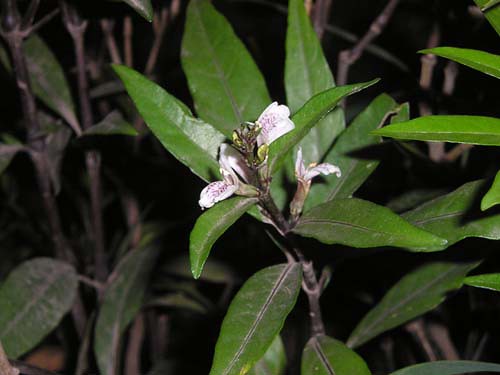
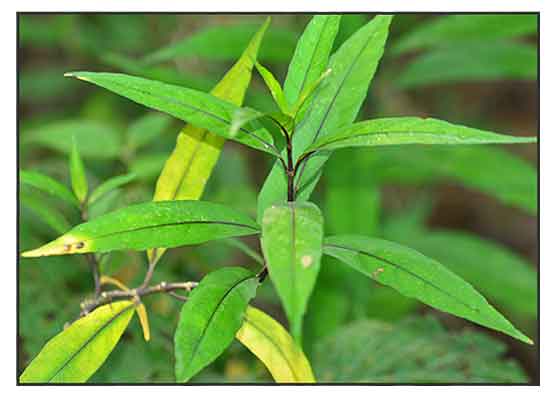
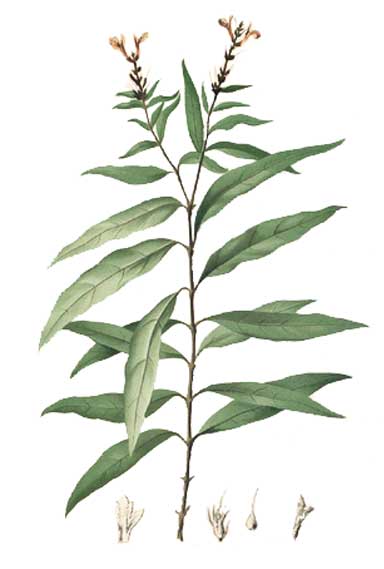
• Tuhod-manok is an erect, branched, smooth
undershrub, 0.8 to 1.5 meters high. Leaves are opposite, lanceolate,
green or variegated
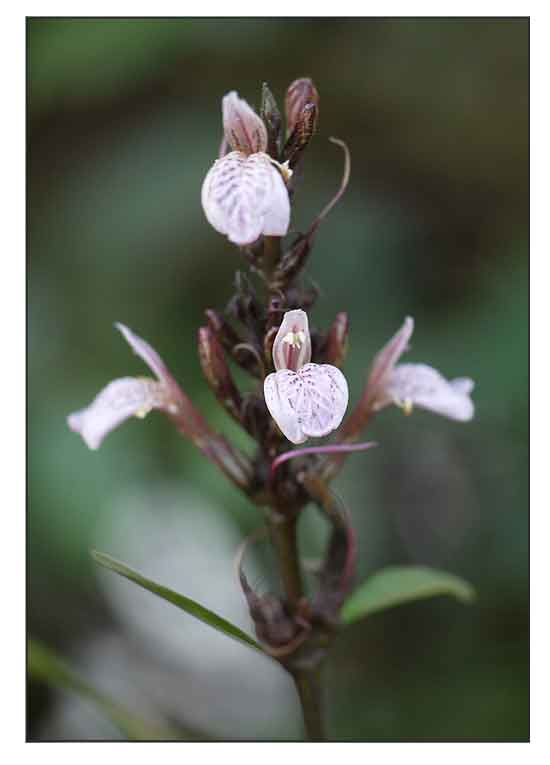
with short petioles, 7 to 14 centimeters long, 1 to 2.5 centimeters wide, pointed at the ends . Flowers are small, in 4- to 12-centimeters long spikes,
terminal or in axils of leaves. Calyx-teeth are smooth, linear, and about 3 millimeters long. Corolla is nearly smooth, 1.5 centimeters long, white or pink,
with purple spots. Capsule is club-shaped, about 12 millimeters long, and smooth.
• A small, erect, fast-growing, branched shrub with attractive, lanceolate (shaped like a lance-head), ascending to spreading green leaves, and produces dainty white flowers. Foliage: Leaves simple, entire, opposite, lanceolate, green, 7 to 14 cm long and 1 to 2.5 cm wide, glabrous on both sides, apex acute-acuminate. Stems: Stems multi-branched, glabrous (smooth; not hairy or rough), terete (having a circular transverse section), thickened at and above the nodes and internodes. Flowers: Inflorescences on spikes, up to 10 cm long and 1.5 cm across; flowers subsessile (with a slight stalk), white with purple streaks and spots inside, 1.6 to 2 cm long. Fruit: Fruit capsules club-shaped, glabrous, 4-seeded, about 12 mm long. (31)
 Distribution Distribution
- Native to the Philippines.
-
Found from northern Luzon to Palawan and Mindanao, in most islands and provinces, chiefly along
streams at low and medium altitudes in secondary and primary
forests, and sometimes in thickets in and about towns, rarely planted.
- Also native to Andaman Is., Assam, Bangladesh, Cambodia, East Himalaya, India, Laos, Lesser Sunda Is., Malaya, Myanmar, New Guinea, Philippines, Sri Lanka, Sumatera, Thailand, Vietnam. (26)
Constituents
- Leaves contain a bitter
alkaloid (justiciine).
-
Leaves are rich in potassium salts.
- Ethanolic extract of leaves yielded flavonoids, terpenes/sterols, and saponins.
(see study below) (21)
- Phytochemical screening of methanolic extracts yielded
alkaloids, flavonoids, reducing sugars, tannins. amino acids and proteins in both leaf and stem parts; anthraquinone was present only in the leaf part. There was absence of steroids and triterpenoids, gum, and saponins. (see study below) (27)
- Phytochemical screening showed the presence of alkaloids, flavonoids, saturated
steroidal saponins or triterpinoidal saponins and amino acids.
Properties
- Root is bitter in taste.
-
Considered anodyne, antiperiodic, antispasmodic, carminative, diaphoretic,
diuretic, emetic, febrifuge and laxative.
- Studies have suggested antioxidant, antinociceptive, immunosuppressive, larvicidal, mosquitocidal, anti-arthritic, anti-angiogenic, anti-inflammatory, cytotoxicity, anti-cancer, hepatoprotective, male contraceptive, anthelmintic, anti-anxiety, antiviral, atheroprotective, CNS stimulant, neuroprotecive properties.
Parts
used
Leaves, bark, leaf juice, roots.
 Uses Uses
Folkloric
- Decoction of boiled leaves
used for bathing during childbirth or for postpartum baths (see: Suob)
- In the Philippines the juice of 20 to 40 leaves or young shoots, extracted with water and a little wine, used as emetic in coughs and asthma.
- Tea of leaves, 50 gms to a liter of boiling water, 5 glasses daily for
fevers, cough, asthma, dysuria.
- Fresh juice of leaves for children's cough and colic.
- Used for respiratory tract infections.
- Mix 2 ounces of fresh juice from leaves with 1 ounce of coconut oil
as a poultice for rheumatism.
- Infusion of leaves for headaches.
- Fresh juice of leaves for earaches.
- Fresh leaves used as topicals to cure the edema of beriberi; also used for rheumatism.
- Fresh juice of leaves, mixed with mustard, is used as an emetic; also
for asthma.
- Bark used as emetic.
- Tea of bitter tasting root for diarrhea, dysuria fevers: 50 gms to a
pint of boiling water, 4 glasses daily.
- Warmed salted leaves and tender stalks, in a bag, over musculoskeletal
aches.
- Roots boiled in milk given for rheumatism, dysuria, fever, carbuncles, jaundice, and diarrhea.
- In the Antilles, plant decoction or wine infusion (30 gm in 1 liter of water) used for
intermittent fevers.
-Root, boiled in milk, for rheumatism, dysuria, fever, carbuncles, and
diarrhea.
- Leaves rubbed with Crinum asiaticum and black pepper used externally
for lumbago.
- Decoction of leaves for as diaphoretic and febrifuge.
- Leaves are scattered in-between clothes to protect from insects.
- Oil prepared from leaves useful for eczema.
- In Sri Lanka, used for its analgesic action.
- In Kerala, leaves J. gendarussa, Hydrocotyle javanica, and Pterospermum rubiginosum are ground and juice used to prepare decoction to use for rheumatism. (25)
- In Malaysia, tribes of Iban, Kayan, and Kenah use poultice of fresh leaves traditionally used for treatment of minor cuts, fractures, wounds, and sprains.
(32)
Others
- Repellant:
Dried leaves repel insects from clothing.
In the news
• Male Contraceptive Study: Research on the contraceptive properties of Justicia gendarussa plant has been ongoing since 1985. Phase 2 studies have suggested a success rate similar to that of oral contraceptives in women. Study has suggested disruption of an enzyme in the sperm head which weakens its ability to penetrate the ovum. Further studies await funding. Data was presented at the American Society of Andrology in Atlanta 2014. (20)
Studies
• Antinociceptive
/ Antioxidant: Study
of JG aqueous leaf extract showed moderate and significant antinociceptive
action, dose-dependent and of moderate duration. In addition, it also
showed strong antioxidant activity. (2)
• Immunosuppressive:
Study of
four medicinal plants that included J gendarussa showed inhibition of
lymphocyte proliferation and suggests the extracts should be further
investigated for their immunosuppressive components. (3)
• Larvicidal / Mosquitocidal: Study
of 11 commonly available medicinal plants, including J gendarussa, was
evaluated for it larvicidal and mosquitocidal activities against Anopheles
stephensi. All the extracts were found effective and the results suggest
that these extracts are easy to prepare, inexpensive and safe for mosquito
control. (4)
• In Vitro HIV-1 Reverse Transcriptase
Inhibition: Study of 20 Thai medicinal plants, J gendarussa
was one of the extracts that showed reverse transciptase inhibition. (5)
• Anti-Arthritic: Study of ethanolic extract of J gendarussa showed significant anti-arthritic activity statistically similar to aspirin. (6)
• Anti-Angiogenic: Study showed both aqueous and ethanolic extracts of leaves of J gendarussa dose-dependently inhibits angiogenesis and provides scientific basis for its traditional use in the treatment of arthritis. (7)
• Antioxidant / Hepatoprotective / Leaves: Study showed the leaf extract of Justicia gendarussa has moderate hepatoprotective effect which may be due to its antioxidant and free radical scavenging potential. (8)
 • Anti-Inflammatory / Leaves: Study of ethanol extract of leaves exhibited a modulatory function in inhibition of NO, iNOS, and MMP-9 in invitro studies providing supporting evidence for the anti-inflammatory properties of J. gendarussa and its potential use in the management of inflammatory conditions like arthritis. (21) • Anti-Inflammatory / Leaves: Study of ethanol extract of leaves exhibited a modulatory function in inhibition of NO, iNOS, and MMP-9 in invitro studies providing supporting evidence for the anti-inflammatory properties of J. gendarussa and its potential use in the management of inflammatory conditions like arthritis. (21)
• Anthelmintic / Dried Leaves and Stems: Study of crude methanolic extract of dried leaves and stems exhibited significant anthelmintic activities against Pheretima posthuma. Albendazole was the positive control. (10)
• Anti-Inflammatory / Antinociceptive / Leaves: Study of ethanol extract of leaves screened for anti-inflammatory and antinociceptive activity in animals exhibited significant inhibition of pain in the acetic acid writhing and hot plate models in mice. (11)
• Male Contraceptive / Renal Precautions: Study has yielded Gandarusin A and reported to have an antifertility effect by preventing spermatozoa penetration by degrading activity of hyaluronidase enzyme. In a 72-day study, a 70% ethanol extract altered the levels of creatinine and calcium. Results caution the use in patients with renal dysfunction. (12)
• Anti-Anxiety: Study evaluated aerial parts of J. gendarussa for anti-anxiety activity. Results showed an effective anti-anxiety effect comparable to that of benzodiazepine diazepam at the dose of 2.0 mg kg. (14)
• Cytotoxicity Activities / Human Cancer Cell Lines: Study evaluated the cytotoxic activity of J. gendarussa methanolic extracts and two standard flavonoids (naringenin and kaempferol) against various human cancer cell lines (HT-29, HeLa and BxPC-3). Methanolic leaf extracts and kaempferol were very toxic against BxPC-3 and HeLa cells. (15)
• Anti-Inflammatory / Roots: Study evaluated a methanolic extract of J. gendarussa roots in a carrageenan-induced paw edema assay. Results showed significant inhibition of edema formation. Extract inhibited carrageenan-elicited total COX-activity, 5-lipoxygenase and 15-lipoxygenase activities. (16) Study of ethyl acetate extract of roots of J. gendarussa dose dependently inhibited LPS-activated COX, 5-LOX, IL-6< and NF-kB hPBMCs. It also reduced LPS induced levels of iNOS and COX-2 mRNA expression in hPBMCs. (21)
• Corrosion Inhibition: Study evaluated the corrosion inhibition effect of J. gendarussa extract on mild steel. Polarization study showed mixed type inhibition. (17)
• Antibacterial / Biomass: Study evaluated a biomass of leaves, stem and root produced through a hydroponic system of cultivation for antibacterial activity against various human pathogens viz. Staphylococcus aureus, Escherichia coli, Shigella sp., Pseudomonas sp., and Klebsiella pneumonia. The methanolic extract showed activity against E. coli. Leaf extracts inhibited growth of Shigella sp., Pseudomonas sp., and K. pneumonia. Stem extract showed maximum inhibition against S. aureus. (19)
• Effect on Plasma Uric Acid: Study evaluated the effect of ethanolic extract of J. gendarussa leaves in oxonate-induced hyperuricemic male albino rats. Results showed dose dependent increased in effect, with greatest effect at 5.2 g/kbw. (see constituents above) (22)
• Male Anti-Fertility Compound / Leaves: Preclinical study of leaves suggested activity as a male contraceptive. Extraction yielded a major compound 6,8- di-C-α-L-arabinopyranosyl-4',5,7-trihydroxyflavone or 6,8-di-C-α-L-arabinosyl-apigénine (gendarusin A) and a minor compounds 6-C- α-L-arabinopyranosyl-4',5,7-trihydroxy-8-C-β-D-ylopiranosyl-flavone or 6-C-α-L-arabinosyl-8-C-β-D-xylosyl- apigenine gendarusin B). (23)
• Hepatoprotective / Stem: Study evaluated a methanolic extract of stem for hepatoprotective activity in isolated rat primary hepatocytes as in-vitro model. Carbon tetrachloride was used as hepatotoxin and silymarin as reference drug. Results showed significant protective activity, but less than silymarin. (24)
• Antioxidant / Leaf and Stem: Study showed J. gendariussa is a potent source of ascorbic acid, 619µg/g in the leaf tissues and 330.33µg/g in the stem bark. DPPH study showed J. gendarussa is a potent free radical scavenger, specially the leaf extract with IC50 of 75 µg/ml, compared to the stem part with 119µg/ml. (see constituents above) (27)
• Potent Inhibitor of Drug-Resistant HIV-1 Strain / Patentiflorin A: Justicia gendarussa was identified as a potent anti-HIV-1 active lead from an evaluation of over 4,500 plant extracts. Boassay-guided separation of stems and root extracts isolated an anti-HIV arylnaphthalene lignan (ANL) glycoside, patentiflorin A (1). Evaluation of the compound against both M- and T-tropic HIC-1 isolates showed significantly higher inhibition effect than the anti-HIV drug AZT. The presence of a quinovopyranosyloxy group is likely essential for the high degree f anti-HIV activity. Investigated against HIV-1 gene expression of R/U5 and U5/gag transcripts, data showed Patentiflorin A acts as a potential inhibitor of HIV-1 reverse transcription. The compound displayed potent inhibitory activity against drug resistant HIV-1 isolates of both nucleotide analogue AZT and non-nucleotide analogue Nevirapine. Results suggest a potential for the development of novel anti-HIV drugs. (28)
• Apigenin / Anti-Inflammatory / Atheroprotective / Leaves: Study isolateds apigenin, a flavonoid, and elucidated its molecular mechanism against inflammation via TLR-NF-kB signaling pathway using ox-LDL-induced hPBMCs in invitro model. The F6 fraction showed 89% paw edema inhibition at dose of 10 mg/kg in carrageenan induced rats. Pre-treatment with apigenin (25µM) significantly (p<0.05) reduced the levels of TLR4, MyDSS, TRIF, TRAF6, NF-kB, COX-2, PGE2, IL-1ß and TNF-a responsibled for generating inflammation and elevated the level of anti-inflammatory cytkine, IL-10. Results indicate apigenin imparts atheroprotective effect by reducing the levels of pro-nflammatory genes. (29)
• Wound Healing / Antibacterial / Leaves: Study evaluated the antibacterial and wound healing activity of J. gendarussa leaves. Water and ethanol extracts of leaves were prepared by cold maceration method into a 10% w/w ointment formulation in excision wound models. Antibacterial efficacy was tested against Bacillus subtilis, Proteus mirabilis, Staphylococcus aureus, Escherichia coli, and Salmonella typhi. The ethanol extract exhibited good antibacterial activity with MIC and MBC at 1-2.5 mg/ml and 2-3 mg/ml respectively. Ointment formulation exhibited significant (p<0.01) wound healing activity. Results were comparable with standard antibiotic, bacitracin ointment (1 mg/gm). Results suggest ethanol and water extracts of J. gendarussa leaves have potential to promote wound healing and antibacterial activities. (32)
• Neuropharmacological Effects / CNS Stimulant / Leaves: Study evaluated various extracts of J. gendarussa leaves on neuropharmacological behavior studies in MPTP induced mice model. Results showed that spontaneous motor activity, retentionn time on rota rod and number of head dipping were decreased (p<0.001), whereas mobility in TST and FST were increased (p<0.01) in MPTP induced animals. Preliminary phytochemical analysis of all extracts revealed presence of flavonoids, polyphenols, amino acids and proteins, terpenoids, carbohydrates, tannins, and alkaloids. Results suggest potential source for CNS stimulant activity with neuroprotective effect. The effect may be due to L-dopa like compounds, terpenoids, flavonoids-polyphenols (Naringenin), amino acids like tyrosine and proteins. (33)
Availability
Wild-crafted. |


_(5506223305).jpg)