|
 Etymology Etymology
Hyptis derives from the Greek word hyptos alluding to the turned back lower lip position of the flower) and the Latin word suaveolens for sweet-smelling.
Botany
Suob kabayo is a coarse,
erect, branched, more or less hairy, aromatic annual, 0.5 to 2
meters tall. Stems are square. Leaves are ovate, opposite, 4 to 9 centimeters long, pointed at the
tip, pointed to somewhat heart-shaped at the base, and toothed
at the margins.
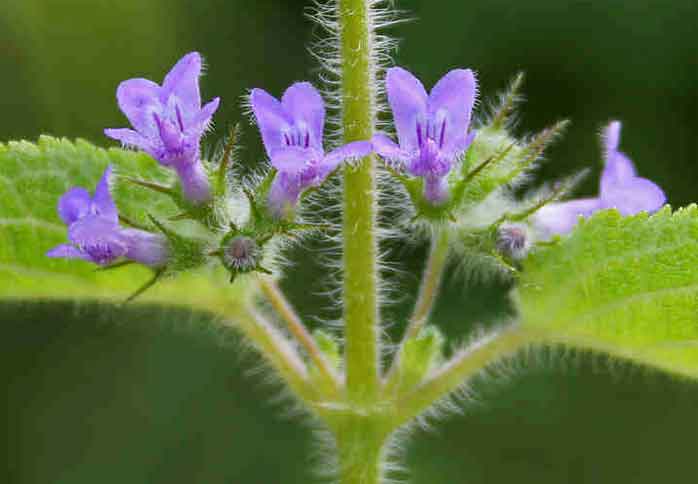
Flowers are long-stalked, occurring at the axils of leaves. Calyx in flower is hairy, about
4 millimeters long, but soon enlarges in fruit to about 1 centimeter long, striate
with erect, stiff teeth. Corolla blue, strongly zygomorphic,
bilabiate; stamens are 4, declinate, and about 8 millimeters long, with a
limb 5 millimeters in diameter. Fruits have flat and mucilaginous seeds.
Distribution
- Very abundant in open,
waste places at low and medium altitudes throughout the Philippines.
- Native of tropical America.
- Now pantropic.
Constituents
• Study yielded a greenish, volatile oil, with a powerful menthol odor.
• Study yielded essential oils in the fruiting stage. The principle
constituents were spathulenol, 1,8-cineole, and (E)-caryophyllene. source
• Study of constituents of essential oil from leaves revealed eucaliptol (47.64%) to be most abundant, followed by gama-ellemene, beta-pynene, (+)3-carene, trans-beta-cariophyllene and germacrene.
• Phytochemical screening yielded sterols, flavonoids, and tannins.
• Leaves yield alkaloids, terpenes, and volatile oils.
• GC-MS study of leaf essential oil yielded 26 compounds comprising 100% of the oil.
The most abundant compound was the terpene alcohol, eucaliptol (47.64%), followed by terpene hydrocarbons gamma-ellemene (8.15%), beta-pyrene (6.55%), (+)-3-carene (5.16%), trans-beta-caryophyllene (4.69%), and germacrene (4.86%). (see study below) (15)
* Phytochemical screening of solvent extracts yielded alkaloids, flavonols, flavones, flavonones, terpenoids, tannins, aldehydes, and ketones, with an absence of steroids, saponins and anthraquinones. (see study below) (32)
* GC-MS analysis of seed oil yielded high amounts (86.96%) of unsaturated fatty acids: linoleic acid (76.13%), oleic acid (10.83%) compared to saturated fatty acids with palmitic acid (6.55%), stearic acid (4.56%) and heptacosanoic acid (1.94%) as main constituents. (see study below) (33)
* Phytochemical screening of ethanol extract of dried leaves revealed the presence of tannins, steroids, terpenoids, saponins, phlobtannins and cardiac glycosides and an absence of flavonoids. (see study below) (41)
* Proximate analysis yielded (%): mineral content tannins 0.45, phenols 0.04, flavonoids 7.54, crude alkaloid 8.21, crude fiber 5.24, crude protein 8.09, carbohydrate 57.58, ash 3.68, crude lipid 3.45, potassium 1.40, nitrogen 1.96, calcium 0.94, magnesium 0.43, sodium 0.34, phosphorus 0.65. (42)
* Study of essential oil from aerial parts yielded more than 45 components, of which eugenol (68.2%) and germacrene D (11.0%) were the major constituents. (44)
* Study of the essential oil of leaves yielded predominant compounds viz. sabinene (7.3-31.3%), eucalyptol (14.0-24.6%), ß-caryophyllene (6.9-12.7%), 1,8-cineole (11.5%), ß-phellandrene (10.2%), terpinolene (8.7-9.6%), fenchone (4.1-8.1%), p-mentha-2 (7),8-diene (7.9%), bicyclogermacrene (4.7-7.5%), ß-pinene (4.9-7.4%), (Z)-ß-ocimene (6.9%), and terpinen-4-ol (5.4-5.9%). (45)
- GC-MS study of fresh leaves for essential oil yielded 24 compounds representing 90.3% of identified oil. Main components were ß-caryophyllene (26.0%), ß-elemene (10.4%), trans-a-bergamotene (7.7%), spathuulenol (7.0%), and bicyclogermacrene (6.5%). (see study below) (47)
• Study yielded eight compounds from the aerial parts, namely: quercetin-3-O-β-D-glucopyranoside (1), apigenin (2), methyl wogonin (3), quercetin (4), kaempferol (5), genkwanin (6), rosmarinic acid (7) and methylrosmarinate (8), respectively. Roots yielded two compounds, identified as podophyllotoxin (9) and picropodophyllotoxin (10). (51)
Properties
• Bitter, minty and
aromatic.
• Leaves considered stimulant, carminative, sudorific, galactagogue.
• Considered analgesic, decongestant, emmenagogue, antipyretic, stimulates
blood circulation.
* Studies have shown
antimicrobial, acaricidal, larvicidal, antinociceptive, anti-inflammatory, antifungal, wound healing, antidiabetic, mosquito repellent, antidiarrheal, gastroprotective, neuroprotective, hepatoprotective properties.
Parts
utilized
- Whole plant.
- Collect from April to June.
- Wash, cut in pieces and compress. Dry under the sun.
 Uses Uses
Edibility
· Edible shoot tips used for flavoring dishes.
· Root decoction used as appetizer.
Folkloric
· In the Philippines, leaves and tops are used in the preparation of antirheumatic and antisuporific baths , and internally, as antispasmodic.
· Decoction of roots valued as appetizer.
· Decoction of plant used for flatulence.
· Leaves are crushed and applied to boils.
· Leaves juice applied to athlete's foot and ringworm lesions.
· Crushed leaves also applied to forehead or temples for headaches.
· Pounded fresh material applied as poultice may be used for
treatment of snake bites.
· Decoction of fresh material may be used as external wash for
dermatitis, eczema.
· Infusion of dried leaves is taken for fever or applied to the
forehead for headaches and to boils. The juice of leaves, mixed with
lime juice, is drunk for stomach aches.
· Root decoction used as emmenagogue. Also used as stimulant for rheumatism.
· A small amount of root, chewed with betel-nut, used as stomachic.
· In Malaya, used as stimulant and sudorific, and against catarrh.
· Used as lactagogue.
· Used for poulticing skin complaints.
· Juice of leaves used for athlete's foot, applied daily to interdigital
areas.
· In Nigeria, leaf decoction used in the treatment of diabetes and in fever associated with colds.
· In India, leaf paste is applied
on sores and fungal skin infections. Also, used for cancers, stomach pains, indigestion, colds, and gallbladder infections.
Others
• Repellent: The intense odor emitted by leaves is used by the Filipinos to drive out bedbugs, putting branches under beds, chairs, etc. (•) In Kenya, also used as bedbug repellent. Burned overnight in rooms to repel mosquitoes.
• Hyptis oil: A high concentration of omega-6 lipids suggests hyptis oil to be an ideal product for dry, flaky skin.
Studies
• Antimicrobial / Essential Oil: Study of the volatile oil distilled from
the overground parts of H suaveolens showed activity against bacteria
and fungi. (1)
• Antimicrobial / Leaves: Study showed a leaf extract with the highest antifungal
and antibacterial activity against Aspergillus niger and Micrococcus
luteus. (3) Study evaluated aqueous and ethanol extracts of leaves of H. suaveolens for antibacterial (K. pneumonia, S. aureus, E. coli, P. aeruginosa) and antifungal (C. albicans, C. capsici, F. oxysporum) activities. All test microbes were susceptible to the e with inhibition zones ranging from 12-19mm. The aqueous extract showed no inhibitory activity. (50)
• Insecticidal
Effect : A comparative study showed that H suaveolens
exerted better larvicidal and ovicidal effect than A indica and O gratissimum. (2) Study of the insecticidal activities of the petroleum ether extract of H suaveolens showed high toxicity on the second instar larvae of the Diamond back moth, Plutella xylostella. (2)
• Acaricidal Effect :
A hydro-distillate of HS leaves showed the adult and nymphal
stages of ticks of Hyalomma sp , Rhipicephalus sp, and Haemophysalis
sp to be highly susceptible, favoring its use as an acaricide. (4)
• Larvicidal Effect / Aedes aegypti:
Study showed the essential oil of Hyptis suaveolens demonstrated
high larvicidal activity against Aedes aegypti compared to that Lantana
camara . A synergistic effect with 100% mortality was obtained with
the mixture of leaf essential oils of H suaveolens and L camara. It
presents a promising source for natural larvicidal compounds. (5)
• Antinociceptive Effect / Toxicity Study / Leaves: Study of HS aqueous leaf extracts showed dose-dependent
nociceptive effects significantly antagonized by naloxone. No toxicity
was found on doses of up to 5 g/kg p.o. (7)
• Anti-Inflammatory Effect / Essential Oil
: In a comparative study with the anti-inflammatory
activity of diclofenac sodium, Hyptis suaveolens leaf essential oil
showed to have better anti-inflammatory activity than the marketed formulation. (8)
• Essential Oils: Study on the composition of essential of H suaveolens showed 1,8-cineole and (E)-caryophyllene to be the principal constituents. Latitude seems to be the most important environmental factor. (9)
• Antioxidant / Antifungal / Essential Oils: Study on the essential oil of H suaveolens showed time and concentration dependent antioxidant effect. Results showed antifungal potential more pronounced than antibacterial properties. (11)
• Mosquito Repellent / Essential Oils: Study showed H. suaveolens to have a high mosquito repellency rate. Statistical analysis showed no significant difference between 10% H. suaveolens essential oil and DEET indicating both products are similarly effective. Study shows a formulation containing 10% essential oil of H. suaveolens has a potential for the integrated management of disease-vector mosquitoes. (14)
• Antifungal / Essential Oils: Study of essential oil revealed an anti-Aspergillus property and a possible rational use as alternative source of new antifungal compounds for aspergillosis treatment. (see constituents above) (15)
• Wound Healing: Five extracts were subjected to antibacterial screening for wound healing activity using excision, incision, and dead space wound healing models. A petroleum ether extract showed significant activity on all three models. (16)
• Acute Toxicity Study / Antidiabetic / Leaves: Study evaluated a methanolic extract of leaves for acute toxicity and hypoglycemic effect in alloxan-induced diabetic rats. Acute toxicity study showed an LD50 of 2154.1 mg/kbw. The methanol extract showed significant reduction in blood glucose concentration. (17)
• Cytotoxicity / Anticancer: Study of the anticancer potentials showed both Hyptis suaveolens and Leonotis nepetaefolia exhibiting potent cytotoxicity against Ehrlich Ascites carcinoma by activating the apoptotic pathway. (18)
• Bioefficacy Against Fish Pathogens: Study investigated the bioefficacy of various leaves extracts of H. suaveolens against fish pathogens isolated from Tilapia (Oreochromis niloticus). An ethanolic extract exhibited broad spectrum of inhibition for B. subtilis, P aeruginosa, K pneumonia and E. coli. (19)
• Antidiarrheal / Leaves: Study investigated an ethanol leaves extract for antidiarrheal activity against an experimental model of castor oil-induced diarrhea in mice. Results showed significant and dose-dependent inhibitory activity against castor oil induced diarrhea. (20)
• Neuroprotective Against Oxidative Stress-Induced Neurotoxicity / Antioxidant: Study investigated the neuroprotective effects of a methanol extract of H. suaveolens using various in vitro systems. The extract showed potent antioxidant activity. Pretreatment with the extract promoted upregulation of tyrosine hydroxylase (s.42-fold, p<0.05) and brain-derived neurotropic factor genes against haO2-induced cytotoxicity in N2A cells. (21)
• Natural Mosquito Repellent / Essential Oil: Study investigated the mosquito repellent activity of Hyptis suaveolens through four parts: plant placement, smoldering, spraying, and stick formation. H. suaveolens was found to a very useful in overcoming the problems associated with synthetic repellents i.e., allergy, unpleasant smell and cost, and most importantly, it is easily available in rural and hilly areas. (22)
• Gastroprotective / Suavelol: Study investigated the gastroprotective activity of H. suaveolens in an ethanol-induced gastric ulcer model in rats. Results showed a hexane extract to have protective effect, and the compound suavelol was one of the active gastroprotective agents. The gastroprotective mechanism involved NO, prostaglandins and sulfhydryl groups. (23)
• Hepatoprotective / Acetaminophen Induced Hepatotoxicity: Study investigated the possible hepatoprotective activity of pretreatment with aqueous extract of leaves on acetaminophen induced hepatotoxicity in rabbits. Marker enzymes were significant reduced almost toward normal. Hepatoprotective potential was suggested by numerous reported bioactivity. (24)
• Hepatoprotective / Cytoprotective: Study showed a methanol extract of H. suaveolens with protective effect against CCl4-induced oxidative damage in albino Wistar rats and H2O2-induced oxidative damage in HepG2 cells. (25)
• Antiurolithiasis / Calcium Oxalate: Study investigated the inhibition of in-vitro calcium-oxalate crystal formation by various extracts of Hyptis. Results showed the inhibitory potency of alcohol extracts of H. suaveolens was comparable to that of cytone (a proprietary drug for dissolving kidney stones). (26)
• Hematologic and Sperm Effect: Study evaluated H. suaveolens, Cleome viscosa and Urena lobata for toxic effects on hematological parameters and sperm count of albino rats. Hyptis suaveolens showed a significant decrease (<0.05) in headless tail which may be of significant effect to their fertility. H. suaveolens hematologic effects were slight and insignificant. (27)
• Gastroprotective / Gastric Ulcers: Study evaluated an ethanolic extract and hexanic fraction of H. suaveolens for gastroprotective effect in several models of gastric ulcer. Results showed the extract and fraction markedly reduced the gastric lesions induced by all ulcerogenic agents (HCl/ethanol, ethanol, NSAIDs, and hypothermic restraint-stress) with a mechanism of action that involves sulfhydryl groups. (29) Study evaluated the curative potential of aqueous extract of H. suaveolens against ethanol-induced gastric ulcers in Wistar rats. Results showed a curative potential as evidenced by reduction in all ulcer index measures, more effective at extract dose of 250 mg/kg compared to 500 mg/kg. (58)
• Antimalarial: Study of ethanolic leaf extract in albino mice and Wistar rats showed good antiplasmodial activity against Plasmodium berghei (08.2±2.70) corresponding to 51.05% suppression and (01.17 ±0.75) corresponding to 94.58% curative. LD50 of the extract was found to be 1264.91 ±0.51 mg/kg in mice and rats. (31)
• Antifungal: Antifungal screening of ethanol extract and partitionates of pulverized plant materials showed growth inhibition in some instances exceeding that of griseofulvin antibiotics against Aspergillus niger, Candida albicans, Cryptococcus and Fusarium species. (see constituents above) (32)
• Antimicrobial / Seed Oil: Study of seed oil was detrimental to growth of fungi and bacterial tested. Salmonella typhi, Pseudomonas aeruginosa, Lactobacillus plantarum, and Candida tropicalis were susceptible at lower concentration. E. coli, Shigella flexnerii, and Vibrio vulnificus were sensitive only at high concentrations. (see constituents above) (33)
• Bioefficacy Against Fish Pathogens / Leaves: Study evaluated the bioefficacy of leaves extracts of H. suaveolens against fish pathogens isolated from diseased Tilapia (Oreochromis nioticus). Ethanolic extracts demonstrated broad spectrum of activities that inhibited the growth of B. subtilis, P. aeruginosa, K. pneumonia, and E. coli. Further studies seek to identify bioactive compounds and mechanisms of action on organisms associated with human diseases. (34)
• Antimicrobial / Synergism Study / Mosquito Repellent Activity: Study evaluated leaf extracts of HS for antimicrobial against P. aeruginosa, S. aureus, and cell phone bacteria. When tested for synergistic activity with Kaempferia galanga and L. amaranthus, results showed greater antimicrobial activity when applied alone. It inhibited the growth of cell phone bacteria and confirmed mosquito repellent activity against Ae. aegypti. (35)
• Suaveolic Acid / Potent Phytotoxic Substance: Study isolated and identified suavelic acid, a phytotoxic substance characterized as 14α-hydroxy-13β-abiet-8-en-18-oic acid. It inhibited the shoot growth of garden cress, lettuce (Lactuca sativa), Italian ryegrass, and barnyard grass at concentration greater than 30 µM. Root growth of all but lettuce was also inhibited at concentrations greater than 30 µM. (36)
• Mosquito Larvicidal / Culex quinquefasciatus: Study evaluated various aerial extracts of H. suaveolens against filarial vector Cx. quinquefasciatus. Among the extracts tested, acetone exhibited the highest larvicidal activity with LC50 value of 485.61 after 24 hours. At 48 hours, petroleum ether showed highest larvicidal activity with LC50 of 298.76 mg/L. (37)
• Enolic-type Bioconstituents / Antifeedant: Study evaluated various extracts and solvents for bioactivity. The ethyl acetate crude extract showed promising antifeedat oviposition deterrent, ovicidal and insecticidal activity against Helicoverpa armigera, Spodoptera litura. Fraction II and IV showed statistically significant ovicidal activity and yielded two bioactive molecules with 99% purity: (2E)-1- (2-hydroxy phenyl) pent-2-en-1-one (I) and 1-[(3-hydroxy-5, 5-dimethyl cyclohex-3-en-1yl) oxy] hexan-3-one (II). (38)
• Reversal of Dexamethasone Suppressed Wound Healing: Study evaluated the effect of ethanolic extract of HS on dexamethasone suppressed wound healing on incision and excision wound models in Wistar rats. Dexamethasone treated group showed significant (p<0.05) reduction in wound breaking strength and significant increase in epithelization. Extract treated group showed significant (p<0.05) in all wound healing parameters. (39)
• Antihyperglycemic / Lipid Effects / Leaves: Study evaluated the antihyperglycemic activity of leaves of Hyptis suaveolens using streptozotocin model. Results showed significant antihyperglycemic effect which may be attributed to stimulation of glucose utilization and antioxidant enzymes. There was also a decrease in total cholesterol, triglycerides, LDL and VLDL. (40)
• Effect on Various Stages of Mosquito Development / Ovicidal Effect / Dried Leaves: Study evaluated an ethanol extract of dried leaves on developmental stages of mosquito development. Results showed great potential as alternative means of controlling mosquitoes. The extract was more effective on eggs than on other developmental stages (larvae, pupae and adult). At highest concentration, the extract showed a mortality rate for eggs of 99.2%. Results suggest great potential as alternative means of controlling mosquitoes by targeting the eggs. (see constituents above) (41)
• Insecticidal / Stored Product Pests: Study evaluated the potency of various concentrations of methanolic extract of Hyptis suaveolens leaves as botanical in the control of stored product pests. Results showed high insecticidal capability in the control of insect pests through contact treatment and 100% mortality of Sitophilus oryzae, Sitophilus zeamais and Callosobruchus maculatus. (42)
• Mild Corrosion Inhibition / Leaves: Study showed the efficiency of Hyptis suaveolens leaf extract for control of mild steel corrosion in 1 M H2SO4. (43)
• Antifungal / Oil / Carboxymethyl Mungbean Gel Local Delivery: Conventional topical antifungal formulations have limited effectiveness. Study evaluated the effectiveness of an antifungal microemulsion formulation of H. suaveolens on an oil-based carboxymethyl mungbean (CMMS) gel. Results showed a promising effective alternative for topical delivery of antifungal agents. (46)
• Antifungal / Essential Oil / Leaves: GC-MS analysis of fresh leaves for essential oil yielded 24 compounds representing 90.3& of the oil identified. The oil exhibited significant antifungal activity against Mucor sp. when compared to ketoconazole. (see constituents above) (47)
• Antimicrobial / Antioxidant / Roots: Study of crude methanolic extract of roots of Hyptis suaveolens showed potent antioxidant activity by DPPH assay and anitmicrobial activity by disc diffusion method. (48)
• Antioxidant / Cytotoxicity / MCF-7 Cancer Cell Line / Leaves: Study of Hyptis suaveolens ethyl acetate leaf extract yielded two bioactive compounds, menthol and linalool. On cytotoxic studies, the compounds showed potent effects on cancer cells (MCF-7) with concentration dependent decrease in cell viability. In vitro antioxidant assays were carried out by DPPH, superoxide, H2O2 radical scavenging assays, ferric reducing power activity and lipid peroxidation inhibition assays. (49)
•
Antiplasmodial / Antioxidant / Leaves: Study evaluated the in vitro antiplasmodial and anti-radical activities of leaves of H. suaveolens from two localities of Benin. Phytochemical screening prior to evaluation of biologic activities yielded several metabolites, mainly phenolic compounds (tannins and flavonoids) that may be responsible for antiplasmodial and antioxidant properties. Pharmacologic study on ethanolic and hydroethanolic extracts showed molecules capable of trapping DPPH and antiplasmodial properties at low doses. (52)
• Antioxidant / Aerial Parts: Study evaluated the phytochemical content, antioxidant activity, and flavonoid profiling of methanolic extracts of aerial parts of four herbs of the Lamiaceae family: C. basilicum, M. arvensis, C. aromaticus, and Hyptis suaveolens. On DPPH assay, H. suaveolens showed second highest activity at 35.76%. Preliminary phytochemical screening yielded tannins,, saponins, flavonoids, steroids, triterpenoids, cardiac glycosides, and alkaloids. Quantitative analysis for phenol yielded 24 mg/g. HPTLC flavonoid profiling yielded peak heights of 91.68 gallic acid, 448.937 ferulic acid, 119.887 quercetin, 13.780 chlorogenic acid, and 13.780 rutin. (53)
• Toxic Effect against Fourth Instar Larvae of Anopheles gambiae / Leaf and Essential Oil: Study investigated the effectiveness of Chenopodium ambrosoides, Hyptis suaveolens, and Lippia adoensis leaf methanolic extracts and essential oils against fourth instar larvae of Anopheles gambiae in the laboratory. All the plant products tested exhibited dose-dependent toxic effect against AG larvae and suggested a potential and eco-friendly approach in vector control programs. (54)
• Inhibition of Fe-Induced Lipid Peroxidation in the Brain / Polyphenolic Extracts / Leaves: Study evaluated the inhibitory effect of polyphenol extracts from H. suaveolens leaves on Fe++induced lipid peroxidation in rat's brain in vitro. The leaf extract yielded 3.88 mg/g total phenol (2.94 free, 0.94 bound). Free soluble polyphenols are more abundant in H. suaveolens leaves than bound polyphenols. The higher antioxidant properties of free soluble polyphenols from leaves may be responsible for the high protection against Fe-induced lipid peroxidation in the brain. (55)
• Anti-Inflammatory / Diterpenes
/ Leaves: Study isolated two main compounds, suaveolol and methyl suaveolate, from the leaves of chichingaste (Hyptis suaveolens). The anti-inflammatory activity of the compounds were evaluated on inhibition of croton oil-induced dermatitis of mouse ear. Both compounds showed nearly the same dose-dependent topical anti-inflammatory activity, only two to three times lower than reference drug indomethacin. The antiphlogistic activity of the extracts support the use of Hyptis suaveolens extracts for dermatological applications. (56)
• Antinociceptive / Aerial Parts: Study evaluated ethanolic extract and fractions of Hyptis suaveolens leaves for antinociceptive and central nervous system depressant effects. Analgesic properties were assessed using acetic acid-induced writhing and hot plate test. while locomotor activity was assessed in mice using hold board test. Results showed CNS depressant activity and analgesic effect on chemical and thermal pain stimulation. Activity may be from activation of opioid and/or peripheral receptors. (57)
• Anthelmintic / Insecticidal / Leaves: Study evaluated the phytochemical, anthelmintic, and insecticidal properties of Hyptis suaveolens leaf extracts. Phytochemical screening yielded carbohydrates, alkaloids, cardiac glycosides, coumarin glycoside, saponins, flavonoids, phytosterols, fats and oils, phenols, tannins, and terpenoids. Extracts showed anthelmintic activity against Pheretima posthuma and insecticidal activity against red flour beetle T. castaneum. (59)
Toxicity Concerns and Studies
• Hepatotoxicty:
Animal study suggests that the use of extracts of H suaveolens in high
doses may be accompanied by weight loss
and toxic effects on the liver. (6)
• Chronic Toxicity Study:
A study of water extract of HS for 6-month chronic toxicity in Wistar rats at five treatment doses failed to produce any dose-related changes or significant toxic effects based on hematologic, biochemical, and histopathologic parameters. (10)
Availability
Wild-crafted.
|


_in_Hyderabad,_AP_W_IMG_0113.jpg)