 Gen info Gen info
- The genus Leucas is one of the largest genera of Lamiaceae family with about 100 species occurring in tropical to southern Africa and tropical and subtropical parts of Asia
Botany
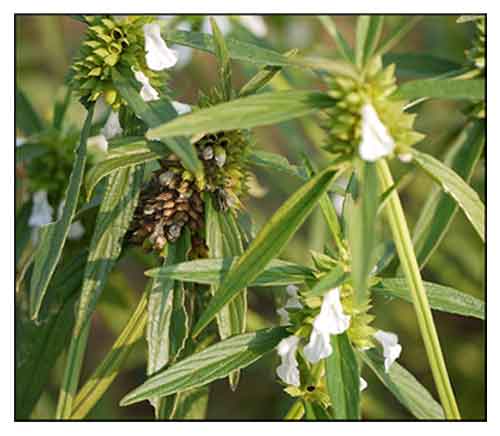
Salita is an annual, erect, branched herb, 40 to 80 centimeters high, more or less covered with short hairs. Leaves are linear to linear-lanceolate, 5 to 9 centimeters long, 8 to 13 millimeters wide, pointed at both ends and somewhat toothed at the margins. Whorls of many flowers are axillary and terminal. Calyx is about 1 centimeter long, green, very oblique, and sharply toothed. Corolla is white and 1.5 centimeters long; the central lobe of the lower lip is obovate, truncate and 8 millimeters wide.
Distribution
- Native to the Philippines.
-
Very common weed in open, waste places at low and medium altitudes.
- Found from Cagayan to Sorsogon Provinces in Luzon; and in Polilo, Mindoro and Mindanao (Surigao).
- Also native to Andaman Is., Assam, Bangladesh, Borneo, China, India, Himalaya, Jawa, Malaya, Maluku, Myanmar, Nepal, New Guinea, Nicobar Is., Sulawesi, Sumatera, Thailand. (11)
 Constituents Constituents
- Chloroform extract yielded acacetin, chrysoeriol.
- An ethanolic extract yielded carbohydrates, alkaloids, steroids, flavonoids, triterpenoids, essential oil, fatty alcohol, saponins, tannins.
(4)
- Study yielded acacetin, chrysoeriol, linifoliside, linifoliol, chrysoeriol-6"(OAc)-4-ß-glucoside, lupeol and taraxerone.
- Aerial parts reported to yield a glycoside, linifoliside, an essential oil, and fatty alcohol.
- Study of essential oil of the SPME head space sample yielded main compounds of ß-caryophyllene (20.5%), linalool (19.8%) , 1-octen-3-ol (12%), cis-3-hexen-1-ol (11.6%) trans-2-hexen-1-ol (3.5%) hexanol (3.3%), 3-octanol (2.5%) and trans-2-octen-3-ol (2.3%). (14)
- Study for secondary metabolites yielded acacetin, chrysoeriol, luteolin, acacetin 7-O-ß-D-glucuronide, acetoside, salicylic acid, and caffeic acid. (see study below) (15)
- In a study of six species of Leucas,
L. lavandulifolia extracts of leaves yielded alkaloids, flavonoids, phenols, tannins, carbohydrates, proteins and amino acids. Quantitative analysis yielded total phenolics of 17.13 ± 0.53, flavonoids 42.75 ± 5.66, and tannins 2.18 ± 0.18. (17)
- Phytochemical screening of crude methanolic extract yielded alkaloids, carbohydrates, glycosides, tannins, flavonoids, phytosterols, and phenols. (see study below) (19)
- Study of aerial parts yielded triterpenoids, steroids, fatty acid, flavonoids, with absence of alkaloids, carbohydrates, glycosides, resins, saponins, and tannins.
(22)
- Study of leave extract for biological composition yielded flavonoids 23.93%, saponins 19.05%, alkaloids 15.28%, tannins 5.81%, and phenols 2.335%. (see study below)
(23)
Properties
- Studies have shown anthelmintic, analgesic, antimicrobial, antitussive, diaphoretic, febrifuge, hepatoprotective, hypoglycemic, stimulant, stomachic, wound healing, thrombolytic, anxiolytic, CNS depressant, immunomodulatory properties.
Parts used
Leaves.
Uses
Edibility
- Leaves cooked and eaten as vegetable.
Folkloric
- In the Philippines, poultice of fresh leaves applied on wounds, especially those with inflammation.
- Decoction of leaves used as stomachic.
- Crush leaves applied to areas of dermatoses.
- In India, leaves, raw or roasted and eaten with salt, have febrifugal properties.
- In India, plant used to alleviate abdominal discomforts such as stomach ulcerations and used to counteract abdominal and liver diseases. (9)
- In India, leaves are used as expectorant, laxative, stomachic, and tonic; used for piles and sore eyes. Juice of fresh leaves applied for colds and chronic headaches. In Assam, paste of young leaves used to stop nose bleeds. (14)
- Leaves are used for roundworms.
- Decoction or poultice of leaves used for old sores.
- Decoction of leaves used as anthelmintic.
- Decoction or poultice used for ulcers, skin disorders and leprosy.
- Used for rheumatism and snake bites.
- To remove mucus, juice used as eye drops, sniffed up the nostrils, or as gargle.
Studies
• Anti-Ulcer: Study evaluated a methanolic extract of L. lavandulifolia for antiulcer activity in albino rats using an indomethacin-induced gastric ulcers model followed by pylorus ligation method. Results showed dose-dependent anti-ulcer activity as evidenced by reduction in ulcer index and gastric acid output. Misoprostol was used as standard drug. (1)
• Anti-Diabetes: Study of methanol extract of Leucas lavandulaefolia on streptozotocin-induced diabetic rats showed a significant reduction of blood glucose. (2)
• Hepatoprotective: Study of chloroform extract of aerial parts of L. lavandulifolia on D(+)galactosamine-induced hepatic injury in a rat model showed significant decreases in hepatic enzymes, total cholesterol and total bilirubin. Results suggest a hepatoprotective effect in rats.
• Wound Healing: Study showed that L. lavandulifolia extract either in ointment or injection form produced a significant respond in both excision and incision wound models. The wound healing property was attributed to the presence of glycosides or terpenoids in the essential oil of the plant. (4)
• Antitussive: Study in mice animal model showed significant dose-dependent inhibition of cough similar to the standard of codeine phosphate. (4)
• Antidiarrheal: Study of the ethanolic extract of aerial parts showed reduction of diarrhea through inhibition of gastrointestinal motility and PGE-2-induced enteropooling.
• Anthelmintic: Study evaluated the anthelmintic activity of L. lavandulifolia, L. cephalotes and L. aspera on the Indian earthworm Pheretima posthuma model. Dose dependent activity was noted with both methanolic and aqueous extracts. L. lavandulifolia methanol extract exhibited better activity than the other extracts, although not better than the reference drug Albendazole. (5)
• Anthelmintic: Study evaluated the anthelmintic activity of L. lavandulifolia, L. cephalotes and L. aspera using earthworm Pheretima posthuma. A methanolic extract of L. lavandulifolia showed the dose-dependent activity better than the other extracts but not better than the reference drug albendazole. (8)
• Analgesic / Hepatoprotective: Study of a methanolic extract of leaves in albino rats showed potent analgesic activity with significant reduction of pain threshold and increase latency period in thermal stimulation. In carbon tetrachloride induced damage, it showed antihepatotoxic activity with significant reduction of liver enzymes with no apparent disruptions of normal hepatic histological structure. (10)
• Hypoglycemic / Flowers: Study of a chloroform extract of flowers in alloxan induced diabetic rats showed significant reduction of in blood glucose and HbA1c, with an increase in total hemoglobin.
• Hepatoprotective / Carbon Tetrachloride Toxicity: Study of ethyl acetate extract of aerial arts of L. lavadulifolia showed significant hepatoprotective activity against CCl4-induced toxicity in rats. (12)
• Antioxidant / Free Radical Scavenging: Study of evaluated the antioxidant, free radical scavenging, and cytotoxic effect of ethanolic extracts of whole plant of L. indica var lavadulifolia and L. indica var. nagalapuramiana. Results showed both extract to be a potential source of valuable antioxidant products. (13) / In a study of five plants in West Garo hills, Meghalaya, the extract of L. landulaefolia exhibited the highest radical scavenging activity at 98.51 ± 0.08 % with IC50 125.17 µg/ml. (16)
• Antibacterial / Attractant Activity: Study for secondary metabolites yielded acacetin, chrysoeriol, luteolin, acacetin 7-O-ß-D-glucuronide, acetoside, salicylic acid, and caffeic acid. Luteolin showed strong attractant activity towards the zoophores of the phytopathogenic Aphanomyces cochlioides. The isolated compounds showed antimicrobial activity against Bacillus subtilis and Staphylococcus aureus. (15)
• Selenium Nanoparticles / Leaves / Antibacterial: Study reports on the green synthesis of selenium nanoparticles using aqueous extracts of leaves. The reduction of selenium ions and stabilization of the nanoparticles were attributed to alkaloid and flavones. Study suggests the selenium nanoparticles could be a potential antibacterial agent. (18)
• Thrombolytic / Anthelmintic / Anxiolytic / Antidepressant: A crude methanolic extract of L. lavandulifolia was studied on Swiss-albino mice. The extract produced dose dependent clot lysis in human erythrocytes, marked anthelmintic activity in earthworms in a dose dependent manner. Using elevated plus maze, hole board, open field, and forced swim tests, results showed significant (p<0.01 and p<0.05) CNS depressant and anxiolytic activity. (19)
• Antitussive: Study isolated a methanol extract of L. lavandulaefolia for effects on a cough model induced by sulfur dioxide gas in mice. Results showed significant dose dependent antitussive activity, which was comparable to codeine phosphate (10 mg/kg). Doses of 100, 200, and 400 mg/kg p.o. showed cough inhibition of 35.0, 51.9, and 56.5% within an hour. (20)
• Taraxerone / Immunomodulator: Study isolated an active immunomodulator from a methanol extract of Leucas lavandulifolia. LC/Q-TPOF revealed it to be taraxerone. Taraxerone at high concentration was capable of suppressing stimulated PBMC, macrophage and PMN. The activated NO, ILD-4, IL-6 production and phagocytosis was also suppressed. Hematological parameters, antibody titer and phagocytic index were lowered in antigenically challenged mice. The terpenoid taraxerone exhibited good modulatory effect o the immune system and showed potential as a drug for the treatment of many allergic disorders. (21)
• Antibacterial / Staphylococcus aureus / Leaves: Antibacterial study showed lenglengan leaf extract significantly inhibited Staphylococcus aureus, with inhibition zones increasing with higher concentrations: 12.5%-11.3 mm, 25%-12.4 mm, 50%-13.43 mm, 62.5%-14.43mm, 75%-15.58mm, with gentamicin 17.4 mm. (see constituents above) (23)
• Antidiabetic / Staphylococcus aureus / Leaves: Study evaluated the potential of an n-hexane fraction from lenglengan leaf ethanol extract as antidiabetic in insulin resistance type 2 diabetic rat. Insulin resistance was induced by administration of long-acting insulin for 14 days. Results showed the leaf extract fraction and metformin had antidiabetic effects. The extract at 250 mg/kg per day showed an antidiabetic effect (25.87%) comparable to metformin 150 mg/kbw per day (21.50%) (p<0.05). (24)
• Memory Enhancing Effect / Salvia lavandulifolia and S. officinalis: Study evaluated the potential pf Salvia lavandulifolia and S. officinalis supplementation on memory and mechanisms of action in mice. Cognitive functions were assessed using Y-maze and Morris water maze models. All Salvia groups had significant effect on Y-maze markers on day 1 of administration. The mix of two Salvia species showed significant improvements in Morris water maze markers at end of administration. Activity of Salvia alone after one intake was confirmed. A combination of different types of Salvia was shown to improve memory with specific synergistic effects after chronic administration in healthy mice. (25)
• Hypoglycemic / Flowers: The oral administration of L. lavandulaefolia flowers chloroform extract of flowers at doses of 0.15, 0.20, and 0.25 g/kg for 30 days resulted in a significant reduction in blood glucose, glycosylated hemoglobin, and increase in total hemoglobin. There was no decrease in body weight and there was significant improvement in glucose tolerance. (26)
Availability
- Wild-crafted.
- Capsules, powders, supplements in the cybermarket.
|


.jpg)


.jpg)