 |

Family • Euphorbiaceae
Saligao
Cleidion javanicum Blume
San tai hua
| Scientific names | Common names |
| Cleidion javanicum Blume | Agipos (Tag.) |
| Accepted infraspecifics (3) | Hantatampsi (C. Bis.) |
| C. javanicum var. alongense (Benn. & Sum.Chand.) Chak.& Balakr. | Kayugkog (Tag.) |
| Cleidion alongense Bennet & Sum.Chandra | Lapo-lapo (Ilk.) |
| C. spiciflora var. alongense (Benn. & Sum.Chand.) Chakr. & Balakr. | Malagasaba (Tag.) |
| Cleidion javanicum var. javanicum | Malatuba (Bik.) |
| Acalypha spicigera Klotzsch | Paitan (Tag.) |
| Lasiostylis salicifolia C.Presl. | Saligao (Tag.) |
| Macaranga tamiana K.Schum. | Saligaw (Tag.) |
| Mallotus geloniifolius Müll.Arg ex Pax & K.Hoffm. | Santiki (Tag.) |
| Rottlera urandra Daizell | Sarigaw (Bag.) |
| Tanarius tamianus (K.Schum.) Kuntze | Tayokan (Tag.) |
| Tetraglossa indica Bedd. | Tubataba (Tagbanua) |
| Cleidion javanicum var. longipedicellatum Chakrab. & M. Gangop. | |
| C. spiciflorum var. longipedicellatum (Chakr. & Gang.) Susila & Balakr. | |
| Above scientific names are from The Plant List. | |
| Cleidion javanicum Blume is an accepted name. The Plant List | |
| Quisumbing's compilation lists Saligao with the following scientific names: Acalypha spiciflora Burm.f., Cleidion spiciflorum (Burm.f.) Merr., Cleidion javanicum Blume, Lasiostylis salicifolia C. Presl. | |
| A revision of the Malesian species in the genus Cleidion is presented. Cleidion javanicum is shown to be the correct name for the widespread type species (instead of the name C. spiciflorum). (5) | |
| Cleidion javanicum is an accepted species. KEW: Plants of the World Online | |
| Some of the sources for studies below list C. javanicum and C. spiciflorum as synonyms. | |
| Other vernacular names |
| BORNEO: Entupak (Iban). |
| CHINESE: Bang bing hua, San tai hua. |
| INDONESIA: Putian (Bali), Urel tenge (Sumatra), Hura batu (Java) |
| MALAYALAM: Yellari. |
| PAPUA NEW GUINEA: Tea (Bembi), Marramamoi (Kaigulin), La mala goli goli (West Nakanai), Siwono, Ibubu (Bougainville Is.) |
| SOLOMON ISLANDS: Saola. |
| THAI: Di mee, Dimi, Kamlai, Kaadaao krachaai, Ma-dee-mee, Maj maduug. |
| VANUATU: Doptop wumer, Nagheliromp. |
| VIETNAMESE: Phân loại khoa học, Mo chim, com gao. |
Gen info
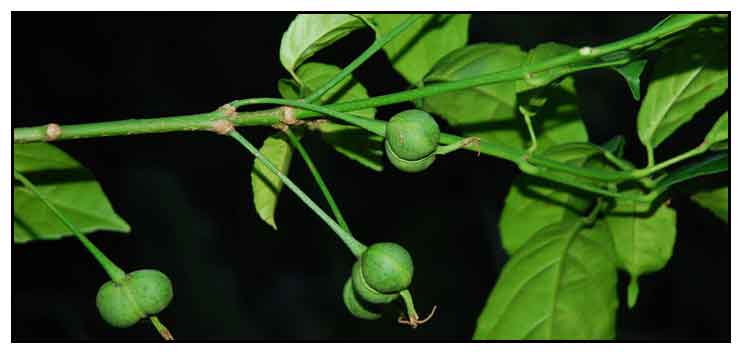
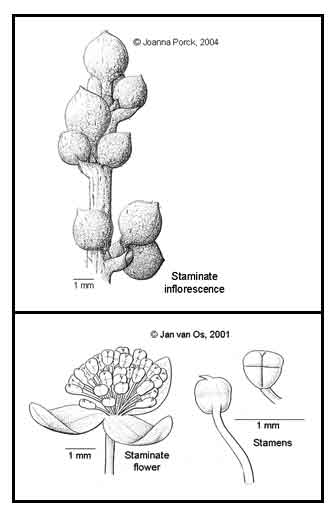
• Shrub to tree up to 20 m high, dbh up to 50 cm. Bark thin, smooth to finely roughened, brown to gray. Stipules triangular, 1.8–2 by 0.8–1.5 mm. Leaves: petiole 2–8 cm long; blade 8.6–27 by 2.4–10 cm, length/width ratio 1.8–4, papery, dark green above, light green underneath, base often slightly oblique, narrowly rounded to cuneate; nerves 8 or 9 per side. Staminate inflorescences up to 23.5 cm long, erect, green. Staminate flowers 6–7 mm in diam., greenish (white) to yellowish; pedicel 1–4 mm long; sepals ovate, 2–3.3 by 1.8–2.8 mm, subglabrous outside; stamens ca 0.3 by 0.3 mm, cream, filaments 0.6–1.2 mm long, pale light green. Pistillate flowers 5–6 mm in diam., green; pedicel 3–9 cm long; sepals 5, ovate, 1.6–1.8 by 1.5–1.6 mm, margin somewhat fimbriate; ovary 2-locular, 5–6 by 3.5–5.2 mm high; style 3.5–15 mm long, greenish; stigmas 2,8–14 mm long, greenish. Fruits 1.8–2 (when 1 lobe developed) to 2.2–2.8 (when 2 lobes developed) by 1.4–1.6 cm, glabrous, yellow to brown. Seeds 12–13 by 10.5–11 mm, endosperm white. (Flora of Thailand) (11) Distribution Properties Availability |
© Godofredo U. Stuart Jr., M.D. / StuartXchange |
 Botany
Updated March 2025 / March 2021 / July 2018 / April 2016

 |
PHOTOS / ILLUSTRATIONS |
| IMAGE SOURCE: Cleidion javanicum / © Phongsak Phonsena/ click on image to go to source page / Non-Commercial Ude / Flora Malesiana / National Herbarium |
| IMAGE SOURCE: Illustration: Line drawing / Cleidion javanicum / © Joanna Porck 2004 / © Jan Van Os 2001 / Click on image to go to source page / Non-commercial use / Flora Malesiana / National Herbarium |
| IMAGE SOURCE: Euphorbiaceae : Cleidion javanicum fruits / Copyright © 2020 by Edmund capuz (contact: pieter.pelser@canterbury.ac.nz) [ref. DOL147822] / Non-Commercial Use / Image modified / Click on image or link to go to source page / Phytoimages.siu.edu |
Additional
Sources and Suggested Readings |
• |
DOI: It is not uncommon for links on studies/sources to change. Copying and pasting the information on the search window or using the DOI (if available) will often redirect to the new link page. (Citing and Using a (DOI) Digital Object Identifier) |
| List of Understudied Philippine Medicinal Plants |
| New plant names needed The compilation now numbers over 1,500 medicinal plants. While I believe there are hundreds more that can be added to the collection, they are becoming more difficult to find. If you have a plant to suggest for inclusion, native or introduced, please email the info: scientific name (most helpful), local plant name (if known), any known folkloric medicinal use, and, if possible, a photo. Your help will be greatly appreciated. |
• |
 |
• |
|
