|
Gen info
- Canarium ovatum belongs
to the family Burseraceae with 75 known genera and about 550 species.
In the Philippines the family is represented by five genera, namely
Canarium, Dacryodes, Garuga, Protium and Santiria.
-
Of the canarium species, there
are 75 known and nine of which are found in the Philippines, with
at least four of economic importance: C. ovatum (Pili), C. indicum,
C. album, and C. luzonicum (Sahing,Manila
elemi).
- The species is the flagship commodity of the Bicol region, the primary location of the pili nut trade. There is almost no commercial planting of the crop. Fruits are collected from natural strands in mountains near the provinces. In 1977, pili export from the Philippines to Guam and Australia was approximately 3.8 t. (23)
-
A municipality in the province
of Camarines Sur is named Pili, after the popular nut-producing tree.
- The genus name Canarium comes from the vernacular name 'kenari' in the Molucca Isles. (13)
- The fruit and tree are often vulgarized with the umbrella term "Java almond", which is a mix of multiple species in the same genus: Canarium vulgare and C. indicum, both not cultivated in the Philippines, with a range that includes maritime Southeast Asia, Papua New Guinea, and northern Australia. (23)
 Botany Botany
Pili is an erect and spreading
tree, deciduous, predominantly dioecious, medium-sized to large, reaching
up to 30 meters or more, with trunk diameters of 50 centimeters or more. Leaves
have deltoid to lingulate stipules, spirally arranged, imparipinnate,
about 40 centimeters long. Leaflets are ovate to elliptic, 4 to 24 centimeters long and
2 to 12 centimeters wide, stiff-coriaceous, entire, base oblique, rounded to subcordate,
apex acuminate with 8 to 12 pairs of nerves. Flowers are borne on cymose
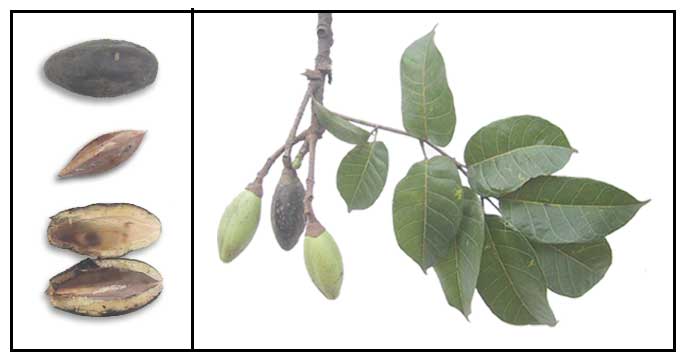
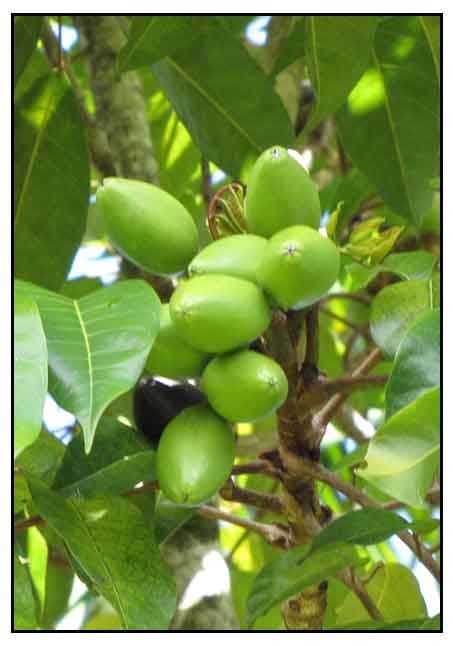
inflorescences at the leaf axils of young shoots. The fruit or nut,
botanically a drupe, ovoid to ellipsoid, 4 to 7 centimeters long, 2.3 to 3.8 centimeters wide.
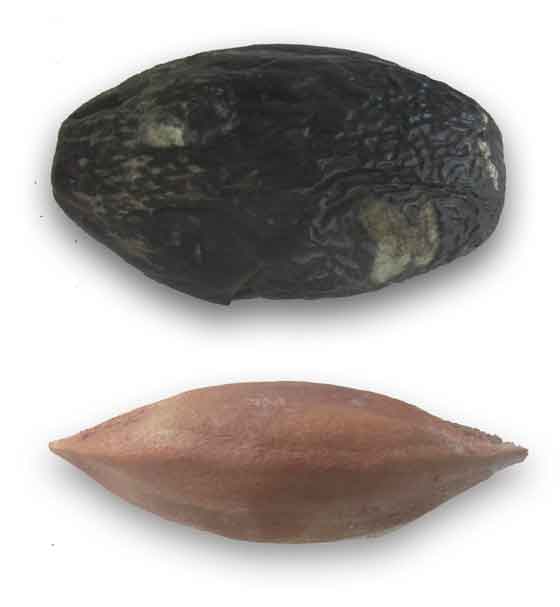
Pulp has a thin skin, smooth and shiny, turning from light green
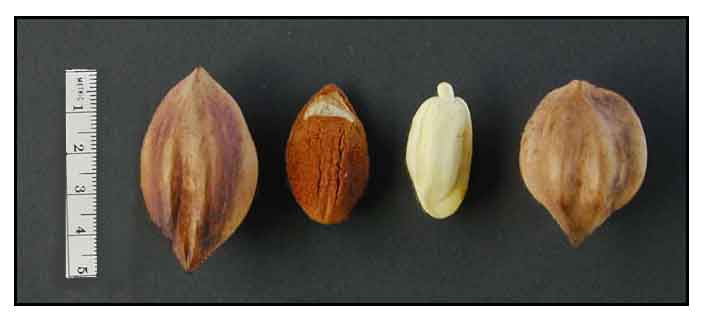
to black when ripened. Shell is carpellary, elongated and trigonous,
nearly triangular in transverse sections, with a basal pointed end,
and a blunt and obtuse apical end, dirty brown outside, shiny and
glabrous inside. Inside the shell is the functional locule containing
the mature seed.
Distribution
- Native to the Philippines.
-
Grown in many areas of the Old World as ornamental, in Indonesia, Malaysia, and the Philippines.
- Only the Philippines processes the pili nuts commercially. Its center of diversity is the Bicol region where
it is the priority crop. The trees have spread to the provinces of
Catanduanes, Masbate and the southern Quezon area.
- With symmetrical branches, C. ovatum makes an attractive border and
avenue shade tree.
 Constituents Constituents
- Pili pulp, 64% of the
fruit by weight, contains 73% moisture. On dry weight, 8% protein,
33.6% fat, 3.4% crude fiber, 9.2 % ash, 45*% carbohydrate. Pulp oil,
greenish yellow in color, is 56.7% oleicglycerides, 13.5% linoleic
glycerides and 29.3% saturated fatty acids. The kernel, which weighs
0.74-5.13 g and which comprises 4.4-16.6% of the whole fruit by weight,
contains: 35.6-51.4% moisture, 11.5-15.7% protein, 69.2-76.6% fats
and 2.59-4.32% carbohydrates. Its mineral and vitamin contents (per
100 g): 119 mg calcium, 508 mg phosphorus, 2.6 mg iron, 489 mg potassium,
45 IU vitamin A, 0.95 mg thiamine, 0.12 mg riboflavin, 0.4 mg niacin
and traces of vitamin C (Intengan et al. 1968). Kernel oil is composed
of oleic glycerides, 58.6% and palmitic acids, 38.2%; yellow with
an agreeable odor and taste, suitable for culinary purposes and keeps
perfectly for as long as 6 months (West and Balce 1923).
- Bark yields 7.8% tannin, providing a satisfactory leather with a yellowish tan, with firm texture and good grain.
 - The kernel yields 71.1% fat, 11.4% protein and 8.4% carbohydrates, and is high in calcium, phosphorus, and potassium. (13) - The kernel yields 71.1% fat, 11.4% protein and 8.4% carbohydrates, and is high in calcium, phosphorus, and potassium. (13)
- Study of dichlormethane extracts of leaves yielded ß-amyrin (1a), α-amyrin (1b), epi-β-amyrin (2a), epi-α-amyrin (2b), epi-lupeol (2c), β-carotene (3) and lutein (4); while the twigs yielded 1a-1b. The dichloromethane extracts of the fruits of C. ovatum yielded triacylglycerols (5); the mesocarp also afforded 1a, 1b, 1,2-dioleylglycerol (6), and monounsaturated and saturated fatty acids; the nutshell also provided 6; and the kernel also yielded monounsaturated and saturated fatty acids. (14)
- Phytochemical screening of pulp yielded biologically active compounds such as sterols, triterpenes, flavonoids, alkaloids, saponins, glycosides and tannins. (see study below) (16)
- The pulp showed to be an excellent source of dietary fiber (4.18-14.5 g/100 g soluble fiber; 34.0-43.2 g/100 g insoluble fiber), white the kernel contributes a considerable amount. Kernel yielded short-chain fatty acid (SCFA) acetic acid (0.46-0.93 mmol/g) organic acid, while the pulp yielded acetic (0.59-2.49 mmol/g), butyric (0.31-1.68 mmol/g), and propionic acid (0.22-1.04 mmol/g) after simulating colonic fermentation. Pulp total anthocyanin ranged from 197-305 mg catechin /100g. (see study below) (21)
- Proximate composition of fruit kernel yielded moisture 6.14%, ash 6.52%, crude protein 3.94%, fat 12.77%, carbohydrate 65.91%, energy 1659.94 KJ/100g. Vitamin composition showed: Vitamin A (ß-carotene) 455.1 mg/kg, vitamin E 8.98 mg/kg, ascorbic acid 8.60 mg/100g, riboflavin 5.5 mg/kg, thiamin 1.25 mg/kg, niacin 8.5 mg/kg. Mineral composition yielded: Sodium 158 mg/100g, potassium 513 mg/100g, calcium 230 mg/100g, phosphorus 131 mg/100g, magnesium 365 mg/100g, zinc 72 mg/kg, copper 121 mg/kg, manganese 156 mg/kg, iron 229 mg/kg, Ca/P ration 1.75, Na/K ration 0.308. Photochemical composition of kernel yielded alkaloid 3.94%, flavonoid 4.82%, saponin 0.62%,tannin 0.28 mg/100g, HCN 0.52 mg/kg, phylate 0.02%, trypsin inhibitor trace (TIU/100g). (24)
Properties
- When raw, the kernel resembles roasted pumpkin seed; when roasted, the mild nutty flavor and tender, crispy texture are superior to the almond. (13)
- The kernel from some trees may be bitter, fibrous, or have a turpentine odor. (13)
- Its resistance to strong winds provides windbreak for other crops.
- Studies have suggested antimutagenic, melanogenesis inhibiting, skin whitening,
anticancer, antioxidant, immunomodualtory, antibacterial, antifungal, colorant properties.
Parts used
- Seed kernel.
- Oleoresin (mixture of oil and resin).
Uses
Edibility / Culinary
- Young shoots are edible,
used for cooking and making green salads.
- Pili nut kernel is edible, crispy and delicious.
- Nut in candied in various forms: sugar-glazed, honeyed.
- Pili "turron" is made from a mixture of ground pili kernel,
sweet potato and sugar, seasoned with sesame and vanilla, mixed and
cooked to desired consistency, cooked, and cut.
- Pili pudding is made from mashed sweet potato, ground pili kernel,
condensed milk, butter, sugar and eggs, vanilla seasoning, then baked
to a light brown color.
- Kernel seeds are roasted and eaten as nuts. Roasted and sugar-coated, used as
ingredient to cakes, puddings and creams, or preserved in syrup. Roasted kernel sometimes used in chocolate-making.
- Green pulp can be pickled, best after the shell has hardened but before
the pulp becomes too fibrous.
- Boiled ripe pulp is edible, best with salt, pepper and fish sauce.
- In Sorsogon, the nut concoction is called "nilanta"—boiled
in hot water to soften, seasoned with soy sauce, bagoong, and sili.
- Sahing (oleoresin) is used in the Philippines as stimulant, rubefacient, and antirheumatic. Elsewhere, as ointment, the oleoresin is applied to indolent ulcers.
- The kernel is a major ingredient of the famous Chinese festive dessert known as "moon cake". (Kernels from some trees may be bitters, fibrous, or turpentine in odor.) (13)
Folkloric
- For laxative effect, seed kernel
is eaten as tolerated.
- Emulsion from crushed kernels has been used as substitute for infant's
milk.
- Used for making medicinal ointments.
Others
- Firewood: Resin-rich wood makes for excellent firewood.
- Wood: Wood used for house framing, musical instruments and box-making.
- Oil: Oil from the pulp has been used for manufacture of soap and other
products. Pulp oil can be used for cooking.
- Soil improver: The hard stony shell makes for excellent fuel and used as growing
medium for orchids and anthuriums. (Coronel 1983)
- Gum / Resin: The valuable resin, Manila elemi or 'breabianca', is used in the manufacture of plastics, printing inks, and perfumes. Also used by Spaniards for ship repairs. (13)
- Manila elemi: Exported in considerable quantities. Used in the preparation of medicinal ointments for healing wounds and as a plaster; also, in the manufacture of varnish.
Studies
• Biodiesel: Preliminary
Evaluation of Biodiesel from Canarium ovatum (Pili) Pulp Oil and Psophocarpus
tetragonolobus (Winged bean) Seed Oil – The resulting FAME (fatty acid methyl ester) was found to comply with biodiesel standards and presents a potential source and alternative to explore for commercial exploitation. (2)
• Protein: Physiochemical characterization showed that the salt-soluble globulin was the main storage protein within the pili kernel, possessing physiochemical properties similar to other oil seed globulins. (3)
• Antimutagenic Potential: Philippine plants were studied for their ability to inhibit chromosomal damage induced by tetracycline in the in vivo micronucleus test. The methanolic extract of Canarium ovatum showed the most promising activity by reducing the number of micronucleated polychromatic erythrocytes by >50%. Study established its antimutagenic activity and identified F4B, the most active sub-fraction in the hexane portion. The F4B may be valuable in cancer chemoprevention. (5)
• Biodiesel (FAME) Potential: Preliminary studies conducted on biodiesel derived from two novel sources of oil - the fruit pulp of Canarium ovatum (pili) and the seed of Psophocarpus tetradonolobus (winged bean) showed that acceptable FAME (fatty acid methyl esters) may be obtained from these two new potential sources of feedstocks. (6)
• Melanogenesis Inhibitory Activity / Skin Whitening: Study yielded four known sesquiterpene alcohols, ten triterpene alcohols, and four triterpene acids from a methanol extract of Canarium ovatum. On evaluation on melanogenesis in B16 melanoma cells induced with α-MSH, compounds 1 and 2 exhibited concentration-dependent melanogenesis inhibitory activity. Results suggest a potential use for skin whitening agents. (8)
• Fatty Acid and Triacylglycerol Composition: Analysis of fatty acid and triacylglycerol composition of pili nut oil and fractions was done by gas and liquid chromatography. Oil by solvent extraction was low in polyunsaturated fatty acids and high in saturates. Results show the HM (high melting) fraction may have applications as cocoa butter substitute in confectionery products. (9)
• Characterization of Proteins of Pili Nut: Analysis of storage proteins of the pili nut showed the aqueous soluble globulin was the main storage protein within the kernel, existing in an 11S-like form, and possessing many similar physiochemical properties to those of other 11S oilseed globulins. (10)
• Anticancer / Antioxidant / Pulp: Study evaluated the antioxidant and anticancer activities of C. ovatum pulp. The canarium ovatum pulp oil (COPO) was prepared through mechanical and ethanolic extractions. Results of DPPH and FRAP assays showed high reducing power and free radical scavenging activities of the COPE compared to COPO and ascorbic acid. The CAM (chorioallantoic membrane) and sea urchin fertilization assays were used to test for cytotoxicity and anticancer activity. CAM assay showed significant inhibition (p=0.05) in blood vessel formation in COPE treated samples. Phytochemical screening yielded bioactive constituents such as alkaloids, flavonoids, glycosides, saponins, sterols, tannins, and terpenens. (12)
• Effects of Thermally Processed Pili on Antioxidant and Polyphenol Status in Humans: Study measured the polyphenol content and antioxidant activity of pili pomace drink and the influence of heating on parameters. Results showed significant changes in plasma antioxidant and polyphenol levels, reaching maximum levels at 120 and between 30-60 min, respectively (p<0.05). Results suggest acute consumption of this phenolic-rich pomace drink may enhance plasma antioxidant and polyphenol status in humans. (15)
• Immunomodulatory / Pulp: Study evaluated the immunomodulatory properties of ethanol extract of pulp of Canarium ovatum using Balb/C mice. Delayed type hypersensitivity and humoral antibody response was evaluated using sheep RBCs. Acute oral toxicity study showed no mortality or signs of toxicity at doses of 300-2000 mg//kg. Results showed stimulatory effects on cellular and humoral responses in mice, suggesting potential as an immunostimulatory agent. (see constituents above) (16)
• Antibacterial Activity of Fungal Endophytes: Fungal endophytes are novel bioactive metabolites.
Study evaluated C. ovatum for the occurrence of fungal endophytes. Results showed the tree to be a good host for fungal endophytes. Antibacterial assay showed 10 mg/mL of Colletotrichum sp. PFE31 crude extract exhibited broad spectrum antibacterial activity against test gram-positive, gram-negative, and spore-forming bacilli. (17)
• Source of Essential Minerals: Study evaluated macro and micro mineral profiles as well as potential toxic metals of pulp and kernel of Pili nut varieties in vitro simulating gastric and intestinal condition. Major minerals in the pulp are K and Ca, and K, P, and Mg in the kernel, The nut contains Na, Fe, Al, Zn, Mn, Cu, Ni, and Cr. Antioxidant Se and toxic Pb and Cd were below the limit of quantitation. Bioavailability of pulp and kernel minerals in the small intestine is high for Mg and Ca. After colonic fermentation of the kernel, there were still appreciable amounts of Mg > Ca > Cu > Mn available for absorption. Fe and Zn were not detected in the large intestine because of elevated phytic acid. Tannic acid was higher in the pulp. Study showed the pili nut is a source of several essential minerals for human nutrition. (18)
• Functional Food Colorant / Antioxidant /Fruit Exocarp: Study evaluated the deeply pigmented fruit exocarp for phytochemical contents, functional properties and as yogurt colorant. Spectrophotometric analysis yielded high phenolic and flavonoid content, particularly anthocyanins (17.5 mg CE/g DW). The pigment extract exhibited potential antioxidant properties by DPPH and FRAP assays. The pigment exhibited excellent color retention in yogurt during 2-week storage at 4°C. There was little difference in over-all acceptability between natural and synthetic-colored yogurt. Results suggest potential as functional food colorant in yogurt. (19)
• Pulp Waste as Functional Antioxidant: The pulp, which is totally discarded as waste, contains considerable quantities of bioactive compounds present in the pulp meal as well as in the oil. Study reports on the characterization of all parts of the fruit as source of hydrophilic and lipophilic bioactive compounds with high antioxidant functionality. Study suggests pili is an underutilized fruit for a potential source of antioxidants. (20)
• Dietary Fiber / Fermentability / Pulp and Kernel: Study evaluated the dietary fiber and in vitro fiber fermentability characteristics of pulp and kernel of seven Pili nut varieties. The pulp showed to be an excellent source of dietary fiber (4.18-14.5 g/100 g soluble fiber; 34.0-43.2 g/100 g insoluble fiber), white the kernel contributes a considerable amount. Kernel yielded short-chain fatty acid (SCFA) acetic acid (0.46-0.93 mmol/g) organic acid, while the pulp yielded acetic (0.59-2.49 mmol/g), butyric (0.31-1.68 mmol/g), and propionic acid (0.22-1.04 mmol/g) after simulating colonic fermentation. Pulp total anthocyanin ranged from 197-305 mg catechin /100g. Results suggest the nut pulp is a readily source of low cost dietary fiber and health promoting SCFA. (21)
• Antifungal / Fixed Oil from Peel Waste: Study evaluated the antifungal activity of fixed oil extracted from pili nut peel waste (pulp, shell, and seed coat) using Resazurin Microbial Assay against common fungal pathogens Candida albicans, Aspergillus niger, and Trichophyton rubrum. Results showed the fixed oil had higher inhibitory activity against systemic pathogens, with percentage inhibition comparable to reference standard, fluconazole. The activity against T. rubrum, a dermatophyte, was significantly lower. Results suggest higher efficacy of the fixed oil against systemic fungal pathogens and lower efficacy against dermatophytes. (22)
Availability
- Small or large scale
commercial production.
|


