 Gen info Gen info
- Selaginella uncinata is a plant species in the Selaginellaceae family.
-
Selaginella, also known as spikemosses or lesser clubmosses, is a genus of lycophyte. It is treated as the only genus in the family Selaginellaceae, with other 750 known species. (12)
- Taxonomic conflicts: Some scientists still place Selaginellales in the class Lycopodiopsida.Some modern authors recognized three generic divisions of Selaginella: Selaginella, and Brydesma (Sojak 1992), and Lycopodioides (Boehm 1760). In 023, Zhou & Zhang suggested the genus should be broken up into 19 different genera. (12)
 Botany Botany
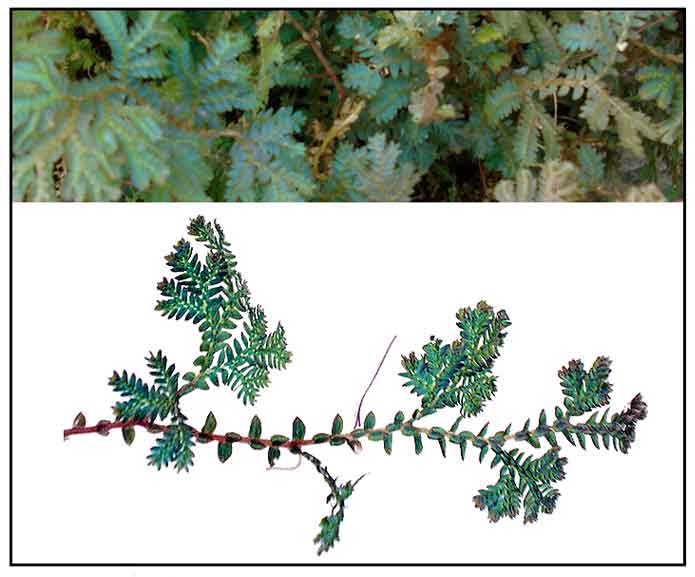
• Selaginella uncinata is a trailing herb with weak stems rooting at the nodes to a length of 60 centimeters long. Leaves are dimorphic, 4-ranked, bright blue-green; the strobili are four-angled and 2 centimeters long.
• A small plant with climbing and widely branching shoots. In indoor cultivation, they reach a height of about 5 cm and a width of up to 25 cm. It consists of bright green, dichotomously branching stems and leaves, which gradually turn yellow, pink, or bluish as they grow. Leaves produce sporangia containing spores. It absorbs water via greenless ligules growing at the base of the leaves. (13)
• Growth form: A scrawling herb that grows between 50 - 100 cm or more. It can also be found hanging, climbing or as an epiphyte on rocky walls. Foliage: Leaves are papery, white-margined, green to metallic blue-green coloured. It has two sets of foliage, the larger leaves along the sides of the main stem and smaller pairs of leaves on the main stem. The larger leaves are broadly elliptic to round, 3 - 4 mm long and 2 - 3 mm wide. The smaller leaves are asymmetrical, oval-shaped, overlapping one another. Reproductive Parts-Non flowering plant: The spore-bearing structure known as a strobilus is compact, ovate-triangular shaped, produced singly at the tip of the branch, measuring 5 - 25 mm long by 2.5 - 4 mm wide. (Flora & Fauna Web)
Distribution
- Introduced, naturalized. (11)
- In Luzon: Laguna, Quezon; in Mindanao: Bukidnon.
-
Native to China and Vietnam.
 Constituents Constituents
- Study of 60% ethanolic extract yielded seven 3',8'-linked bioflavonoids, including one new compound, (2'S)-2',3'-dihydro-amentoflavone-4'-methyl ether (1) and six known compounds: (2S)-2,3- dihydroamentoflavone-4'-methyl ether (2), (2S,2'S)-2,3,2',3' -tetra-hydroamentoflavone-4'-methyl ether (3), (2S,2'S)-tetrahydroamento-flavone (4), (2S)-2,3-dihydro- amentoflavone (5) and (2'S)-2',3'-dihydroamentoflavone (6) and amentoflavone (7).
- Study isolated a new flavonoid from a 75% ethanol extract of whole plant of S. uncinata. The flavanoid was called unciflavone G and the structure was elucidated as 8-[4-(carboxyl) phenoxyl]-5-4'-dihydroxy-7-methoxyflavanone. (8)
- Study of dried whole plants yielded five compounds: two new chromone glycosides, uncinoside A and uncinoside B. The other three compounds were identified as 8-methyl eugenitol, amentoflavone and hinokiflavone. (see study below) (9)
- Studies have yielded 151 chemical compounds including flavonoids, chromones, steroidal saponins, terpenoids, etc.
- Study of 75% ethanol extract of S. uncinata by column chromatographies isolated a new flavonoid, elucidated as 8-[4-(carboxyl)phenoxy]-5,4'-dihydroxy-7-methoxyflavanone (1) and named unciflacone G. (17)
- Study isolated six new flavonoids, unciflavones A-F. (18)
- Study isolated three new carboxylated flavonoids, uncinatic acids A-C (1-2) from whole herb of S. uncinata.
(see study below) (19)
- Study of air-dried aerial parts isolated a new biflavonoid, 5,7,4',5"-tetrahydroxy-7”-metroxy-[3-O-4”’] biflavone along with four known biflavonoids and one known phenolic acid. (22)
Properties
• Studies have suggest antiviral, antifungal, antibacterial, antitumor, anti-anoxic, anti-inflammatory anticancer, antioxidative, renal-curative, antiproliferative, apoptosis-inducing properties.
Uses
Folkloric
• No recorded folkloric medicinal use in the Philippines.
• In China, S. uncinata is the most used as folk medicine by ethnic minorities. Whole plant is used for eliminating heat and drying dampness; used for treating jaundice, dysentery, diarrhea, edema, gonorrhea, muscle pain, hematemesis, hemoptysis, trauma, bleeding, hemorrhoids, burns, and snakebites. (14) Used to treat acute infectious jaundiced hepatitis, cholecystitis, enteritis, edema, and rheumatic diseases. Also used post-childbirth.
Studies
• Anti-Viral / Biflavonoids: Previous studies have yielded chromone glycosides (uncinoside A and B) which has shown good anti-tumor and anti-viral activity. This study isolated a new biflavonoids with five known compounds and one known phenolic acid. Preliminary study found the ethyl acetate extract exhibited good anti-HSV1 and Anti-COX B3 virus activity.
• Bioflavonoids / Anti-Anoxic Effect:
Study of ethanolic extract of S uncinata isolated four new and three known bioflavonoids. Compounds 4 and 5 showed potent anti-anoxic effect in the anoxic PC12 cell assay. (1)
• Benzoic Acid Flavonoid:
Study yielded a new flavonoid from the ethanol extract of S uncinata – 6-(5-carboxyl-2-methoxyphenyl)-apigenin, a first of a flavanoid with a benzoic substituent at C-6. (3)
• Biflavonoids / Protective Effect Against Anoxia: Hypoxia is a common environmental stress in high altitude which can influence signaling pathways and cell functions. This study yielded seven 3′,8′′-linked bioflavonoids. All seven compounds showed protective effect against anoxia in the anoxic PC12 cells assay, with compound 6 displaying particularly potent activity. (see constituents above) (5)
• Steroidal Saponins / Protective Effect Against Anoxia: Study of 60% ethanolic extract yielded four steroidal saponins. The four compounds showed potent protective effect against anoxia in anoxic PC12 cells assay, with compounds 1 and 2 the most active. (6)
• COX-2 Inhibition / Anti-Tumor / Colon Carcinoma Cell Line: Study evaluated the action of total flavones from Selaginella uncinata on cyclooxygenase-2 (COX-2) mRNA expression in carcinoma of colon cell line HT-29, and explore the related molecular mechanism. Study suggests the mechanisms involved may be the inhibition of COX-2 protein expression in mRNA level by the total flavonoids, which may be one of the anti-tumor mechanisms of Selaginella uncinata. (7)
• Antiviral Chromone Glycosides / Uncinoside A and B: Study of dried whole plants isolated five compounds. Of these, uncinoside A and B showed potent antiviral activities against respiratory syncitial virus (RSV) with IC60 of 6.9 and 1.3 µg/ml, and moderate antiviral activity against parainfluenza type 3 virus (PIV3) with IC50 of 13.8 and 20.8 µg/ml, respectively. (see constituents above) (9)
• Anti-Inflammatory / Amelioration of Ovalbumin-Induced Airway Inflammation in Rat Model of Asthma: Study evaluated the protective mechanisms of total flavonoids from S. uncinata (SUF) on airway hyperresponsiveness, cytokine, release, and bitter taste receptors (T2Rs) signaling with emphasis on inflammatory responses in a rat model of ovalbumin (OVA)-induced asthma. SUF treatment significantly up-regulated T2R10 gene expression, down-regulated IP3R1 and Orai1 gene expression. SUF further suppressed eotaxin, NFAT1 and c-Myc protein expression in lung tissues of OVA-challenged rats. Results suggest SUF exerts anti-inflammatory function via T2R10/IP3R1/NFAT1 dependent signaling pathway, and warrants further study as potential treatment for asthma. (15)
• Cytotoxic / Antitumor: Study evaluated the chemical profiles and cytotoxicity and apoptosis induction of ethyl acetate, ethanol, and water-soluble extracts from seven Selaginella species. Results showed Selaginella uncinata, S. labordei, and S. tamariscina had relatively stronger activities on Bel-7402 and HeLa cells. Ethyl acetate extracts showed abundant biflavonoids. Effects of the extracts were more apparent on HeLa cells than on HT-29 cells. (16)
• Uncinatic Acids / Anticancer / Whole Herb: Study isolated three new carboxylated flavonoids, uncinatic acids A-C (1-2) from whole herb of S. uncinata. Compounds 1 and 2 are furanoflavonoids. Both compounds displayed effective anticancer activities against A549 and BGC-823 cells. Results suggest potential of S. uncinata as anticancer, including lung and gastric cancers. (19)
• Antiviral, Antibacterial, Antifungal: Study evaluated extracts of Selaginella uncinata, Houttuynia cordata, and Lobelia chinensis for antimicrobial activities against Chikungunya virus, selected yeasts, filamentous fungi, and gram-negative and gram-positive bacteria. Extract of S. uncinata showed antifungal activity against all tested fungi except A. fumigatus. S.uncinata also showed broad spectrum antibacterial activities. Studies have shown S. uncinata to have antiviral activity against respiratory syncitial virus and parainfluenza type 3 virus (Ma et al, 2003). Ethyl acetate extract has also showed antiviral activity against herpes simplex virus type 1 and coxsackie B3 virus (Jiang et al, 2008). Results suggest extracts of S. uncinata could be potential sources of new antifungal and antibacterial agents with broad spectrum activity. (20)
• Anti-Inflammatory Polysaccharides: Study purified three water soluble polysaccharides (SUSP 1, 2, and 3) from S. uncinata, which contained different contents of galactose, arabinose, mannose, glucose, and xylose, with large amount of galacturonic acid in SUSP-3. SUSP-1,-2, and -3 significantly inhibited ROS levels, promoted IL-10 expression, suppressed mRNA levels of IL-6, TNF-α, and IL-1ß, and effectively blocked LPS binding to CD14 receptor to reduce inflammation. Results provide data for development of natural polysaccharides from S. uncinata with anti-inflammatory activities. (21)
• Amelioration of Renal Fibrosis via Antioxidant Pathway: Study evaluated the effect of Cuiyuncao in a rat model of renal fibrosis esstablished via unilateral ureteral obstruction (UUO). Oxidative stress and levels of transforming growth factor beta-1 (TGF-ß1), collagen-1 (Col-1) and alpha-smooth muscle actin (α-SMA). Cuiyuncao aqueous extract ameliorates renal fibrosis in rats of UUO, reduces oxidative stress levels and expressions of TGF-ß1, Col-1 and α-SMA. Upon oxidative stress, the antioxidant transcription factor NRF2 enhances the expression of numerous genes regulated by ARE (antioxidant response element). The aqueous extract showed significant curative effect on renal fibrosis via antioxidant pathway. (23)
• Inhibition of Breast Cancer Cell Proliferation and Apoptosis Induction / Flavones: Study evaluated the effects of total flavones of S. uncinata on breast cancer cell tumor properties and possible mechanism. MDA-MB-231 cells were treated with total flavones of S. uncinata. Results showed increase in cell proliferation inhibition rate, cell apoptosis rate, cell proliferation inhibition rate, and cleaved caspase-3 and caspase-9 levels. Results showed total flavones of S. uncinata can inhibition the proliferation and cell colony-forming ability and induce apoptosis of breast cancer cells via negatively modulating microRNA-1269. (24)
Availability
Wild-crafted. |




.jpg)


