|
 Gen info Gen info
The genus Trichosanthes comprises about 100 species, of which a few have been domesticated in Asia. Trichosanthes cucumerina yields two varieties: the wild var. cucumerina and the cultivated var. anguina (L.). Only traditional landraces of T. cucumerina are used in West and Central Africa, while improved cultivars from India are grown in East Africa. (28)
Botany
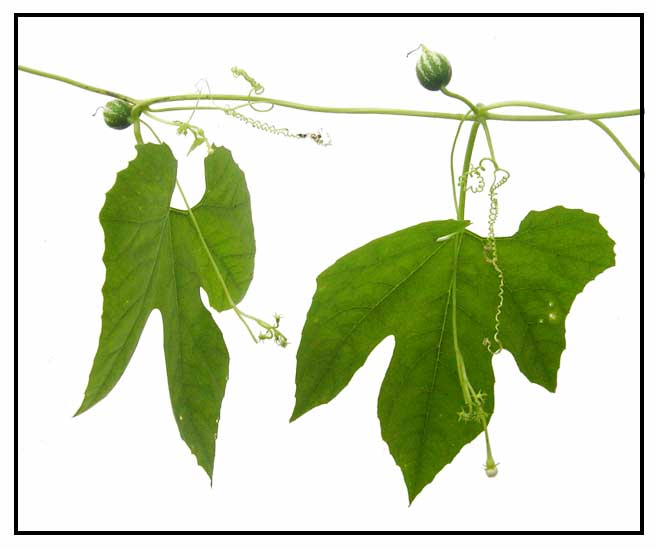
Melon-melonan is a climbing, herbaceous vine,
5 to 6 meters high. Stems are green, 4-angled, slightly hairy, and faintly disagreeable
in odor. Roots are somewhat tuberous and whitish. Leaves are somewhat hairy on both surfaces,
rounded, 7 to 14 centimeters long and broad, 3- to 5-lobed, the lobes being broad, rounded
or obtuse, the sinuses broad or narrow and rounded; and the base broadly heart-shaped.
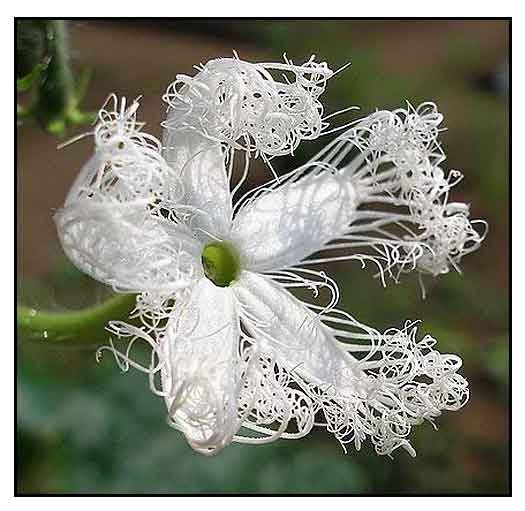
Staminate inflorescences are long-peduncled and axillary with 6 to 15
flowers. Calyx-tube is dilated above, about 1 centimeter long, green, and hairy. Petals are white, fimbriate, oblong, about 1.3 centimeters long. Pistillate flowers occur singly in the axils of the leaves. Fruit
is ellipsoid, 3 to 4.5 centimeters long, 2.5 to 3 centimeters in diameter, green and mottled with longitudinal gray
stripes when young, and orange-red when mature. Seeds are half-ellipsoid,
somewhat compressed, undulate, hard, rugose, nearly 1 centimeter long, and embedded in a soft, foetid, bitter and red pulp.
 Distribution Distribution
- Only in Ilocos Sur, Benguet, La Union, Pangasinan, Bataan, Rizal and Laguna Provinces in Luzon, in thickets at
low and medium altitudes, ascending to 1,200 meters.
- Also occurs in India, through Malaya to tropical Australia.
Properties
• Leaves, roots, and fruit are all bitter.
• Considered abortifacient,
anthelmintic, emetic and purgative.
• Fruit is purgative and emetic.
• Root is cathartic, aperient.
• Used as antidiabetic, hepatoprotective, cytotoxic, antibacterial.
 Constituents Constituents
• Root extract study isolated bryonolic acid, chondrillasteryl glucoside, bryononic acid, cucurbitacin B, dihydrocucurbitacin B.
• Aqueous extract yielded carbohydrates, flavonoids, saponins, flavonol glycoside and triterpenoid
saponins. (See study below) (19)
•
Rich in protein, fat, fiber, carbohydrate, vitamin A and E. Total phenolics and flavonoids are 46.8% and 78.0% respectively. Fruit is rich in vitamins C and E. Crude protein content is 30.18%. Predominant minerals are potassium (121.60 mg/100g) and phosphorus (135.0 mg/100g). Sodium, magnesium, and zinc are found in fairly high amounts. (28)
• Plant yields cucurbitacin B, cucurbitacin E, isocucurbitacin B, 23,24- dihydroisocucurbitacin B, 23,24-dihydrocucurbitacin E, sterols 2 β-sitosterol stigmasterol 11, with low amounts of chemical substances like oxalate, phytates and tannins. (28)
• Phytochemical analysis of various solvent extracts of leaf, stem, fruit wall, and seed yielded alkaloids, glycosdies, tannins, flavonoids, phenols and sterols. Glycosides showed strong presence in leaf extracts. Flavonoids were present only in leaf and stem. Tannins were absent in all the solvent extracts of stem and seeds.
Lignins were present in leaf extracts, but absent in solvent extracts of leaf, stem, fruit wall and seeds. (29)
• Phytochemical analysis of seeds, leaves, fruits, and roots revealed the absence of cardiac glycosides and saponins; tannins and phenols were present only in old leaves; and terpenoids in seeds and roots. Steroids, flavonoids, alkaloids, and reducing sugars were major phytochemicals in all plant parts. Most abundant minerals were: calcium, ranged from 13.05 to 152.41 mg/100g (mean 88.26 mg/100g); potassium 13.20 to 26.60mg/100g; magnesium 30.28-50.10 mg/100g; sodium 3.45 to52.25 mg/100g; and iron 10.40 to 65.50 mg/100g. (30)
- In a comparative nutrient analysis of aerial parts, the highest concentration of phenolic compounds, flavonoids, and antioxidant capacity was found in the leaves and least in the fruits. The mineral element content of leaves and flowers was significantly higher than that of the fruit, while fiber content was significantly higher in the fruit compared to leaves and flowers. (33)
- Study on phenolic content of n-hexane, chloroform, and ethyl acetate extracts of leaves showed 18.79, 31.33 and 29.04 mg of GAE/gm extractives. (see study below)
- GC-MS study of methanolic extract of T. anguina root yielded eight major peaks with twelve major compounds viz. ester (15.13%), alcohol 2.12%), heterocyclic compound (19.67%), amine/amide (0.51 / 0.41%), thioether (0.51%), diene (9.88%), aldehyde (9.88%), nitrocompound (1.35%), ketone (0.56%), alkene (0.56%), amino compound (1.17%), and amino acid (0.61%).
(38)
Parts
utilized
Leaves, stems,
shoots, fruit.
Uses
Edibility
- Fruit consumed as vegetable.
- In Africa, locally grown as vegetable in home gardens.
- Green leaves and fruit eaten cooked or raw.
Folkloric
- Two ounces of root
juice is a drastic purgative.
- Bulbous part of the roots acts as hydragogue cathartic.
- Roots used for expelling worms.
- Plant reported to cure quotidian and quartan fevers chiefly by inducing vomiting.
- In Konkan, leaf-juice is rubbed over the liver to relieve congestion, or all over the body in remittent fevers.
- Infusion of tender shoots and dried capsules used as aperient.
- Expressed juice of leaves used as emetic.
- Leaves and stems used for bilious disorders and skin diseases; also used as emmenagogue.
- Bitter, unripe fruit
capsule are dried, and as sugared decoction or infusion used to assist digestion.
- Fruit is considered a violent purgative and efficient emetic.
- Seeds are anthelmintic and antiperiodic.
- Leaves used for hair growth.
- In the Guianas, whole plant extract used as depurative, stomachic; fruit used as anthelmintic, purgative and vomitive.
(26)
- In China, widely used
it traditional medicine, where it is also used as an abortifacient.
- Roots used for diabetes, skin swellings likes boils and furuncles.
- Stalks and leaves for fevers.
- In Ayurvedic medicine,
a constituent in many formulations; used for treatment of liver disorders.
- In India, seeds have been sued for dysentery, coughs and as an emetic.
- Used as a purgative; for fever and bronchitis.
- In India, leaf juice is rubbed over the whole body for remittent fevers. Infusion of tender shoots and dried capsules used as aperient; juice of leaves used as emetic. (28) In Andhra Pradesh tribal medicine, ground root tuber and juice mixed with Foeniculum vulgare powder is warmed and made into paste, applied to joint swellings, back pain, and nerve pains (42)
Studies
• Anti-diabetic:
Trichosanthes cucurmerina improves glucose
tolerance and tissue glycogen in non insulin dependent diabetes mellitus
induced rats: Study showed T cucurmerina possess antidiabetic activity
with improvement in oral glucose tolerance and glucose uptake in peripheral
tissues. (1)
• Anti-inflammatory / Root Tubers:
Study showed anti-inflammatory activity of root tubers of trichosanthes cucumerina
(LINN) in mouse's hind paw edema induced by carrageenan. (2)
• Hepatoprotective / Carbon Tetrachloride Toxicity:
A study of the methanolic extract of the whole plant of Tricosanthes
cucumerina, evaluated for hepatoprotective activity against carbon tetrachloride
induced hepatotoxicity, showed histopathologic changes that support the protective
effect of the extract and scientifically supports its use in various
Ayurvedic preparations and traditional medicine for treatment of hepatic
disorders. (4)
• Anti-fertility:
The ethanol extract of TC was evaluated for antiovulatory activity in
adult rats. The extract affected normal estrous cycle, reduced the number
of healthy follicles and increased the number of regressing follicles.
The study observed antiovulatory activity of the EE of the whole plant
of TC. (5)
• Gastroprotective:
Results show the hot water extract of Tricosanthes cucumerina possesses significant and dose-dependent gastroprotective effects in the alcohol model. The same dose also mediated a significant gastroprotective activity in the indomethacin model. In both, the effect was comparable with that produced by cimetidine. (8)
• Bioactive Constituents of Root and Fruit Juice:
Study of root and fruit juice isolated bryonolic acid, chondrillasteryl glucoside, bryononic acid, cucurbitacin B and dihydrocucurbitacin B. The isolated compounds showed antimalarial and antiviral activity. (9)
• Antibacterial / Leaves:
Studies on extracts of the leaves of Trichosanthes cucumerina screened for antibacterial activity against various pathogenic bacteria (B cereus, E faecalis, S paratyphi, S aureus, E coli, Strep faecalis, P vulgaris, K pneumonia, P aeruginosa and S marcescens) showed the ethyl acetate, chloroform and methanol extracts of T cucumerina leaves showed pronounced activity on all organisms tested with activity comparable to standard antibiotics. Results suggest the extracts can be used as a potential external antiseptic and incorporated into drug formulations. (10)
• Antioxidant / Seeds:
Using the hydrogen peroxide free scavenging method, study of seed extract showed significant antioxidant potential. (12)
• Bladder Toxicity Effects:
Study of both low and high doses of a methanolic extract of Tc seeds used for the treatment of inflammation did not cause any significant effect on bladder weights and no histological aberration in the urinary bladder. (13)
• Cardioprotective:
Study of pretreatment of methanol extract of T. cucumerina fruit in Wistar rats showed reduction of doxorubicin-induced cardiotoxicity. (14)
• Anti-Inflammatory:
Study of a hot-water extract in a carrageenan-induced paw edema model in Wistar rats showed significant inhibition of inflammation. Probable mechanisms were inhibition of nitric oxide (NO) production and membrane stabilization activities. Effect was comparable to indomethacin. (15)
• Anti-Diabetic / Aerial Parts:
Study evaluated a hot-water extract of aerial parts for antidiabetic potential in STZ-induced diabetic rats. The hot water extract mediated a dose-dependent reduction in fasting blood glucose levels. Results showed significant antidiabetic activity, possibly through mechanisms involving pancreatic and extra pancreatic mechanisms.(16)
• Anti-Prostate Cancer / Antiproliferative / Natural Compounds:
Natural compounds found in T. cucumerina (punicic-, quinic-, gallic-, trans-vaccenic-, and cis-vaccenic-, pelargonidin-, cyanidin-, malvidin-, and delphinidin chloride, epicatechin gallate, epicatechin, kaempferol, and epigallocatechin) delay prostate cancer progression. These compounds were tested in vitro in a hormone-dependent prostate cancer and steroidogenesis model. Results showed various natural compounds in T. cucumerina have antiproliferative effects in LNCaP cells and punicic acid acts as an aromatase inhibitor in H29R5 cells. (18)
• Hair Growth Promotion:
An aqueous extract was evaluated for hair growth promoting activity on Wistar albino rats. Hair growth completion, length of hair, percentage of hair follicles and diameter of hair patch were comparable with animals treated with 2% minoxidil. Results suggest leaves of T. cucumerina are a potent hair growth promoter which supports traditional claims. (19)
• Toxicity and Cytotoxicity Studies / Fruit and Leaves:
Study evaluated the lethal dose and cytotoxicity of an ethanolic extract of T. cucumerina fruits and leaves. Results showed the extracts of fruit and leaves to be quite safe and can be used in the treatment of chronic diseases in diabetes without toxicity. (20)
• Wound Healing / Seeds:
Study evaluated the efficacy of seeds on wound healing in a male wistar rat model. A 28% concentration of Trichosanthes cucumerina seed was topically applied on wounds of experimental animals. Results showed shorter periods of total wound closure and increased inflammatory response. (21)
• Antioxidant / Analgesic / Anti-Ulcer / Seed Extract:
Study evaluated the antioxidant, analgesic and antiulcer effect of ethanol seed extract. There was maximum scavenging activity by DPPH radical scavenging method. There was ulcer inhibition in a NSAID drug-induced model and ethanol model. Also, it showed potential analgesic activity by Eddy's hot plate method. (22)
• Diuretic / Anthelmintic:
Study evaluated various extracts of Trichosanthes cucumerina for diuretic activity. The methanolic extract exhibited significant diuretic activity with increased total urine volume and urine concentration of Na+, K+, and Cl-., with furosemide as standard. It also exhibited potent anthelmintic activity against Pheretima posthuma. with Albendazole as reference. (23)
• Diabetic Renoprotective:
Study of aqueous extract of T. cucumerina in alloxan-induced diabetic rabbits showed prevention of some and significant reduction of diabetic adverse renal effects. The results were attributed to cytoprotective and antioxidant properties of the extract. (24)
• Antiproliferative / Cucurbitacin B / Human Cancer Cell Lines:
Study evaluated the antiproliferative effect of cucurbitacin B from T. cucumerina on human cancer lines. Results showed a modest direct toxic effect on the cell lines with the highest toxic effect on human colon cancer cells. (25)
• Hepatoprotective / Paracetamol Induced Toxicity: Study evaluated the hepatoprotective activity of ethanolic extract of T. cucumerina
in paracetamol induced hepatotoxicity in male albino rats. Results showed hepatoprotective activity as evidenced by marked prevention of paracetamol induced elevation of liver enzyme parameters and increase of total proteins in the EETC treated group. Result were comparable to that of silymarin. (31)
• Anti-Ulcer / Fruits: Study evaluated the antiulcer activity of 50% ethanolic extract of fruits of T. cucumerina in various experimental models of gastric and duodenal ulceration in rats. Results showed significant antiulcer activity in ethanol-induced and aspirin-induced gastric ulcer models. In all models studies, the antiulcer activity was comparable to that of cimetidine (100 mg/kg po). The TCFE also showed remarkable protection in cysteamine-induced duodenal lesions. The significant antiulcer activity may be attributed to cytoprotective action and inhibition of acid secretory parameters. (32)
• Effect on Experimentally
Increased PSA / Seeds: Study evaluated the methanolic extract of T. cucumerina seed on experimentally increased PSA (prostatic specific antigen) in adult Wistar rats. Study showed the combined administration of testosterone and estradiol caused an increase in PSA values which were reversed after high and low doses of seed extract. (34)
•
Antibacterial / Cytotoxic / Antioxidant / Leaves: Study evaluated the antibacterial, cytotoxic, and antioxidant activities of n-hexane, chloroform, and ethyl acetate extracts of T. cucumerina leaves. The chloroform and n-hexane extract of Tc showed moderate antibacterial activity with average zone of inhibition 713 and 7-9 mm respectively. On brine shrimp lethality assay, the chloroform soluble fraction showed highest cytotoxic activity with LC50 17.09 µg/ml. On antioxidant evaluation by DPPH free radical scavenging method, the ethyl acetate fraction showed strongest antioxidant activity with IC50 of 52.18 µg/ml. (see constituents above) (35)
• Cucurbitacin B /
Anticancer / Cytotoxic Effect on Breast Cancer Cell Lines: Study evaluated the anticancer activity of cucurbitacin B and dihydrocucurbitacin B extracted from T. cucumerina. Results showed a mixture of cucurbitacin B (mixture CuB) showed cytotoxic effect on breast cancer cell lines, SKBR-3, MCF-7, HBL-100 and T47D with the IC50 of 4.60 µg/ml, 88.75 µg/ml, 55.46 µg/ml and >100 µg/ml respectively. Data suggests induction of apoptotic cell death and growth inhibitory effect via inhibition of Wnt signaling pathway. (36)
• Increased Platelet Count / Cyclophosphamide Induced Thrombocytopenia: Study evaluated the effect of Trichosanthes cucumerina juice extract in increasing platelet count using Cyclophosphamide induced thrombocytopenia in rats. Results showed a significant increase in platelet count along with other hematologic parameters like hemoglobin, total leucocyte count, polymorphs, lymphocytes, eosinophils monocytes, and RBC count (p<0.05). The efficacy of 400 mg/kg dose was comparably more than 200 mg/kg dose. (37)
• Analgesic
Activity: Study evaluated the analgesic activity of petroleum ether and methanol extract of T. cucumerina using acetic acid induced abdominal writhing in mice. Diclofenac was used as standard. The methanolic extract exhibited significant analgesic effect (p<0.001) as evidenced by increased percentage of reduction in reaction time. The plant showed no toxicity up to dose of 100 mg/kg in mice. (39)
•
Antifungal / Seeds: Study evaluated the antifungal activity of stem, leaf, flower, and seed extracts of T. cucumerina against six important fungi viz. Penicillium, Fusarium chlmydosporum, Aspergillus flavus, A. terreus, A. fumigatus and Curvularia lunata. The seed extract showed antifungal activity against all microbes studies. (40)
• Antibacterial / Effect on Larva of Silworm / Leaf and Seeds: Study evaluated the effect of leaf and seed extracts of T. cucumerina on bacteria which infect the larva of silk worm Bombyx mori. The leaf and seed extracts showed maximum ZI against all gram positive and gram negative bacteria and influenced the larval and cocoon characteristics of B. mori. Results suggest a promising effect on commercial parameters of silkworm. (41)
• Study on Toxicity Potential / Safety / Aerial Parts: Study evaluated the toxicity potential of standardized hot water (HWE) and cold ethanolic extracts (CEE) of T. cucumerina. Results showed no serious side effects in measure of hematologic and chemical parameters, effects on liver and kidney functions, and fertility of both male and female mice. The extracts were were tolerated at doses ranging from 1.5 g/kg to 30 g/kg. Even at highest dose of 30 g/kg, no adverse effects were noted. Therefore, the LD50 could not be estimated. (43)
• Fertility Studies / Effect on Estrous Cycle: The ethanol extract of T. cucumerina at doses of 200 and 400 mg/kbw affected the normal oestrus cycle with a significant increase in estrus and metestruc phase and a decrease in diestrus and proestrus phases. The extract also significantly reduced the number of healthy follicles and corpora lutea and increase the number of regressing follicles, along with significant reduction in serum FSH and LH. Acute and chronic toxicity studies recorded no mortality. (Devendra et al, 2009) (44)
• Effect on Dyslipidemia / Fruit Pulp: Study evaluated the effect of T. cucumerina fruit pulp extract on dyslipidemia, protein oxidation, lipid peroxidation and DNA fragmentation in the liver of high-fat diet-fed rats. The extract significantly attenuated (p<0.05) and dose-dependently lowered high-fat diet-mediated elevation in the levels of conjugated dienes, lipid hydroperoxides, malondialadehyde, protein carbonyl and DNA fragmentation. (45)
• Nephroprotective / Acute Renal Failure / Seeds: Study evaluated the nephroprotective activity of 60% hydroalcoholic extract of T. cucumerina seeds against Cisplatin-induced renal failure in a Wistar rat model. The extract attenuated the nephrotoxicity as evidenced by reversal of increased levels of serum markers and urinary functional parameters increased by cisplatin-nephrotoxicity. (46)
Availability3
Wild-crafted. |


