 General info General info
- Ipomoea is the largest genus in the plant family Convulvulaceae, with over 600 species.
-
Ipomoea pes-tigridis is a species of Ipomoea in the family Convulvulaceae. It is known as tiger foot ipomoea or tiger foot morning glory. It is the type species of the genus ipomoea. (5)
- Etymology: The genus name Ipomoea derives from the Ancient Greek ἴψ, meaning 'woodworm' and homois, meaning "resembling", referring to its twining habit. (19)
Botany
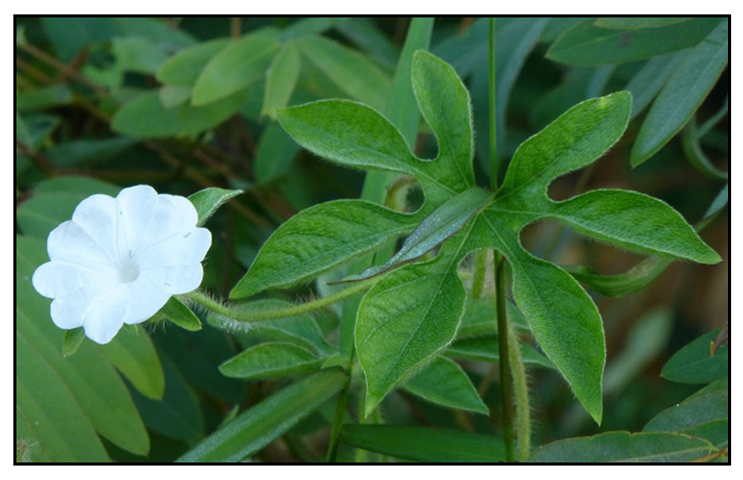
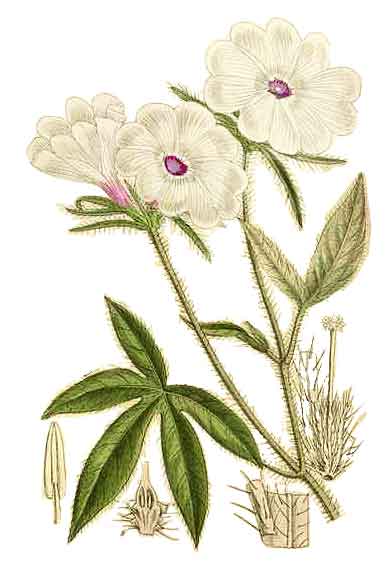
• Malasandia is a twining, herbaceous, annual vine, all part being more or less covered with rather long, spreading, pale or brownish hairs. Leaves are somewhat rounded in outline, 6 to 10 centimeters in diameter, palmately 5- to 9-lobed, heart-shaped at the base and somewhat hairy on both surfaces. Lobes of the blade are elliptic, with narrowed base and rounded sinuses. Flowers occur in axillary clusters, but usually only one open at a time in each cluster. Calyx is green and about 1 centimeter long. Corolla is white and 4 centimeters long, the limb about 3 centimeters in diameter. Fruit is rounded, 6 to 7 millimeters in diameter.
• Growth form: An annual herbaceous vine, it has a twining growth form. The surface of the plant is covered in a layer of white hairs. Foliage: Leaves are arranged alternately along the stem. The leaf blade is palmately lobed. The leaf lobes are elliptic to oblong in shape and are tapered at both ends. Flowers: Flowers are white and funnel-shaped. The corolla has mid-petaline bands covered sparsely with hairs.Â
 Distribution Distribution
- Native to the Philippines.
-
In all or most parts of the Philippines in open grasslands and waste places at low and medium altitudes.
- Also native to Angola, Bangladesh, Benin, Borneo, Botswana, Burkina, Cambodia, Caprivi Strip, Central African Republic, Chad, China South-Central, China Southeast, East Himalaya, Guinea-Bissau, Hainan, India, Jawa, Kenya, Lesser Sunda Is., Malawi, Malaya, Mali, Maluku, Mauritius, Mozambique, Myanmar, Namibia, Nepal, New Guinea, Niger, Nigeria, Northern Provinces, Pakistan, Somalia, South China Sea, Sri Lanka, Sudan, Sulawesi, Sumatera, Taiwan, Tanzania, Thailand, Vietnam, West Himalaya, Zambia, Zaïre, Zimbabwe. (9)
Constituents
- Ethyl acetate extract yielded flavonoids, glycosides, alkaloids, saponins, carbohydrates and tannins. (see study below) (10)
- Preliminary phytochemical of shade-dried whole plant yielded
flavonoid, alkaloid, tannin, terpenoid, steroid, saponin, cardiac glycosides and anthraquinone glycosides. Â (15)
Properties
- Studies suggest analgesic, cytotoxic, sedating, antibacterial, anti-acne, anti-inflammatory, antioxidant, thrombolytic, anticancer, wound healing, anti-convulsant, anti-anxiety, antimelanoma properties.
Parts used
Leaves
 Uses Uses
Folkloric
- Poultices of leaves used as resolvent for pimples, boils, carbuncles, etc.
- In the Indian subcontinent, extracts of roots and leaves used to treat snakebites, inflammation, skin diseases, boils, gout, ulcers, arthritis, rheumatism, dropsy, bronchial spasms, urinary retention, constipation, and gynecological disorders. (21)
- In Java, leaves used for poulticing sores, boils, pimples. (13)
- In Sri Lanka, entire creeper is crushed and the juice extracted and take orally for treatment of or prevention of rabies if bitten by a rabid dog. (13)
- In India, used for wound healing. In the Jalgaon district of Maharashtra, leaf powder is smoked to get relief from bronchial spasm. Leaves used for treating boils.
-
The Kerala tribe use the herb for various painful conditions - headaches, swellings, poisonous stings, snake bites, etc. (4)
- In Tamil Nadu, southern India, leaf paste is applied twice daily for 2 days to treat pimples. Seed paste with coconut oil is applied to facilitate wound healing.
- In Andhra Pradesh, India, leaf paste is warmed and cooled, and applied to the head for hypnotic effect. Twining stems are dipped in tumeric water and worn around the neck of children for restlessness and to drive away evil spirits. Leaf paste is applied on whole body before bathing with warm water to treat fever. Also used for wound healing. Leaf powder smoked to relieve bronchial spasm. (12)
- In Bangladesh, used for the treatment of tumors and cancers. Leaf powder smoked to get relief from bronchial spasm. (16)
- In Maharashtra, India, whole plant used to treat hemiplegia, gripe, and malarial fever. (24)
Others
- Fodder: In India, used as fodder plant.
Studies
• Analgesic / Leaves:
Study showed the ethanolic leaf extract of Ipomoea pes-tigridis has significant analgesic activity with significant dose-dependent reduction of writhes (p<0.05) with 100 mg/kbw dose showing the highest reduction. using plate reaction time. (4)
• Analgesic and Neuropharmacological Testing: Study investigated the analgesic and neuropharmacological activities of an ethyl acetate extract of I. pes-tigridis in albino mice. In acetic acid writhing test and hot plate method in mice the extract showed significant analgesic activity. Testing did not show any CNS depressant activities. (see Constituents above) (10)
• Cytotoxic / HepG2 Cell Line / Leaves: Study of 70% ethanolic extract of I. pes-tigridis leaves showed significant anticancer effect against liver cancer on HEPG2 cell line in concentration range of 500 µg/mL with 99.87% cell inhibition. The antiproliferative effect comparable to that of Ipomoea stans. (11)
• Alkaloids and Flavonoids / Antibacterial / Anti-Inflammatory / Aerial Parts: Study evaluated methanolic extract of aerial parts for antibacterial activity against routine bacterial strains and anti-acne activity against S. epidermis and Propionibacterium acnes. Staphylococcus epidermis was more susceptible to the extract than P. acnes, with MIC of 96 µg/ml and 100 µg/ml, respectively. Alkaloids and flavonoids were the potent inhibitors of these microorganisms. Anti-inflammatory activity screening showed 100 mg/kg as the most effective dose. (14)
• Antioxidant / Cytotoxicity / Neuropharmacological Effects: Study showed dose-dependent radical scavenging effect in DPPH assay, with IC50 for free radicals of 79.05 µg/ml. Leaf petroleum benzene extract showed dose dependent lethality in brine shrimp lethality assay. LC50 of leaf extract was 12.035 µg/ml. In open field and hole cross tests in mice, extract exhibited a critical sedative effect at doses of 200 mg/kg and 400 mg/kg by oral route, with diazepam as standard. (16)
• Antimicrobial / Thrombolytic / Cytotoxic /
Leaves:Study evaluated the EA and n-hexane extract of leaves for antimicrobial, cytotoxic, and thrombolytic activities. The EA extract showed mild antimicrobial activity with ZOI ranging from 11 to 14 mm while the n-hexane extract showed mild activity with ZOE range from 4 to 9 mm, with ciprofloxacin standard 50 mm ZOI. The extracts showed clot lysis effect with thrombolytic activity of 14.90% and 8.18% for the EA and n-hexane extracts, respectively. In Brine Shrimp Lethality Bioassay, the EA extract showed an LC50 of 14.125 µg/ml while the n-hexane extract exhibited an LC50 of 33.11 µg/ml. (17)
• Anti-Acne / Dermatological Herbal Hydrogel: Study formulated and evaluated a herbal hydrogel incorporated with extract of Ipomoea tes-tigridis for anti-acne activity. The formulation passed all evaluation parameters i.e., organoleptic characters, pH, skin irritation tests, microbial contamination, extrude and spread ability, drug content, and diffusion studies. The anti-acne and anti-inflammatory activity was comparable to standard drug clindamycin and diclofenac, respectively. Results suggest the formulation can be a substitute for synthetic anti-acne agents. (18)
• Accelerates Wound Healing / Stem and Leaf: Study evaluated crude extracts of stems and leaves for antioxidant activity, polyphenolic content, and wound healing activity using incision and excision wound models in animals, measuring tissue parameters viz., hydroxyproline, hexosamine, hexuronic acid content, and antioxidant enzyme activity (SOD, catalase, GPX, LPO). The leaf methanol crude extract showed highest polyphenolic and antioxidant activities. RP-HPLC analysis revealed highest amount of p-coumaric acid in the leaf ethyl acetate extract. In invivo excision wound healing model, the 1% leaf EA extract showed better wound healing activity with maximum wound healing area. In the incision wound model the leaf methanol extract showed maximum tensile strength. A significant functional effect of granulation tissue parameters and enzyme antioxidants on wound-healed area of dry tissue was observed. Histopathological study showed enhanced re-epithelization, fibroblast proliferation, and collagen synthesis in wound-treated tissues in both models. (21)
• Anticonvulsant / Antianxiety / Whole Plant: Study evaluated an ethanolic extract of whole plant for anticonvulsant and antianxiety activity in mice. Antiepileptic activity was assessed by MES (maximal electroshock) model (200 and 400 mg/kg), and antianxiety by hole board and open field test. In MES model, the extract showed dose-dependent reduction in duration of hind limb extensor phase compared to control. At 400 mg/kg the mice showed significant (p<0.0001) effect in all phases of MES induced convulsion. In HBT (hole board test), 400 mg/kg of extract showed significant (p<0.0001) effect on number of head dipping due to anxiolytic effect. In OFT (open field test), at 400 mg/kg extract the mice showed significant (p<0.0001) lowering effect on locomotor activity (anxiolytic effect). Results suggest anticonvulsant and antianxiety activity through a GABA-ergic interaction. (22)
• Silver Nanoparticles / Anti-Melanoma Effect / Leaves: Study reports on the eco-friendly and green synthesis of silver nanoparticles using leaf extract of Ipomoea pes-tigridis. The AgNPs exhibited promising cytotoxic effects on melanoma cells and lower toxicity toward normal cells. Results suggest potential for future applications in cancer therapy with a degree of selective toxicity. (23)
Availability
Wild-crafted.
|


.jpg)


