 Botany Botany
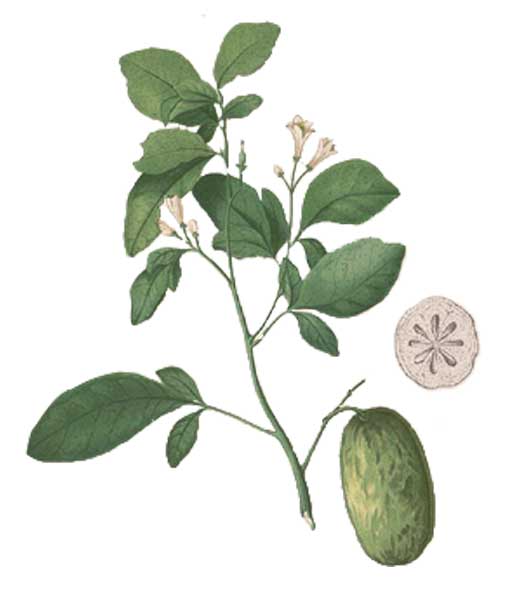
Malakabuyau is a tree reaching a height of 10 meters, smooth except for the younger branchlets and inflorescences. Trunk is usually spiny. Small spines are usually present on the branches. Leaves are 3-foliate, oblong-ovate to elliptic, entire or somewhat crenate; the terminal one is 6 to 10 centimeters long and the lateral ones are smaller. Flowers are white, fragrant, and about 1.5 centimeters long. Fruit is green or yellow, rough on the outside, oblong, about 10 centimeters long, and 10-celled. Seeds are numerous and surrounded by a fibrous coating.
 Distribution Distribution
- In thickets and secondary forests at low and medium altitudes from Isabela to Quezon Provinces of Luzon.
Constituents
- Study isolated eleven acridone alkaloids. Three were characterized as: 1,3,5-trihydroxy-4-methoxy-10-methyl-2,8-bis(3-methylbut-2-enyl)acridin- 9(10H)-one (1), 2,3-dihydro-4,9-dihydroxy-2-(2-hydroxypropan-2-yl)-11-methoxy-10-met hylfuro[3,2-b] acridin-5(10H)-one (2) and 3,4-dihydro-3,5,8-trihydroxy-6-methoxy-2,2,7-trimethyl-2H-pyrano[2,3-a] acridin-12(7H)-one (3). (See study below) (3).
- Study
of methanol extract from stems and fruits yielded 11 known acridone alkaloids and three N-phenylethyl-benzamide derivatives. (see study below) (6)
- Study of stem bark yielded a new prenylated acridone alkaloid, Study isolated a new prenylated acridone alkaloid, 1,3,5-trihydroxy-2,8-bis(3-methylbut-2-enyl)-10-methyl-9-acridone (1), along with three known alkaloids, 5-hydroxynoracronycine (2), 1,3,5-trihydroxy-4-methoxy-2-(3-methylbut-2-enyl)-10-methyl-9-acridone (3), and 1,3,5-trihydroxy-4-methoxy-10-methylacridone (4). (see study below) (8)
- Study isolated five acridone alkaloids from S. glutinosa viz., citrusinine (1), glycocitrine-IV (2), 1,3,5-trihydroxy-10--methyl-2,8-bis(3-methylbut-2-en--1-yl)-9(10H)-acridone (3), (2R)-2-tert-butyl-3,10-dihydro-4,9-dihydroxy-11-methoxy-10-methylfuro[3,2-b]acridin-5(2H)-one (4), and (3R)-2,3,4,7-tetrahydro-3,5,8-trihydroxy-6-methoxy-2,2,7-trimethyl-12H-pyrano[2,3-a]acridin-12-one (5). (see study below) (14)
- Study of leaves and fruit peel for essential oil by GC-MS analysis yielded 67 compounds, 64 of which were found in both oils. The main component of EO from fruit peel or leaves were trans-nerolidol (19.1% and 28.4%, respectively). Sesquiterpene hydrocarbons (50%) and their oxygenated analogues (35%) were abundant in the leaf oil. Monoterpene hydrocarbons (51%) were principle compound family found in the EO of fruit peels. (16)
Parts used
Fruit, leaves.
Uses
Folkloric
- Juice of fruit used as a cure for a skin affliction, known in Ilocano as "kurad."
-
Also used in dogs to get rid of ticks.
- Leaves and bark used for cough.
Others
- EcoSwing: A liquid botanical fungicide based on extract of Swinglea glutinosa, touted to be effective against several important crop and ornamental diseases including powdery mildew, botyris, monilinia, and others. (17)
 Studies Studies
• Anti-Tuberculosis / Essential Oil: Study assessed the in vitro antitubercular activity of essential oils of 11 medicinal plants grown in Columbia. The major components were carvacrol, thymol, p-cymene, 1,8-cineole, limonene and beta-pinene. INH and rifampin were used for control treatments. Essential oil from S. glutinosa showed a minimal inhibitory activity of 100 ±36 mcg/ml(-1). Results showed the essential oils from Achyrocline alata and Swinglea glutinosa were the most active and suggests A alata and S glutinosa and their identified components are potential candidates as phytotherapeutic antitubercular agents. (1)
• Alkaloids / Cytotoxicity / Anti-Plasmodial / Stem Bark: Study isolated a new prenylated acridone alkaloid from the stem-bark of S glutinosa, along with three known acridone alkaloids. The isolated alkaloids were assessed for anti-plasmodial activity and for cytotoxicity using HeLa cells. (2)
• Antiparasitic / Anti-Plasmodial: Study evaluated the in vitro anti-plasmodial activity of 11 acridone alkaloids isolated from S. glutinosa. Nine had varying range of activity against P. falcifarum, a smaller number against T brucei rhodesiense and Leishmania donovani. (see constituents above) (3)
• Cytotoxicity / Stems and Fruits: A methanol extract from stems and fruits yielded 11 known acridone alkaloids and three N-phenylethyl-benzamide derivatives. The compounds were examined against three cancer cell lines: human lung carcinoma (COR-L23), human breast adenocarcinoma (MCF7), and human melanoma (C32).. The acridones exhibited weak cytotoxicity but the amides showed moderate nonselective activity. (6)
• Bioactive Acridone Alkaloids / Stem Bark: Study isolated a new prenylated acridone alkaloids, 1,3,5-trihydroxy-2,8-bis(3-methylbut-2-enyl)-10-methyl-9-acridone (1), from the stem bark of S. glutinosa along with three known alkaloids. The isolated alkaloids were assessed for in vitro activity against chloroquine- sensitive Plasmodium falcifarum strains and cytotoxicity using HeLa cells. (8)
• Natural Repellent / Anti-QS / Essential Oil: Essential oils from six plants cultivated in Colombia, including Swinglea glutinosa, were evaluated for repellent activity and quorum sensing (QS) inhibition. Results suggest the EOs are sustainable, promising new sources of natural repellents and could be important as anti-quorum sensing molecules. (10)
• Acridone Alkaloids / Cathepsin V Inhibitor: Cathepsin V is a lysosomal cysteine peptidase highly expressed in thymus, testis, and corneal epithelium. Study isolated 11 acridone alkaloids with eight identified as potent and reversible inhibitors of cathepsin V (IC50 1.2-3.9 µM). The most potent inhibitor (7) had a K(i) value of 200 nM. (11)
• Antioxidant / Fatty Acid Composition / Leaves and Fruits: Study evaluated the antioxidant capacity of methanolic extracts and fatty acid composition of leaves and fruits of S. glutinosa. Results showed an IC50 of 28.2 g/mL for the leaf extract, and 10 µg µg/mL for the fruit extract by DPPH method. The fruit extract showed highest anti-radical effect while the leaf extract showed highest effect against lipid peroxidation. On GC analysis, the major fatty acid was linoleic and oleic acids, 0.5% for both. (12)
• Invention / Acari Control / Combination with Avermectins / Leaves: Invention reports on the application of a natural material derived from Swinglea glutinosa leaves in combination with avermectins which increases the effect of avermectins over mites. Results suggest an all natural material with potential to replace avermectin combinations with synthetic pyrethroids. (13)
• Acridone Alkaloids / Effects on Photosynthesis: In a search for herbicide models, study investigated the mechanisms of action of five alkaloids isolated from S. glutinosa viz., citrusinine (1), glycocitrine-IV (2), 1,3,5-trihydroxy-10--methyl-2,8-bis(3-methylbut-2-en--1-yl)-9(10H)-acridone (3), (2R)-2-tert-butyl-3,10-dihydro-4,9-dihydroxy-11-methoxy-10-methylfuro[3,2-b]acridin-5(2H)-one (4), and (3R)-2,3,4,7-tetrahydro-3,5,8-trihydroxy-6-methoxy-2,2,7-trimethyl-12H-pyrano[2,3-a]acridin-12-one (5). The compounds inhibited the non-cyclic electron transport in the basal, phosphorylating, and uncoupled conditions fro H2O to methylviologen, therefore acting as Hill reaction inhibitors. (14)
• Production of Leaf Extract: This invention provides a standardized method to obtain an extract from the leaves of Swinglea glutinosa with a yield of 60% of weight of leaves. Study also presents use of the extract as fungicide, mite and insect repellent. (15)
• Larvicidal / Insecticidal Against Aedes aegypti / Mixtures of Essential Oil: Study evaluated the larvicidal activity of essential oils from ten herbal medicinal plants, including Swinglea glutinosa. All EOs showed larvicidal activity with LC50s lower than 115 mg/L. Some EO mixtures showed lower LC50 than oils used individually, such as mixtures of Lippia origanoides + S. glutinosa (LC50 38.40 mg/L), Turnera diffusa + S. glutinosa (LC50 63.71 mg/L), Lippia alba + S. glutinosa (LC50 48.87 mg/L). The main compounds of EOs with highest larvicidal activity were thymol (42%) and p-cymene (26.4%). (18)
• Acridone Alkaloids as Potent Inhibitors of Cathepsin V: Cathepsin V is a lysosomal cysteine peptidase highly expressed in thymus, testis, and corneal epithelium. Eleven acridone alkaloids were isolated from S. glutinosa, eight of them identified as potent and reversible inhibitors of cathepsin V with IC50 values ranging from 1.2 to 3.9 µM. (19)
Availability
- Wild-crafted.
- As botanical fungicide in the cybermarket.
|


