|
Gen info
The name derives from the Greek words pedilon, meaning "slipper," and ant-hos, meaning "flower."
Botany
Luha is a half-woody, succulent, and erect shrub growing
to a height of 1.5 meters or less, with fleshy and stout branches which produce
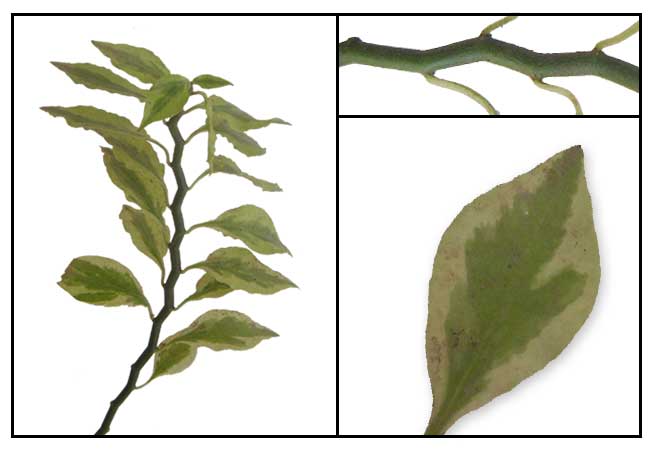
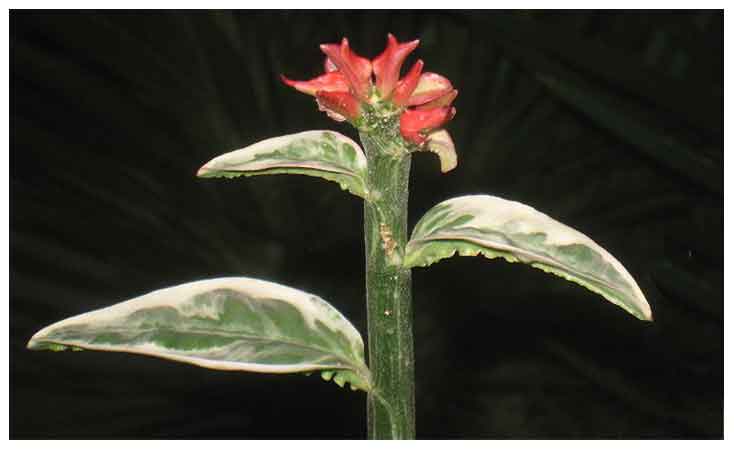
a milky latex. Leaves are green or variegated, fleshy, smooth, alternate, deciduous, ovate
or oblong, 3.5 to 7.5 centimeters long, 2.5 to 5 centimeters wide, pointed at both ends. Flowers are reddish, clustered on leafless stems, terminal or axillary.
Capsules are 9 millimeters broad.
 Distribution Distribution
- Recently introduced species.
-
Ornamental cultivation, especially as a hedge plant.
- Native of the West Indies.
Properties
• Considered emetic,
anti-inflammatory, antibacterial, antiseptic, antihemorrhagic, antiviral,
antitumoral and abortive.
• Milky juice is
caustic, irritant, and emetic.
Constituents
• A study assessing its scavenging properties yielded the antioxidant
principles: a kaempferol, quercitrin, isoquercitrin and scopoletin;
phenolics and flavonoids - gallic acid and rutin.
• A new proteolytic enzyme, pedilanthain, with anti-inflammatory
activity was isolated from the latex.
• Caustic, milky juice of the roots, stems and leaves contains euphorbol and other diterpene esters which are irritants and cocarcinogens. A lectin and proteolytic enzymes are experimentally indicated.
• Extracts of leaves yielded five known compounds, viz. epifriedelanyl acetate (1), friedelanol (2), β-sitosterol (3), ursolic acid (4), and luteolin (5), along with the new compound 1,2-tetradecanediol 1-(hydrogen sulfate) sodium salt (6). (see study below) (22)
• Study of leaves yielded a total phenolic content of 10.98 ± 0.08 mg TAE/g DW, flavonoid content of 11.49 ± 0.15 µg QE/g DW, and total antioxidant content of 6,64 ± 0.05 mg TAE/g DSW. (see study below) (30)
Parts utilized
Leaves, roots, latex.
Uses
Edibility
- In the southeastern foothills of Bhutan, the delicate bark is roasted and eaten in small doses as appetizer. (31)
Folkloric
- No reported folkloric medicinal use in the Philippines.
- In other folk systems, leaf tea used for laryngitis, mouth ulcers, venereal disease, asthma, cough.
- Root tea has been used as abortifacient and as purgative substitute for ipecacuanha.
- Latex has been used to treat cancer and umbilical hernia; also, dripped into painful dental caries and aching ears. (See eye toxicity: Caution)
- Used for treating warts, calluses and ringworm.
- The centipede leg-like leaf arrangement has given it folkloric application for treatment of centipede and scorpion stings.
- In Indian medicine, leaves used to heal wounds, burns, and mouth ulcers.
- Decoction of leaves used for abdominal afflictions. Latex used for treatment of venereal diseases and to relieve sprain. (26)
- In the Nawarangpur district of Odisha, India, leaf paste heated in castor oil is applied on sprains to reduce swelling and pain. (29)
Studies
• Anti-inflammatory / Antioxidant / Tincture: Anti-inflammatory and
antioxidant activity of a medicinal tincture from Pedilanthus tithymaloides:
A Cuban study showed inhibition of carrageenan-induced rat paw edema
while scavenging assays showed it to be effective against all assayed
ROS and RNS. Study results support its traditional use as an anti-inflammatory
medicine. (1)
• Antimalarial / Anti-tuberculosis:
Study yielded six new poly-O-acylated jatrophane diterpenes along
with five known compounds from the white latex of P tithymaloides. Antimalarial
and antituberculous poly-O-acylated jatrophane diterpenoids from Pedilanthus
tithymaloides: Compounds 1, 3, 4 and 5 showed antiplasmodial activity
and antimycobacterial activity against Mycobacterium tuberculosis. (3)
• Antifungal: Antimycotic Screening
of 58 Malaysian Plants against Plant Pathogens: Of 58 Malaysian plants
screened, PT was one of 34 plants that showed selective antifungal activity. (5)
• Antibacterial / Antifungal: Study investigated the antifungal and antibacterial properties of an ethanolic extract of leaves of P. tithymaloides and some of its constituents.
• Antioxidants: Study
yielded principles identified as kaempferol 3-O-B-D-glucopyranoside-6"-(3-hydroxy-3-methylglutarate),
quercitin, isoquercitrin and scopoletin.
• Mosquito Control: Ethanolic
extract study of P tithymaloides yielded flavonoids, steroids and phenols
and showed that phytochemicals from spurge exhibit significant biological
activity against mosquitoes and presents a potential as a natural product-based
biocide for disease vector control. (9)
• Hemagglutination / Lectin / Diabetes: The
usefulness of a galactose specific lectin from P. tithymaloides was
examined to study the hemagglutination pattern in patients with diabetes
mellitus. Significantly low titer was seen in patients with insulin
dependent diabetes and no significant change in non-insulin dependent
diabetics. The low titer was shown to occur along with increased duration
of the diabetic condition. (8)
• Anti-inflammatory / Latex / Pedilanthain: Study isolated pedilanthin, a new protease, from the latex of P. tithymaloides, and was subjected to anti-inflammatory screening. (11)
• Petrocrop Potential: Studies showed P. tithymaloides, PT var. cuculatus and PT var variegatus are promising varieties for development of petro-crops, with potential for good biomass and hydrocarbon yields. (12)
• Larvicidal / Dengue Vector / Aedes aegypti: Study evaluated a crude ethanol leaf extract for larvicidal activity against dengue vector Aedes aegypti. Results showed moderate larvicidal property with LC50 of 0.32 and 0.12 percent after 24 and 48 hours. (16)
• Anti-Inflammatory / Leaves: Study evaluated various extracts of leaves for anti-inflammatory activity in male albino rats using a carrageenan-induced paw edema model. A methanol extract showed significantly more anti-inflammatory activity in a dose-dependent manner. (17)
• Renewable Hydrocarbon Source: Study evaluated P. tithymaloides for a renewable and potential source of hydrocarbons. Extractions yielded a white amorphous mixture of hydrocarbons comparable with gasoline. (18)
• Wound Healing / Leaves: Study evaluated P. tithymaloides leaves for wound healing property. Fractionation yielded 2-(3,4-dihydroxy-phenyl)-5,7-dihydroxy-chromen-4-one and 1, 2-tetradecanediol, 1-(hydrogen sulfate), sodium salt. An ointment formulation showed significant wound healing activity on excision, incision and dead space wound models in rats. (19)
• Anthelmintic / Leaves: Study evaluated the in vitro anthelmintic activity of an ethanolic leaf extract of Euphorbia tithymaloides against adult earthworm Pheretima posthuma. Albendazole was used as standard drug. Results showed remarkable anthelmintic activity at 45 mg mL-1. (21)
• Anti-Inflammatory / Analgesic / Antipyretic / Leaves: Study evaluated the anti-inflammatory, antinociceptive, and antipyretic activity of chloroform and methanol leaf extracts in animal models. Results showed significant anti-inflammatory activity in carrageenan-induced paw edema, vascular permeability, and cotton pellet granuloma models; antinociceptive activity with significant increase in hot-plate reaction time and decreased writhing response; and significant antipyretic activity in a yeast-induced pyrexia model. (see constituents above) (22)
• Antibacterial: Study evaluated the antibacterial activity of P. tithymaloides against various gram positive and gram negative bacteria. n-Butanol extracts showed significant antibacterial activity against B. subtilis, P. mirabilis, S. pyogenes, Aermonas, K. pneumonia, S. aureus, E. coli, K. pneumonia and P. aeruginosa. (23)
• Antidiabetic / Anti-Inflammatory: Study evaluated the potential anti-inflammatory and antidiabetic activities of E. tithymaloides ethanol extract using RAW 264.7 murine macrophages cells and 3T3-L1 adipocytes. The ETE decreased NO production in macrophages RAW 264.7 cell line and reduced protein expression of COX-2, IL-6, iNOS, tumor necrosis factor a and nuclear factor kB in a dose dependent manner. The ETE stimulated 2-NBDG uptake through activation of the insulin pathway through insulin sensitizing PPARy agonists in a dose-dependent manner. Results showed the ETE has immunomodulatory activity and antidiabetic effects. (24)
• Antibacterial / Flowers69: In a study for antibacterial activity, the flowers of P. tithymaloides inhibited the growth of P. vulgaris and S. aureus. Flavonoids and steroids and triterpenoid contents were highest in the flowers of T. tithymaloides at 41.20% and 46.74%. The MIC values of flower extracts showed inhibitory activity against P. vulgaris and S. aureus. DMSO extracts of fresh flowers inhibited the growth of P. vulgaris alone, while dry flowers inhibited growth of both P. vulgaris and S. aureus, with highest ZOI of 16 mm against S. aureus. (26)
• Anti-Inflammatory: Study evaluated the anti-inflammatory activity of E. tithymaloides ethanol extract in RAW264.7 macrophages. LPS was used to activate the cells. Results showed increasing extract concentration decreased mRNA expression of IL-6, iNOS, COX-2, TNF-a. IFN-y and MF-kB. as well as protein expression. Results support the use of E. tithymaloides ethanol extract as anti-inflammatory medicine. (27)
• Wound Healing Stimulation: Study evaluated the potential of an ethanolic extract of P. tithymaloides to stimulate excision wound healing in female mice. Parameters of wound healing were significantly (p<0.05) higher compared to the control group. Histopathological exam showed increased fibroblast, collagen fiber, and blood vessel formation. Wounds treated by 0.5% crude extract healed faster compared to 1.5% crude extract treatment. Results suggest the latter was too concentrated and caused irritation and inflammation, leading to delayed healing. (28)
• Antioxidant / Free Radical Scavenging / Leaves: Study evaluated a methanolic extract of leaves of P. tithymaloides for total phenol, total flavonoids, total antioxidant and free radical scavenging activity. Results showed significant free radical scavenging activity as assessed by FTC., TBA, FRAP. and ABTS assays. Structural elucidation by GC-MS analysis yielded five different compounds, including three esters, an amine and an alkaloid. (see constituents above) (30)
• Inhibition of Herpes Simplex Virus Infection by Modulation of NF-kB Signaling / Leaves: Study evaluated the in vitro antiviral activity of a methanolic extract of P. tithymaloides leaves and isolated compounds against Herpes simplex virus type 2 (HSV-2). Bioactivity-guided assay showed the extract and one of its constituents, luteolin, exhibited potent antiviral activity against wild type and clinical isolates of HSV-2. Results indicate that both PT leaf extract
and luteolin modulate the NF-kB signaling pathway, resulting in the inhibition of HSV-2 replication. (32)
Caution / Toxicity
• Toxicity: Ingested, a few drops of the juice produce irritation of the mouth and throat, vomiting and diarrhea. Externally, the juice produces irritation, inflammation and skin blistering. In the eye, it produces intense and painful irritation, followed by keratoconjuctivitis and temporary reduction of visual acuity. The seeds cause violent persistent vomiting and drastic diarrhea. In livestock, skin lesions are prone to secondary infections. (13)
• Euphorbol and other toxic components: The roots, stems, and leaves contain euphorbol (a complex terpene) and other diterpene esters which are known irritants and carcinogens. Leaves and stems also contain beta-sitosterol, cycloartenone, octalosanol and oxime, all known to have both medicinal and toxic properties. (25)
• Case Report / Mechanism of Injury: A case of eye injury consisted of severe conjunctivitis with chemosis and corneal erosion secondary to contact with the sap. Probably mechanism was the combined effect of the plant sap, possible proteolytic activity, and mechanical trauma.
• Treatment / Prevention: As a potential hazard to eyes, it should not be planted in places easily accessible to children, like gardens and playgrounds. Avoid contact with the sap. Wear goggles when cutting the plant. Skin contact should immediately be washed with soap and water. Topical steroids reduced pain and inflammation. Fluid replacement and hydration may be needed for acute gastrointestinal manifestations.
Availability
Wildcrafted. |


