Botany
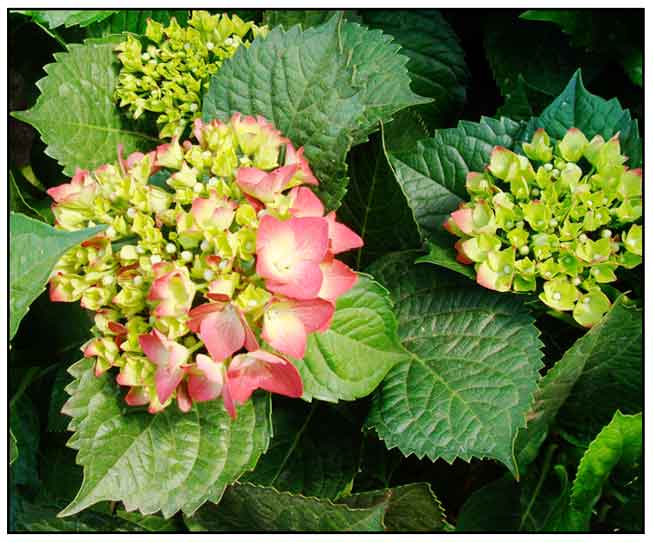
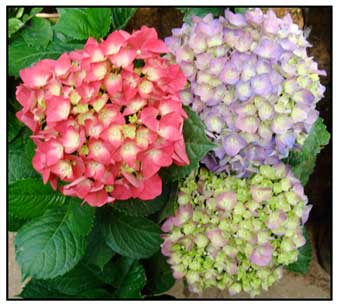
Hydrangea is a deciduous shrub growing to a height of 1.5 to 2 meters. Leaves are opposite, petioled, oblong-ovate, acuminate, light green with serrate margins, up to 15 cm long. Flowers are in large, terminal cymes; clusters up to 12 centimeters across, blue, pink, or white, with broadly oval sepals. Fruit is a subglobose capsule.
 Distribution Distribution
- Garden cultivation.
- Thrives well in Baguio and other high altitude areas.
- A popular hedge plant.
- Native to Japan and China.
Constituents
• Leaves contain phyllodulcin, a sweet substance that can be used as a sugar substitute.
• Ethanolic extract of aerial parts isolated two new cyanogenic glycosides viz. [(2R)-2- (ß-D-glucopyranosyloxy)-2-(3,4-dimethoxy-phenyl)] acetonitrile (1) and {(2R)-2-[ß-D- glucopyranosyl(1—6)ß-D-glucopyranosyloxy]-2-(3-hydroxy-4-methoxy-phenyl)}acetonitrile (2). (7)
• Flowers yielded hydragenol glucoside. Acid hydrolysates of flower, leaf and root yielded a free isocoumarin, hydrangenol. (8)
• From characterization of dihydroisocoumarin constituents, leaves yielded two secoiridoid glucoside complexes: hydramacrosides A and B. (see study below) (9)
• Study isolated twelve compounds and identified as methyl-ß-rutinoside (1), gentisic acid (2), pyrocatechol (3), 8-epiloganic acid (4), caryoptoside (5), quercetin-3-O-ß-D-glucopyranoside (6), kaempferol3-O-ß--rutinoside *7), m5-4'-dihydroxy-kaempferol-7-O-ß-rutinoside (8), mkaempferol-3-O-ß-D-glucopyranoside (9), m 1,2,4-benzenetri (10), 7-hydroxycumarin (11), and rutin (12). (14)
• Study isolated a new kaempferol glycoside, named kaempferol
3-O-16"-ß-D-glucopyranosyl-6'"-O-a-L-rhamnopyranosyl-D-glucopyranoside, (15)
- Study of flowers of Hydrangea macrophylla var. thunbergii isolated six dihydroisocoumarin glycosides, florahydrosides I and II, thunbergin G 8-O-ß-D glucopyranoside, thunberginol C 8-O-ß-D-glucopyranoside, 4-hydroxythunberginol G 3'-O-ß-D-glucopyranoside, and thungerginol D3'-O-ß-D-glucopyranoside along with 20 known compounds. (see study below) (22)
- Study isolated 12 compounds, i.e.,ß-sitosterol (1), α-tocopherol (2), hydrangenol (3), belliferone (4), isovanillic acid (5), isoarborinol (6), rubiarbonol B (7), rutin (8), myo-inositol (9), osterol (10), protocatechuic acid (11), and shikimic acid (12). (see study below) (24)
Properties
• Reported toxicity due to hyydrangenol, a strong irritant to skin.
•
Considered antiperiodic, antitussive, diuretic.
• Leaves, roots and flowers considered antimalarial, antitussive and diuretic.
Uses
Edibility
• Young leaves, dried and rubbed becomes sweet
• Used to make sweet tea, or "tea in heaven," used in Buddhist ceremonies.
• Leaves are dried, powdered and used as food flavoring.
• Young leaves and shoots can be eaten cooked.
Folkloric
• No known folkloric medicinal use in the Philippines.
• Elsewhere, used for malaria; as diuretic and antitussive.
Toxicity
• Contact Dermatitis:
Hydrangenol, is the toxic constituent of H. macrophylla, which can cause allergic contract dermatitis presenting as eczema, fissures, and inflammation, affecting mainly the fingers. The toxicity is usually associated with exposure to the sap while pruning the plant. (17)
• Accidental ingestion:
Reports of cute food poisoning from ingestion of leaves were reported in Japan in 2008. All patients recovered uneventfully. Ingestion can cause nausea, vomiting, diarrhea and abdominal pain. (17)
• Animal toxicity: Dog, Dogs, cats and horses may be affected. While poisoning is rare and occurs with eating large quantities of the plant, a horse was seriously poisoned after eating a single potted hydrangea. The plant may contain cyanogenc glycoside hydrangin, but cyanide intoxication is rare and poisonings do not generally involve effects or clinical signs typical of cyanide. (20)
Studies
• Antimalarial Activity:
Study evaluated the antimalarial activity of fractions isolated from the leaves of Hydrangea macrophylla against Plasmodium yoelii. (2)
• Antimalarial Activity / Leaves: In a study of the leaves of 13 common Japanese plants, the leaf extract of Hydrangea macrophylla inhibited the parasitic growth of Plasmodium falcifarum with IC50 of 0.18 microg/ml. The IC50 to NIH 3T3-3 cells from a common mouse line was 72 microg/ml. (3)
• Phyllodulcin / Water Extraction: A subcritical water extraction, an alternative environmentally friendly extraction method, was developed for the extraction of phyllodulcin, the well known sweetener in Hydrangea macrophylla var. thunbergii. (4)
• Secoiridoid Glycosides: Study isolated seven secoiridoid glycosides from the leaves of H macrophylla subsp. serrata. (5)
• Halofuginone / Root / Immunomodulatory: Halofuginone, a drug derived from the hydrangea root, shows promise in the treatment of autoimmune disorders, inhibiting the development of Th17 cells in both mice and humans, interrupting processes in autoimmune pathology. (6)
• Hydramacrosides / Inhibition of Histamine Release: Hydramacrosides A and B, isolated from leaves of hydrangea macrophylla var. thunbergii exhibited an inhibitory effect on histamine release from rat mast cells induced by antigen-antibody reaction. (see constituents above) (9)
• Antifungal: Study evaluated the antifungal effect of leaves against Alternaria alternata, Aspergillus flavus, and Fusarium solani following poisoned food technique. Results showed significant reduction in the growth of tested fungi. The fungitoxic effect of the leaf increased when combined with Allium cepa bulb extract. (10)
• Prevention of Male Pattern Baldness: Study showed TGF-ß—which plays an important role in catagen induction during the hair cycle—activation of caspase in human hair follicles. The induction of catagen by TGF-ß is mediated via activation of caspases and that a suppressor of TGF-ß could help prevent male pattern baldness. (11)
• Herb-Drug Interactions / Lithium: Lithium interacts with Hydrangea. Hydrangea may have a diuretic of "water pill" effect, which may decrease how the body gets rid of lithium, and increase the level of lithium in the body, and cause serious side effects. (18)
• Hepatoprotective / Sodium Arsenite Induced Oxidative Stress: Study evaluated the therapeutic role and molecular mechanism of H. macrophylla on NaAsO2-induced toxicity in human liver cancer (HepG2) cells and liver in mice. Results showed co-treatment with HM significantly attenuated the NaAsO2-induced cell viability loss, intracellular ROS and LDH release in HepG2 cells in a dose dependent manner. Liver histopathology lipid peroxidation and serum biochemical parameters ALT and AST were notably improved. HM downregulated both gene and protein expression level of the mitogen-activated protein kinase (MAPK) cascade. Study showed a hepatoprotective role via reduction in apoptosis, likely involving modulation of MAPK/caspase-3 signaling pathways. (19)
• Antiallergic Effects / Hydrangenol / Leaves: Study evaluated the antiallergic effects of phylodulcin, hydrangenol, and their 8-O-glucosides, and thunberginols A and F isolated from processed leaves of Hydrangea dulcis folium and dried leaves of Hydrangea macrophylla var. thunbergii using passive cutaneous anaphylaxis (PCA) reaction. Except for phyllodulcin, the constituents significantly inhibited the PCA reaction. While thunberginol A showed most potent inhibitory activity, hydrangenol was deemed the principal antiallergic component in the processed leaves. (21)
• Aldose Reductase Inhibitory Effect / Dihydroisocoumarin Glycosides / Flowers: Study of flowers isolated twelve compounds along with 20 known compounds. Among the constituents, acylated quinic acid analog, neochlorogenic acid, was shown to substantially inhibit aldose reductase (IC50=5.6 µM). In a study of several caffeoylquinic acid analogs, 4,5-O-trans-p-dicaffeoyl-D-quinic acid was also found to exhibit potent inhibitory effect on aldose reductase (IC50=0.29 µM). (see constituents above. (22)
• Anti-Inflammatory / Attenuation of Expression of Pro-Inflammatory Mediators / Leaves: Study evaluated the anti-inflammatory effect of a water extract of leaves in lipopolysaccharide (LPS)-stimulated RAW 264.7 macrophage cells. Results showed inhibition of expression of LPS-stimulated pro-inflammatory mediators such as nitric oxide (NO), prostaglandin E2 (PGE2) and tumor necrosis alpha. (23)
• α-Glucosidase Inhibitory Activity: Study evaluated phytoconstituents and α-glucosidase inhibitory activity of Hydrangea macrophylla. Twelve compounds were isolated. Compound 3 showed significant α-glucosidase inhibitory activity, similar to acarbose; compounds 6, 7, 11, and 12 showed some inhibitory activity. (see constituents above) (24)
Availability
Wild-crafted. |




