|
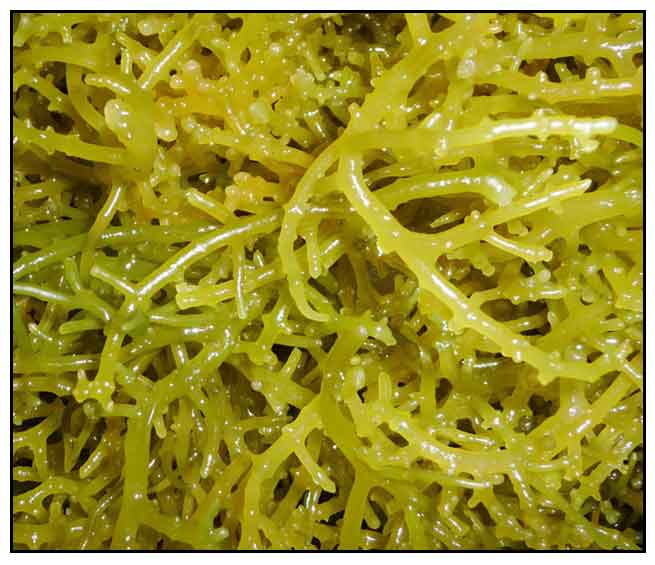
Gen info
- Gracilaria is a genus of red algae (Rhodophyta) notable for its economic importance as an agarophyte, as well as food for humans and various species of shellfish.
- Various species among the genus are cultivated.
- In Japanese cuisine, it is called ogonori or ogo
(14)
Botany
Gracilaria lichenoides is one of the most common
edible alga, 15 to 25 centimeters high, rising from a peltate holdfast. Fronds are elongated, cylindrical, 2
to 3 centimeters in diameter at their thickest, gradually diminishing upwards, soft or subcartilaginous, smooth
and irregularly and dichotomously branched. Color is purplish with a tinge of green when fresh,
becoming yellowish white when dry. Branches are rather fastigiate, bare below, divided
above with tapering branchlets, which are often forked at the apex with short divaricate segments. Fortifications consist of small, stalkless,
more or less spherical, slightly elongated bodies.
Distribution
- Common in the Philippines.
- Plentiful on rocks and sandy places.
- Also reported on the coast of the Indian Ocean, Burma, the Malay Archipelago, Java, and Australia.
Constituents
- Plant yields gelose, 60%; protein,
2.3%; fat, 0.1%; carbohydrate, 72.5%; galactose; fructose; pentose;
iodine, 0.05%.
- Dried alga contains salts, such as sulfate and chloride of soda, and sulphate and phosphate of lime, and contains wax and iron.
- Study of elemental content yielded: calcium 3.33 mg/g, Mg 1.73 mg/g, Na 29.08 mg/g, K 4.46 mg/g, F 40.97 mg/g and carbohydrate 116.23 mg/g. (5)
Properties
- Pectoral and antidysenteric, emollient, demulcent and alterative.
- Studies have suggested antioxidant and photoprotective properties.
Parts
used and collection
- Entire plant.
- Two ways of collecting the alga: (1) by diving and (2) by picking them from shallow water at low tide.
Uses
Edibility
- In the Philippines, popularly used to make gelatin.
-
Members of the genus are highly prized as foodstuff or for the agar
content.
- One of the most common edible algae.
- Entire plant is blanched and eaten as salad.
-
In Japanese cuisine,
called ogonori or ogo.
- As decoction or jelly, used as a light and readily digestible food for invalids and children.
Folkloric
- Used by Malays for cough and consumption.
- Poultice used for swollen knee joints and sores.
- Mucilaginous decoction and jelly extracted from the alga are used as pectoral and antidysenteric.
- In India, used as emollient, demulcent, and as alterative.
- Extracted jelly from strained mucilaginous decoction used for constipation.
- Used for intestinal and bladder difficulties, bladder irritation, menorrhagia,and leucorrhea.
- In China, used for treatment
of chronic constipation with intestinal atony, tuberculosis of lymph
node, tumor of thyroids, abdominal mass, edema, beriberi, testicular
swelling.
- With its iodine content, useful in goiter, scrofula, etc.
- Good substitute for ising-glass.
- Decoction given for dysentery and diarrhea.
- Used for pulmonary complaints.
Other
- Commerce: Used in manufacture of commercial agar-agar.
Studies
•
Pharmaceutical Biology of Seaweeds: Study showed grown
seaweeds exhibited greater antibacterial activity than the green and
red ones. In elemental composition, green seaweeds had higher Ca, Cr,
and Pb; green seaweeds with highest Co, Cu, Fe and Zn; and red seaweeds
highest in Cd, K, Mg and Na. (1)
• Chemical Structure of Agar Fraction: The chemical structure of the agar fraction of Gracilaria compressa, determined by C-NMR spectroscopy, consists of agarobiose, pyruvate agarobiose, and a low concentration of 6-O-methylated agarobiose repeating units. (3)
• Bioactivities: In various bioassay models, Gracilaria lichenoides exhibited an antihypertensive effect in rats and Gracillaria compressa showed allelopathic activity. (4)
• Attenuation of Ultraviolet B Radiation-Induced Oxidative Stress in Human Keratinocytes: Study evaluated the protective effects of an ethanol extract from red alga Gracilaria bursa-pastoris on ultraviolet B (UVB)-irradiated human HaCaT keratinocytes. GBE-treated keratinocytes showed reduction in UVB-induced apoptosis. Results suggest GBE exerts cytoprotective effects against UVB-stimulated oxidative stress by scavenging ROS and absorbing UVB rays, thereby attenuating injury to cellular constituents and preventing cell death. (6)
• Antioxidant Activity: Study evaluated the antioxidant activity of methanolic and aqueous extracts from marine macroalgae Gracilaria bursa-pastoris. Results yielded a high total phenolic content (142,26 and 79.43 mg GAE g-1 extract) for ethanolic and aqueous extracts, respectively. All extracts exhibited DPPH radical scavenging activity with the ME showing great antioxidant potential with very low EC50 (0.085 mg/mL) significantly equivalent to commercial antioxidant ascorbic acid with EC50 of 0,028 mg/mL). (7) Study showed that Gracilaria bursa-pastoris contained high phenolic content, vitamin E, vitamin C, and antioxidant capacity. Results suggest GBP can be a source of natural antioxidant molecules and be useful for the food industry. (9)
• Eco-Friendly Corrosion Inhibitor for Mild Steel: Study reports on the eco-friendly corrosion inhibitor performance of G. bursa-pastoris for mild steel in HCl a 1M solution. GBP is a mixed type inhibitor with a mode of inhibition that results from the geometric blocking effect of physiosorbed inhibitive species on the metal surface. (8)
• Sulfated Polysaccharides / Phycocolloids / Anti-Leishmanial: Study evaluated the in vitro activity of algal polysaccharides against Leishmania infantum. Polysaccharides were extracted from seven different macroalgae, including G. bursa pastoris, from the Mediterranean Sea. Preliminary results showed good anti-leishmanial activity of the investigated species. (10)
• Bioindicator of Zinc: Study evaluated the capacity of red macroaalga to act as bioindicator of iron, zinc, copper, lead and cadmium. Results suggest that G. bursa-pastoris efficiently reflects the ambient abundance of zinc in oligohaline coastal environments and satisfies its use as bioindicator of this trace element in these environments. It dose not reflect the ambient abundance of cadmium, Zinc may significantly reduce the accumulation of cadmium in the red seaweed tissues, It aloe did not reflect the abundance of copper and lead. (11)
• Hemagglutinin: Study isolated a new agglutinin from the red alga Gracilaria bursa-pastoris It agglutinated trypsin-treated rabbit erythrocytes at low concentration. The agglutinin showed mitogenic activity for mouse splenic lymphocytes. (12)
• Phycocolloids against Protozoan Leishmania: Sulfated polysaccharides from marine macroalgae have shown a variety of biological activities against fungi, bacteria, viruses and protozoa. Study evaluated the in vitro activity of algal polyssaccharides against Leishmania infantum. The polysaccharides were extracted from seven macroalgae —including Gracilaria bursa-pastoris—of the Mediterranean Sea. Preliminary results showed good anti-leishmanial activity of the investigated species, suggesting potential as natural resources in an integrated management strategy for the use of local macroalgae. (13)
Availability
- Wild-crafted.
- Sold in markets in sun-dried state.
- Capsules, powders, supplements in the cybermarket.
|


