HOME      •      SEARCH      •      EMAIL    •     ABOUT


Family Achariaceae
Dudoa
Hydnocarpus alcalae C. DC.

ALCALA'S HYDNOCARPUS

Scientific names Common names
Hydnocarpus alcalae C. DC. Dudoa (Bik.)
  Dudu-dudu (Bik.)
  Alacala's hydnocarpus (Engl.)
  Alcalae oil tree (Engl.)
Hydnocarpus alcalae C.DC. is an accepted species. KEW: Plants of the World Online


Gen info
- Hydnocarpus is a genus of medium to large trees in the family Achariaceae, previously placed in the now defunct family Flacourtiaeae. Species have been recorded from Indochina, Indonesia, Malaysia, and the Philippines. Plants of the World Online currently lists 45 species.
- The genus Hydnocarpus (Flacourtiaceae) includes approximately forty species of shrubs and trees
occurring in south western India, Sri Lanka, Myanmar, Indo-China, southern China, Thailand (7 species), Peninsular Malaysia (12), Sumatra (12),Java (2), Borneo(17), The Philippines (5) and Sulawesi (2). Hydnocarpus kurzii, Hydnocarpus alcalae and Hydnocarpus anthelmintica used to be cultivated, but with the advent of synthetic leprosy drugs in the 1960’s, this cultivation has lost its importance. (6)

Botany
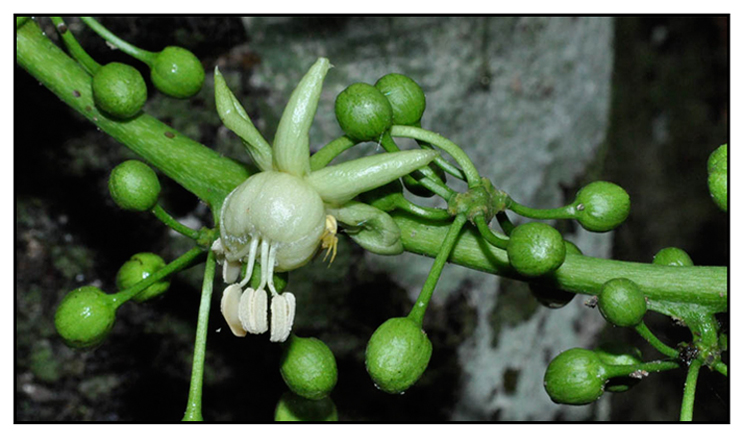
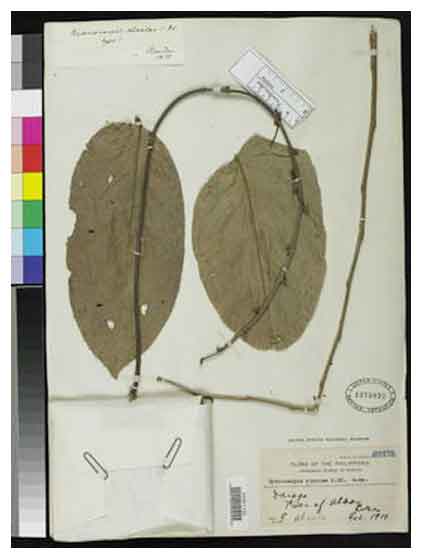
• Dudoa is a small tree reaching a height of 5 meters. Leaves are oblong-ovate or oblong, 20 to 25 centimeters long, 9 to 11 centimeters wide, entire and smooth, with pointed tip and somewhat rounded base. Flowers are yellowish, about 3 centimeters across
, borne on simple racemes on the trunks and branches which are about 50 centimeters long. Sepals are five, ovate, about 1.2 centimeters long, and smooth. Petals are five, elliptical, about 0.8 centimeter long, and hairy on the margins. Fruit is large, hard, woody, brownish, smooth, obovoid, 20 to 25 centimeters long, and 10 to 14.5 centimeters wide, containing 80 to 90 oblong-elliptic or ovoid seeds which are dull brown with gray longitudinal stripes, which are about 3 centimeters long and embedded in whitish pulp.
Distribution
- An endemic species in forests at low altitudes in Albay Province, Luzon.
- Most ravines at low elevations.
- Cultivated in Laguna and other provinces.

- Considered a "Threatened" plant in the Philippines.
- IUCN listed as Endangered.

Constituents
- Seeds yield 65.5% fixed oil.
- More than 90% of the free acids consists of chaulmoogric acid, with palmitic acid making up most of the remaining portion, with only traces of oleic acid. (11)
- Seed coat yields 3.73% of resin acid.

- Study yielded two naphthol esters of chaulmoogric acid and 2 chaulmoogryl naphthlamines.
- Study of nuts and oil yielded: average weight of fruit 420 gms; hulls 59.68%; seeds, do 40.32; moisture in seeds, do 60.50; oil in dry seeds, do 65.50, melting point, 52 degrees; specific gravity at 30° C, 0.9502; iodine value (Hanus) 93.10; saponification value, 188.90. (4)
- Study of freed acids of the oil yielded: melting point, 59°; specific gravity at 30°m 0.9342; iodine value (Hanus) 98.6; acid value cc. 0.1N alkali 37.4; saponification value 193.0. (4)

Properties
- Irritating property of the oil may come from the resins.
- Wound healing.
- Studies have suggested wound healing, antibacterial properties.

Parts used
Oil, seeds, leaves.

Uses

Edibility
- No report found on edibility.
Folkloric

- Hydnocarpus oil and its derivatives were once used extensively for the treatment of leprosy.
- Oil extracted from seeds used for wound healing.
- Chaulmugra oil once used in the treatment of laryngeal tuberculosis for the relief of pain and dysphagia. (7)

-
Others
- Ayurvedic uses:
Ayurvedic uses of Chaulmoogra oil include: (1) Ringworm/Tinea corporis: 10cc of Chaulmoogra oil mixed with 50 g of Vaseline or oil mixed with butter is applied to affected area. (2) Leprosy: Oil used topically and orally. (3) Blood vitiation: 5 drops of oil orally with butter. (4) Itching: Oil diluted with castor oil applied externally.

Studies
Chaul-moogryl Derivatives:
Chaulmoogra oil obtained from Hydnocarpus alcalae yielded double esters chaulmogrul methyl lactate, chaulmoogruyl ethyl lactate, chaulmoogrul n-butyl salicylate. The double esters decomposed in hot weather, needling cool storage. (1) Study has stated that more than 90% of free acids from the oil of Hydnocarpus alcalae C. DC. consists of a compound identical in properties with chaulmoogric acid. (Brill, Harvey, 1916) (10)
Oil of Hydnocarpus / Antileprotic / Wound Healing / Incision Wound and Dead Space: Anecdotal reports have claimed that leprosy patients who used hydrocarpus oil capsules exhibited more rapid wound healing. Study evaluated the effect of oil of hydnocarpus in wounds experimentally inflicted on male Wistar rats. In the incision model, there was a significant increase in body weight and strength of scar tissue, while in the dead space model there was increased strength of collagen tissue and hydroxyproline content. Results showed oil of hydnocarpus, besides antileprotic activity, may have adjunctive benefits in wound healing in leprosy patients. (2)
Effect of Hydnocarpus Oil on Excision Wounds: Study concluded the use of oil in the excision wound model topically (alone or as a paste) or administered orally promoted epithelization without affecting wound contraction. (3)
• Chaulmugra Oil for Laryngeal Tuberculosis: An JAMA article in January 1922 reported on the experience of the author with chaulmugra oil in the treatment of laryngeal tuberculosis: (1) The chief value of chaulmugra oil is relief of pain and dysphagia. (2) Relief is continuous, in contrast to that produced by cocaine. (3) There is no untoward side effects to the larynx, and can be used with previous cocainization. (4) Improvement seems better compared to other drugs. (7)
• Chaulmoogra Oil: Chaulmoogra oil is a fixed oil obtained from fresh ripe seeds of Hynocarpus species. H. wightiana is the major source of chaulmoogra oil. The fixed oil is characterized by the presence of cyclopentenyl fatty acids (CFAs), hydnocarpic, chaulmoogric and gorlic acids as major constituents. Studies on the oil and isolated acids have showed potential activity against Mycobacterium leprae and was effective in treating early cases of leprosy. Study reviews the literature on chaulmoogra oil, use, chemistry, and pharmacology. (8)
• Silver Nanoparticles / Antibacterial / Leaves: Study reports on a one-step green, cost-effective synthesis of silver nanoparticles using Dudoa leaf extract as reducing and stabilizing agent. The AgNPs showed complete inhibitory and mild reactivity against representative pathogenic Gram(+) (S. aureus) and Gram(-) (E. coli) bacteria. (9)

Availability
Wild-crafted.

Updated  May 2025 / April 2019 / March 2015
October 2013

PHOTOS / ILLUSTRATIONS
IMAGE SOURCE: Hydnocarpus alcalae / Flower / Copyright © 2014 by Danilo Tandang (contact: pieter.pelser@canterbury.ac.nz) [ref. DOL81226] / Non-Commercial Use / Click on image or link to go to source page / Phytoimages.siu.edu
OTHER IMAGE SOURCE: / Photo / 00114654.tif © Smithsonian Institution, National Museum of Natural History, Department of Botany / Oct 18, 2012 / Supplier: National Museum of Natural History Image Collection / Creator: Ingrid P. Lin / Location Created: Darago., Luzon, Hundred Islands, Albay, Philippines, Asia-Tropical / EOL
OTHER IMAGE SOURCE: Hydnocarpus alcalae / Flower close- up / Copyright © 2014 by Danilo Tandang (contact: pieter.pelser@canterbury.ac.nz) [ref. DOL81221] / Non-Commercial Use / Click on image or link to go to source page / Phytoimages.siu.edu

Additional Sources and Suggested Readings
(1)
Chaul-moogryl derivatives of lactates and salicylates / West, A. P. / Philippine Jour Sci: 405-409, 1928
(2)
Effect of oil of hydnocarpus on wound healing. / Oommen ST, Rao M, Raju CV. / Int J Lepr Other Mycobact Dis. 1999 Jun;67(2):154-8.
(3)
The Effect of Oil of Hydnocarpus on Excision Wounds / T. Oommen, B.Sc., M.D. / International Journal of Leprosy
(4)
A CHEMICAL INVESTIGATION OF THE SEEDS OF PANGIUM EDULE AND OF HYDNOCARPUS ALCALDE l / Harvey C. Brill / Philippine Journal of Sciences, 1917; 12(37)
(5)
Hydnocarpus: An ethnopharmacological, phytochemical and pharmacological review / Manas Ranjan Sahoo, S P Dhanabal, Atul N Jadhav, Vishali Reddy, Ganesh U V Babu, Paramesh Rangesh /
Journal of Ethnopharmacology, 2014; 154: pp 17-25
(6)
A REVIEW ON PHARMACOLOGICAL ACTIVITY OF HYDNOCARPUS WIGHTIANA
/ Lija Johny, Bhat AR, Sandhya S, Kavitha MP, Krishnakumar K / World Journal of Pharmaceutical Research, 2015; 4(8): pp 605-610
(7)
Chaulmugra Oil in the Treatment of Laryngeal Tuberculosis / Dr. G. M. Van Poole, Honolulu / Jan 1922 / Read before the Fourth Annual Meeting, Hawaii Territoriaal Mecdical Association, April 27, 1929 / Laryngoscope, 1932: 40(2): pp 132-139 / https://doi.org/10.1288/00005537-193002000-00010
(8)
Chemistry and Therapeutic Potential of Chaulmoogra Oil / Rameshkumar Koranappallil B / Hisham Abdulkhader, P G Latha / Book: Recent Progress in Medicinal Plants. Vol. 33. Fixed Oils and Fats of Pharmaceutical Importance
(9)
A pharmacognostical study on the fruit and seed of Hydnocarpus alcalae C. DC. / Vallarta MT / Naat Appl Sci Bull., 1936
(10)
The chaulmoogra tree and some related species : a survey conducted in Siam, Burma, Assam, and Bengal / Wm. A, Taylor / United Sttes Department of Agriculture, Bull No 1057
(11)
Chemistry of Leprosy Drugs / Howard Irving Cole / Internatiional Journal of Leprosy, April 1933; 1(2)
(12)
Green Synthesis, Characterization and Antimicrobial Activity of Silver Nanoparticles Using Dudoa (Hydnocarpus alcalae C.DC.) Leaf Extract As a Reducing and Stabilizing Agent / Edward  Kevin B Bragais, Lynne M Labaclado / Current Nanomaterials, 2019; 4(2)
(13)
Hydnocarpus / Wikipedia
(14)
A Review on Formulation Development using Chaulmoogra Oil / Nishigandha D Naikawadi, Mayuri C More et al / Research Journal of Pharmacognosy and Phytochemistry, 2023; 15(4): pp 311-318 /
DOI: 10.52711/0975-4385.2023.00049
(15)
Hydnocarpus alcalae / KEW: Plants of the World Online

DOI: It is not uncommon for links on studies/sources to change. Copying and pasting the information on the search window or using the DOI (if available) will often redirect to the new link page. (Citing and Using a (DOI) Digital Object Identifier)

                                                            List of Understudied Philippine Medicinal Plants
                                          New plant names needed
The compilation now numbers over 1,500 medicinal plants. While I believe there are hundreds more that can be added to the collection, they are becoming more difficult to find. If you have a plant to suggest for inclusion, native or introduced, please email the info: scientific name (most helpful), local plant name (if known), any known folkloric medicinal use, and, if possible, a photo. Your help will be greatly appreciated.

HOME      •      SEARCH      •      EMAIL    •     ABOUT