Gen info
- Decaspermum is a genus of the botanical family Myrtaceae, first described as a genus in 1776. It is native to China, Southeast Asia, and various islands in the Pacific Ocean. (13)
Botany
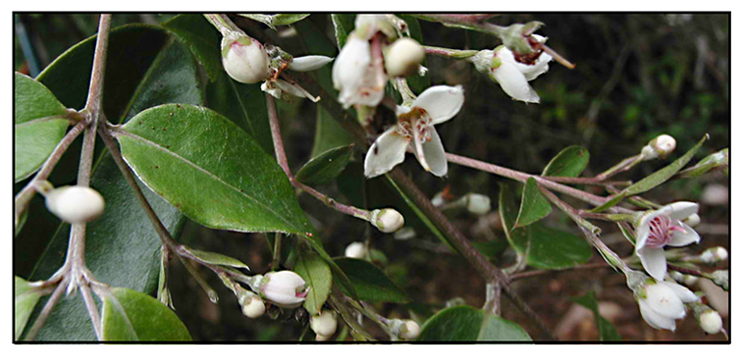
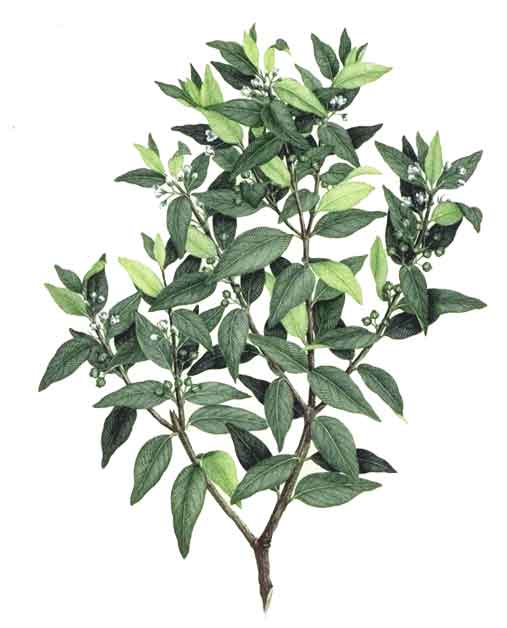
Daniri is an erect shrub or small tree. Leaves are opposite, ovate or lanceolate-ovate, up to 8 centimeters or more in length, 1 to 3 centimeters in width, pointed or blunt at the base, pointed at the tip, smooth when old, and often silky beneath when young. Flowers are white or pink and borne on terminal panicles or from the upper leaf axils, with numerous anthers in a ring around the center. Fruit is rounded, flattened, 5 to 8 millimeters thick, and terminated by the calyx crown which turns red when ripe.
 Distribution Distribution
- Common throughout the Philippines in all or most islands and provinces, in thickets and secondary forests from sea level to an altitude of 2,000 feet.
- Also occurs in India and China through Malaya to tropical Australia and Polynesia.
Constituents
- Phytochemical screening yielded terpenoids, phenols, steroids, and flavonoids.
Properties
- Astringent, antidysenteric.
- Studies have shown ligand binding inhibition and anti-babesial activity.
Parts used
Leaves, sap, fruits.
Uses
Edibility
- In Java and Sumatra, sweetish berries are eaten.
- In Java, terminal shoots are used as seasoning.
Folkloric
- In the Philippines, fruit is used as a remedy for stomach pains.
- Sap of branches used as remedy for sore eyes. Heated leaves applied to axe or knife wounds.
- Leaves are chewed with betel for dysentery.
- Astringent leaves are chewed for helping the teeth become firm.
- An ingredient in the preparation of Tongan oil for massage - the pounded endocarp of nuts of Aleurites moluccans with the leaves or flowers of M. denticulatum, Decaspermum fruticosum, Cinnamomum spp, and C. amboinicus in the oil of grated coconut. (7)
- In the swamp areas in Narathivas province of Thailand, fresh leaves mixed with other herbs, crushed into a small ball and swallowed, given after uterotonic and to decrease ochia after giving birth. (8)
- In Malaysia,
roots of F. fruticosum mixed with leaf and root of Ixora elliptica are boiled and infusion drunk to treat warm body and fatigue. Decoction also used as a bath. (10)
- In Borneo, leaves chewed with betel nuts to treat dysentery, swollen gums, and to make the teeth firm; fruits used as remedy for stomach pains. (11)
- In Indonesia, used as cold medicinal: decoction of boiled leaves drunk and used for bathing. (6) Leaves used for dysentery and malaria.
(14)
Studies
• Inhibitory Activity on Ligand Binding on 5HT1a Receptors: Study evaluated 185 plant samples from 30 plant families from Malaysian forests on its ability to inhibit specific radioligand binding to 5HT1a, GABA)B), and dopamine (D25) receptors. In preliminary screening, 23 plant extracts showed activity, and of these, seven, including Decaspermum friuticosum extract from bark, were reconfirmed to be active on 5HT1a receptor. None showed activity against either GABA(B) or D25 receptors. (2)
• Anti-Babesial Activity: Canine babesiosis is a tick-borne disease of wild and domestic dogs caused by intraerythrocytic parasites, Babesonia gibsoni and B. canis. Study evaluated 45 plants extracts for in vitro antibabesial activity. Twenty-one extracts, including D. fruticosum leaves, showed antibabesial activity with IC50 baluyes ≤ 62.5µg/ml. (3)
• Anti-Inflammatory / Antiasthma / Pharmaceutical Composition: This invention relates to a pharmaceutical composition for the prevention and treatment of inflammatory disease or asthma with the extract of Decaspermum as active ingredient. The extract inhibited the increase of eosinophils in bronchoalveolar lavage fluid of the ovalbumin-induced asthma animal model, with inhibition of secretion of immunoglobulins and chemokine (Eotaxin) in BAL fluid and blood, and inhibition of secretions of NO and TNF-α in macrophages. (5)
• Secretory Structure: Study sought to identify the secretory structure of plants used as stimulant and chemical compounds accumulated in it. Results showed idioblast cells and secretory cavities were found in leaves of Decaspermum fruticosum and P. rumphii. Most idoblast cells contain lipophilic substances and terpenoids or alkaloids, while secretory cavity contained alkaloids. Phytochemical analysis yielded terpenoids, phenols, steroids, and flavonoids, (6)
• Muscarinic Receptive Activity Inhibition: Muscarinic receptor binding was tested on 224 plant extracts from 50 plant families found in Malaysia. Extracts were dissolved in 50% DMSO for a concentration of 2 mg/ml. Activation of muscarinic receptors in the periphery causes decrease in heart rate, relaxation of blood vessels, airway constriction, increase in secretions, increase in lacrimal sweat glands, among others. Bark of Decaspermum fruiticosum showed 2+ inhibition equivalent to 40-60% inhibition. (9)
• Anti-Inflammatory / Anti-Asthma / Invention: Invention relates to a pharmaceutical composition for preventing and treating inflammatory disease and asthma containing an extract of Decaspermum fruiticosum, which suppressed increase of eosinophils in bronchoalverolar lavage fluid in an ovalbumin-induced asthmatic animal model, and confirmed to suppress immunoglobulin secretion and chemokine secretion in alveolar lavage fluid and blood, and suppress macrophage NO and TNF-α secretion. (12)
Availability
Wild-crafted.
|


