 |

Family • Gentianaceae
Chang-bato
Canscora diffusa (Vahl) R. Br. ex Roem. & Schult.
KILWAR
Pu di chuan xin cao
| Scientific names | Common names |
| Canscora decurrens Daizell | Chang-bato (Tag.) |
| Canscora diffusa (Vahl) R. Br. ex Roem. & Schult. | Kobamba (Tag.) |
| Canscora diffusa var. tenella C.B.Clarke | Maliñgal (Tag.) |
| Canscora divaricata Miq. ex C.B.Clarke | Malenggal (Tag.) |
| Canscora foliosa D. Don | Tsamg-bato (Tag.) |
| Canscora khandalensis Santapau | |
| Canscora kirkii N.E.Br. | |
| Canscora lancifolia Miq. ex C.B.Clarke | |
| Canscora lauri C.B.Clarke | |
| Canscora lawii Wight | |
| Canscora pusilla Schult. & Schult.f. | |
| Canscora rubiflora X.X.Chen | |
| Canscora sanjappae Diwakar & R.Kr.Singh | |
| Canscora tenella Wall. ex Wight | |
| Cobamba dichotoma Blanco | |
| Exacum diffusum (Vahl) Willd. | |
| Exacum erectum (R.Br.) Roth | |
| Exacum tenellum Wall. | |
| Gentiana diffusa Vahl | |
| Orthostemon erectus R. Br. | |
| Orthostemon huegelii Griseb. | |
| Orthostemon kirkii N.E.Br. | |
| Pladera virgata Roxb. | |
| Pladera pusilla Roxb. | |
| Striga esquirolii H. Lév. | |
| Canscora diffusa (Vahl) R.Br. ex Roem. & Schult. is an accepted species. KEW: Plants of the World Online | |
| Other vernacular names |
| BENGALI: Dhankuni. |
| BURMESE: Kyoukpan. |
| CHINESE: Pu di chuan xin cao. |
| HINDI: Bhuin neem. |
| INDIA: Janjada, Banbana, Sankihvel, Titavi, Yavotchi, Zinku, Zinku kariatu, Shankhupuhi. |
| MADAGASCAR: Kifiofio. |
| MALAYALAM: Jeerakapullu. |
| MARATHI: Kilwar. |
| SANSKRIT: Sankhapushpi. |
| VIETNAM: Can tran, Buom buom tran. |
Gen info Botany
Constituents Properties Availability |
© Godofredo U. Stuart Jr., M.D. / StuartXchange |

Updated May 2023 / July 2018 / September 2015

 |
PHOTOS / ILLUSTRATIONS |
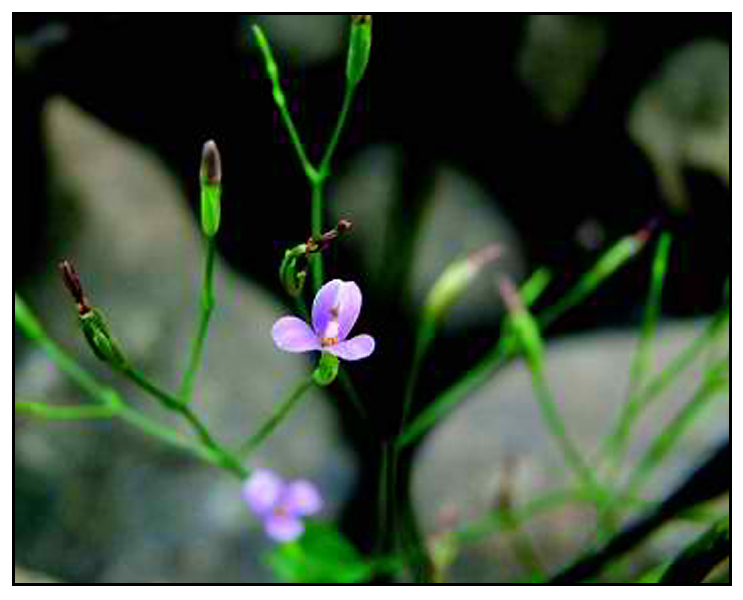
| IMAGE SOURCE: Canscora diffusa/ Close-up flower / Marco Schmidt / 2010 / Creative Commons Attribution 3.0 Unported (CC BY 3.0) / Keystone Foundation / India Biodiversity Portal |
| IMAGE SOURCE: Canscora diffusa from a riverbed in SE Burkina Faso / File:Canscora diffusa MS 10577.jpg / Marco Schmidt / 2010 / Creative Commons Attribution / click on image to go source page / Wikipedia |
Additional
Sources and Suggested Readings |
• |
DOI: It is not uncommon for links on studies/sources to change. Copying and pasting the information on the search window or using the DOI (if available) will often redirect to the new link page. (Citing and Using a (DOI) Digital Object Identifier) |
| List of Understudied Philippine Medicinal Plants |
• |
 |
|
