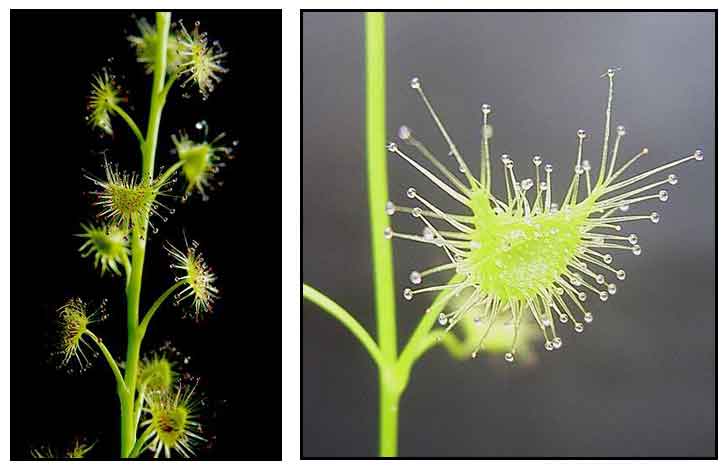
 Gen info Gen info
Genus Drosera Vahl, popularly known as Sundews, is one of the largest genuses of carnivorous plants with over 105 species belonging to the family Droseraceae. The species use mucilage-secreting glandular hairs to trap prey.
The earliest documented use of Drosera species dates back to the 12th Century, when Matthaeus Platearius, an Italian physician, described it use as a cough remedy.
Botany
Bain is a perennial tuberous herb. The tuber is usually 4-6 centimeters under the soil surface. Aerial parts are 5 to 50 centimeters high. with erect, leafy stem, 8 to 25 centimeters high. Leaves are alternate, long-petioled, lunate-peltate, more evident at the soil surface. Flowers are usually white, but may be variable in color. Sepals are ovate, smooth, erose or fimbriate. Seeds are obovoid, with prominently reticulated fascia.
Distribution
- Common in Bontoc and Benguet Subprovinces, and Zambales Province in Luzon.
- On open, grassy slopes, in thin pine forests, at an altitude of from 1,000 to 1,800 meters.
- Also occurs in India to Japan, and southward to Tasmania.
Constituents
- Leaf extract yields a proteolytic enzyme.
- Study of leaves yielded three naphthoquinones (plumbagin, droserone, hydroserone) together with four flavanols (quercetin, gossypetin, gossypin, isogossypetin) and proteolytic enzymes of the pepsin type (Yoganarasimhyan, 2002).
- Study yielded five crystalline compounds were obtained and elucidated as plumbagin, droserone, hydroxydroserone, beta-sitosterol, and stigmasterol.
(9)
- Chemical study of D. peltata var. multisepala isolated 11 compounds: isoshinanolone-4-O-beta-D-glucoside (1), isoshinanolone (2), epi-isoshinanolone (3), plumbagin (4), droserone (5), droserone-5-O-glucoside (6), quercetin (7), kaempferol (8) , gossypetin-8-O-glucoside (9), 3,3'-dimethoxy ellagic acid (10), and ellagic acid (11).
(14)
Properties
- Bitter, acrid, and caustic flavor.
- Leaves have an insectivorous property.
- Considered alterative, anodyne, blood tonic, carminative, rubefacient, antifertility.
- Studies have shown antimicrobial, bronchodilatory, anticancer, antioxidant properties.
Parts used
Leaves, aerial parts.
Uses
Folkloric
- Igorots dry and powder to leaves to place in the cavity of aching teeth.
- Plant is used in phthisis.
- Used for asthma, hoarseness, and whooping cough.
- In Kumaon, crushed leaves, with or without salt, used as blistering agent. The same practice is done in Kanawar, with the use of salt.
- Vaidyas use the plant for reducing gold to powder. A gold coin is enclosed in plant paste, the burned thoroughly, reducing the gold to powder; the powder is used in grain doses as tonic and antiseptic. Drug also used for phthisis.
(8)
- Resin from plant used in bronchitis and whooping cough.
- In India, used in making gold bhasma which is considered antisyphilitic, alterative and tonic.
- Plant used as antisyphilitic. (11)
- In Chinese medicine, used for the treatment of rheumatism and bruises
Studies
• Antimicrobial / Caires / Periodontitis / Aerial Parts: A chloroform extract of the aerial parts of Drosera peltata showed the most significant antimicrobial activity against oral bacteria. Results suggest DP could be used in the treatment of oral infectious diseases like dental caries and periodontitis. (1)
• Constituents: Study of whole plant of D. peltata var. lunata yielded five crystalline compounds: plumbagin, droserone, hydrodroserone, beta-sitosterol and stigmasterol.
• DCBT1234-Lung KR / Respiratory Benefits / COPD: In a randomized, double-blind, placebo controlled clinical study comparing 6 months of a plant based formulation of 3 herbs (Bryonia alba, Drosera peltata, and Cephaelis ipecacuanha) against a combination of oral salmeterol, theophylline and bromhexine (STB) and both against placebo, patients treated with DCBT 1234-Lung KR showed statistically significant (95%) improvement in FEV1 and PaO2 (oxygen) compared with STB in control of symptoms such as shortness of breath, wheezing, cough, expectorations, disability and sleep disturbances. (6)
• COPD: Using FEV1 and arterial blood gases values, DCBT1234-Lung KR was equivalent, if not better than present day treatment with salbutamol, theophylline and bromhexine combination in COPD. (5)
• Anticancer / Antioxidant: Study assessed the in vitro antioxidant and anticancer properties of Drosera peltata. Aqueous extract showed considerable antioxidant antioxidant activity as in metal chelating assay with IC50 of 28.46±0.7 mcg/ml in hydroxyl radical scavenging assay. Higher doses of ethanol and aqueous extracts showed significant cytotoxic effects on DAL (Daltons's Ascitic Lymphoma) and EAC (Ehrlich Ascitic Carcinoma) LDH leakage assay model. (12)
Availability
- Wild-crafted.
- Ingredient of many cough preparations.
- A solitary or an ingredient of 200-300 registered medications.
|


