 |

Family • Apocynaceae
Tulus-baybay
Sungay-kambing / Kalak-kambing
Finlaysonia obovata Wallich
GOAT'S HORN / OVAL FINLAYSONIA
| Scientific names | Common names |
| Finlaysonia obovata Wallich | Tulus-baybay (Hanunoo) |
| Gurua obovata (Wall.) Buch.-Ham. ex Voigt | Oval finlaysonia (Engl.) |
| Tabernaemontana cirrhosa Blanco | Oval tree fern (Engl.) |
| Finlaysonia obovata Wall. is an accepted species. KEW: Plants of the World Online | |
| Note: PROSEA includes Finlaysonia maritima Backer ex Heyne as a synonym. |
|
| Other vernacular names |
| INDIA: Khasai lata (Odissa). |
| INDONESIA: Kalak kambing, Oyod kambing. |
| MALAYSIA: Pelir kambing. |
| THAILAND: Kraphopla. |
| VIETNAM: Phin lai son. |
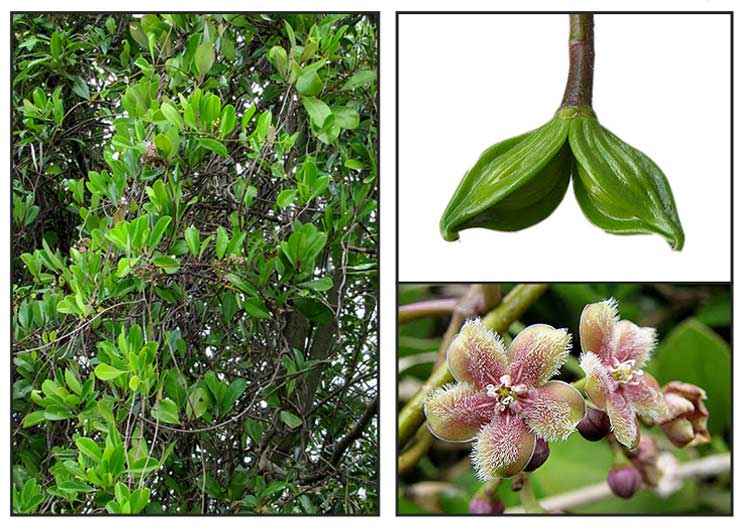 |
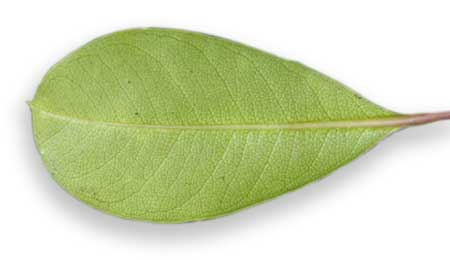
Gen info • Woody liana with white latex, up to 5 m long, bark papery. Leaf-blade obovate-oblong to elliptical, 4-15 cm × 2-8 cm, coriaceous, glabrous; petiole 1-2 cm long. Fruit a widely divergent pair of follicles; follicle ovoid, 5-8 cm long, ribbed, hooked acuminate at apex. (PROSEA) (5)
Properties
- Leaves exude a white sap when broken. - Studies have suggested antibacterial properties. Parts used 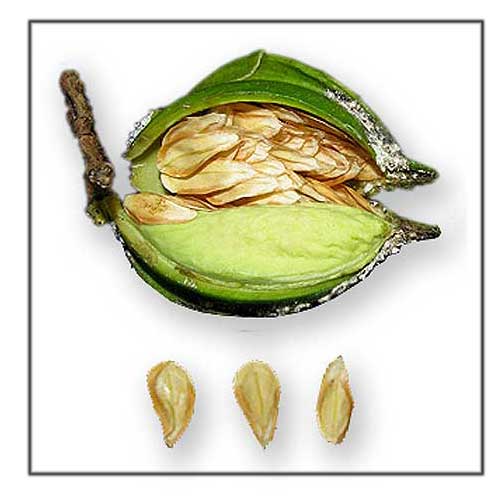 Roots, leaves. Uses Edibility - In the Moluccas salty leaves are eaten raw or eaten in salads. Folkloric - No reported folkloric medicinal use in the Philippines. - In Bangladesh, folk medical practitioners use the roots of F. obovata for treatment of headache: Dried roots of F. obovata and Tamarindus indica, plus roots of Bambusa vulgaris that sprout along its nodes, are put in a bag following drying and tied to the head. Another polyherbal formulation containing F. obovata along with roots of Phyllanthus reticulata and Musa paradisiaca is taken orally for treatment of diarrhea in children. (9) Others - Host: It is a larval host plant of blue tiger and dark blue tiger butterflies. (3) Studies • Antibacterial / Leaves: Study of evaluated the antibacterial activity of hexane, chloroform, and alcohol extracts of leaves of F. obovata against fresh water fish pathogenic bacteria viz., Aeromonas hydrophila, Pseudomonas aeruginosa, Vibrio alginolyticus, Staphylococcus aureus, Escherichia coli, Edwarsiella tarda and Micrococcus sp (multidrug-resistant strain) by disc assay method. The hexane and chloroform extracts showed activity against four and five pathogens, respectively. (see constituents above) (6) Availability |
March 2026

 |
PHOTOS / ILLUSTRATIONS |
| IMAGE SOURCE: Kalak kambing (Finlaysonia obovata) / © Ron Yeo / Non-commercial use / Image modified / Click on image or link to go to source page / The Tide Chaser |
| OTHER IMAGE SOURCE: Finlaysonia obovata Leaf and splitting fruit / © uforest.org / Non-commercial use / Images modified / Click on images or link to go to source page / URBANFOREST |
| OTHER IMAGE SOURCE: Finlaysonia obovata splitting fruit and seeds / © Teo Siyang / Non-commercial use / Images modified / Click on images or link to go to source page / FloraofSingapore |
Additional
Sources and Suggested Readings |
• |
DOI: It is not uncommon for links on studies/sources to change. Copying and pasting the information on the search window or using the DOI (if available) will often redirect to the new link page. (Citing and Using a (DOI) Digital Object Identifier) |
| List of Understudied Philippine Medicinal Plants |
| New plant names needed The compilation now numbers over 1,750 medicinal plants. While I believe there are hundreds more that can be added to the collection, they are becoming more difficult to find. If you have a plant to suggest for inclusion, native or introduced, please email the info: scientific name (most helpful), local plant name (if known), any known folkloric medicinal use, and, if possible, a photo. Your help will be greatly appreciated. |
• |
 |
|
