HOME    •    SEARCH      •      EMAIL    •     ABOUT  •     DONATE


Family • Asteraceae
Sticky daisy
Adenostemma viscosum J.R.Forst. & G.Forst.
DUNG WEED
Xia tian ju

Scientific names Common names
Adenostemma dregei DC. Dung weed (Engl.)
Adenostemma erectum (Sw,) DC. Sticky daisy (Engl.)
Adenostemma fastigiatum (Blume) DC.  
Adenostemma glutinosum (Gaudich.) DC.  
A. lavenia var. viscosum (J.R.Forst. & G.Forst.) M.R.Almeida  
Adenostemma leiocarpum DC.  
Adenostemma natalense DC.  
Adenostemma ovatum Miq.  
Adenostemma perrottetii DC.  
Adenostemma rivale Dalzell  
Adenostemma tinctorium Cass.  
Adenostemma viscosum J.R.Forst. & G.Forst.  
A. viscosum var. angustifolium Edgew. ex C.B.Clarke  
Ageratum strictum Sims  
Ethulia aquatica Roxb. ex DC.  
Lavenia alba Wall.  
Lavenia carnosa Wall.  
Lavenia divaricata Buch.-Ham. ex DC.  
Lavenia erecta Sw.  
Lavenia fastigiata Blume  
Lavenia glutinosa Gaudich.  
Lavenia latifolia Spreng.  
Lavenia nudiflora DC.  
Lavenia viscida Buch.-Ham.  
Spilanthes tinctoria Lour.  
Adenostemma viscosum is an accepted species. KEW: Plants of the World Online
Note: Adenostemma viscosum and Adenostemma lavenia are separate and distinct speciies.

Other vernacular names
BENGALI: Buro-keshubi.
CHINESE: Xia tian ju, Ma zhi hu.
FRENCH POLYNESIA: Vaianu.
GERMAN: Färbende Fleckblume.
HAWAIIAN: Kamanamana.
INDONESIAN: Rumput babi.
JAPANESE: Numa-daikon.
MALAYSIA: Rumput tahi babi.
KOREAN: Mul meo wi
SPANISH: Mama juana.
THAI: Yieo muu.
VIETNAMESE: Co hoi hoa trang.

Gen info
- Asteraceae is a large family of flowering plants consisting of over 32,000 known species in over 1,900 genera within the order Asterales. The number is rivaled only by Orchidaceae. It was first described in 1740 under the name Compositae. The family is commonly known as aster, daisy, composite, or sunflower family. (9)
- Adenostemma is a genus of flowering plants in the Asteraceae family, first described as a genus in 1775. As of 2020, POWO has 23 accepted species.
- Adenostemma viscosum was first described by J.R.Forster and G. Forster in 1776.
- Etymology: The genus name Adenostemma derives from Greek roots aden (gland) and stemma (crown). The specific epithet viscosum means "viscid" or "sticky", referring to the sticky seed pappus awns (bristly seeds) that aid animal dispersal. The Hawaiian name Kamanamana literally means "the many-branched one" or "the one of great power." (5)

Botany
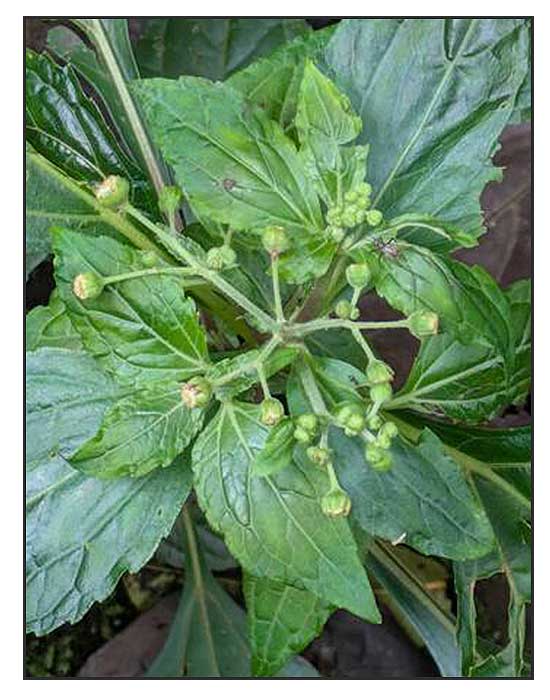
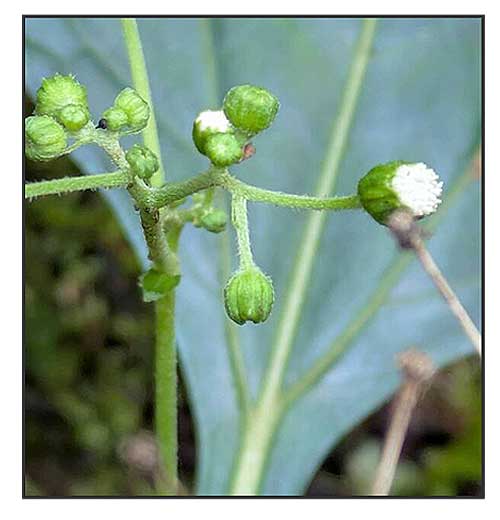
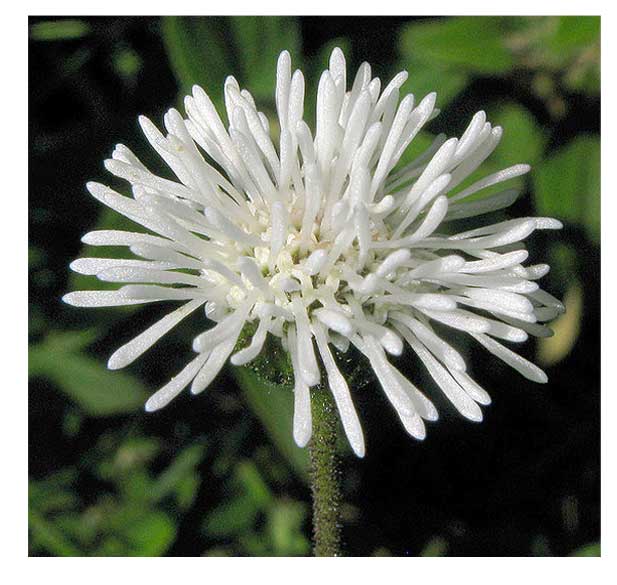
• Adenostemma viscosum are perennial shrubs 5-10 dm (19-40 in.) tall. Stems are upright, often red-tinged, and covered in glandular, purplish hairs. Leaves are glabrous, opposite, simple, ovate to rhombic, 5–20 cm (ca. 2-8 in.) long and 1.5-8 cm (ca. .5-3 in.) wide, with coarsely serrated, gland-tipped margins. Kāmanamana has small white flower heads (capitula) measuring about 5 mm (ca. 0.19 in.) in diameter, often in lax terminal clusters (paniculate corymbs). Achenes (fruits) are brown, sticky, tuberculate, 2-3 mm long, with a persistent, warty pappus [Wagner et al. 1990,Lyon Arboretum]. The sticky plant, sometimes with extremely sticky fruits are in fact one of the defining characteristics of this native plant and specific epithet viscosum reflects this. (5)

• Stems - erect, fleshy, smooth, hairless,sparsely branched, sometimes rooting from lower nodes. Leaves - thin, opposite, the upper ones alternate, oblong to broadly ovate, and 5 to15 cm long, with a pointed apex, and entire or scalloped margins. Flowers - very small and white, with the corolla hairy near the mouth. Inflorescence is lax, the heads 5-7 mm in diameter. Fruit - an achene, obovate-oblong, irregularly triangular, 2.5-4 mm x 1 mm, glandular when young, after wards glabrous or warty, crowned with a pappus consisting of a few clavatesetae, usually thickened at the top and glandular.
(SOCFINDO CONSERVATION)

Distribution
- Native to the Philippines. (1) (2)
- In open wet places along streams, forests, and thickets.
- In Babuyan isls, Camiguin, Catanduanes, Culion, Palawan, Panay; in Luzon: Abra, Bataan, Benguet, Bulacan,Cagayan, Ilocos Norte, Laguna, Mountain Province, Nueva Viscaya, Quezon, Zambales; in Mindanao: Cotobato, Davao del Norte. (2)
- Also native to
Andaman Is., Assam, Benin, Burkina, Burundi, Cambodia, Cameroon, Cape Provinces, Caroline Is., Central African Republic, China South-Central, China Southeast, Comoros, Congo, DR Congo, East Himalaya, Eritrea, Ethiopia, Fiji, Gabon, Ghana, Guinea, Guinea-Bissau, Gulf of Guinea Is., Hainan, Hawaii, Ivory Coast, Japan, Jawa, Kazan-retto, Korea, KwaZulu-Natal, Laos, Liberia, Madagascar, Malawi, Malaya, Maldives, Mali, Marquesas, Mauritius, Mozambique, Myanmar, Nansei-shoto, New South Wales, Nicobar Is., Nigeria, Niue, Northern Provinces, Pakistan, Queensland, Samoa, Senegal, Sierra Leone, Society Is., South China Sea, Sudan-South Sudan, Taiwan, Thailand, Togo, Tokelau-Manihiki, Tuamotu, Tubuai Is., Vietnam, West Himalaya, Zambia, Zimbabwe. (1)
- Native range is Tropical to Subtropical Old World to Australia. An annual or subshrub that grows primarily in the wet tropical biome. (1)

Constituents
- In a study of branch and leaf extracts from 36 species for essential oil, A. viscosum yielded higher values than other species: essential oils (1.239%), along with quercetin (0.67%). (8)

Properties
- Kamanamana readily produces very sticky seeds from unopened flowers, which quickly develop and are sown on the spot with other shade-loving plants, with no further attention to cultivation.

Parts used
Roots, stems, leaves.

Uses

Edibility
- Leaves eaten as vegetable; bitter, always eaten with other vegetables.
Folkloric
- No reported folkloric medicinal use in the Philippines.
- Whole plants use for treatment of lung congestion, pneumonia, edema, and inflammation.
- Stems and leaves used as antiscorbutic. Leaves used for treatment of palpitations, dysuria, toothache, aphthae, and sore throat. Used for post-partum infections. Leaves chewed for treatment of dysentery; combined with leaves of Centella asiatica and Phyllanthus urinaria, used against colic. Boiled leaves rubbed on skin for itches and infected sores, and on the whole body for fever. Leaf lotion used to arrest baldness. Paste of leaves used as poultice on sun-burnt skin, and applied to boils and ulcers to facilitate ripening. Fresh plant juice used for ear infection. (3)
- Pounded combination with leaves of Mimusops elengi and bark of Baccaurea mtleyana used for treatment of sore eyes. Root decoction drunk for stomach aches. Roots are chewed alone or with Piper betle leaves and ginger against cold. (3)
- In French Polynesia, used for treatment of wounds, abscesses, bronchitis, cough, menstrual and postpartum problems, and various skin afflictions. (4)
- In Hawaii, infusion of leaves used for treatment of fevers. (5)
- In India, fresh plant juice used for treatment of pneumonia, fever, and diarrhea; as emetic and disinfectant. (6)
- In Malaysia, Leaves and stems used for treatment of headaches and sinusitis. Leaf extracts used to prevent postpartum infections. Root decoction used for treatment of stomachaches. In French Polynesiaused for headaches, vertigo, sinusitis, and migraines. (7)
Others

- Dye: Plant is source of a blue dye. (3)

Studies
• Essential Oil / Branch and Leaves:
In a study of 36 species in 23 genera of family Asteraceae, Adenostemma viscosum yielded the higher essential oils in the branch and leaf extracts than other species. It's high value of essential oils (1.239%), along with quercetin (0.67%), make it a potential source of bioactive ingredients for foods, pharmaceutical and medicinal products. (8)

Availability
- Wild-crafted.


November 2026

                                                 PHOTOS / ILLUSTRATIONS
IMAGE SOURCE: Adenoma viscosum / © Kevin Faccenda / CC BY 4.0 International / Some rights reserved / Images modified / Click on image or link to go to source page / iNaturalist
IMAGE SOURCE: Adenoma viscosum - close-up of flower / © Robert V Bittersdorff / Non-commercial use / Click on image or link to go to source page / TropicalTheFerns

Additional Sources and Suggested Readings
(1)
Adenostemma viscosum / KEW: Plants of the World Online
(2)
Asteraceae: Adenostemma viscosum / Co's Digital Flora Database
(3)
Adenostemma viscosum / Ken Fern: Tropical Plants Database / Useful Tropical Plants
(4)
Antimicrobial Properties of Compounds Isolated from Syzygium malaccense (L.) Merr. and L.M. Perry and Medicinal Plants Used in French Polynesia / Camille Quenon, Thierry Hennebelle, Vincent Roumy et al / Life, 2022
(5)
Adenostemma viscosum / Native Plants of Hawai'i
(6)
Herbal Treatment of Pneumonia (Treatment of Pneumonia from Medicinal Plants): A Review / Sanjana Mishra, Navneet Kumar Verma, Tarun Kumar / Scholars Academic Journal of Pharmacy, 2024;13(6): pp 238-248 / pISSN: 2347-9531 / eISSN: 2320-4206 / DOI: 10.36347/sajp.2024.v13i06.006
(7)
The medicinal potential of plants from the Adenostemma genus / Nurlela Nurlela, Badrunanto, Auliya Ilmiawati, Irmanida Batubara et al / Journal of Applied Pharmaceutical Science, 2023; 13(8): pp 1-11 / ISSN: 2231-3354 / DOI: 10.7324/JAPS.2023.95766
(8)
THE CONTENTS OF 20-HYDROXYECDYSONE (20E), QUERCETIN AND ESSENTIAL OILS IN ASTERACEAE SPECIES GROWING IN TAM DAO DISTRICT, VINH PHUC PROVINCE, VIETNAM / Dang Ngoc Huyen, Phung Thi Tuyenm Vu Thi Loan, Le Xuan Dac / Journal of Forestry Science and Technology, 2019; No 7
(9)
Asteraceae / Wikipedia

•

DOI: It is not uncommon for links on studies/sources to change. Copying and pasting the information on the search window or using the DOI (if available) will often redirect to the new link page. (Citing and Using a (DOI) Digital Object Identifier)

                                                            List of Understudied Philippine Medicinal Plants
                                          New plant names needed
The compilation now numbers over 1,830 medicinal plants. While I believe there are hundreds more that can be added to the collection, they are becoming more difficult to find. If you have a plant to suggest for inclusion, native or introduced, please email the info: scientific name (most helpful), local plant name (if known), any known folkloric medicinal use, and, if possible, a photo. Your help will be greatly appreciated.
•

•
HOME      •      SEARCH      •      EMAIL    •     ABOUT