 Gen info Gen info
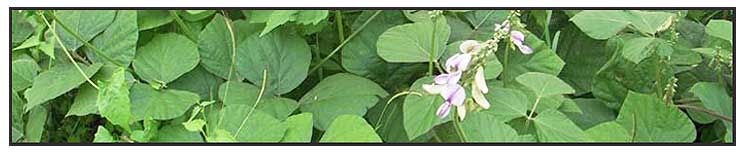
- Neustanthus is a monotypic genus of flowering plants in the pea family Fabaceae and its tribe Phaseoleae. The only species is Neustanthus phaseoloides, called tropical kudzu. Prior to 2016, the accepted namer was Pueraria phaseoloides.
- Neusanthus phaseoloides is indigenous in east and southeast Asia. It has been introduced and naturalized in a broad range of other wet tropical environments: Africa, Americas and Australia. It is capable of growth in a large soil spectrum.
(13)
- Etymology: The genus name Neustanthus derives from Greek words neos + anthos, meaning "new/fresh" and phaseoloides from phaseolus, the bean genus and Greek -oides, meaning "like", referring to the vigorous, twining growth and legume-bean appearance. The local "singkamas aso" probably relates to the similarity of its trifoliate leaf with Singkamas.
 Botany Botany
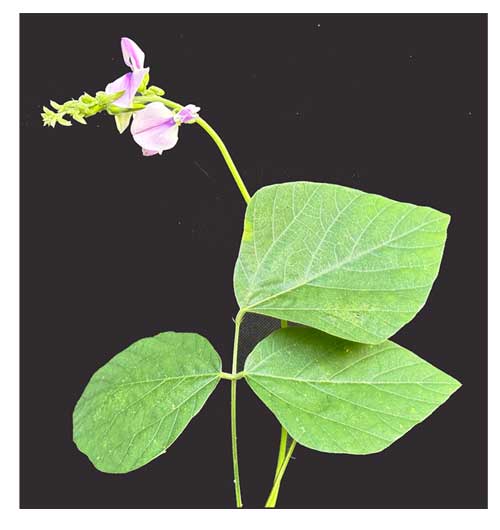
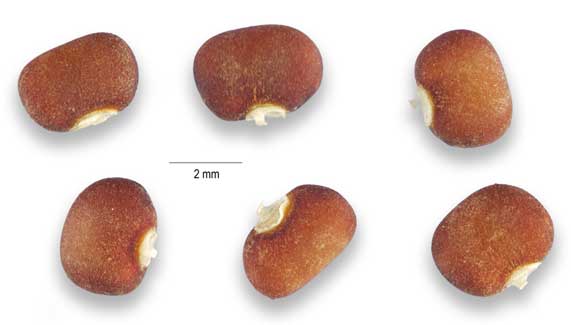
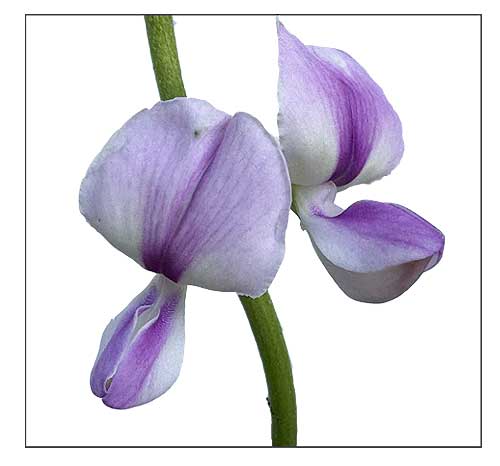
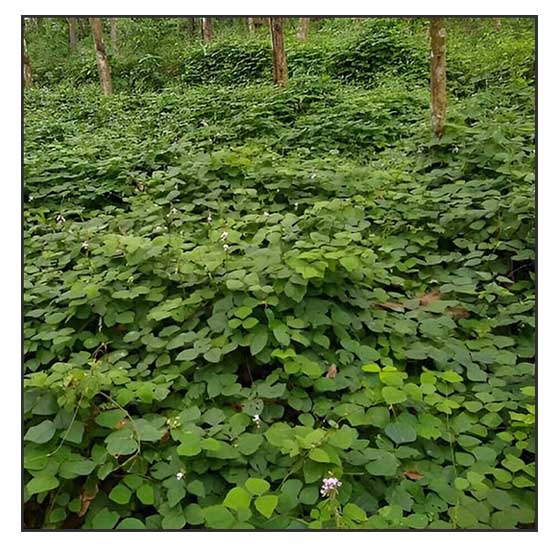
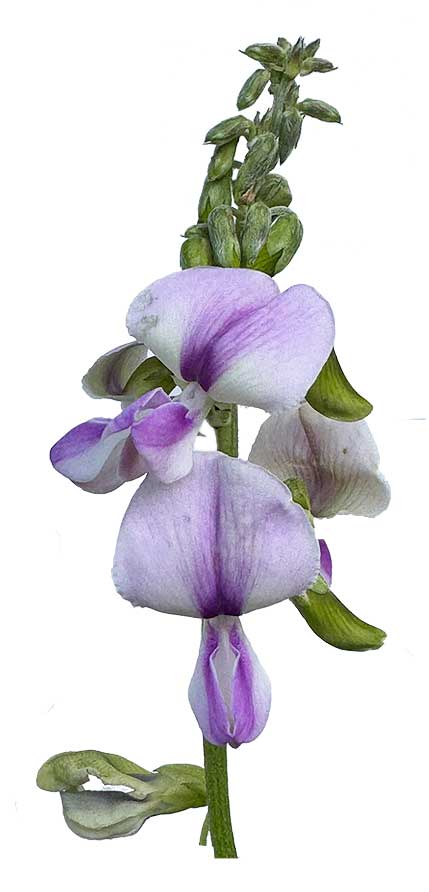
• Deep-rooting perennial herb with climbing or twining, hairy stems. Roots subtuberous. Main stems about 6 mm in diameter, extending 4.5—10 m, rooting at nodes if in contact with moist soil, lateral stems branching from nodes; young shoots densely covered with brown hairs. Leaves large, trifoliolate; stipules triangular to ovate, 4—11 mm x 2—3 mm, pubescent; petiole 3—11 cm long, hairy; stipels lanceolate to setaceous, 3—7 mm long; petiolule 2—5 mm long; top leaflet symmetrical, triangular or ovate, 2—20 cm x 2—16 cm, thin, base broadly cuneate or subrhomboidal and very shallowly lobed, apex acuminate, lateral leaflets oblique, (4—)6—7(—14) cm x (3—)6—7(—12) cm, thinly hairy on upper surface, grayish-green and densely pubescent on lower surface. Inflorescence an axillary, unbranched raceme, 10—46 cm long, pubescent; peduncle about 13 cm long; bracts 2—5 mm long, pubescent; flowers 10—23 mm long, mauve to deep purple, borne in pairs; bracteoles lanceolate, 1—3 mm long; pedicel 2—6 mm long; calyx campanulate, 6 mm long, hairy, upper teeth broad, lateral ones triangular, the lower lanceolate and all terminating in a bristle; standard orbicular, 1—2.5 cm in diameter, spurred, greenish on outside and white on the inner side with a mauve violet central blotch; stamens 10, diadelphous. Fruit a straight or slightly curved, terete or compressed cylindrical pod, 4—12.5 cm x 3—5 mm, thinly clothed with stiff appressed hairs, black when mature, 10—20-seeded. Seed cylindrical to cubic with rounded corners, about 3 mm x 2 mm, brown to brownish-black. (PROSEA) (2)
• Neustanthus phaseoloides is a deep rooting perennial herb, building a subtuberus, which allows it to resist waterlogged soils and short periods of drought. Above ground structure can grow up to 30 cm at day and often the steams can reach 20 m of elongation. It is a twiner and climbs over other plants or anthropogenic objects. Leaves are large and trifoliate, typical for leguminosae. Single leaflets can have an oval or triangular shape; diimensions can vary from 2 x 2 cm to 20 x 15 cm. The growing season goes from early spring to late fall in the subtropics and year-round in the tropics. Flower color ranges from mauve to purple and the dimensions are small and occur in scattered pairs on a raceme. Mature pods show a black color and hair coat; straight or slightly curved, 4 to 11 cm long; each pod containing 10-20 seeds. Seeds have a particular squarish form with rounded corner (3 x 2 mm) , black or brown in color. (Wikipedia)
 Distribution Distribution
- Native to the
Philippines. (1)
- Also native t0 Andaman Is., Assam, Bangladesh, Bismarck Archipelago, Borneo, Cambodia, China South-Central, China Southeast, East Himalaya, India, Jawa, Laos, Malaya, Maluku, Myanmar, Nepal, New Guinea, Nicobar Is., Solomon Is., Sri Lanka, Sulawesi, Taiwan, Thailand, Vietnam. (1)
- Invasiveness: Its vigorous fast-growing habits ranks it as one of the most aggressive weeds invading moist habitats in tropical and subtropical regions in the USA and Australia. It is declared a noxious weed in the USA and an invasive plant in Costa Rica, Ecuador, Puerto Rico and some Pacific Islands. (3)
 Constituents Constituents
- Phytochemical screening of ethanolic leaf extract revealed alkaloids + (5.1%), saponins ++ (8.7%), tannins ++ (9.0%), flavonoids ++ (8.8%), triterpenoids + (5.4%), cardiac glycosides ++ (8.6%), carbohydrate + (4%), and reducing sugars ++ (8.2%), with absence of steroids and proteins. (4)
-
Physiochemical evaluation indicated 5.8% moisture content, 1.3% total ash value, 0.5% acid insoluble ash value, 1.0% water soluble ash value, 8.0% water soluble extractive value and 6.0% alcohol soluble extractive valuer. (4)
- Elemental analysis of leaves revealed presence of calcium (2.44 mg/kg), magnesium (0.58 mg/kg), sodium (0.130 mg/kg), potassium (1.60 mg/kg),
phosphorus (1.52 mg/kg),
manganese (0.032 mg/kg),
zinc (0.040 mg/kg),
iron (0.071 mg/kg),
and copper ( 0.019 mg/kg). (see study below) (5)
- GC-MS analysis of ethanolic leaf extract revealed: Glycerin, 4H-pyran-4-one, 2,3-dihydro-3,5- dihydroxy-6-methyl, Hexadecanoic acid, methyl ester, n-Hexadecanoic acid, Hexadecanoic acid, ethyl ester, Phytol, 9,12,15-Octadecatrienoic acid, Octadecanoic acid, ethyl ester, Hexadecanoic acid, 2-hydroxy-1-(hydroxyl-methyl) ethyl ester, Squalene, Vitamin E, Stigmasterol, D:B-Friedo-B':A'-neogammacer-5-en-3-ol, (3.beta.). (see study below) (8)
- Nutrient content: N. phaseoloides has a high protein content
in seeds (12-20%). Whole fresh plant also yields high nutrients: protein 3.8% and sugar 7.3%, especially when compared to other tropical plant species. Its feeding value at 100 g yields 1800 kJ of energy. (13)
Properties
- Easy to grow: Scarify the Seeds: Rub gently with sandpaper or soak in warm water for 24 hours. Plant: Sow directly into soil about 2–3 cm deep. Water: Keep the soil moist until germination. Wait: Sprouts appear in 7–14 days. Then… Boom! Vines everywhere! (9)
-
Studies have antioxidant, estrogenic, anxiolytic, antiulcer, nutrient properties.
Parts used
Leaves, bark, roots.
 Uses Uses
Edibility
- Tuberous roots are edible.
Folkloric
- No reported folkloric medicinal use in the Philippines,
- In Malesia, plant poultice used for treatment of boils and ulcers. (3)
- Plant decoction used as anti-infective.
- Powdered roots used to treat symptoms of menopause.
- Decoction of crushed bark used as aid to mother giving birth.
- In Nepal, ethnic tribes use sap of plant for treatment of wounds.
- In West Bengal and Odisha, used orally and topically for its diuretic, anti-inflammatory and antimicrobial properties. (12)
Others
- Agrofrestry: Mainly used as cover crop. It is one of the most used cover crops in plantations of rubber, oil palm, and coconut in the humid Asian tropics. Planted on sloping sites to control soil erosion and in rotation with annual crops as a green manure. Its ability to smother weeds makes it a useful pioneer legume grown in combination with other species. (2) Its main advantage as cover crop is the comparable high nitrogen accumulation and the improvement of soil structure due to its deep rooting system. (13) Considered the poster plant of green manure.
- Fodder: In South-East Asia, tropical America and Australia, used as a pasture legume. Usually directly grazed, but can be cut for hay, silage, or for feeding as fresh forage. As forage legume, it has high palatability and vigorous initial growth on fertile soil. (2)
- Crafts: Vine used for making bags and fishing nets.
- Rope: Strong fibers from stems used for rope making. (2)
 Studies Studies
• Antioxidant / Elemental Composition / Leaves: Study of ethanolic extract of leaves yielded alkaloids, flavonoids, saponins, tannins, steroids, and phenols. Antioxidant activity using DPPH free radical scavenging method showed scavenging activity comparable (p>0.05) to ascorbic acid. Phytochemical and elemental analysis, along with antioxidant activity, suggests great potential for widespread use as cover crop for soil enrichment and as food/medicine for humans and livestock. (see constituents above) (5)
• Effect of Kudzu Supplementation on Forage Grass Degradability: Study evaluated the effects of supplementing Brachiaria hybrid cv Mulato II and elephant grass (Cenchrus purpureus) with tropical kudzu to target crude protein content of 130 g/kg DM on in vitro dry matter degradability (DMD), estimated metabolizable energy (ME) content and methane production. Study concludes supplementation offsets the negative effects of maturity on DMD and ME content and reduces CH4 yield in ruminants. (6)
• Estrogen-Like and Anxiolytic
/ Ovariectomized Rats: Study evaluated the potential health benefit of P. phaseoloides in ovariectomized rats treated for 3 days with aqueous and DCM/MeOH extracts in rats with functionally perceptible estrogen decline. Estrogen-like effects were assessed on primary estrogen target organs, while anxiolytic effects were evaluated with help of elevated plus-maze (EPM) and open field (OF) tests. Extract dose of 500 mg/kg significantly increased the uterine epithelial thickness. Both extracts induced differentiation of acini, and led to increase in eosinophilic secretary granules in mammary glands. Extract induced increase inn % of time spent and number of entries in the open arms of EPM, and in time spent in the OF test. Most pronounced anxiolytic effects were induced by AE at doses of 150 and 300 mg/kg. The DCM/MeOH had strongest estrogen-like effect and significantly reduced the total number and frequency of hot flushes and duration. Results suggest oestrogenic properties and ability to correct physiologic alterations related to estrogen depletion in ovariectomimzed rats, possibly through the estrogenic pathway. (7)
• Antiulcer / Leaves: Study evaluated the antiulcer activity of ethanolic leaf extract of Pueraria phaseoloides using pylorus-ligation induced model, in measures of gastric volume, pH, ulcer index, and % inhibition of ulceration. Omeprazole was used as standard at dose of 20 mg/kg and extract dose of 50, 150, and 300 mg/kg. Results showed significant reductionn in ulcer index. Antiulcer activity may be due to flavonoids, tannins, and saponins. While omeprazole at 20 mg/kg has more anti-secretory effect, both 50 and 300 mg/kg extract doses exhibited better reduction of ulcer index than the standard drug, which may be due to more combined cyto-protective and anti-secretory effect of the extract than of the standard drug. (see constituents above) (8)
• Adverse Effects on Sperm Parameters: Study evaluated the effects of oral administration of Pueraria phaseoloides on reproductive characteristics of male wistar rats. Results showed slight decrease (p<0.05) in mean sperm motility, mean relative testes weight, and mean testosterone concentration. Findings suggest adverse effects on sperm parameters of male wistar rats. Pueraria phaseoloides contain phytoestrogens that are estrogen mimicking chemicals with estrogenic activities, which could have altered the hormone receptor expression dues to binding affinity for estrogen receptors α and ß and androgen receptors. (10)
Availability
- Wild-crafted.
- Seeds in the cybermarket.
|


