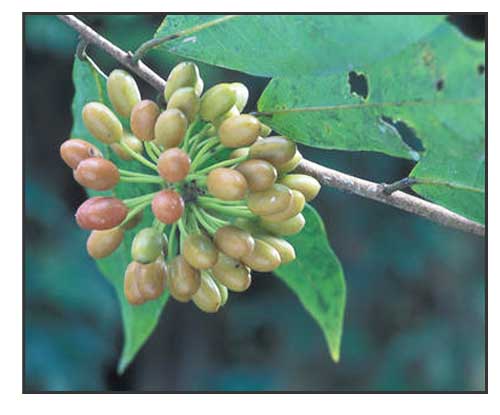
 Gen info Gen info
- Huberantha is a genus of plants in the family Annonaceae and tribe Miliusease, distributed in Australia, tropical Asia, East Africa, and some Pacific Islands.
- Huberantha Chaowasku is a replacement generic name, proposed for the recently described genus Hubera Chaowasku segregated from Polyalthia Blume. Consequently, new combinations of 27 species presently recognized are made under Huberantha.
- Etymology: The genus name Huberantha means "Huber's flowers", coined by botanist Tanawat Chaowasku to honor the German botanist Herbert Huber (1931-2005). The antha part of the genus name derives from Greek anthos, meaning "flower", which was added to highlight the importance of the flower and its features that distinguish it from morphologically similar genera in the tribe Miliuseae. The specific epithet jenkinsii honors Richard Jenkins. (Alternative eponymy: Francis Jenkins, 1793-1866, Englishman who served with the East India Company in Assam).
 Botany Botany
• Tree to 10 m tall. Twigs appressed-puberulous. Leaves subcoriaceous, elliptic, 12.3–17 by 4.1–5.5 cm, base cuneate, apex acute to acuminate, glabrous on both sides, secondary veins 10–13 per side, distinct below, hairy domatia generally present at axils of secondary veins below. Inflorescences 1-flowered, pedicels 14–22 mm long, each bearing 1–2 bracts at or near the base. Sepals free, ovate-triangular, 2.5–3 mm long, apex acute. Petals yellow, ± subcoriaceous, erect at anthesis; outer petals elliptic, 32–50 by 10–16 mm, apex obtuse; inner petals elliptic, 32–47 by 12–19 mm, apex obtuse. Stamens numerous, 1.2–1.8 mm long, anther connective apex truncate. Carpels numerous, ovaries appressed-villous, stigmas ± ellipsoid. Receptacle ± conical. Fruit of up to 38 monocarps borne on a pedicel up to 25 mm long. Monocarps ellipsoid(-cylindrical), 1–1.2 by 0.5–0.65 cm, apex usually short-apiculate, base contracted into a stipe 13–18 mm long. Seed 1, ellipsoid to ellipsoid-cylindrical, 9–11 by 4–5.5 mm. (eFlora of Thailand)
Distribution
- Native to the Philippines.
- Also native to Andaman Is., Assam, Bangladesh, Borneo, Hainan, Malaya, Myanmar, Nicobar Is., Thailand, Vietnam. (1)
 Constituents Constituents
- Study of stems isolated two new alkaloids, Huberanthin A and B (1,2), together with 5 known compounds, characterized as allantoin (3), oxylopinine (4), N-trans-feruloyl tyramine (5), N-trans-p-coumaroyl tyramine (6) and mangiferin (7). (see study below) (3)
- Methanol extract of leaves
isolated 6 compounds, identified as: mangiferin (1), iriflophenone 3-C-β-glucoside (2), iriflophenone 3,5-C-β-diglucoside (3),
p-hydroxybenzoic acid (4), protocatechuic acid (5), and p-methoxy benzoic acid (6). (see study below) (7)
Properties
- Studies have suggested neuroprotective,
α-glucosidase inhibitory, glucose-uptake inhibitory, anti-adipogenic properties.
Parts used
Stems, leaves.
Uses
Edibility
- No reports found on edibility or use as food source.
Folkloric
- No reported folkloric medicinal use in the Philippines.
Others
- Repellent: Leaves used as honey bee repellent. (4)
Studies
• Neuroprotective / 6-OHDA-Induced Neurotoxicity / Stems: Study of stems isolated two new alkaloids, Huberanthin A and B (1,2), together with 5 known compounds, characterized as allantoin (3), oxylopinine (4), N-trans-feruloyl tyramine (5), N-trans-p-coumaroyl tyramine (6) and mangiferin (7). Compounds were evaluated for protective activity against neurotoxicxity induced by 6-OHDA)Compound 5, N-trnas-feruloyl tyramine, showed recognizable neuroprotective potential at 100 µM with 60.9% cell survival (6-OHDA: 48.4% at 100 µM). Mangiferin(7) showed strong neuroprotective activity with 60.5% cell survival at 25 µM (6-OHDA: 53.1% at 100 µM). (3)
• α-Glucosidase Inhibitory / Stems: Isolated compounds 3-7 were evaluated for α-glucosidase inhibitory activity and cellular glucose uptake stimulatory activity. Compounds 5 and 6 exhibited strong inhibition of the enzyme with IC50s of 30.6 and 0.6 µM, respectively. Mangiferin (7) showed strong moderate activity with IC50 of253.6 µM, compared to acarbose with IC50 of 724.7 µM. Results suggest the C-glucosidic xanthone mangiferin has potential as lead compound for development of preventive agents for NCDs (non-communicative diseases). (3)
• Neuroprotective / Glucose Uptake Inhibitory / Anti-Adipogenic / Leaves: Methanol extract of leaves
isolated 6 compounds. Glucose-uptake stimulatory activity was conducted in rat skeletal muscle L6 cells. Compounds 2 (iriflophenone 3-C-β-glucoside) and compound 3 (iriflophenone 3,5-C-β-diglucoside) were selected for study as both showed not toxicity toward L6 cells up to 100 µg/mL by MTT assay. Compound 2 at 100 µg/mL or 244.88 µM and compound 3 at 100 µg/mL or 175.29 µM showed glucose uptake enhancement of 234.5 and 119.9% respectively, compared to positive control insulin (0.5 µM) with 146.6% enhancement. In anti-adipogenic activity, all 6 compounds were evaluated at 50 µM. Compounds 1, 2, and 5 showed decrease in cellular fat accumulation (37.6, 38.2, and 34.5% respectively. Compounds 3, 4, and 6 suppressed intracellular adipogenesis, with reduction of lipid levels to 54.2, 82.9 and 37.9%. Protective potential against Parkinson's disease used the SH-Sy5Y cell model. Compound 2 and 3 at 100 µM reversed the decrease level of cell survival. Results suggest potential of the xanthone-C-glycosides as new preventive agents for NCDs (Non-communicable diseases). (see constituents above) (7)
Availability
- Wild-crafted. |


