 Gen info
•
Denbrobium is a huge
genus of tropical orchids of about 1,200 species. Over 60 species of
Dendrobium are recorded in the Philippines. Two of the favorite cultivated
species are: Dendrobium anosmum Lindl. (sanggumay) and Dendrobium
crumenatum Kranzl (Pigeon orchid). Some species are grown as medicinal
plants, one of which is Dendrobium nobile, used in traditional Chinese
medicine. In Vietnam, the entire genus of Dendrobium is considered medicinal.
• In 1839, the scented variety was first discovered by Lindley in the Philippines and named Dendrobium macrophyllum. (7)
• Dendrobium genus is one of the largest in the Orchidaceae family, which manifest a diversity of medicinal effects viz. antiangiogenic, immunomodulating, antidiabetic, cataractogenesis-inhibiting, neuroprotective, hepatoprotective, anti-inflammatory, antiplatelet aggregating, antifungal, antibacterial, antiherpetic, antimalarial, among others.
• Etymology: The genus name Dendrobium derives from Greek words Dendron (tree) and bios (life), meaning "one who lives on trees" or "epiphyte," describing the orchid's natural habit of growing on tree trunks and branches rather than in soil. The specific epithet anosmum derives from Greek: prefix a-/an, meaning "smell," "scent," or "odor," meaning "without scent" or "unscented," a misnomer, as the species emits a strong, sweet fragrance akin to raspberries, rhubarb, or perfumed candy
• Sanggumay is derived from two Tagalog root words: "sangsang" meaning nauseating and overpowering (smell), and "umay" meaning "tiresome".
 Botany
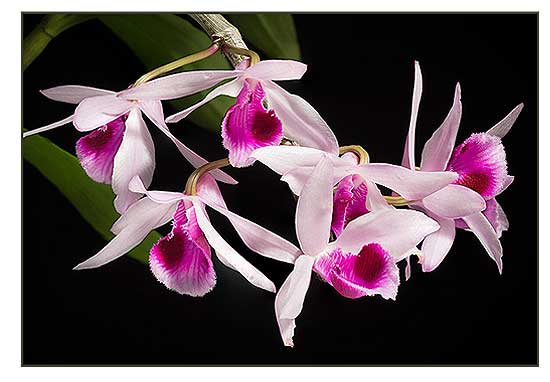
• Denbrobium anosmum is a tufted epiphytic, occasionally lithophytic herb. Stems are terete, nodose and erect or pendulous. Leaves are
about 10 centimeters long and 3 centimeters wide, coriaceous or entire, flat, often articulate with sheaths. Stems make a yearly growth, after which the leaves drop off and the flowers appear. Flowers are
borne on leafless stems, each flower measuring about 8 centimeters, with mauve
to purple petals, with a broad lip and a dark purple throat, exuding
a characteristic raspberry fragrance.
• Growth form: An epiphytic orchid, it has a pendulous and clumping growth form. Foliage: Leaves are deciduous, leaf blades are oblong to elliptic in shape. Stems: Stems are pendulous and are 40 to 60 cm long and have many nodes, each covered with a sheath. The new stems are covered with leaves along its length. Leaves drop when mature. Flowers: The fragrant flowers grow on the mature, leafless stems in small clusters of 1 to 3 flowers. The flowers have purple sepals and petals while the flower lip purple with a deep purple throat, the lip margin is finely toothed. (Flora & Fauna Web)
Distribution
- Native to the Philippines.
-
Reported in the Abra, Benguet, Bontoc, Lepanto, Nueva Viscaya, Leyte, Rizal, and Davao del Sur.
- Also native to Bangladesh, Borneo, Jawa, Laos, Lesser Sunda Is., Malaya, Maluku, Myanmar, New Guinea, Sri Lanka, Sulawesi, Sumatera, Thailand, Vietnam. (1)
Constituents
• Study of volatile components yielded
twenty-five components, mostly methylketones and 2-alkyl acetates.
• Monoterpene d-, l-, and dl- forms of linalool have been described.
source
• Linalool used as odor agent in cosmetics, soaps,
etc.
• Main chemical components of Dendrobium are alkaloids, aromatic compounds, sesquiterpenoids and polysaccharides. (4) Yields alkaloid dendroparine (Leander and Luning, 1968).
Properties
- Dendrobium genus is one of the largest in the Orchidaceae family, which manifest a diversity of medicinal effects viz. antiangiogenic, immunomodulating, antidiabetic, cataractogenesis-inhibiting, neuroprotective, hepatoprotective, anti-inflammatory, antiplatelet aggregating, antifungal, antibacterial, antiherpetic, antimalarial, among others.
- As a Dendrobium species, D. anosmum is an understudied plant.
- Studies have suggested attractant, antibacterial, hypoglycemic properties.
 Uses
Edibility
- Both flowers, pseudobulbs (canes), and stems considered edible.
- In parts of Southeast Asia,
deep-fried as snacks or used in local dishes.
- Caution: Orchids for commercial or home display often treated with pesticides, fungicides, and chemical fertilizers that make it unsafe for human consumption. Safety depends entirely on how the plant was grown and harvested.
Folkloric
- Except for isolated anecdotal reports of use of decoction of flowers
as invigorating, there is no recorded folkloric use in the Philippines.
- Used as ingredient in Chinese medicine.
- In Vietnam,
the entire genus Dendrobium is medicinal. D. anosmum used for treating nervousness, sore throat, and physical weakness in men.
- Some Dendrobium species are touted to provide superb sexual vigor.
- Stems of many species are sweetish and have a cooling effect.
- In the Philippines, of the Dendrobium species, D. crumenatum
is as using the pseudobulbs for ear afflictions, and the Malays and
Javanese use poultice of leaves for acne and pimples. Another is D.
nutans, a liniment of its bulb is used for tumors and abscesses.
- Fresh or dried stems of many Dendrobium species are one of the most expensive tonics in traditional Chinese medicine. (4)
Others
- Ornamental: Flowers used for decorative for ceremonies and rituals.
- Scent: Linalool used as odor agent in cosmetics, soaps, etc.
- Superstition: Some believe it to ward off evil spirits; others, that it will bring good fortunes. Some believe it is bad for Feng Shui. (5)
Studies
• Volatile Components: Volatile components of the orchid
Dendrobium superbum Rchb. f: Studied yielded twenty-five components,
mostly methylketones and 2-alkyl acetates. (2)
• Attractant Factor / Flower: Study isolated a specific attractant factor -4-(4-Hydroxyphenyl)-2-butanone was characterized from flowers of the orchid licked from the flower surface of D. superbum and sequestered in the rectal glands of male melon fly, Dacus cucurbitae. (6)
• Endophytes / Source of Bioactive
Compounds: Endophytes living inside plant tissues are known to be a rich source of unique bioactive compounds. In this study, endophytic fungi were isolated from leaves stems, and roots of five species of epiphytic orchids viz. Dendrobium anosmum, D. phyllum, Doritis pulcherrima, Ascocentrum curvifolim, and Aerides falcata. Most endophytic isolates were obtained from leaf segments, followed by roots and stems, with potential role in producing extracellular enzymes, including lipase, cellulase, pectinase, protease, and amylase enzymes. (10)
• Hypoglycemic Effect: Study evaluated the effect on Dendrobium anosmum on lowering blood glucose levels using dextrose-induced hyperglycemic chicken embryo model. Of five treatment groups, T1 exhibited most potent hypoglycemic effect by lowering of blood glucose level to value of 30 mg/dL. Other treatment groups showed reduced values from 70 to 112 mg/dL. (11)
• Zinc Oxide Nanoparticles / Nanogel Formulation / Effect on Acne Vulgaris: Study reports on the biogenically synthesized zinc oxide nanoparticles using Dendrobium anosmum leaf extract as reducing and capping agent for topical anti-acne nanogels and its antimicrobial effect on Cutibacterium ace and Staphylococcus aureus. Hydrogels with biogenically synthesized NPs showed to be more effective against Gram(+) bacteria. The hybrid nanogels showed more efficacy against microbes causing acne and has potential as a green product against skin infection. (13)
• Dendrobium alkaloid: Studies have shown that alkaloids isolated from Dendrobium have neuroprotective, anti-inflammatory, and antitumor activities, suggesting potential medicinal activity and potential source of lead compounds for innovative drug development. (15)
Availability
- Wildcrafted.
-
Ornamental cultivation.
|


