HOME      •      SEARCH      •      EMAIL    •     ABOUT


Family Piperaceae
Sambañganai
Piper baccatum Blume
CLIMBING PEPPER OF JAVA

Scientific names Common names
Muldera baccata (Blume) Miq.         Sambañganai (Tag.)
Muldera firma Miq.         Climbing pepper of Java (Engl.)
Muldera recurva Zoll.          
Muldera recurva (Blume) Miq.          
Piper baccatum Blume        
Piper firmum (Miq.) C.DC.  
Piper flavimarginatum C.DC.        
Piper pachyphyllum Hock.f.      
Piper protrusum Chaveer. & Tanee       
Piper recurvum Blume        
Piper sarcopodum C.DC.        
There is a dearth of information and studies on Piper baccatum. Quisumbing's compilation lists P. baccatum (sambañganai) as a separate species. Other compilations list it as synonym of Piper nigrum (black pepper).
Piper baccatum Blume is an accepted species. KEW: Plants of the World Online

Other vernacular names
INDONESIA: Bodeh (Javanese), Rinu, Rinu manuk (Sundanese).
THAILAND: Thao khan (Surat Thani), Yan phrik nok (Trang)..

Gen info
- The genus Piper of the Piperaceae family contains over 2,000 species.
- Works on Philippine wild Piperaceae have been extensive. Candole (1910) reported 133 species of Piper and 26 of Peperomia; Merill (1923) 115 Piper, 25 Peperomia; and Quisumbing (1930) documented 87 Piper and 21 Peperomia.

- Etymology: The genus name Piper derives from Sanskrit pippali. The specific epithet baccatum derives from Latin, meaning having berries, fruits with fleshy or pulpy coats.

Botany
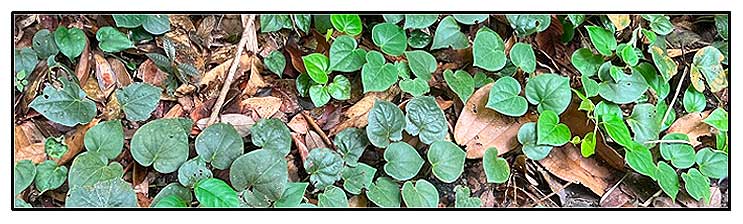
• Sambañganai is a dioecious vine with branches smooth, terete, 2 to 4 millimeters in diameter. Leaves are leathery, oblong-elliptic or rounded-ovate, 12 to 16.5 centimeters long, 4 to 9.5 centimeters wide, 5- to 7-plinerved, and smooth on both surfaces. Pistillate spikes are pendulous, 4.5 to 9.5 centimeters long, and about 1.5 centimeters in diameter. Bracts are smooth, conate to the rachis, with their ends fusing and forming the cupular receptacles. Fruits are globose, borne on the cupular receptacles, 4.5 to 6 millimeters long, 4 to 5 millimeters in diameter. Stigmas number 3 to 4, slightly hairy and rounded. Cupular receptacle is sessile to subsessile, stout, smooth outside, smooth to ciliate on the rim, and pilose inside. Staminate spikes are pendulous, slender, 3 to 6 centimeters long, and 2 to 2.25 millimeters in diameter. Stamens are 5, small, and sunk in the cupular receptacle, with very small, ovoid to subglobose, bilocular, 2-valved anthers, and the filaments oblong, swollen at the base and slightly longer than the anthers.

• Growth form: A woody climber. Foliage: Alternate, stalked leaves have leaf blades that are heart-shaped, and up to 13 by 9 cm. Flowers: Flowers are arranged in stalked clusters that are about 10 cm long. (Flora & Fauna Web)

Note: The leaves of P. baccatum are highly succulent, shiny green when fresh and coriaceous when dry; fresh petioles have red spots or hands. Based on leaf and fruit characteristics, the species is similar to P. ribesioides but has glabrous rachis.

Distribution
- Native to the Philippines. (2) (5)
- In
low and medium elevation forests; 300 m.
- In Luzon: Laguna, Sorsogon: Mindanao: Agusan del Norte, Lanao del Sur, Zamboanga del Sur; Negros, Palawan. (5)
- Also native to Jawa, Malaya, Sumatera, Thailand,

Constituents
-
Hydrodistillation, GC-FID and CG-MS analysis for essential oil identified a total of 14 compounds, representing 98.1% of total EO composition. Major components were ß-caryophyllene (30.7%), camplene (22.1%), eucalyptol (14.9%), γ-muurolene (6.9%), and
α-pinene (5.3%). (see study below) (6)

Properties
-
Study suggested acetylcholinesterase inhibitory properties.

Parts used
Roots, leaves, stems.

Uses

Folkloric
- Decoction of roots used in venereal diseases.
-
Juice of plant drunk as cough remedy and shredded leaves used as neck poultice.
- In Indonesia, leaves and stems used for fever and swelling.
Others
- Fruits: Used in tonics. Reportedly used to adulterate P. cubeba.

Studies
Naturally Occurring Antioxidants:
Study of compounds of Piper species (P. nigrum, P. retrofractum, P. baccatum) revealed 14 phenolic amides, two from P. baccatum. All the phenolic amides exhibited significant antioxidant activities more effective than naturally occurring alpha-tocopherol. (1)
Anticholinesterase Activity / Essential Oil: Hydrodistillation, GC-FID and CG-MS analysis for essential oil identified a total of 14 compounds, representing 98.1% of total EO composition. Moderate inhibitory effect was observed for acetylcholinesterase (CChE) and butyrylcholinesterase (BChE) with IC50s of 80.5 and 96.4 µg/mL, respectively. Molecular docking studies of PB components with AChE and BChE showed binding energy ranges of -5.6 to -8.5 Kcal/mol and -5.2 to -7.8 Kcal/mol, respectively. Notably, ß-caryophyllene and γ-muurolene showed superior binding energy profiles with both AChE and BChE compared to other components. Docking results underscore the potential of the EO components as cholinesterase inhibitors, with implications for food, aromatherapy, and pharmaceutical applications. ß-caryophyllene and γ-muurolene showed attributes with potential for targeting cholinesterase-related conditions. (see constituents above) (6)
Anticholinesterase Activity: Study evaluated the acetylcholinesterase (AChE), tyrosinase, and
α
-glucosidase inhibitory activity of ethanolic extracts of 5 Malesian Piper species: Piper baccatum, P. rostratum, P. frustratum, P. penangense, and P. crassipes. Extracts exhibited varying degrees of enzyme inhibition, with O, baccatum showing strongest AChE inhibition with IC50 of 21.5 µg/mL. (7)

Availability
Wild-crafted.

Updated April 2026 / December 2018 / August 2016

PHOTOS / ILLUSTRATIONS
IMAGE SOURCE: Piperaceae : Piper baccatum det. J.V. LaFrankie 18-Mar-14 / Abaxial view of leaf Copyright © 2015 by P.B. Pelser & J.F. Barcelona (contact: pieter.pelser@canterbury.ac.nz) [ref. DOL97276]/ Non-Commercial Use / click on image to go to source page / Phytoimages.siu.edu
IMAGE SOURCE: Piperaceae : Piper baccatum det. J.V. LaFrankie 18-Mar-14 / Inflorescence / Copyright © 2015 by P.B. Pelser & J.F. Barcelona (contact: pieter.pelser@canterbury.ac.nz) [ref. DOL97286] / Non-Commercial Use / click on image to go to source page / Phytoimages.siu.edu
IMAGE SOURCE: Piperaceae : Piper baccatum det. J.V. LaFrankie 18-Mar-14 / Flowering vine / Copyright © 2015 by P.B. Pelser & J.F. Barcelona (contact: pieter.pelser@canterbury.ac.nz) [ref. DOL97310]/ Non-Commercial Use / click on image to go to source page / Phytoimages.siu.edu
OTHER IMAGE SOURCE: Piper baccatum Blume / Preserved Specimen Database of China Plant / Identifier: K - Herbarium Catalogue - K000794884 © The Board of Trustees of the Royal Botanic Gardens, Kew. / Europeana: Rights Reserved - Free Access/ Europeana Foundation
IMAGE SOURCE: Bodeh: Piper baccatum / © uforesst,org / Non-commercial use / Image modified / Click on image or link to go to source page / uforest.org

Additional Sources and Suggested Readings
(1)
Chemical constituents of peppers (Piper spp.) and application to food preservation: naturally occurring antioxidative compounds / N Nakartani, R Inatani, H Ohta and N Nishioka / Environ Health Perspect. 1986 August; 67: 135–142.
(2)
Piper baccatum / KEW: Plants of the World Online
(3)
Piper L.:Piperaceae / Proseanet.Org
(4)
Initial Studies on Alkaloids from Lombok Medicinal Plants / Surya Hadi and John B. Bremner / Molecules 2001, 6, 117-129
(5)
Piperaceae:L Piper baccatum / Co's Digital Flora of the Philippines
(6)
Chemical composition, anticholinesterase activity, and molecular docking studies of Piper baccatum Blume (Piperaceae) essential oil / Abubakar Siddiq Salihu, Wan Mohd Nuzul Hakimi Wan Salleh, Keith Kathrinna Adward, Ravikumar Kapavarapu, Nurunajah Ab Ghani / Journal of Essential Oil Bearing Plants, 2024; 27(4): pp 993-1005 / DOI: 10.1080/0972060X.2024.2369242
(7)
Unlocking the Therapeutic Potential: Comparative Enzyme Inhibition by Five Malaysian Piper Species / Syarifah Nadhirah Wan Idrus, Wan Mohd Nuzul Hakimi Wan Salleh et al / Agriculturae Conspectus Scientificus, 2025; 90(2)
(8)
A synopsis of Thai Piper (Piperaceae) / Chalermpol Suwanphakdee, David A Simpsom et al. / Thai Forest Bull. Got, 2020; 48(2): pp 145-183 / DOI: 10.20531/tfb.2020.48.2.08

DOI: It is not uncommon for links on studies/sources to change. Copying and pasting the information on the search window or using the DOI (if available) will often redirect to the new link page. (Citing and Using a (DOI) Digital Object Identifier)

                                                            List of Understudied Philippine Medicinal Plants
                                          New plant names needed
The compilation now numbers over 1,750 medicinal plants. While I believe there are hundreds more that can be added to the collection, they are becoming more difficult to find. If you have a plant to suggest for inclusion, native or introduced, please email the info: scientific name (most helpful), local plant name (if known), any known folkloric medicinal use, and, if possible, a photo. Your help will be greatly appreciated.

HOME      •      SEARCH      •      EMAIL    •     ABOUT