HOME    •    SEARCH      •      EMAIL    •     ABOUT  •     DONATE


Family Araceae
Salot
Gonatopus boivinii (Decne.) Engl.
GIRAFFE'S KNEE / SAND FOREST ARUM

Scientific names Common names
Gonatopus boivinii (Decne.) Engl. Salot (Tagalog)
Gonatopus boivinii var. lanceolatus Peter Giraffe's knees (Engl.)
Zamioculcas boivinii Decne. Sand forest arum (Engl.)
Note: No generally accepted Philippine name for the plant. Local plant hobbyists sometimes refer to it as "salot", meaning a scourge, pest, or nuisance, alluding to its highly invasive and invasive growth habit.
Gonatopus boivinii is an accepted species. KEW: Plants of the World Online

Other vernacular names
EAST AFRICA: Wanga-mke.
FINNISH: Kirjokamelinpolvi.
SPANISH: Muda de Joelho de Girafa.
SWAHILI: Mnazi wa nyoka/Kiti; Cha nyoka.
TANZANIA: Kunzulu, Wangadume, Ikumh'e.

Gen info
- Araceae is a family of monocotyledonous flowering plants in which flowers are borne on a type of inflorescence called a spadix. Also known as the arum family, members are colloquially known as aroids. The family contains 114 genera and about 3,750 known species. (1)
- Gonatopus boivinii is a robust perennial herbaceous plant belonging to the Araceae family.
- Etymology: The genus name Gonatopus derives from Greek words gonato, meaning "knee" and pous meaning "foot", referring to the knee-like swollen joint (pulvinus) found on the plant's leaf stalk. The specific epithet boivinii honors Louis Hyacinthe Boivin (1808-1852), a French Botanical collector who gathered plants in East Africa, Madagascar, and the Mascarene Islands. The local name Giraffe's knees refers to the swollen joint or pulvinus on its leaf stalk/petiole.

Botany
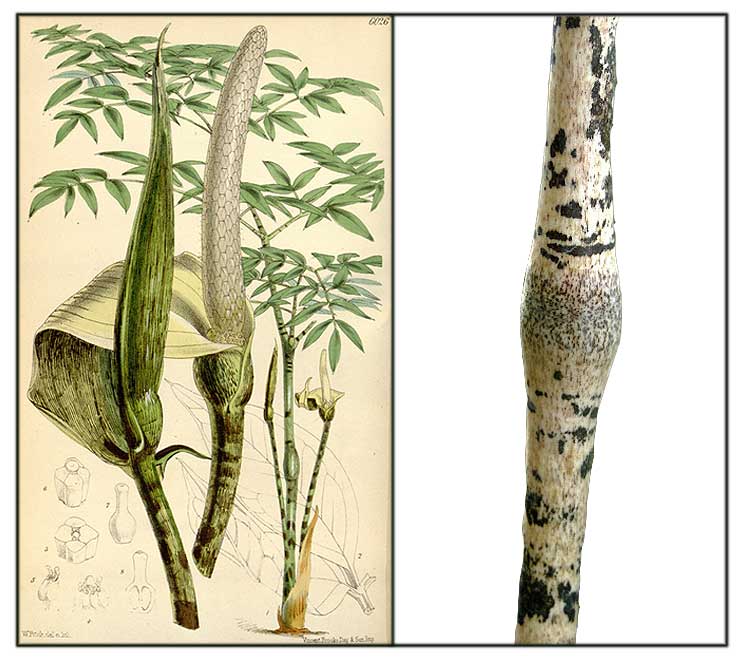
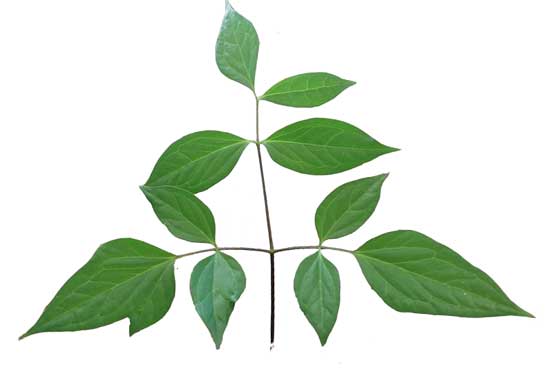
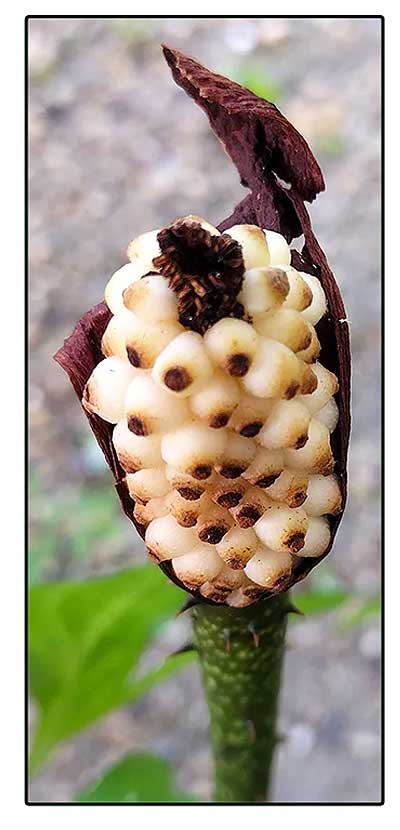
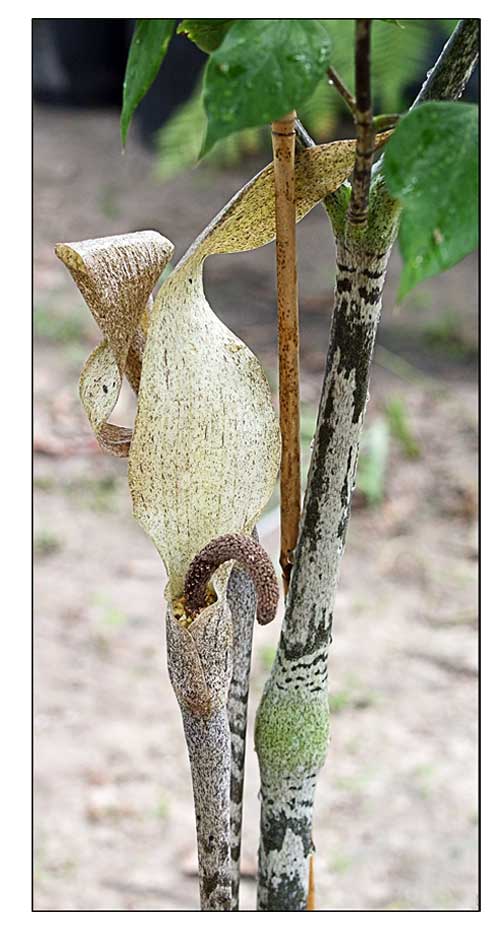
Growth form: Tuberous herb producing a solitary leaf to 1.2m tall. Foliage: Leaf solitary, tri-pinnate. Leaflets to 5 (6)cm long by 2.5(3)cm wide, mid - dark green, venation distinct. Petiole   with distinct, 'knee like' swollen zones, usually dull grayish silver with olive green mottling and dark brown- black spots, in some specimens completely pale green without spots/ mottling. Flowers: Inflorescence to 20(30)cm tall, appearing together with the solitary leaf. Adaxial surface of spathe (facing the spadix) cream - white, in some specimens with dull olive green streaks or mottling. Abadxial surface of spathe cream, densely mottled with olive green - brown streaks and spots  . Spadix cream - white. 
(Flora & Fauna Web)

• Robust perennial herb, up to 1.2 m. Leaf solitary, 3-pinnate on a long, thick fleshy stalk with a knee-like swelling in the middle. Flowers 1-5, appearing with the leaf; spathe up to 22 cm long; spadix creamy-yellow. (Flora of Mozambique)

Distribution
- Naturalized in Batangas and NCR.
- Introduced as an ornamental, but persists after cultivation, and has started to colonize some areas.
- Potentially invasive. (3)
- Native to
DR Congo, Kenya, KwaZulu-Natal, Malawi, Mozambique, Tanzania, Zambia, Zimbabwe. (4)

Properties
- Toxicity: Toxicity is caused by both raphides and sap. Belonging to the Araceae family, it likely shares typical family characteristics, holding calcium oxalate crystals called raphides, which can cause severe localized irritation if handled without precaution, and swelling, and burning of the mouth, lips, and tongue if consumed raw.
- It is also mildly toxic to cats and dogs. Cats may exhibit short-lived signs of mouth irritation, drooling, and vomiting. (8)
- Keep out of reach of children and pets.

Parts used
Stems, roots, leaves.

Uses

Edibility
- In Kenya, used as famine food.
Folkloric
- No reported medicinal use in the Philippines.
- In African traditional medicine, dried, ground and powdered roots used topically for treatment of snakebite. Stem heated for 7 to 10 minutes used for treatment of ear infections. (5)
- In Tanzania, topically used as antifungal. (6)
- In Kenya, roots used for treatment of mumps. (7)
- Dried and powdered plant parts are added to porridge or tea to alleviate headaches.

Studies
• No studies found.


Availability
- Wild-crafted.
- Plants in the cybermarket.

September 2026

                                                 PHOTOS / ILLUSTRATIONS
IMAGE SOURCE: Gonatopus boivinii / © TopTropicals / Non-commercial use / Image modified / Click on image or link to go to source page / TopTropicals
OTHER IMAGE SOURCE: Gonatopus boivinii flower with wild berries / © TopTropicals / Non-commercial use / Image modified / Click on image or link to go to source page / TopTropicals
OTHER IMAGE SOURCE: Beautiful weeds: Gonatopus boivinii - pulvinus / by Jardinerong Sunog / Non-commercial use / Image modified / Click on image or link to go to source page / Jardinerong Sunog
OTHER IMAGE SOURCE: Gonatopus boivinii leaves / by HerbalSea / Posted May 2018 by Anonymous / Image modified / Click on image or link to go to source page / Herbal SEA Underground
OTHER IMAGE SOURCE: Illustration: Gonatopus boivinii / Walter Hood Fitch - Curtis's Botanical Magazine (1873) / PUBLIC DOMAIN / Clck on image or link to go to source page / Wikimedia Species

Additional Sources and Suggested Readings
(1)
Araceae: Wikipedia

(2)
Gonatopus boivinii / Wikipedia
(3)
Araceae: Gonatopus boivinii / Co's Digital Flora Database
(4)
Gonatopus boivinii / KEW: Plants of the World Online
(5)
Ethnomedicinal plants used for treatment of snakebites in Tanzania – a systematic review / Neema Gideon Mogha, Olivia John Kalokora, Halima Mvungi Amir, David Sylvester Kacholi / Phar Biol., 2022; 60(1): pp 1925-1934 / DOI: 10.1080/13880209.2022.2123942
(6)
Brine Shrimp Toxicity Evaluation of Some Tanzanian Plants Used Traditionally for the Treatment of Fungal Infections / Mainen J Moshi, Carolien JP van den Beukel, Andre JAM van der Ven et al / African Journal of Traditional, Complementary and Alternative Medicine, 2006; 4(2): pp 219-225 /
DOI: 10.4314/ajtcam.v4i2.31211
(7)
Important Medicinal and Food Taxa (Orders and Families) in Kenya, Based on Three Quantitative Approaches / Fredrick Munyao Mutie, Yuvenalis Morara Mbuni, Qing-Feng Wang et al / Plants (Basel), 2023; 12(5): 1145 / DOI: 10.3390/plants12051145
(8)
Is Gonatopus boivinii toxic to cats? / Grwoli

DOI: It is not uncommon for links on studies/sources to change. Copying and pasting the information on the search window or using the DOI (if available) will often redirect to the new link page. (Citing and Using a (DOI) Digital Object Identifier)

                                                            List of Understudied Philippine Medicinal Plants
                                          New plant names needed
The compilation now numbers over 1,750 medicinal plants. While I believe there are hundreds more that can be added to the collection, they are becoming more difficult to find. If you have a plant to suggest for inclusion, native or introduced, please email the info: scientific name (most helpful), local plant name (if known), any known folkloric medicinal use, and, if possible, a photo. Your help will be greatly appreciated.

HOME      •      SEARCH      •      EMAIL    •     ABOUT