HOME      •      SEARCH      •      EMAIL    •     ABOUT


Family Rubiaceae
Salasik-lupa
Scleromitrion verticillatum (L.) R.J.Wang

SHRUBBY FALSE BUTTONWEED
Cu ye er cao

Scientific names Common names
Hedyotis crassifolia Blume Boñgat (Mbo.)
Hedyotis hirta Ridl. Basiñgau (Ilk.)
Hedyotis hispida Retz. Manaal (Sub.)
Hedyotis verticillata (L.) Lam. Salasik-lupa (Tag.)
Hedyotis verticillata var. barlettii Fosberg & Sachet Shrubby false buttonweed (Engl.)
Hedyotis verticillata var. scaberrima Hatus.  
Hedyotis wallichii Walp.  
Oldenlandia augustifolia Benth.  
Oldenlandia hispida (Retz.) Lam.  
Oldenlandia verticillata L.  
Scleromitrion crassifolium Miq.  
Scleromitrion hispidum (Retz.) Korth.  
Scleromitrion verticillatum (L.) R.J.Wang  
Hedyotis verticillata and Oldenlandia verticillata are synonyms of Scleromitrion verticillatum.
Scleromitrion verticillatum is an accepted species. KEW: Plants of the World Online

Other vernacular names
CHINESE: Cu ye er cao.
MALAYSIA: Rumput sebueh, Rumput chengkering, Lidah tiong.
THAILAND: Tong haeng hin.
VIETNAM: An di[eeef]n v[of]ng, An dien.

Gen info
- Scleromitrion is a genus of flowering plants in the family Rubiaceae, first established in 1834 as a section of Hedyotis, and was raised as full genus in 1838.
- Scleromitrion verticillatum is a perennial native to south and southeast Asia.
- It was originally described as Oldenlandia verticillata by Carl Linnaeus in 1767, later moved to the genus Scleromitrion by R.J.Wang in 2014.

Botany
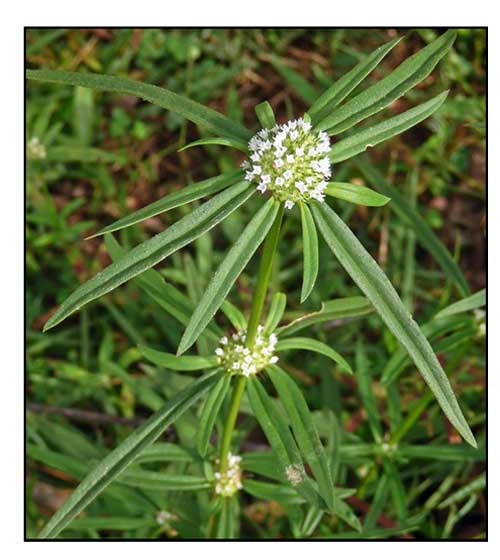
• Salasik-lupa is a spreading, diffuse, branched herb, with branches 15 to 45 centimeters long. Leaves are stalkless, rough, rigid, slender, elliptic- or linear-lanceolate, 3.5 to 6 centimeters long, 2 to 5 millimeters wide, and pointed at both ends. Flowers are borne in clusters in the axils of the leaves. Calyx-teeth are triangular. Capsules are smooth, ovoid, and 2.5 to 3 millimeters long.

• Annual often robust, but very variable. Stems 10-30cm, terete or subterete below 4 angled above, hispid. Leaves opposite sessile; Lamina elliptic or linear lanceolate, 20-55 x 1.5-10mm, acute or acuminate, base shortly attenuate, uppersurface with conspicuous epidermal cells, scabrid lower surface paler, scabrid with prominent, hispid midrib; stipules with long often brownish often filiform, sparsely hispid appendages 3-6.5mm. Flowers in sessile axillary verticilasters; pedicels c 1mm in fruit.Calyx 3-4.5mm; Tubes and lobes subequal, densely hispid. Corolla shortly campanulate; tube very short without a ring of hairs; filaments long anthers almost reaching tips of corolla lobes. Stigma slightly overlapping anthers shortly bifid. Capsule ovoid, c 2mm, hispid, loculicidal on crown only. (eFloraOfIndia)

Distribution
- Native to the Philippines.
- n open places, old clearings, and thickets at low altitudes, from northern Luzon to Mindanao, in most islands and provinces.
- Also native to
Assam, Bangladesh, Borneo, Cambodia, Caroline Is., China South-Central, China Southeast, East Himalaya, Gilbert Is., Hainan, India, Jawa, Kazan-retto, Laos, Malaya, Maluku, Myanmar, Nansei-shoto, Nepal, Nicobar Is, Sulawesi, Sumatera, Taiwan, Thailand, Vietnam, West Himalaya. (5)

Constituents
- Leaves have yielded kaempferitin, the 3,7-dirhamnoside of kaempferol.

Properties
- Studies have suggested antioxidant, NO inhibitory properties.

Parts used
Whole plant.

Uses

Edibility
- No info found on edibility.
Folkloric

- Plant used for making poultices; applied for headaches; in small children applied to abdomen for stomachaches.
- Decoction of plants drunk for dysentery.

Studies
Antioxidant / NO Inhibitory Activity:
In a study of the methanol extracts of seven Malaysian medicinal plants, including Hedyotis verticillata, all showed strong antioxidant activity comparable to or higher than α-tocopherol, BHT and quercetin in the FTC and TBA methods. In one assay, H verticillata was one of five that showed strong NO activity inhibition in LPA and IFN-g-induced RAW 264. (1)
• Phytotoxicity of Allelochemical 2,4-Di-Tert-Butylphenol: The allelochemical 2,4-di-tert-butylphenol (2,4-DTBP) is a natural compound found in medicinal plants and has been reported to possess herbicidal properties. The compound was tested on the root and leaf tissues of grassy weed, L. chinensis and broadleaf weed, Hedyotis verticillata. Results showed 2,4-DTBP could be used as a natural herbicide for control of H. verticillata and L. chinensis. (4)

Availability
Wild-crafted.

Updated December 2025 / October 2018 / April 2014

PHOTOS / ILLUSTRATIONS
IMAGE SOURCE: Scleromitrion verticillatum / © Edward Steven / CC BY-SA 4.0 International / Click on image or link to go to source page / Wikimedia Commons
OTHER IMAGE SOURCE: Scleromitrion verticillatum / © earth.com / Non-commercial use / Image modified / Click on image or link to go to source page / earth.com

Additional Sources and Suggested Readings
(1)
Evaluation of antioxidant and nitric oxide inhibitory activities of selected Malaysian medicinal plants / K Saha, N H Lajis, D A Israf et al /
Journal of Ethnopharmacology, 2004; 92(2-3): pp 263-267 / DOI:10.1016/j.jep.2004.03.007
(2)
Kaempferitrin from the leaves of Hedyotis verticillata and its biological activity / Hamzah, A.S., Lajis, N.H., Sargent, M.V. / Planta Med.- Journal of Medicinal Plant Research, 1994; 60(4): pp 388-389
(3)
Hedyotis verticillata (L.) Lamk / Vernacular names / GLOBinMED
(4)
Phytotoxic activity of the allelochemical, 2,4-Di-Tert-butylphenol on two selected weed species / T S Chuah, M Z Norhafizah, A H Naimah, B S Ismail / Universiti Kebagsaan Malaysia / Sains Malaysiana, 2016; 45(6): pp 963-967
(5)
Scleromitrion verticillatum / Synonyms / KEW: Plants of the World Online
(6)
Scleromitrion verticillatum / Wikipedia
(7)
Scleromitrion / Wikipedia

DOI: It is not uncommon for links on studies/sources to change. Copying and pasting the information on the search window or using the DOI (if available) will often redirect to the new link page. (Citing and Using a (DOI) Digital Object Identifier)

                                                            List of Understudied Philippine Medicinal Plants
                                          New plant names needed
The compilation now numbers over 1,730 medicinal plants. While I believe there are hundreds more that can be added to the collection, they are becoming more difficult to find. If you have a plant to suggest for inclusion, native or introduced, please email the info: scientific name (most helpful), local plant name (if known), any known folkloric medicinal use, and, if possible, a photo. Your help will be greatly appreciated.

HOME      •      SEARCH      •      EMAIL    •     ABOUT