HOME      •      SEARCH      •      EMAIL    •     ABOUT


Family Amaryllidaceae
Rain flower
Pancratium zeylanicum L.
JAVANESE LILY / CEYLON SPIDER LILY

Scientific names Common names
Pancratium tiarifllorusm Salisb. Ceylon spider lily (Engl.)
Pancratium uniflorum Stokes Javanese lily (Engl.)
Pancratium zeylanicum L. One-flowered pancratium (Engl.)
  Rain flower (Engl.)
  Sea daffodil (Engl.)
Pancratium zeylanicum L. is an accepted species. KEW: Plants of the World Online

Other vernacular names
SRI LANKA: Wal lunu (Sinhala).

Gen info
- Pancratium is a genus of African and Eurasian perennial, herbaceous and bulbous plants in the Amaryllis family, subfamily Amaryllidoideae. It was published by Carl Linnaeus in 1753. As of 2023, POWO lists 24 accepted species in the genus. (3)
- Pancratium zeylanicum, commonly known as Javanese Lily, is a bulbous perennial herb, sometimes grown as a hothouse container plant. It does not have a rest period unless water is withheld. It propagates by producing offsets and seed. (3)
- Etymology: The name Pancratium is derived from the Greek, meaning "all strength", probably referring to the strength of a plant that can tolerate extreme climate — species often inhabit extremely dry and sandy areas. (3) Alternatively, Pancratium derives from the Greek word "pagkration", meaning "almighty", referring to its medicinal properties. Pancratium is the most widespread of all the genera in the Eurasian clade of Amaryllidaceae. (•)

Botany
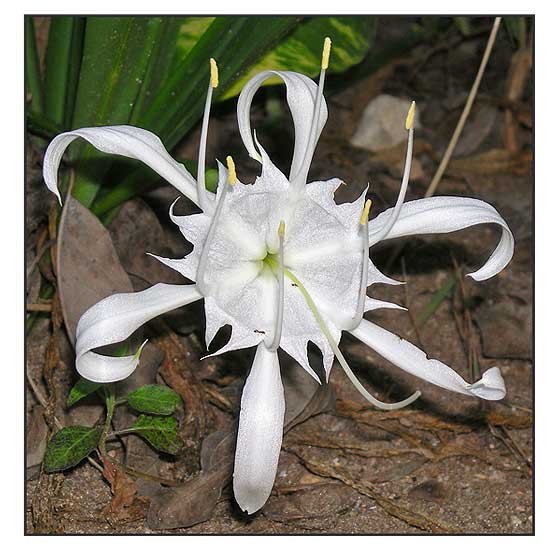
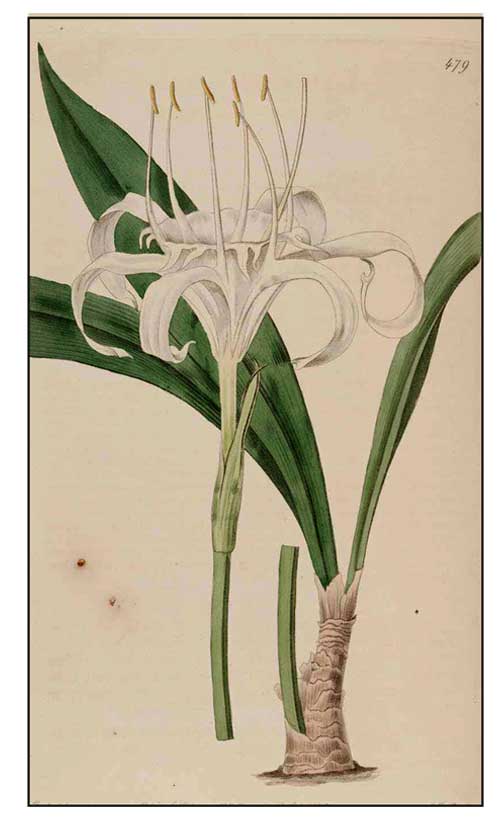
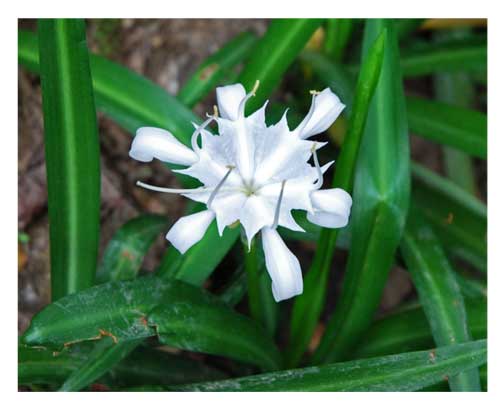
Growth form: It is a perennial herb. Foliage: Leaves 6 - 8, green, linear or elliptical in shape, and measuring around 25 cm long and 2 cm wide.  Stems: The bulb is globose in shape, measuring around 5 cm in diameter. Flowers: The flowers are solitary, growing erect, and showy white. The perianth measures 4 -5 cm long and 5 cm wide, and has 12 recurved lobes. The lobes are lanceolate in shape, acuminate apex and measuring 5 cm x 1 cm. Its filaments are 3 cm long. (Flora & Fauna Web)

• Rain Flower is a perennial herb with a spherical bulb reaching a diameter of up to 5 cm. The leaves grow out of the ground in a rosette, 6-12 in number, are lance-shaped or strap-shaped, up to 30 cm long and about 2 cm wide, hairless, dark green. Flowers appear singly on stems that are 10-20 cm long. Flowers are pure white, with 2.5-3.5 cm long flower-tube, tepals linear, 6.5-8 cm long and 4-7 mm wide, tapering, narrowly lance-shaped. Stamen filaments are erect, 3 cm long. The fruit is a capsule. (5)
Distribution
- Native to the Philippines. (1)
- Also native to Borneo, India, Jawa, Laccadive Is., Maldives, Maluku, Sri Lanka, Sulawesi. (1)
- Per Leonardo Co' Database: Naturalized. (2)
- In Biliran, Jolo; Luzon: Camarines, La Union; Palawan. (2)
- Ornamental cultivation.

Constituents
- Study of bulbs isolated three triterpenoids: hippadine (0.2%), α-amyrin acetate (0.06%), and ß-amyrin acetate (0.03%). (7)

Properties
- Studies have suggested cytotoxicity, anticancer, antioxidant properties.

Parts used
Bulbs, leaves.

Uses

Edibility
- No reports found on edibility.
Folkloric
- No reported folkloric medicinal use in the Philippines.
- In Cambodia, Laos, and Vietnam, used to treat bone injury, fractures, and bruises. In Indonesia, used to treat fever. (4)
- Bulbs are macerated with ghee and applied externally to promote suppuration of boils. (7)
- In Sri Lanka, used for treatment of cancer.   (8)


Studies
Anticancer / Bulbs:
Study of evaluated the anti-cancer activity of P. zeylanicum bulb ethanolic extract (PZBE) by MTT assay, cell cycle analysis, and apoptosis studies using different cancer cell lines. MTT assay against HeLa, (cervical cancer), HT-29 (colon cancer), A549 (lung cancer) and MCF-7 (breast cancer) cells lines showed IC50s of 208.28, 133.09, 264.46 and 264.75 µg/mL, respectively. Cell cycle analysis showed increase of populations in G2-M and G0-G1 cells by 42% and 44.78%. PZBE significantly induced cell G0-G1 arrest in A-549 cells. The PZBE also effectively induced apoptosis.
The ethanol extract of bulbs demonstrated potent cytotoxic activity against the cancer cell lines. Results suggest the PZBE extract as potential source of anticancer molecules. (6)
Antioxidant / Leaves: Study of methanolic leaf extract for antioxidant activity by DPPH radical scavenging assay showed IC50 of 0.0201 g/mL compared with standard ascorbic acid (0.019g/mL). Results suggest potent antioxidant activity, and warrants further studies for medicinal properties that can be used in cancer therapies. (7)

Availability
- Wild-crafted.
- Ornamental cultivation.

January 2026

                                                 PHOTOS / ILLUSTRATIONS
IMAGE SOURCE: en: Pancratium zeylanicum / © SMuhammad Mahdi Karim / CC BY-SA 4.0 International Deed / Click on image or link to go to source page / Wikipedia
OTHER IMAGE SOURCE: en: Pancratium zeylanicum / © Ettore Balocchi / CC BY-SA 4.0 International Deed / Click on image or link to go to source page / iNaturalist
OTHER IMAGE SOURCE: Illustration: Pancratium zeylanicum / Botanical Register, 1820 / Public Domain / Wikimedia Commons

Additional Sources and Suggested Readings
(1)
Pancratium zeylanicum / KEW: Plants of the World Online
(2)
Amaryllidaceae: Pancratium zeylanicus / Co's Digital Flora of the Philippines
(3)
Pancratium / Wikipedia
(4)
Pancratium zeylanicum / National Parks: FLORA & FAUNA WEB
(5)
Rain flower / Flowers of India
(6)
Screening of in vitro Anticancer Activity of Various Human Cancer Cell Lines and Induced Apoptosis and Cell Arrest by Ethanolic Bulb Extract of Pancratium zeylanicum / Elumalai Shanti Priya, Devaraj Sathiya Sheela, Periannan Viswanathan et al / Pharmacogn. Res., 2024; 16(4): pp 718-726 /
ORCID: 0000-0003-4189-2458
(7)
Hippadine from Pancratium zeylanicum. / A S Amarasekara, H E Gottlieb / Fitoterapia, 1993; 64(5) /
pISSN: 0367-326X / CABI Rec No: 19950303294
(8)
Comparative Study on Antioxidant Potency of Methanolic Leaf Extract of Wal Lunu Zepharantheus roseus and Pancratium zeylanicum : An Ayurvedic Remedy for Cancer Used in Sri Lanka / Jayani Dunukara, Nirmani Ann Samarakoon, Deepthi Uluwaduge / Conference: Peradeniya University International Research Sessions, 2021; Sri Lanka

DOI: It is not uncommon for links on studies/sources to change. Copying and pasting the information on the search window or using the DOI (if available) will often redirect to the new link page. (Citing and Using a (DOI) Digital Object Identifier)

                                                            List of Understudied Philippine Medicinal Plants
                                          New plant names needed
The compilation now numbers over 1,720 medicinal plants. While I believe there are hundreds more that can be added to the collection, they are becoming more difficult to find. If you have a plant to suggest for inclusion, native or introduced, please email the info: scientific name (most helpful), local plant name (if known), any known folkloric medicinal use, and, if possible, a photo. Your help will be greatly appreciated.

HOME      •      SEARCH      •      EMAIL    •     ABOUT