 |

Family • Apocynaceae
Pulasari
Alyxia reinwardtii Blume
ALYXIA CINNAMON
Chang hua lian zhu tentg
| Scientific names | Common names |
| Alyxia calcicola Markgr. | Pulasari (Adopted) |
| Alyxia cinerea Bakh.f. | Alyxia cinnamon (Engl.) |
| Alyxia flavescens Pierre ex Pit. | Blackboard tree (Engl.) |
| Alyxia forbesii King & Gamble | Devil's tree (Engl.) |
| Alyxia jasminae Tsang & P.T.Li | Forges alyxia (Engl.) |
| Alyxia kerrii D.J.Middleton | Milkwood tree (Engl.) |
| Alyxia kurzii Burkill | Scholar tree (Engl.) |
| Alyxia lucida Wall. | White cinnamon (Engl.) |
| Alyxia lucida var. meiantha Stapf | |
| Alyxia nitens Kerr | |
| Alyxia odorata Wall. ex G.Don | |
| Alyxia oleifolia var. tenuifolia Ridl. | |
| Alyxia pisiformis Pierre ex Pit. | |
| Alyxia pumila Hook.f. | |
| Alyxia quinata Miq. | |
| Alyxia reinwardtii Blume | |
| Alyxia reinwardtii var. cinerea (Bakh.f.) Markgr. | |
| Alyxia reinwardtii var. insularis Markgr. | |
| Alyxia reinwardtii var. latifolia (Blume) Bakh.f. | |
| Alyxia reinwardtii var. lucida (Wall.) Markgr. | |
| Alyxia reinwardtii var. meiantha (Stapf) Markgr. | |
| Alyxia reinwardtii var. obovatula Markgr. | |
| Alyxia reinwardtii var. pumila (Hook.f.) Markgr. | |
| Alyxia stellata var. latifolia Blume | |
| Alyxia winckelii Bakh.f. | |
| Brabejum pinnatum Blanco | |
| Gynopogon breviflorus Kurz | |
| Gynopogon flavescens Pierre | |
| Gynopogon pisiformis Pierre | |
| Gynopogon pumilus (Hook.f.) K.Schum. | |
| Gynopogon reinwardtii (Blume) Koord. | |
| Pulassarium breviflorum (Kurz) Kuntze | |
| Pulassarium flavescens Pierre | |
| Pulassarium odoratum (Wall. ex G.Don) Kuntze | |
| Pulassarium pisiforme Pierre | |
| Pulassarium pumilum (Hook.f.) Kuntze | |
| Pulassarium quinatum (Miq.) Kuntze | |
| Alyxia reinwardtii Blume is an accepted species. KEW: Plants of the World Online | |
| Other vernacular names |
| CHINA: Chang hua lian zhu teng. |
| INDONESIA: Pulasari (General), Adas pulasari, Akar mempelas hari, Areuy palasari, Areuy pulasari, Balasari, Calapari, Calpari, Das plasera, Empelas hari, Mempelas hari, Pulosari (Javanese), Palasari (Sundanese), Purasane, Talatari. |
| GERMANY: Alyxia-Zimtrinde. |
| MALAYSIA: Mempelasari, Pulasari, Akar began. |
| THAILAND: Chalut, Luut, Nut, Nuut, Chalood, Cha-loot. |
| VIETNAME: Ng[oo]n d[aa]y v[as]t. |
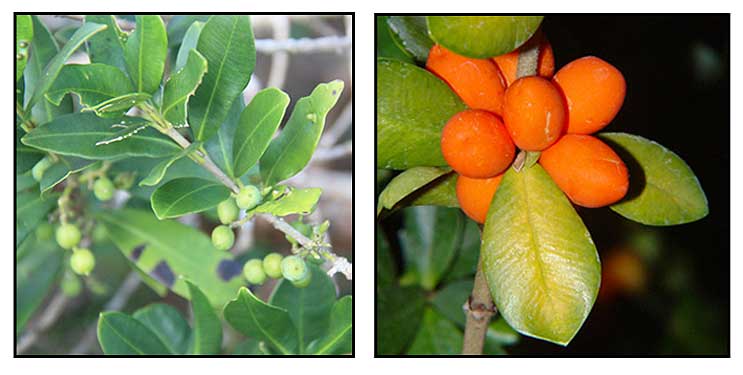 |
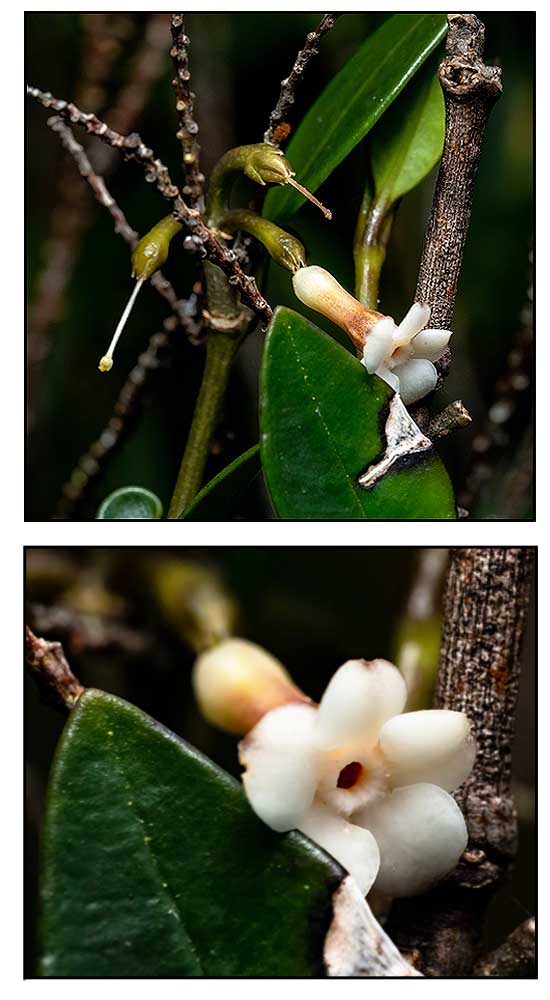
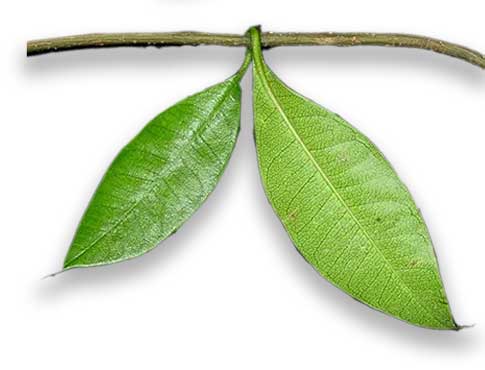
Gen info • A climbing shrub freely branching with younger branches quadrangular and pubescent. They are covered with smooth, shining, brown, or mahagony-coloured bark. Leaves: Opposite; in young branches are quatern, obovate, acute, sometimes obtuse, coriaceous, shining above and smooth, 7.5-10 cm long. Flowers: Small, yellowish white, fragrant, pubescent, and in corymbs appearing axillary. Bracts are linear, villous. Calyx is villous, deeply divided into five linear teeth. Lobe of the limb is oblong, about as long as the tube, which is a little pubescent within. Ovary is villous with capillary and long style. The stigma is sub-capitate. Drupes are two on each calyx, oval, subacute, of a pale ferruginous color, obscurely eight furrowed and single seeded. (GLOBinMED)
Properties Parts used Availability |
November 2026

 |
| PHOTOS / ILLUSTRATIONS |
| IMAGE SOURCE: Alyxia reubwardtii / © Peter Voboril / CC BY NC-SA / Image modified / Click on image or link to go to source page / BioLib.cz |
| IMAGE SOURCE: Alyxia reubwardtii / © Wangworn Sankamethawee / CC BY-NC / Image modified / Click on image or link to go to source page / iNaturalist |
| IMAGE SOURCE: Alyxia reubwardtii / © Samuel LeeSankamethawee / Some rights reserved / CC BY 4.0 International / Image modified / Click on image or link to go to source page / iNaturalist |
| IMAGE SOURCE: Alyxia reubwardtii - flower close-up/ © Samuel LeeSankamethawee / Some rights reserved / CC BY 4.0 International / Image modified / Click on image or link to go to source page / iNaturalist |
| IMAGE SOURCE: Alyxia reubwardtii leaves/ © The Total Vascular Flora of Singapore / Non-commercia use / Image modified / Click on image or link to go to source page / FloraofSingapore |
| https://www.biolib.cz/en/taxonimage/id157688/?taxonid=868173&type=1 |
| IMAGE SOURCE: Kalak kambing (Finlaysonia obovata) / © Ron Yeo / Non-commercial use / Image modified / Click on image or link to go to source page / The Tide Chaser |
| OTHER IMAGE SOURCE: Finlaysonia obovata Leaf and splitting fruit / © uforest.org / Non-commercial use / Images modified / Click on images or link to go to source page / URBANFOREST |
| OTHER IMAGE SOURCE: Finlaysonia obovata splitting fruit and seeds / © Teo Siyang / Non-commercial use / Images modified / Click on images or link to go to source page / FloraofSingapore |
| IMAGE SOURCE: Hedyotis costata / Subject Database of China Plant <http://www.naturemuseum.net/album/ShowPhoto.aspx?photoid=2671c974-77ca-44f9-b304-0f16660a06f7> Helixcn |
| OTHER IMAGE SOURCE: /Gliricidia sepium (JacqBarcelona Kunth ex Walp. - quickstick GLSE2 / Steve Hurst @ USDA-NRCS PLANTS Database / USDA |
| OTHER IMAGE SOURCE: / File:Fruit of Syzygium samarangense / Wax apple / Plate from book / Flora de Filipinas / Francisco Manuel Blanco (OSA) / Public Domain / Wikimedia Commons |
| IMAGE SOURCE: / Photos (2) / Pterocaulon redolens (Willd.) F.-Vill. / © Collected by www.plant.ac.cn / ZHIWUTONG / CLICK ON IMAGE TO GO TO SOURCE PAGE |
| IMAGE SOURCE: / Line drawing / Pterocaulon redolens (Willd.) F.-Vill. / © Collected by www.plant.ac.cn / ZHIWUTONG / CLICK ON IMAGE TO GO TO SOURCE PAGE |
| IMAGE SOURCE:Phyllantaceae : Flueggea flexuosa / Leaf / Copyright © 2018 by P B Pelser & J F Barcelona (contact: pieter.pelser@canterbury.ac.nz) [ref. DOL131909] / Non-Commercial Use / Image modified / Click on image or link to go to source page / Phytoimages.siu.edu |
| OTHER IMAGE SOURCE: / Flower close-up / dracobotanicus -- Wayne Dumbleton / Creative Commons Attribution / flickr / Click on graphic to see original image / flickr |
| OTHER IMAGE SOURCE: Mexican tea / Dysphania ambrosioides / © J Richard Abbott / Some rights reserved / NC BY-NC / Click on image or link to go to source page / iNaturalist |
| OTHER IMAGE SOURCE: / Illustration / Cissampelos pareira L. [5809-247450-161657] / Indian medicinal plants, vol. 1: t. 42 / PlantIllustrations.org |
| ebay |
| IMAGE SOURCE: Pterocaulon redolens (Willd.) F.-Vill. / © Collected by www.plant.ac.cn / ZHIWUTONG / CLICK ON IMAGE TO GO TO SOURCE PAGE / iNaturalist |
| flickr |
| iNaturalistUK |
| IMAGE SOURCE: Erythrina fusca (Ngatae fisi) / Tau'olunga / CC BY-SA 3.0 / Click on image or link to go to source page / Wikipedia |
| Pacific Island Ecosystems at Risk (PIER) |
| Photos ©Godofredo Stuart / StuartXchange |
| Content © Godofredo Stuart / StuartXchange |
| Content / Photos © Godofredo Stuart / StuartXchange |
| Photos © Godofredo Stuart / StuartXchange |
Additional
Sources and Suggested Readings |
• |
DOI: It is not uncommon for links on studies/sources to change. Copying and pasting the information on the search window or using the DOI (if available) will often redirect to the new link page. (Citing and Using a (DOI) Digital Object Identifier) |
| List of Understudied Philippine Medicinal Plants |
| New plant names needed The compilation now numbers over 1,830 medicinal plants. While I believe there are hundreds more that can be added to the collection, they are becoming more difficult to find. If you have a plant to suggest for inclusion, native or introduced, please email the info: scientific name (most helpful), local plant name (if known), any known folkloric medicinal use, and, if possible, a photo. Your help will be greatly appreciated. |
• |
 |
• |
|


