HOME      •      SEARCH      •      EMAIL    •     ABOUT


Family • Selaginellaceae
Plumed spikemoss
Selaginella biformis A. Braun ex Kuhn
BIFORMIS SPIKEMOSS
Er xing juan bai

Scientific names Common names
Kungiselaginella biformis (A.Braun ex Kuhn) Bing Zhang & M.Zhou Biformis spikemoss (Engl.)
Lycopodioides flagellifera (W.Bull) Satou Plumed spikemoss (Engl.)
Selaginella biformis A.Braun ex Kuhn  
Selaginella biformis var. cataphracta Alderw.  
Selaginella flagellifera W.Bull  
Selaginella flagelliformis G.Nicholson  
Selaginella hirticaulis Warb.  
Selaginella plumosa Chitt.  
Selaginella plumosa subsp. flagellifera (W.Bull) G.Schneid.  
Selaginella plumosa var. flagellifera Dyer  
Selaginella subaquatilis Alderw.  
Selaginella utchinensis Koidz.  
Selaginella biformis is an accepted species. KEW: Plants of the World Online
Note: For now, no indigenous name unique to the Philippines.

Other vernacular names
CHINA: Er xing juan bai.
MYANMAR: Migyaung-kunbat, Hsay-dan, Meegyaung-kun-hpat.

Gen info
- Selaginella, also known as spikemosses or lesser clubmosses is a genus of leucophute. It is the only genus in the family Selaginellaceae, with over 750 known species.
- Selaginella biformis is a species of plant in the family Selaginellaceae.

Botany
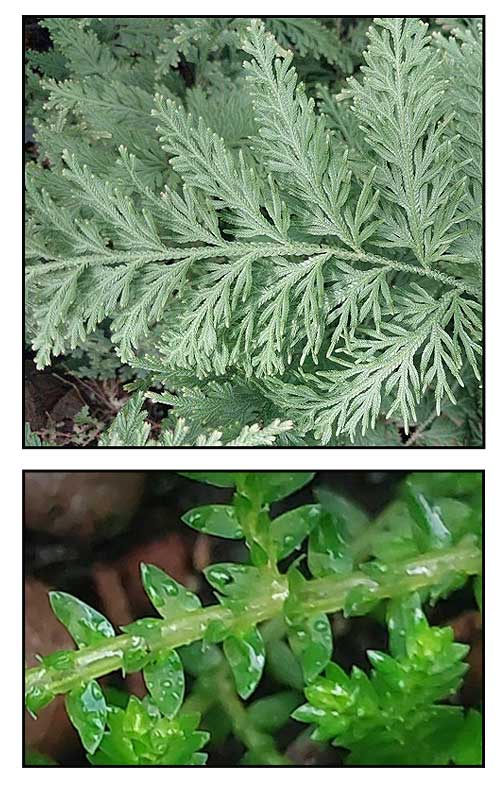
• Plants terrestrial or epilithic, evergreen, erect or creeping, 15-45 cm, with creeping subterranean rhizome and stolons. Rhizophores restricted to creeping rhizomes and stolons. Main stems branched in upper part, pinnately branched, stramineous, stem 1-1.5 mm in diam. at lower part, angulate or subquadrangular, sulcate, unbranched main stem glabrous or pubescent in leafy branched part, apex of main creeping stems flagelliform; primary leafy branches 4-7 pairs, 2 times pinnately branched, leafy branches dorsiventrally flattened, pubescent on ventral side, leafy portion of main stem including leaves 4-5 mm wide at middle, ultimate branches 2-3 mm wide including leaves. Axillary leaves on branches slightly asymmetrical, ovate-lanceolate or elliptic, 1.8-2.4 × 0.8-1.2 mm, base exauriculate, margin ciliolate at base. Dorsal leaves on branches contiguous, ovate, 0.8-1.4 × 0.6-0.8 mm, not carinate, base obliquely cordate, margin very ciliolate, apex aristate. Ventral leaves on branches contiguous or imbricate, slightly ascending, oblong-falcate or falcate, 1.8-3.2 × 1.2-1.6 mm, apex acute; basiscopic base rounded, margin subentire except base with a few cilia; acroscopic base not enlarged, not overlapping stem and branches, margin ciliolate to denticulate. Strobili solitary, terminal, compact, tetragonal, 5-15 × 1.5-2 mm; sporophylls uniform, not white-margined, ovate, sharply carinate, margin denticulate or ciliolate, apex acuminate; megasporophylls in basal portion on lower side of strobili, or megasporophylls and microsporophylls at intervals, microsporangia elliptic; microspores yellowish orange, megaspores pale yellow, whitish, or dark brown, without equatorial flange, undulate-rugose.
(Flora of China)

Distribution
- Native to the Philippines. (1) (2)
- Widespread.
- In Biliran, Bohol, Leyte, Negros, Palawan; In Luzon: Albay, Bataan, Batangas, Benguet, Bulacan, Cagaya, Camarines Sur, Ilocos Norte, Kalinga, Laguna, Mountainn Province, NCR, Nueva Ecija, Nueva Vizcaya, Pampanga, Pangasinan, Quezon, Rizal, Sorsogon, Zambales; in Mindanao: Agusan del Norte, Bukidnon, Cotobato, Davao, Lanao del Sur, South Cotobato, Zamboanga del Sur. (1)
- Also native to Assam, Bangladesh, Borneo, Cambodia, China South-Central, China Southeast, East Himalaya, Hainan, Jawa, Laos, Lesser Sunda Is., Myanmar, Nansei-shoto, New Guinea, Nicobar Is., Sulawesi, Sumatera, Thailand, Vietnam. (2)

Constituents
- No studies found.

Properties
- Studies have suggested anti-inflammatory, acetylcholinesterase inhibitory properties.

Uses

Edibility
- While not a standard culinary vegetable, the plant is non-toxic and consumed in limited regional contexts.
Folkloric
- No reported medicinal use in the Philippines.
- In Kali Gandaki Watershed, Nepal used for treatment of cuts and wounds. (4)

Studies
• Acetylcholinesterase Inhibitory Activity / Anti-Inflammatory:
In a study of 8 Selaginella species for anti-acetylcho-linesterase effect, inhibitory activity was mostly discerned in DCM extracts and only in extracts of Selaginella biformis, S. myosuroides, S. cupressina, and S. apoda, with IC50s in range of 19 to 62 mg/L. S. biformis also halved the production of NO, TNF-α, and IL-6 at concentrations of 105, 11, and 10 mg/L, respectively. (3)

Availability
- Wild-crafted.

October 2026

                                                 PHOTOS / ILLUSTRATIONS
IMAGE SOURCE: Selaginella biformis / by Chhe / Public Domain / Click on image or link to go to source page / Wikipedia
OTHER IMAGE SOURCE: Selaginella biformis / by Chérif-Jacques Allali / Pl@ntNet / CC BY-SA / 2 images / Click on image or link to go to source page / Pl@ntNet

Additional Sources and Suggested Readings
(1)
Selaginellaceae: Selaginella biformis / Co's Digital Flora of the Philippines
(2)
Selaginella biformis / KEW: Plants of the World Online

(3)
Comparison of Chemical Composition and Biological Activities of Eight Selaginella Species / Bara Krizkovska,Rohitesh Kumar, Katerina Rehorova, Jan Lipov, Jitka Viktorova et al / Pharmaceuticals, 2021; 14(1): 16 / DOI: 10.3390/ph14010016
(4)
Forests and Human Health: Assessing the Evidence: CIFOR Occasional Paper No 45 / Carol J Pierce Colfer et al

•

DOI: It is not uncommon for links on studies/sources to change. Copying and pasting the information on the search window or using the DOI (if available) will often redirect to the new link page. (Citing and Using a (DOI) Digital Object Identifier)

                                                            List of Understudied Philippine Medicinal Plants
                                          New plant names needed
The compilation now numbers over 1,830 medicinal plants. While I believe there are hundreds more that can be added to the collection, they are becoming more difficult to find. If you have a plant to suggest for inclusion, native or introduced, please email the info: scientific name (most helpful), local plant name (if known), any known folkloric medicinal use, and, if possible, a photo. Your help will be greatly appreciated.
•

•
HOME      •      SEARCH      •      EMAIL    •     ABOUT