HOME      •      SEARCH      •      EMAIL    •     ABOUT  •     DONATE


Family Fabaceae
Pink uraria
Basing
karan
Uraria lagopodioides (L.) DC.
HARE'S FOOT PLANT
Li wei dou

Scientific names Common names
Doodia alopecuroides Roxb. Basing karan (Bagobo)
Doodia lagopodioides (L.) Roxb. Ikug-kuting (Subanun)
Hedysarum cercifolium (Desv.) Steud. Hare's foot plant (Engl.)
Hedysarum lagopoides Burm.f. Pink uraria (Engl.)
Hedysarum lagopodioides L. Tick trefoil (Engl.)
Lespedeza lagopoides (Burm.f.)  
Uraria aequilobata Hosok.  
Uraria alopecuroides Sweet ex Wight  
Uraria cercifolia Desv.  
Uraria cylindracea Benth.  
Uraria lagopoda St.-Lag.  
Uraria lagopodioides (L.) DC.  
U. lagopodioides var. alopecuroides (Roxb.) A.Pramanik & Thoth.  
Uraria retusa Wall.  
Uraria lagopodioides is an accepted species. KEW: Plants of the World Online

Other vernacular names
CAMBODIA: Kantuy kam prok.
CHINA: Li wei dou.
FIJI: Lakanikasa, Lakanirase, Setamoli.
INDIA: Chakulia, Chakule, Bandarjhuti, Isharjata, Lata-chakuley, Gurkha0chakulia, Golak-chakulia (Bengali); Pithran (Hindi); Laageli, Nadiyaala bone, Naribaalada gida (Kannada); Davala, Peethavana (Marathi); Prisnee Paarnee, Seto bhatte (Nepali); Prysnipornni (Oriya); Kalasi (Sanskrit); Chithamalli, Orilai-palai (Tamil);Anghriparnika, Nakkatokaponna (Telugu);Prasiparni, Pitharana (Urdu).
INDONESIA: Ekor tupai, Buntut rase (Javanese), Rai-rai (Ternate).
LAOS: Bai khi:z hno:n no:yz, Ha:ng ma:z.
MALAYSIA: Pokok korat tanah, Ekur anjing.
NIUE: Uluhenga.
SAMOA: Lala.
THAILAND: Ya-hangon.
TONGA: Hiku 'i pusi, Iku 'i pusi.
VIETNAM: Duoi chon.

Gen info
- Fabaceae or Leguminosae, commonly known as the legume pea, or bean family, is a large and agriculturally important family of flowering plants that includes trees, shrubs, and perennial or annual herbaceous plants, which are easily recognized by their fruit (legume) and their compound, stipulate leaves. It is widely distributed and is the third largest land plant family, behind only Orchidaceae and Asteraceae, with about 765 genera and nearly 20,000 known species.
- Uraria is a genus of plants in the legume family, Fabaceae. It includes 24 species of shrubs, sub-shrubs, and perennial herbs native to tropical and subtropical regions of the Old World, particularly Africa and Asia. (3)
- Uraria lagopodioides is a species of flowering plant in the family Fabaceae.
- Taxonomy: The genus was first described by Nicaise Augustin Desvaux in 1813 in the Journal de Botanique Agricole, as a member of the family Fabaceae. (3)
- Etymology: The scientific name derives from Greek and Latin roots describing the tailed flower clusters and furry, hare-like flower heads. The genus name Uraria derives from Ancient Greek word oura, meaning "tail."The species epithet lagopodioides derives from lagopus, lagos (hare) pous (foot), and eides (resembling or similar to), meaning "hare's foot,"describing the wooly appearance of the dense hairs on the plant.

Botany
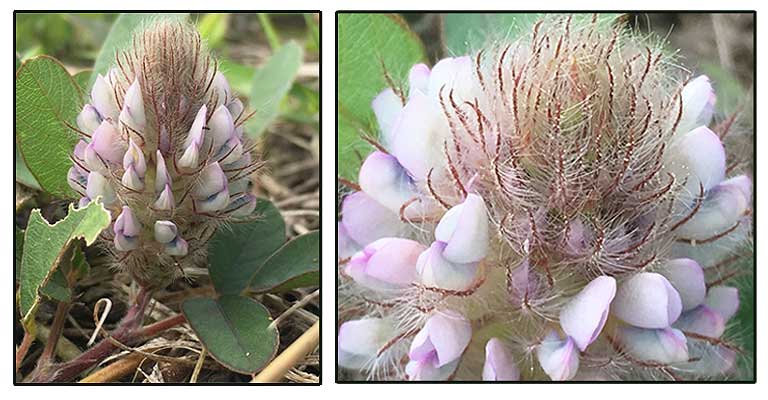
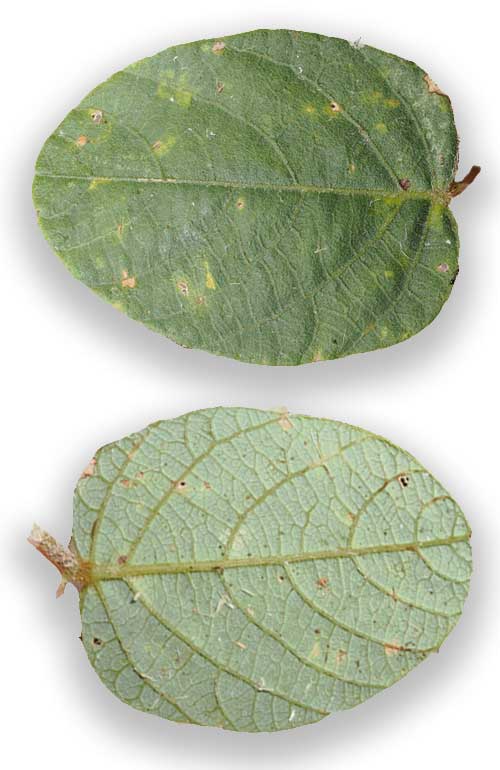
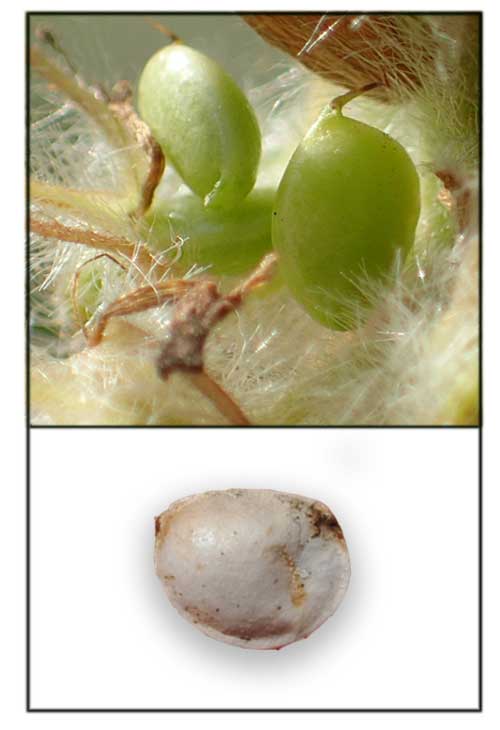
Herbs, prostrate or spreading, to 60 cm tall. Leaves mostly 3-foliolate, rarely 1-foliolate; petiole 1-2 cm; terminal leaflet blade nearly orbicular or elliptic to ovate, 2-6 × 1.5-3 cm, abaxially gray-yellow pubescent, base rounded or cordate, apex rounded or emarginate. Racemes terminal, 3-6 cm, densely flowered. Pedicel ca. 4 mm, sparsely white villous. Calyx 5-parted; lower lobes ca. 2 × as long as upper ones, white villous. Corolla pale purple, ca. 6 mm; standard obovate, base attenuate. Ovary glabrous, 1- or 2-ovuled. Legume enclosed by calyx, black-brown at maturity, small; articles 1 or 2, elliptic, ca. 2.5 mm, swollen, glabrous, slightly lucid. (Flora of China)

• Suffrutescent herb, often creeping, up to 1.5 m long. Branches terete, densely pubescent, glabrescent. Leaves alternate, partially 3-foliolate, partially or rarely all 1-foliolate; petiole up to 4 cm long; stipules lanceolate, 4-8 mm long, acuminate, persistent; stipels 1-4 mm long; leaflets variable, elliptical or ovate, 2.5-7 cm × 1-6.5 cm, apex obtuse or slightly emarginate, lower surface densely hairy. Inflorescence a simple, terminal, dense, cylindrical pseudoraceme, 2.5-10 cm long; bracts ovate, acuminate, 6-8 mm long, containing 2 flowers, silky, persistent; pedicel 4-8 mm long, densely pubescent. Calyx campanulate, 7 mm long; corolla 5-6 mm long, pinkish violet or bluish violet; standard broadly obovate, 5-7 mm × 4.5-6.5 mm; wings 2 mm long, with short claw; keel longer than wings, curved. Pod 1-2-jointed, joints up to 3 mm long, gray or black. Seed 2 mm × 1.2 mm, brown. (PROSEA)

Distribution
- Native to the Philippines. (1) (2)
- From north Luzon to Mindanao.
- In open grasslands at low and medium elevation, often abundant. (2)

- Also native to Andaman Is., Assam, Bangladesh, Bismarck Archipelago, Borneo, Cambodia, China South-Central, China Southeast, East Himalaya, Fiji, Hainan, India, Jawa, Laos, Lesser Sunda Is., Malaya, Myanmar, Nansei-shoto, Nepal, New Caledonia, New Guinea, New South Wales, Nicobar Is., Northern Territory, Queensland, Samoa, Sumatera, Taiwan, Thailand, Vanuatu, Vietnam, Wallis-Futuna Is., West Himalaya, Western Australia. (1)

Constituents
- Flavonoids are the principal constituents. Whole plant contains carbohydates, flavonoids, glycosides, alkaloids, saponins, steroids, and tannins. Stems and leaves contain alkaloids, glycosides, and sterol. Root contains alkaloids, glycosides, steroids, tannins, saponins, and flavonoids. (5)

Properties
- Studies have suggested antidiarrheal, antioxidant, anti-inflammatory, analgesic properties.

Parts used
Roots, leaves, aerial parts.

Uses

Edibility
- No information found on edibility.
Folkloric
- No reported medicinal use in the Philippines.
- In China, whole plant used to relieve swelling.
- Decoction of leaves and roots used for treatment of dysentery and diarrhea.
- Aqueous extract of leaves has abortifacient properties.
- In Bangladesh, traditionally used as abortifacient, aphrodiasiac, and laxative; used for remittent fever, asthma, dysentery, chest inflammation, rheumatisms, bleeding hemorrhoids, catarrh, and scorpion stings.    (5)
- In Ayurveda, used as topical treatment for minor cuts, insect bites, and joint pains. In Tamil Nadu, leaves are chewed or applied as poultice for dental aches.
- In India, aqueous and alcoholic extracts of plants used for treatment of intermittent fever and chest inflammation. Aqueous extract of leaves reported to have abortifacient properties. (7)
Others

- Pesticide: Used as a natural pesticide.
- Agroforestry: As a legume, it helps fix nitrogen in farm soils. Also used as green manure plant crop in rubber plantations.

Studies
Antidiarrheal:
Study evaluated the antidiarrheal effects of U. lagopodioides using castor oil-induced diarrhea and castor oil-induced enteropooling in rats. Extract showed significant (p<0.001) dose-dependent protection against castor oil-induced diarrhea and enteropooling at 400 mg/kg. Loperamide (3 mg/kg p.o) was reference drug. (8)
Antioxidant : Study evaluated the antioxidant activity of various extracts (ethyl acetate EA, acetibe AE, and 95% ethanol EE) of U. lagopodioides. Total flavonoid content of EAE, AE, and EE were 74.0, 65.7, and 84.2 g/kg, respectively. Results showed good scavenging activities on ABTS, DPPH, and reducing power. The ethanol extract showed best activity with IC50s of 0.52, 1.36, and 4.88 g/L, respectively. Results suggest potential as natural oxidants and health care products. (9)
Anti-Inflammatory / Analgesic / Aerial Parts: Study evaluated the anti-inflammatory and analgesic activities of aerial parts of U. lagopodioides. At doses of 100 and 200 mg/kg orally, the extract exhibited significant inhibition (p<0.01) of rat paw edema. In acetic acid-induced writing, it showed marked analgesic activity in mice (p<0.01) compared with stylistically acid (100 mg/kg). (10)

Availability
- Wild-crafted.
- Seedlings in the cybermarket.

August 2026

                                                 PHOTOS / ILLUSTRATIONS
IMAGE SOURCE: Pink uraria (Uraria lagopodioides) - flower close-up / by 葉子 / No rights reserved / PUBLIC DOMAIN / Click on image or link to go to source page / iNaturalist
IMAGE SOURCE: Pink uraria (Uraria lagopodioides) / © Ann Lazaro / Some rights reserved / CC BY-SA 4.0 / Click on image or link to go to source page / iNaturalist
IMAGE SOURCE: Pink uraria (Uraria lagopodioides) flower close-up / © Ann Lazaro / Some rights reserved / CC BY-SA 4.0 International / Click on image or link to go to source page / iNaturalist
IMAGE SOURCE: Pink uraria (Uraria lagopodioides) / © Thomas Mesaglio / Some rights reserved / CC BY-SA 4.0 / Click on image or link to go to source page / iNaturalist iNaturalist

Additional Sources and Suggested Readings
(1)
Uraria lagopodioides / KEW: Plants of the World Online

(2)
Fabaceae: Uraria lagopodioides / Co's Digital Flora of the Philippines
(3)
Uraria / Grokipedia
(4)
Uraria lagopodioides / Ken Fern: Tropical Plants Database
(5)
A Phyto-Pharmacological-BasedReview on Uraria lagopodies / Muhammad Torequl Islam / Journal of Cancer Biology & Research, 2017; 3(2): 1100
(6)
Uraria lagopodioides / Dr Sara Garg / Ask Ayurveda
(7)
Uraria lagopodioides / MSM Sosef & LJG van der Maesen / PROSEA: Plant Resources of South-East Asia
(8)
Research Article In-vivo Evaluation of Antidiarrhoeal Activity of Ethanolic Extract of Uraria lagopoides (L.)
/ Konda Ravi Kumar, V Nuthakki / Semantic Scholar / Corpus ID: 59405358
(9)
Antioxidant Activity of Different Extracts of Uraria lagopodioides
/ Deng Yan-Hong / Chinese Journal of Experimental Traditional Medical Formulae / Corpus ID: 100665519
(10)
Anti-inflammatory and Analgesic Activity of Uraria lagopoides /
Hinna Hamid, Tarique Abdulllah, Asif Al, SH Ansari et al / Pharmaceutical Biology, 2004; 42(2): pp 114-116 / DOI: 10.1080/13880200490510892

DOI: It is not uncommon for links on studies/sources to change. Copying and pasting the information on the search window or using the DOI (if available) will often redirect to the new link page. (Citing and Using a (DOI) Digital Object Identifier)

                                                            List of Understudied Philippine Medicinal Plants
                                          New plant names needed
The compilation now numbers over 1,750 medicinal plants. While I believe there are hundreds more that can be added to the collection, they are becoming more difficult to find. If you have a plant to suggest for inclusion, native or introduced, please email the info: scientific name (most helpful), local plant name (if known), any known folkloric medicinal use, and, if possible, a photo. Your help will be greatly appreciated.

HOME      •      SEARCH      •      EMAIL    •     ABOUT