 Gen info Gen info
- Meiogyne is a genus of flowering plants in the family Annonnaceae, containing 38 species.
- Meiogyne cylindrocarpa, known as fingersop or native apricot in Australia, is a small tree of shrub in the custard family Annonaceae, native to to parts of tropical Asia and Australasia. (3)
- Taxonomic journey: The plant was first described in 1909 as Mitrephora cylindrocarpa by Dutch botanist William Burck, and published in the book Nova Guinea. In 1845 it was transferred to the genus Polyaulax by another Dutch botanist, Cornelis Andries Backer, and transferred anew in 1994 by E.C.H. van Heusden from the Netherlands, and given the current combination Meiogyne cylindrocarpa. (3)
-
Etymology: The genus name Meiogyne derives from Greek words that refer to the small number of female reproductive parts in the flower: Meion, meaning "smaller" or "less" in Ancient Greek, and gyne, meaning "female", referring to the carpels or ovaries of the flower. The specific epithet cylindrica derives from Latin, referring to the cylinder-shaped fruits.
Botany
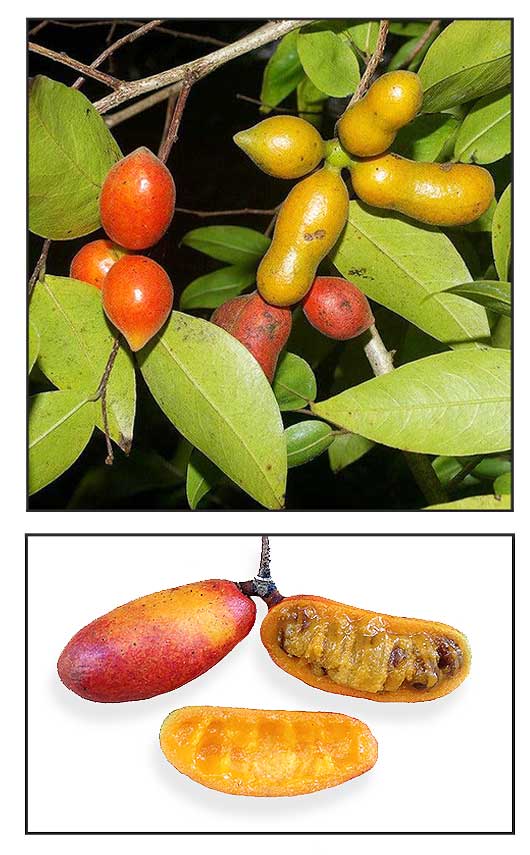
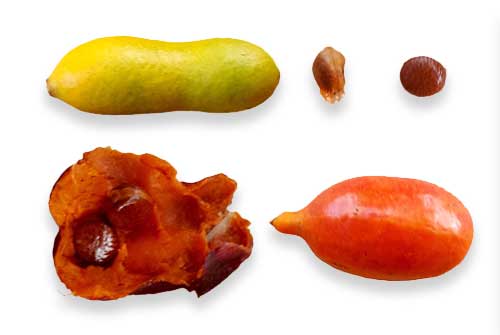
• Meiogyne cylindrocarpa is an evergreen rainforest plant with an open habit, growing up to 10 m (33 ft) high, and perhaps 20 m (66 ft). Dark green leaves are held on petioles about 1.5 to 3 mm (0.06 to 0.12 in) long, and measure up to 9.6 cm (3.8 in) long by 4.3 cm (1.7 in) wide, with 7 to 13 pairs of secondary veins, glossy above and glabrescent (minutely hairy) underneath. Flowers may be solitary or paired, with six fleshy, triangular petals arranged in two whorls of three. Outer petals measure up to 10 mm (0.39 in) long by 7 mm (0.28 in) wide. Fruits are elongated and cylindrical in shape, 3.3 cm (1.3 in) long and 1.6 cm (0.63 in) diameter, initially green, becoming orange or red when ripe, containing up to 9 disc-like seeds up to 9 mm diameter. Fruits are edible and sweet, similar to a sapodilla with a floral flavour. (3)
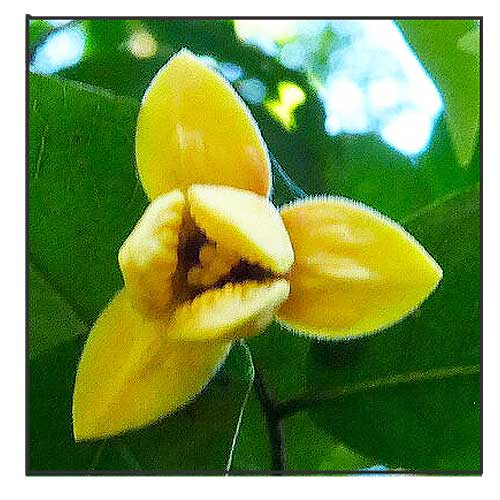 • A small tree up to 20 m tall and 30 cm dbh. Leaves alternate, simple, 3.5-5.5 x 1.5-2.5 cm. Oil dots visible with a lens. Twig bark strong and fibrous when stripped. Buds and young shoots clothed in cream or pale brown hairs. Inflorescence 1-4 flowered, appear terminal or axillary, solitary. Flowers 12-13 mm across, white-yellow. Bracts 3-5, about 0.7-2 x 0.8-1.4 mm. Pedicels about 4-7 mm long, pubescent. Sepals depressed ovate to ovate, about 1-3 x 1-3.5 mm, pubescent outside, glabrous inside. Petals slightly imbricate or valvate at the apex, spreading, narrowly to broadly (triangular-)ovate to elliptic. Outer 3 petals about 5-22 x 3-8 mm wide. Inner 3 petals about 5-16 x 3-6.5 mm, pubescent on both sides. Stamens ca. 28, about 1.2-2 mm long, apex shield-like, elongated in the inner whorl. Ovaries 2-14, densely hairy. Ovules 6 or 7 per ovary. Stigma globose to discoid or to oblong-obovoid, fleshy, sparsely hairy or glabrous. Fruiting carpels 5-10 per fruit, bright red when ripe, each about 12-40 mm long, sausage-shaped and clothed in short velvety hairs. Seeds about 7-9 x 4-6 mm, 1-3 per fruiting carpel. (AsianPlantNet) • A small tree up to 20 m tall and 30 cm dbh. Leaves alternate, simple, 3.5-5.5 x 1.5-2.5 cm. Oil dots visible with a lens. Twig bark strong and fibrous when stripped. Buds and young shoots clothed in cream or pale brown hairs. Inflorescence 1-4 flowered, appear terminal or axillary, solitary. Flowers 12-13 mm across, white-yellow. Bracts 3-5, about 0.7-2 x 0.8-1.4 mm. Pedicels about 4-7 mm long, pubescent. Sepals depressed ovate to ovate, about 1-3 x 1-3.5 mm, pubescent outside, glabrous inside. Petals slightly imbricate or valvate at the apex, spreading, narrowly to broadly (triangular-)ovate to elliptic. Outer 3 petals about 5-22 x 3-8 mm wide. Inner 3 petals about 5-16 x 3-6.5 mm, pubescent on both sides. Stamens ca. 28, about 1.2-2 mm long, apex shield-like, elongated in the inner whorl. Ovaries 2-14, densely hairy. Ovules 6 or 7 per ovary. Stigma globose to discoid or to oblong-obovoid, fleshy, sparsely hairy or glabrous. Fruiting carpels 5-10 per fruit, bright red when ripe, each about 12-40 mm long, sausage-shaped and clothed in short velvety hairs. Seeds about 7-9 x 4-6 mm, 1-3 per fruiting carpel. (AsianPlantNet)
Distribution
- Native to the Philippines. (1)
- In rain forest, on limestone or on red or sandy soil; 0-1450 m.
- In Luzon: Camarines Norte, Camarines Sur, Nueva Ecija, Rizal; Palawan, Panay.
(1)
- Also native to Borneo, Jawa, Marianas, New Guinea, Northern Territory, Queensland, Vanuatu, Western Australia. (2)
 Constituents Constituents
- Study of EtOAc bark extract isolated two new enyne- and four newenediyne-γ-lactones, sapranthins A-G (2-7). (see study below) (5)
- Study has shown M. cylindrocarpa to contain azafluorene alkaloid, aporphine alkaloids, oxoaporphine alkaloids, and sesquiterpenes.
(7)
- Study of the only 3 Meiogyne species found in Malaysia, M. cylindrocarpa, M. monosperma, and M. virgata, yielded azafluorene alkaloid, kinabaline, together with liriodenine, cleistopholine and other aporphine alkaloids. (8)
Properties
- Studies have suggested antiapoptotic protein inhibitor, cytotoxicity properties.
Parts used
Bark.
Uses
Edibility
- Fruit is edible; sweet, sapodilla-like with floral undertones.
Folkloric
- No info found on folkloric medicinal use in the Philippines.
Others
- Host plant: It is a host plant for the pale green triangle butterfly Graphium eurypulus. (3)
Studies
• Antiapoptotic Protein Inhibitor / Meiogynin A / Bark: In a search for potent inhibitors of antiapoptotic protein Bcl-xL frp, 1470 Malaysian plant extracts. An ethyl acetate extract of M. cylindrocarpa bark was selected for its interaction weith Bcl-xL/Bak association. Bioassay-guided purification isolated two new dimeric sesquiterpenoids (1,2). Meiogynin A (1) showed strongest activity with a Ki of 10.8 µM. (4)
• Sapranthins / Cytotoxicity / Bark: EtOAc bark extract isolated two new enyne- and four newenediyne-γ-lactones, sapranthins A-G (2-7). Sapranthins B, C, and E (2,3, and 5) showed weak cytotoxic activity against L1210 tumor cell line with IC50s between 9.1 and 18.0 mµM. (5) Saprathines B-E isolated from bark extracts of M cylindrocarpa exhibited cytotoxicity against mouse lymphocytic leukemia. (6)
• DST (Dimeric Sesquiterpenoid) / Meiogynin A / Bark: Study on dimeric sesquiterpenoids suggest they may enhance activity and binding affinity to molecular targets due to increased number of alkylating centers and improved flexibility and lipophilicity. Meiogynin A isolated from the bark was identified as a novel inhibitor of Bcl-xL/Bcl-2 antagonist killer 1 (Bak) binding with a Ki value of 10.8 µmol. The compound was found to have inhibitory effects on myeloid cell leukemia-1 (Mcl-1)/BH3 interacting domain death agonist (Bid) binding with a Ki value of 5.2 µmol.L. The dual targeting effects of meiogynin A result in cancer cell death and apoptosis. (9)
Availability
- Wild-crafted.
- Ornamental cultivation. |


