HOME      •      SEARCH      •      EMAIL    •     ABOUT


Family Fabaceae
Orange tick-clover
Hylodesmum repandum (Vahl) H.Ohashi & R.R.Mill
BEGGAR LICE / ORANGE TICK-TREFOIL
Qian bo ye change bing shan ma huang

Scientific names Common names
Aeschynomene remota Poir. Beggar lice (Engl.)
Desmodium abyssinicum DC. Hitchhikers (Engl.)
Desmodium afrum Eckl. & Zeyh. Orange desmodium (Engl.)
Desmodium aparine Chiov. Orange tick-clover (Engl)
Desmodium remotum (Poir.) Drake Orange tick-trefoil (Engl)
Desmodium repandum (Vahl.) Poir. Waxy-leaf desmodium (Engl.)
Desmodium scalpe DC.  
Desmodium schimperi Hochst. ex A.Rich.  
Desmodium strangulatum Wight & Arn.  
Desmodium strangulatum var. parvulum Miq.  
Desmodium trichocaulon Hassk.  
Hedysarum abyssinicum Hoffmanns.  
Hedysarum ignescens Zipp. ex Miq.  
Hedysarum repandum Vahl  
Hedysarum scalpe Comm. ex DC.  
Hylodesmum repandum (Vahl) H.Ohashi & R.R.Mill  
Meibomia repanda (Vahl) Kuntze  
Meibomia scalpe (DC.) Kuntze  
Papilionopsis stylidioides Steenis  
Pleurolobus remotus (Poir.) J.St.-Hil.  
Podocarpium repandum (Vahl) Yen C.Yang & P.H.Huang  
Hylodesmum repandum is an accepted species. KEW: Plants of the World Online

Other vernacular names
AFRICA: Kirhuza likasi, Kirhuza lilume (Shi).
CHINA: Qian bo ye chang bing shan ma huang, Ba qia ye tie xian lian.
FRANCE: Fausse pistache marronne.
WEST CAMERROONS: Bamileke mmerku mini.

Gen info
- Hylodesmum is a genus of f16 species of perennial herbs or flowering plants in the family Fabaceae, characterized by trifoliolate leaves with pinnate venation.
- Historically, the species of Hylodesmum were classified within the larger genus Desmodium, but morphological differences, its unique pod structure, along with molecular phylogenetic analysis, supported its recognition as a distinct monophyletic group.
- Hylodesmum was formally established in 2000 by Hiroyuki Ohashi and Robert R.Mill to replace the invalid homonym Podocarpium.
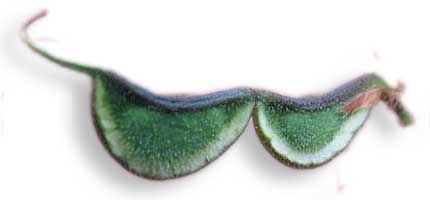
- Etymology: The genus name Hylodesmum derives from Greek words hylos, meaning "wood" or "forest", and desmos, meaning a "bond" or "chain", referring to its preferred forest habitat and the jointed pod which resembles links of a chain. (7)

Botany
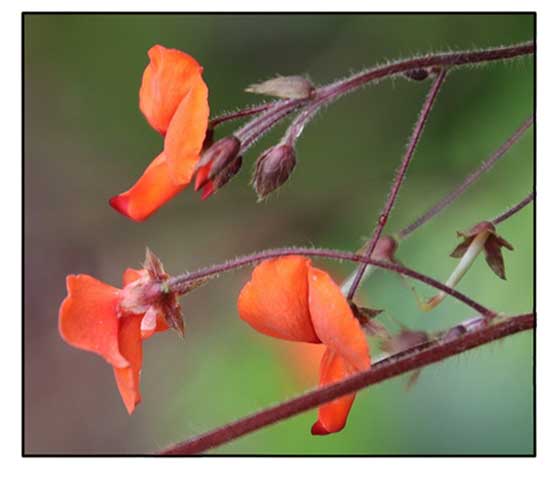
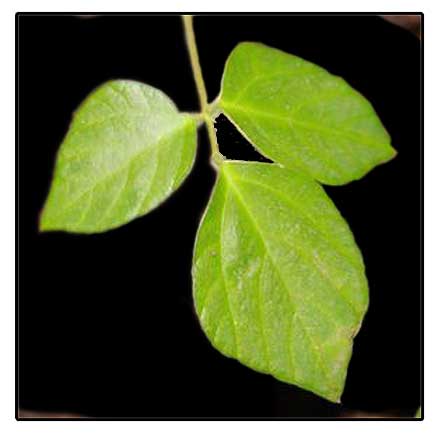
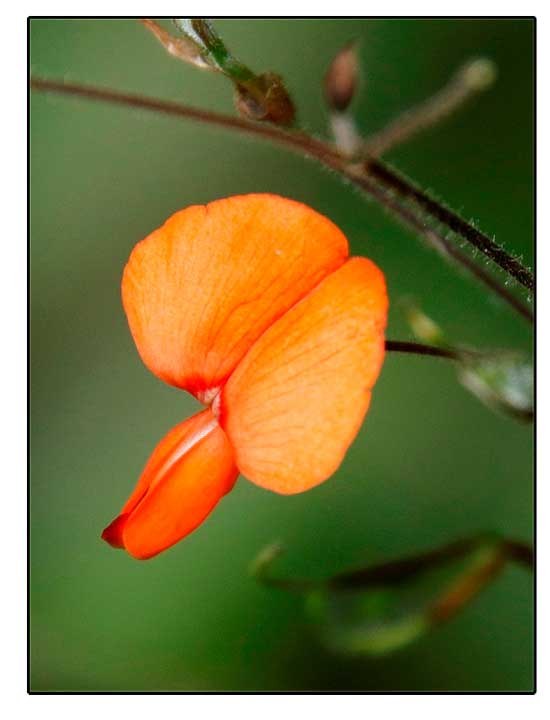
Subshrubs, erect, 50-150 cm tall. Stem and petiole spreading pubescent. Leaves 3-foliolate; petiole 3-9 cm; leaflet blade rhombic to ovate, 5-8 × 3.5-6 cm, both surfaces sparsely to densely adpressed hairy, more densely especially on veins abaxially, base cuneate, margin repand, apex acute to shortly acute. Racemes or sometimes panicles, terminal or often termi­nal and axillary, 15-30 cm. Pedicel 1.5-3 cm, with spreading straight or uncinate hairs. Calyx 2.5-3.5 mm; lobes longer than or equal to tube. Corolla red or orangish red; standard broadly elliptic, 8-10 × 7-8 mm, shortly clawed; wings narrowly ellip­tic, ca. 7 × 2 mm, clawed; keel ca. 10 × 3 mm, clawed. Legume often 3- or 4-jointed; articles slightly broadly subobovate, 6-3 × ca. 3 mm, densely uncinate pubescent; stipe ca. 5 mm; fruiting pedicel 2-4 cm.
(Flora of China)

• Undershrubs; branches slender. Leaves few; leaflets to 20 x 6 cm, ovate, acuminate, rounded at base, glabrous above, adpressed pubescent below; nerves finely reticulated below; stipules ovate, acuminate. Flowers in panicled racemes, terminal or axillary; rachis tomentose, to 25 cm long; calyx 4-lobed, campanulate; standard to 10 mm across, reddish, orbicular, retuse at apex. Joints of pod 2 or 3, to 1.5 x 0.6 cm, falcate, densely covered with hooked hairs. (eFloraOfIndia)

Distribution
- Native to the Philippines. (1)(2)
- In Luzon: Benguet, Mountain Province; in Mindanao: Bukidnon, Soouth Cotobato. (2)
- Montane thickets and ravines. 1200-2200m.
- Also native to
Angola, Assam, Borneo, Burundi, Cameroon, Cape Provinces, China South-Central, Comoros, DR Congo, East Himalaya, Equatorial Guinea, Eritrea, Eswatini, Ethiopia, Gabon, Guinea, Gulf of Guinea Is., India, Jawa, Kenya, KwaZulu-Natal, Laos, Lesser Sunda Is., Madagascar, Malawi, Malaya, Maluku, Mozambique, Myanmar, New Guinea, Nigeria, Northern Provinces, Rwanda, Sierra Leone, Sri Lanka, Sudan-South Sudan, Sulawesi, Sumatera, Tanzania, Thailand, Uganda, Vietnam, Yemen, Zambia, Zimbabwe. (1)

Constituents
- Phytochemical screening of ethanol leaf extract yielded presence of anthocyanin, phenolic compounds, coumarins, flavonoids, quinones, tannins, sterols, and triterpenes. (see study below) (7)
- GC-MS analysis of methanolic extract of leaves revealed 14 compounds, with major compounds: Palmitic acid (12.95%), N-acetyltyramine (8.28%), Propan one, i-hydroxy-3(4-hydroxy-3-methoxyphenyol) (4.99%), and tyrosol (3.41%). (9)

Properties
- Studies have suggested hepatoprotective, antiplasmodial, antioxidant properties.

Parts used
Leaves, flowers, roots.

Uses

Edibility
- Seeds are edible; cooked, gound into a powder, or steamed.
Folkloric
- No reported medicinal use in the Philippines.
- Roots used for treatment of stomach troubles. (4)
- In Ethiopia, traditional healers crush fresh leaves and apply the paste over the body for rheumatism.(6)
- In Rwanda, filtrate of herbal mix of crushed leaves of Desmodium repandum, Clematis sinensis, Maesa lanceolata, Kalanchoe integra and Mitragyna subrostipulosa taken orally for rheumatism. Herbal mix of crushed leaves applied to wounds. Leaves also used for treatment of anorexia.
- In Democratic Republic of Congo (DRC) traditional medicine, used for treatment of malaria. In the Uvaria region, aqueous decoction or infusion of leaves or flowers used for treatment of dysmenorrhea, female sterility, malaria, and new-born colic. Also used for treatment of anorexia, asthenia, diarrhea, dehydration, gastric ulcers, and liver inflammation. (9)
Others

- Agroforestry: Plants used as green manure and ground cover. Grows well in shade and appears suitable as cover crop for coffee and other plantation crops. (4) Plant has symbiotic relationship with nitrogen-fixing bacteria, which help in enriching the soil.
- Fodder: A good source of fodder for cows.

Studies
Hepatoprotective / Paracetamol-Induced Liver Injury / Leaves:
Study evaluated the in vivo hepatoprotective potential of ethanolic extract of leaves of Desmodium repandum in hepatotoxicity induced by oral paracetamol at 500 mg/kg in male guinea pigs. Silymarin was used as reference drug. At dose of 200 mg/kg, the extract significantly reduced (p<0.05) the levels of aspartate transaminase (AST), alanine transaminase (ALT), and total bilirubin. Results demonstrated the hepatoprotective potential of ethanolic extract of D. repandum. (5)
Antiplasmodial / Antioxidant / Aerial Parts: Study evaluated the potential of methanolic extracts of four plants used in traditional medicine in the Democratic Republic of Conge (DRC) for treatment of malaria against Hylodesmum repandum for treatment of malaria. Extracts were screened for in vitro activity against chloroquine sensitive (3D7) and resistant (W2) Plasmodium falciparum strains. Extracts of H. repandum aerial parts showed promising and moderate antiplasmodial activities with IC50s of <15 µg/mL against 3D7 strain, IC50 15-50 µg/mL against W2 strain.

Availability
- Wild-crafted.

June 2026

                                                 PHOTOS / ILLUSTRATIONS
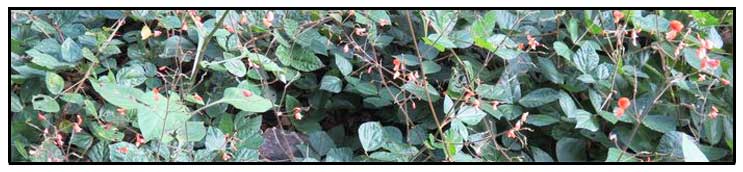
IMAGE SOURCE: Orange Tick-Trefoil (Hylodesmum repandum) / © Tony Rebello / Some rights reserved / CC BY-SA / CLICK ON IMAGE TO GO TO SOURCE PAGE / iNaturalist
OTHER IMAGE SOURCE: Orange Tick-Trefoil (Hylodesmum repandum) flowers / © Tony Rebello / Some rights reserved / CC BY-SA / Image modified / Click on image or link to go to source page / iNaturalist
OTHER IMAGE SOURCE: Orange Tick-Trefoil (Hylodesmum repandum) flower close-up / © Tony Rebello / Some rights reserved / CC BY-SA / Image modified / Click on image or link to go to source page / iNaturalist
OTHER IMAGE SOURCE: Desmodium repandum pod / © SANBI: PlantZAFRICA / image modified / Click on image or link to go to source page / SANBI: South African National Diversity Institute
OTHER IMAGE SOURCE: Desmodium repandum leaves / © SANBI: PlantZAFRICA / image modified / Click on image or link to go to source page / SANBI: South African National Diversity Institute
OTHER IMAGE SOURCE: Desmodium repandum growth habit / © SANBI: PlantZAFRICA / image modified / Click on image or link to go to source page / SANBI: South African National Diversity Institute

Additional Sources and Suggested Readings
(1)
Hylodesmum repandum / KEW: Plants of the World Online
(2)
Fabaceae: Hylodesmum repandum / Co's Digital Flora of the Philippines
(3)
Hylodesmum / Grokipedia
(4)
Hylodesmum repandum / Ken Fern: Tropical Plants Database / Useful Tropical Plants
(5)
Preliminary phytochemical and hepatoprotective studies of ethanol extract of Desmodium repandum (Vahl) D.C. in paracetamol induced liver injury in guinea pigs / Justin Bazibuhe Safari, Fidel Mutelesi Bin Mutelesi et al / GSC Biological and Pharmaceutical Sciences, 2022; 21(2): pp 56-64 / eISSN: 2581-3250 / DOI: 10.30574/gscbps
(6)
Ethnomedicinal plant knowledge and practice of the Oromo ethnic group in southwestern Ethiopia / Haile Yineger et al / Journal of Ethnobiology and Ethnomedicine, 2008; 4(11) / DOI: 10.1186/1746-4269-4-11
(7)
Hylodesmum repandum / SANBI:PlantZAfrica
(8)
Ethnobotanic study around Volcanoes National Park, Rwanda / Nahayo Alphonse, Bigendako MJ, Fawcett K, Gu Yansheng / New York Science Journal, 2010; 3(5)
(9)
Evaluating phytochemical constituents and in-vitro antiplasmodial and antioxidant activities of Fadogiella stigmatolobaHygrophylla auriculataHylodesmum repandum, and Porphyrostemma chevalieri extracts / Henry Manya Mboni, Marie Faes, Stephanie Fraselle, Moussa Compaore, Caroline Stevigny et al / Heliyon, 2023; 9(9): e20103 / DOI: 10.1016/j.heliyon.2023.e20103

DOI: It is not uncommon for links on studies/sources to change. Copying and pasting the information on the search window or using the DOI (if available) will often redirect to the new link page. (Citing and Using a (DOI) Digital Object Identifier)

                                                            List of Understudied Philippine Medicinal Plants
                                          New plant names needed
The compilation now numbers over 1,750 medicinal plants. While I believe there are hundreds more that can be added to the collection, they are becoming more difficult to find. If you have a plant to suggest for inclusion, native or introduced, please email the info: scientific name (most helpful), local plant name (if known), any known folkloric medicinal use, and, if possible, a photo. Your help will be greatly appreciated.

HOME      •      SEARCH      •      EMAIL    •     ABOUT