Gen info
• Cycadaceae is an ancient plant family of slow-growing, seed-producing gymnosperms belonging to the order Cycadales. It is often referred to as "living fossils," with a lineage dating back to the Permian and Mesozoic eras, roughly 280 million years ago, when they dominated global vegetation.
- Cycas: Cycadaceae is a monotypic family, containing a single extant genus: Cycas, the type genus, contains about 113 species.
- Etymology: The genus name Cycas derives from the Greek word kykas (or koikas), an ancient Greek name used by figures like Theophrastus to mean a "palm tree," which was applied to the genus due to its resemblance to a true palm, even though the cycads belong to a completely different and ancient group of gymnosperms. The specific epithet revoluta derives from Latin revolutus (or revolutum), meaning "rolled back" or "curled back", referring to the margins or edges of the plant leaflets, which naturally curl downward.
Botany
• Oliba is a cycad with a
stout and cylindric trunk marked with prominent scars, in the Philippines usually
not growing more than a meter in height, elsewhere reported to grow as high as 5 meters. Leaves are numerous,
crowded, spreading, 0.5 to 1.5 meters long. Leaflets are very numerous,
close, and linear; 18 centimeters long in the middle, 4 to 6 millimeters wide, the upper surface glabrous, the lower, hairy. Ovules
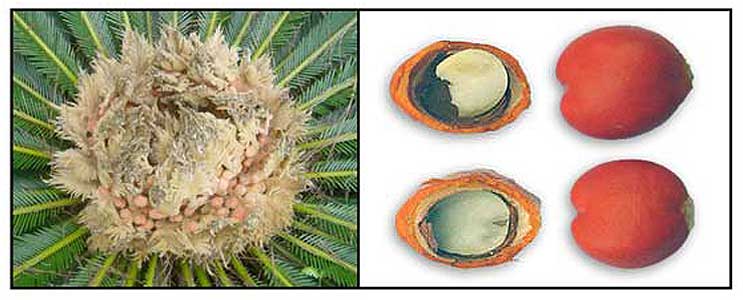
are hairy. Seeds are on loosely arranged leaves around the stem. Seeds are large, plum-like, and pale-yellow to tan.
• Very symmetrical plant supports a crown of shiny, dark green leaves on a thick shaggy trunk that is typically about 20 cm (7.9 in) in diameter, sometimes wider. Trunk is very low to subterranean in young plants, but lengthens above ground with age. It can grow into very old specimens with 6–7 m (20–23 ft) of trunk; however, the plant is very slow-growing and requires about 50–100 years to achieve this height. Trunks can branch several times, thus producing multiple heads of leaves. Leaves are a deep semiglossy green and about 50–150 cm (20–59 in) long when the plants are of a reproductive age. They grow out into a feather-like rosette to 1 m (3.3 ft) in diameter. The crowded, stiff, narrow leaflets are 8–18 cm (3.1–7.1 in) long and have strongly recurved or revolute edges. The basal leaflets become more like spines. Petiole or stems of the sago cycad are 6–10 cm (2.4–3.9 in) long and have small protective barbs. Roots are called coralloid with an symbiosis allowing nitrogen fixation. Tannins-rich cells are found on either side of the algal layer to resist the algal invasion.
 Distribution Distribution
- Introduced; not naturalized.
- Now, cultivated
for ornamental purposes.
- Native to China Southeast, Japan, Nansei-shoto, Taiwan.
Constituents
• Many cycads are toxic
because the stems, leaves and seeds contain high amounts of cycasin
alkaloids, macrozamin or methylazoxymethanol. Both cycasin and macrozamin
are harmful to the liver; cycasin and methylazoxymethanol are neurotoxic
and carcinogenic.
• Japanese study isolated a novel leptin from the leaves of CR.
• Seeds have yielded B-N-methylamin-L-alanine (BMAA) used for
tonics and poultices.
• Study yielded a novel nonprotein amino acid, cycasindene.
• Cycad palms produce three toxins: cycasin, beta-methylamino-L-alanine, and an unidentified toxin. (see toxicity below)
• GC-MS analysis of essential oil extracted with petroleum ether yielded 5 components of fatty acids: Linolenic acid (18.47%), Oleic acid (12.96%), Linoleic acids (10.9%), Palmitic acid (8.82%) and Octadecanoic acid (7.85%). (22)
• Phytochemical analysis of ethyl acetate extract of leaves yielded five compounds including two new two new dihydroamentoflavone glucosides, (2S)-I-(2,3)-dihydro-I-7-O-β-d-glucopyranosylamentoflavone (1) and (2S)-I-(2,3)-dihydro-I-7,II-7-di-O-β-d-glucopyranosylamentoflavone (2), in addition to the known compounds prunin (3), vitexin-2″-rhamnoside (4) and protocatechuic acid (5). (see study below) (23)
• Preliminary phytochemmical analysis of ~70% ethanolic extract of rachis revealed presence of alkaloids, amino acids, flavonoids, glycosides, steroids, and terpenoids. (see study below) (28)
• A total of 62 components were characterized from CR leaves including 10 flavonoids: (-)-epigallocatechin, amentoflavone, bilobetin, catechin, ginkgetin, hinokiflavone, naringenin, podocar-pusflavone A, sciadopitysin, and vitexin. (see study below) (35)
• GC-MS study of CR for essential oil extracted by petroleum ether revealed 5 components of fatty acids: Linoleic acid (18.47%), oleic acid (12.96%), linoleic acid (10.9%), palmitic acid (8.82%), and octadecanoic acid (7.85%). (36)
Properties
• Seeds of Cycas
species reported to be toxic and carcinogenic.
• Terminal shoot considered astringent and diuretic.
• Seed considered emmenagogue, expectorant, tonic.
• Studies have suggested aromatase inhibitory, antimicrobial, antioxidant, bactericidal, pro-apoptotic, cytotoxic, anti-leishmanial, toxicity, antidiabetic, alpha-glucosidase inhibitory, radioprotective, anticancer properties.
Toxicity
• Toxic / Caricinogenic: Seeds of Cycas
species reported to be toxic and carcinogenic. Many cycads are toxic
because the stems, leaves and seeds contain high amounts of cycasin
alkaloids, macrozamin or methylazoxy-methanol. Both cycasin and macrozamin
are harmful to the liver; cycasin and methylazoxymethanol are neurotoxic and carcinogenic.
• Cycasin / Toxins: Although all parts of the plant are toxic, it is the seed that contains the highest level of toxin cycasin. Cycasin causes gastrointestinal irritation with vomiting, diarrhea and may cause seizures, hepatotoxicity with jaundice, cirrhosis, ascites and liver failure. Other toxins are beta-methylamino-L-alanine and an unidentified toxin. Beta-methylamino-L-alanine is a neurotoxic amino acid known to cause ataxia in rat and neuro-manifestations in humans. The unidentified toxin may cause hind limb paralysis in cattle from CNS axonal degeneration. Besides the excitatory and putative neurotoxin BMAA, Cycas revoluta also yield o-N-oxalylornithine.
• Guam Disease: Beta-methylamino-L-alanine, a neurotoxic amino acid, causes ataxia in rats and is implicated in Guam disease with symptoms similar to Alzheimer, Parkinson, and Lou Gehrig (ALS) diseases.
• Livestock: In cattle, an unidentified toxin may cause hindlimb paralysis, with axonal degeneration the CNS.
Parts utilized
Fruit, leaves, shoots, seeds.

Uses
Edibility
• Fleshy seeds, leaves, unprocessed flour from stem pith considered poisonous. Considered by some to be toxic only if consumed in large quantities.
• Seeds are widely consumed as food and medicine (as tonic or poultices) in southern Japan, the Chamorros of Guam, and the Auyu people of New Guinea, Australia, and the western Pacific Islands.
• Seeds are dried and ground into powder, and mixed with brown rice and fermented into "date miso" or "sotetsu miso."
Folkloric
• Like the palaspas, some albularyos have the leaves 'blessed'
on Palm Sunday and used for a variety of medicinal uses.
For suob, the leaves are dried and powdered, and added
to to the insenso kamanyan for the the ritual.
• In China, fruit used as expectorant
and tonic.
• Despite known toxicities, Cycad stems and seeds are used for
high blood pressure, headaches, congestion, rheumatism and bone pain.
• Leaves used in the treatment of cancer and hepatoma.
• Terminal shoots used as astringent and diuretic.
• In Japan's Kii Peninsula, a "tonic"
is made from the dried seeds of CR.
• In Bangladesh, the whole plant used for paralysis, indigestion, snake bites.
• In the Assam district of India, used for painful urination: a piece of young female cone eaten daily until cure. (17)
• Leaves used for treatment of blood vomiting and flatulence, skin diseases, and as astringent and diuretic. Seeds in powdered form used for treatment of hypertension, gastrointestinal distress and cough, blood pressure, rheumatism, headache, bone pain, liver diseases, and for hair growth. Whole plant parts used for treatment of snake bites and for wound dressing.
(29)
Others
• Palm Sunday Ritual: Leaves used for the ritual palms for Palm Sunday.
Studies
• Aromatase inhibitors in cycads: Cycas revoluta was one of five
species of cycad folia studied for inhibition of cytochrome P-450 aromatase
for use in the treatment of estrogen-dependent tumors. All five test Cycas species were found to contain inhibitors of the human enzyme. (2)
• Lectin: Study isolated a novel lectin from the leaves of Cycas revoluta. The inhibition analysis of hemagglutinating activity and partial amino acid sequences of lysylendopeptic peptides show it to belong to the jacalin-related lectin family. (5)
• Leaves / Antimicrobial / Antioxidant: Hydroalcoholic extracts of leaves showed potent antimicrobial activity against E. coli, Klebsiella pneumoniae and Saccharomyces cerevisae. Extracts also showed antioxidant activity. (13)
• Peptide / Anticancer / Bactericidal / Proapoptotic / Seeds: Study purified a peptide from the seeds of Cycas revoluta. The peptide showed deleterious effects against human epidermoid cancer (Hep2) and colon carcinoma cells (HCT15), and caused inhibition of cancer cell proliferation and induced apoptosis by direct DNA binding. A remarkable bactericidal activity was also observed in the same peptide. (15)
• Antibacterial: In a pharmacologic study of selected plants, ethanol and ethanol extracts of C. revoluta showed antibacterial activity against E. coli, S. aureus, Pseudomonas, B. subtilis, Klebsiella and S. typhimurium. (16)
• Chitinase-A: Study purified chitinase-A (CrChi-A) from the leaf rachises of C. revoluta. It exhibited transglycosylation activity not previously observed in plant chitinases. Studies have suggested chitinases have roles in plant defenses and interactions with symbiotic microorganisms and developmental processes. (18)
• Antimicrobial / Leaves and Female Cones: Study screened C. revoluta for the isolation of a potent molecule responsible for antimicrobial potential against pathogenic and drug resistant strains. Study isolated a novel molecule, 2, 3-dihydro-4′-O-methyl-amentoflavone from the chloroform extract of leaves and female cones which promising antimicrobial activity against MRSA (methicillin resistant Staphyloccocus aureus), E. Coli, Salmonella abony, Aspergillus niger, Candida albicans, among others. (19)
• Antibacterial Biflavonoids / Leaves: Study of methanolic extract of leaflets of Cycas circinalis and chloroform extract Cycas revoluta yielded one new biflavonoid and 15 known compounds. Compounds 2, 6, and 18 exhibited moderate antibacterial activity against Staphylococcus aureus and MRSA. (20)
• Antimicrobial / Leaves and Cones: Study evaluated chloroformic and hydroalcoholic extracts of leaves and female cones of Cycas revoluta for antimicrobial potential. Results showed promising antimicrobial activity against methicillin resistant Staphylococcus aureus, Escherichia coli, Salmonella abony, Aspergillus niger, Candida albicans, among others. The chloroformic extract of cones showing more activity than the chloroformic extract of leaves. (21)
• Cytotoxic / Anti-Leishmanial / Antimicrobial / Leaves: Study of EA extract of leaves yielded two new dihydroamentoflavone glucosides, along with three known compounds. The EA extract showed weak cytotoxicity against HepG2. Compound 4, vitexin-2"-rhamnoside, showed significant activity against Leishmania donovani. The isolated compounds showed weak antimicrobial activity. (see constituents above) (23)
• Antioxidant / Leaves and Cones: Study investigated different solvent extracts of Cycas female cone and leaves for in vitro antioxidant activity. Results showed chloroform extracts of female cones showed more potent antioxidant activity followed by chloroformic extract of leaves. (24)
• Amentoflavones / Antioxidant / Cytotoxicity / Leaflets: Study of leaves isolated eight compounds. Compounds 5, 6, and 7 (amentoflavone, amentoflavone glucoside, neohesperidin) showed antioxidant activity nearly two to four folds higher than quercetin at dose of 12.5 µg/ml. Compound 6 NS 7 showed very strong cytotoxicity against MCF-7 cell line with IC50 of 5.12 and 4.73 µg/ml, respectively. The cytotoxic and antioxidant activities were likely due to the biflavonoid content. (25)
• Macrozamin / Seeds and Leaves: HPLC analysis showed macrozamin, a toxic methylazoxymethanol glycoside, to be ubiquitous in leaf and seed kernel samples of selected South African cycad species, detected at fresh levels at range of 0.026 to 0.23%. Cycas revoluta macrozamin content in this study was 0.12 ± 0.052 % for leaves and 0.11 ± 0.023 % for kernel. (also see: Pitogo) (26)
• Antidiabetic / Rachis: Study evaluated the effect of Cycas revoluta rachis extract on alloxan-induced diabetic rats. Doses of 50 to 2000 mg/kg showed the plant to be non-toxic in nature. Dose of 300 mg/kg showed reduction in blood glucose from 289.5 to 98.33 at 14th day of protocol. Serum lipid profile reversed to normal compared with standard drug. (see constituents above) (28)
• Preparation of Antioxidant from Leaves / Invention: Invention reports on the preparation method of cycad leaf antioxidant using extract from dried cycas leaf powder with 75% ethanol, ultrasonic extraction, filtering and distillation, extraction processes, to freeze-drying. The cycad leaf extract from the invention has shown ability to scavenge DPPH and ABTS free radicals. (30)
• Cycas revoluta-Based Topical Ointment / Leaves: Study reports on the formulation of a Cycas revoluta-based topical ointment focusing on phytochemical screening, fluorescent analysis, and interaction of chemical reagents with various phytoconstituents using ethanol ethanol extract of leaves. Physicochemical parameters measured were color, odor, pH level, spreadability, extrudability, consistency, solubility, and washability. (31)
• Anti-Lung Cancer / Roots: Study evaluated the anti-proliferative effect of an n-butanol fraction from Cycas revoluta root extract on A549 human lung adenocarcinoma cells. The root extract exhibited notable anti-proliferative effects on A549 lung cancer cells, suggesting potential as a natural anti-cancer therapeutic agent. Further study suggested to identify active components, clarify molecular mechanisms, and its in-vivo efficacy. (32)
• Antidiabetic / Anti-α-Glucosidase / Leaves: Study evaluated C. revoluta various extracts of leaves for antioxidant, α-glucosidase and α-amylase inhibitory properties. Results showed promising and statistically significant antioxidant and α-glucosidase activities of 60% ethanolic extract compared to other plant extracts. UHP:C-Q-TOF-MS/MS analysis of leaf extract showed presence of three apigenin derivatives, kaempferol derivative, hexadecenoic acid, and citric acid. Binding energy values of molecular docking studies supported synergistic behavior of leaf extract to inhibit α-glucosidase activitry. (33)
• Diuretic: Study evaluated an ethanolic extract of C. revoluta for phytochemicals and diuretic activity. Ethanolic extract revealed major constituents of phytosterols and alkaloids, along with flavonoids, tannins, diterpenes, and saponins. The extract exhibited significant diuretic activity in doses of 200 and 400 mg/kbw. Results justify its use in Ayurvedic medicine as a diuretic drug. (34)
• Regulation of Immune Markers in Lung Adenocarcinoma / Flavonoids / Leaves: Study evaluated the medicinal value of flavonoids from leaves of C. revoluta as a potential treatment of lung adeno-
carcinoma (LUAD). A total of 62 components were characterized from CR leaves including 10 flavonoids: (-)-epigallocatechin, amentoflavone, bilobetin, catechin, ginkgetin, hinokiflavone, naringenin, podocar-pusflavone A, sciadopitysin, and vitexin. Among them, amentoflavone and podocarpusflavone A showed great therapeutic potential for lung adenocarcinoma treatment. CAT and CCNA2 were potential markers of flavonoids in CR leaves against lung adenocarcinoma. Flavonoids in CR leaves are the main source of anti-lung adenocarcinoma through targeting immune-related markers. (35)
• Radioprotective / Therapeutic Potential in Radiation-Induced Brain Damage and Pancreatitis: Study evaluated the radioprotective potential of three Cycas plant species (Cycas revoluta, C. armstrongii, C. circinalis) on rats exposed to whole-body 8 Gy ionizing radiation. Extracts of the 3 Cycas species were administered at dose of 200 mg/kg each. Results indicated Cycas spp. extracts significantly ameliorated radiation-induced brain and pancreatic damage as well as protected against radiation-induced oxidative stress. (37)
• Antimicrobial / Leaves and Cone: Comparing the antibacterial efficacy of hydroalcoholic leaf extract of CR to chloramphenicol, the Cycas extract showed significant antibiotic action against K. pneumonia, E. coli, and Saccharomyces cerevisae. Comparing CR female cone chloroform extract to erythromycin and fluconazole, the CR cone extract was more efficient against (MRSA) Methicilin-resistant S. aureus strains, Candida albicans, Aspergillus niger, Micrococcus luteus, and Salmonella abony. Higher antibacterial efficacy was attributed to high contents of dihydro-bilobetin, amentoflavone, tetrahydro-
isoginkgetin, among others. (38)
Availability
Ornamental cultivation. |


