 Gen info Gen info
- Uvaria is a genus of flowering plants in the family Annonaceae.
-
Uvaria micrantha is a plant in the custard family Annonaceae.
-
Taxonomical journey: Uvaria micrantha was first described in 1832 as Guatteria micrantha by Alphonese de Candolle in Memoires de la Societe de Physique et d'Histoire Naturelle de Geneve, It was reclassified into the genus Uvaria in 1855 by Jospeh Dalton Hooker and Thomas Thomson in Flora Indica, establishing its current accepted name. Further historical transfers were placement in Uva by Otto Kuntze in 1891 and in Cyathostemma by John Sinclair in 1955, reflecting evolving taxonomic interpretations based on morphology and regional floras. (4)
-
Etymology: The genus name Uvaria derives from Latin uva, meaning "grape," referring to the grape-like clustering of fruits in some species within the genus. The specific epithet micrantha derives from Greek words micro (small) and anthos (flower), referring to the plant's small flowers. (4)
Botany
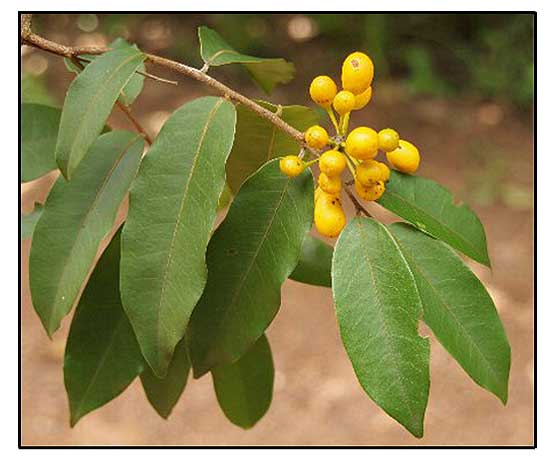
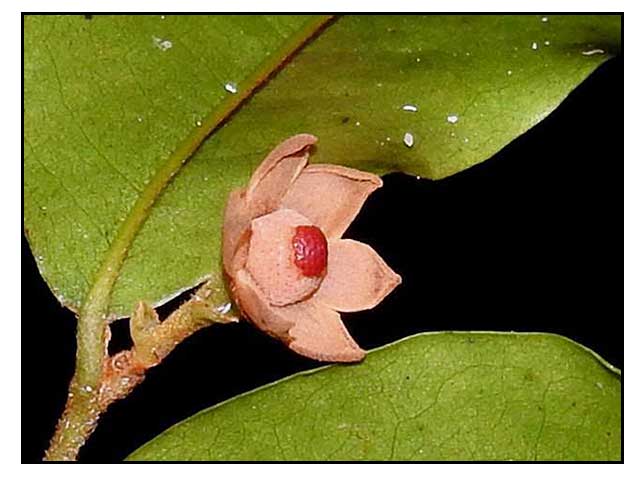
• Climber or scrambling shrub with narrow tangling branches forming dense thickets. Young shoots sub-tomentose, striations appearing early. Leaves thinly coriaceous, waxy, elliptic to short-lanceolate to narrowly obovate, ca 7–12 by 2–4 cm, base cuneate, apex acuminate-acute, glabrous on both surfaces except for midrib sub-tomentose to sparsely pubescent with erect 2–3-branched hairs above and isolated ca 1–2-branched ascending hairs along midrib below, secondary veins 9–12 per side (or up to 16 with long acumen); petioles 2–3(–4) by 0.75 mm. Inflorescences leaf-opposed, floral buds 1–3, often only the primary flower opened, the others enclosed by bracts, peduncle rudimentary, ca 1.5(–2) mm by 0.75 mm, pedicels 2–4(–5) by 0.5 mm, basal bract ovate, 4–6 by 1–2(–4) mm, medial bract smaller, ovate-acute, to 1.5 by 2 mm; buds ovoid. Sepals 3, free, valvate, broadly ovate-acute, ca 2 by 2.75 mm, concave. Petals in two whorls of 3, green-yellow to maroon, thick and fleshy, concave, spreading at maturity; outer petals ovate-oblong, ca 3.25 by 2.5 mm; inner petals broadly elliptic with a distinctly constricted base, ca 3.35 by 2 mm. Stamens numerous, cuneate, 0.6–1 mm long, anther connective apex flat, cap-like, papillate, filament absent. Carpels ca 20, 0.8–1.5 mm long, straight or bent inward at margin of gynoecium, hairy along ridges and just beneath stigma, hairs fine, many-branched, stigmas U-shaped, glabrous, somewhat elongate; ovules 2(–4). Monocarps 10–20, green turning yellow, orange, red, or purple, globose to short-oblongoid, ca 0.95 by 0.8 cm, stipe 14–20–(–23) mm, glabrous, smooth. Seeds 1–2(–3), ca 7 by 4 by 4 mm when in single-seeded monocarp, to 7 by 4 by 2 mm when 2–3 seeded, aril 2.5 by 1.75 mm, triangular. (e-Flora of Thailand)
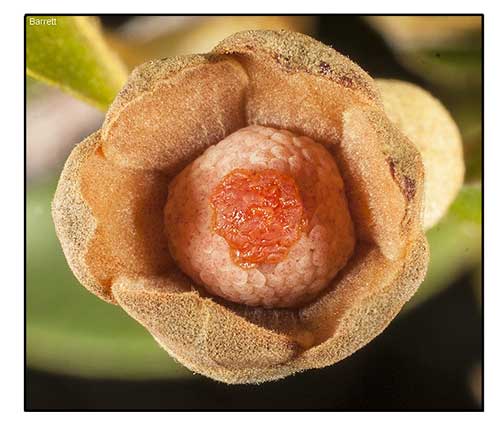 • Uvaria micrantha is a scrambling shrub or liana in the family Annonaceae, native to the wet tropical regions of Southeast Asia and northern Australia.[1] It typically grows as a stem-twining climber with narrow, tangling branches that form dense thickets, reaching stem diameters up to 5 cm. Young shoots are densely hairy with ferruginous to brown stellate hairs, and leaves are thinly coriaceous, elliptic to narrowly obovate, measuring 3–12 cm long by 1–4.5 cm wide, with petioles 1.5–6 mm long.[4][2]The species produces small, leaf-opposed inflorescences with 1–3 flowers, featuring three broadly ovate sepals and six fleshy petals in two whorls, colored green-yellow to maroon or orange to reddish brown, typically 3–5 mm long. Fruits consist of 10–50 globose to oblong monocarps, 5–20 mm long, turning from green through yellow and orange to purple or black at maturity, each containing 1–5 seeds. (4) • Uvaria micrantha is a scrambling shrub or liana in the family Annonaceae, native to the wet tropical regions of Southeast Asia and northern Australia.[1] It typically grows as a stem-twining climber with narrow, tangling branches that form dense thickets, reaching stem diameters up to 5 cm. Young shoots are densely hairy with ferruginous to brown stellate hairs, and leaves are thinly coriaceous, elliptic to narrowly obovate, measuring 3–12 cm long by 1–4.5 cm wide, with petioles 1.5–6 mm long.[4][2]The species produces small, leaf-opposed inflorescences with 1–3 flowers, featuring three broadly ovate sepals and six fleshy petals in two whorls, colored green-yellow to maroon or orange to reddish brown, typically 3–5 mm long. Fruits consist of 10–50 globose to oblong monocarps, 5–20 mm long, turning from green through yellow and orange to purple or black at maturity, each containing 1–5 seeds. (4)
Distribution
- Native to the Philippines. (1)
(2)
- In Busuanga; in Luzon: Batangas, Bulacan, Sorsogon; Mindoro, Palawan, Panay, Tawi-tawi. (2)
- In low elevation thickets and open forests, or or nrear the seashore. 0-210 m.
- Also native to Andaman Is., Borneo, Cambodia, Jawa, Laos, Lesser Sunda Is., Malaya, Myanmar, New Guinea, Nicobar Is., Queensland, Sulawesi, Sumatera, Thailand, Vietnam, Western Australia. (1)
 Constituents Constituents
- Study of stems isolated five mon-tetrahydrofuran acetogenins: uvamicranins A-E and three known mon-tetrahydrofuran acetogenins: reticulatacin, calamistrin A, and uvarigrin. (see study below) (5)
- Study of stems isolated two novel benzoquinones, uvarmicranones A and B (1,2), along with 15 known compounds (3-17). (see study below) (7)
- SGCC combined with TLC isolated five pure compounds from ethyl acetate extract of stems: oleanoic acid (1), lup-20(29)-en-3-ol (2), stigmastane-3,6-dione (3), stigmast-4-en-3-one (4), and 1H-indole-3-carbaldehyde (5). (8)
- Essential oils from rhizomes and leaves are dominated by monoterpenes, with ß-pinene as primary component (21.07%) in the rhizome oil, accompanied by 1,8-cineole (20.63%), α-pinene (8.80%), and camphene (6.35%). Leaf oil is likewise rich in ß-pinene, contributing to a composition of 57 identified volatile compounds, accounting for 94-99% of total oil. (9)
Properties
- Studies have suggested anticancer, antiproliferative, antioxidant, antibacterial properties.
Parts used
Leaves, stems.
Uses
Edibility
- Fruits are edible. Ripe red berries contain a soft, pulpy inside with a sour and aromatic flavor.
Folkloric
- No reported medicinal use in the Philippines.
- In Malaysia, used for postpartum care: decoctions prepared from roots and leaves are used as an "ubat meroyan" to aid in recovery after childbirth. In Southeast Asian ethnobotany, used for treating fever and tumors. (4)
Others
- Host plant / Herbivory: U. micrantha plays an important role in its ecosystem as a larval host plant for the green-spotted triangle butterfly (Graphium agamemnon), a species in the Papilionidae family, the caterpillars of which feed on its leaves. Other insects, including beetles and moths, also feed on its leaves. (3)
Studies
• Acetogenins / Antiproliferative on HepG2 Liver Cancer Cells / Stems: Study of stems isolated five mono-tetrahydrofuran acetogenins: uvamicranins A-E and three known mono-tetrahydrofuran acetogenins: reticulatacin, calamistrin A, and uvarigrin. The isolated compounds showed more potent antiproliferative activity towards human hepatocellular carcinoma cell line HepG2, compared to five other tested cell lines. Among the compounds, uvamicranin B (UvB) and uvarigrin (Uv) showed strong antiproliferative activity with IC50s of 2.89 ˜M and 0.37 µM, respectively. Study for antiproliferative mechanism suggested both compounds marginally induced apoptotic cell death, but exhibited cytostatic effect through induction of cell cycle arrest at the G2/M phase. (5)
• Antimicrobial / Antioxidant / Leaves: Study evaluated the antimicrobial and antioxidant activities of various leaves extracts of U. micrantha using disc diffusion and DPPH tests. The methanol extract was rich in alkaloids, phenols and terpenoids, while hexane and ethyl acetate extracts had only terpenoids. Only the methanol extract showed antimicrobial activity against S. aureus. The ME also showed highest antioxidant activities than hexane and ethyl acetate extracts. (6)
• Cytotoxicity / Uvamicranones and Benzoquinones / Stems: Study of stems isolated two novel benzoquinones, uvarmicranones A and B (1,2), along with 15 known compounds (3-17). Compounds 1, 14, and 15 showed moderate cytotoxic effects against T-cell acute lymphoblastic cells (MOLT-3), with IC50s of 7.83, 6.53, and 4.20 µM, respectively. Compound 15 also showed moderate cytotoxicity against cervical carcinoma cells (HeLa) with IC50 of 7.00 µM. (7)
Availability
- Wild-crafted. |


