 |

Family • Annonaceae
Maasia
Maasia glauca (Hassk.) Mols, Kessler & Rogstad
GLAUCOUS MAASIA
| Scientific names | Common names |
| Guatteria glauca (Hassk.) Miq. | Maasia (Tag.) |
| Guatteria hypoleuca Miq. | Glaucous maasia (Engl.) |
| Maasia glauca (Hassk.) Mols, Kessler & Rogstad | |
| Monoon glauca (Hassk.) Miq. | |
| Polyalthia glauca (Hassk.) F.Muell. | |
| Polyalthia merrittii (Merr.) Merr. | |
| Polyalthia parkinsonii Hutch. | |
| Unona merrittii Merr. | |
| Uvaria glauca Hassk. | |
| Maasia glauca. KEW: Plants of the World Online | |
| Other vernacular names |
| BORNEO: Balikan putih, Bin(g)hut, Dilah saie, Djilu, Kembalikan putih, Lirap, Samukau, Sirap. |
| INDONESIA: Pete jawa. |
| MALAYSIA: Mempisang. |
| THAILAND: Tara. |
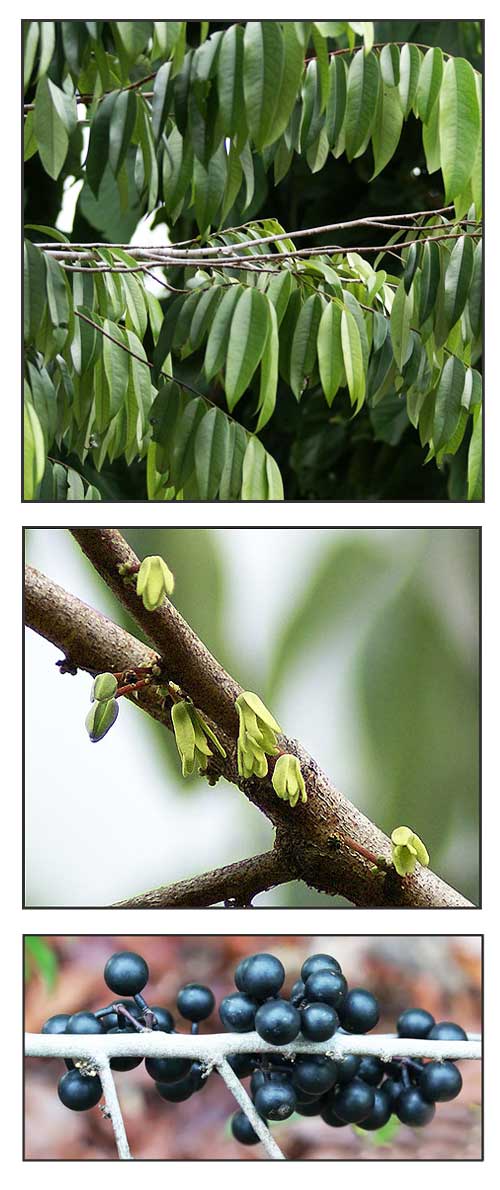
• Tree to 45 m tall, sometimes with pneumatophores. Bark white, smooth on young trees, papery flakey on old trees with distinct hooping. Twigs white; young twigs slightly pubescent. Leaves brightly white beneath when fresh, chartaceous to coriaceous, generally glabrous, drying gray, olive-green or brown above, gray to pale brown beneath; blades narrowly oblong-elliptic, sometimes obovate, 9–22 × 2.5–8 cm, base rounded to acute, apex acuminate to apiculate; midrib sunken above, prominent beneath; lateral veins obscure, 13–39 pairs, looping to form weakly discernible intramarginal vein; petioles 3–8 mm long, sometimes tomentose. Inflorescences many-flowered (2–15) fascicles arising from woody tubercles on branches and twigs behind leaves; bracts 1–3. Flowers very fragrant; pedicels 1–3 cm long, glabrous, sometimes sparsely pubescent; sepals triangular, minute, c. 2 mm long, tomentose outside; petals yellow, linear, 6–18 × 1–5 mm, pubescent; stamens 15–30; carpels 10–25, glabrous. Fruiting pedicels 1–4 cm long, glabrous. Monocarps globose, c. 2.5 cm diameter, red to black, drying dark brown to black; stipes 1–3.5 cm long. Seeds 1–2 in each monocarp, biconvex, with longitudinal groove. (Tree Flora of Sabah and Sarawak) Distribution Properties Studies Availability |
 Gen info
December 2025

 |
| PHOTOS / ILLUSTRATIONS |
| IMAGE SOURCE: Maasia glauca / Fruits / © Marina Khaytarova / TopTropicals / Non-commercial use / Image modified / Click on image or link to go to source page / TooTropicals |
| OTHER IMAGE SOURCE: Maasia glauca / Leaves / © Marina Khaytarova / TopTropicals / Non-commercial use / Image modified / Click on image or link to go to source page / TooTropicals |
| OTHER IMAGE SOURCE: Maasia glauca / Flowering branch / © Marina Khaytarova / TopTropicals / Non-commercial use / Image modified / Click on image or link to go to source page / TooTropicals |
Additional
Sources and Suggested Readings |
• |
DOI: It is not uncommon for links on studies/sources to change. Copying and pasting the information on the search window or using the DOI (if available) will often redirect to the new link page. (Citing and Using a (DOI) Digital Object Identifier) |
| List of Understudied Philippine Medicinal Plants |
| New plant names needed The compilation now numbers over 1,730 medicinal plants. While I believe there are hundreds more that can be added to the collection, they are becoming more difficult to find. If you have a plant to suggest for inclusion, native or introduced, please email the info: scientific name (most helpful), local plant name (if known), any known folkloric medicinal use, and, if possible, a photo. Your help will be greatly appreciated. |
• |
 |
|
