Gen info Gen info
- Logwood was of great economic importance from the 17th to the 19th century, when it was logged and exported to Europe for use in dyeing fabrics. (3) Despite Spain's claim to Central and South America, the English, Dutch, and French logwood cutters -- pirates, too -- fought over it . (3)
- Haematoxylum (bloodwood) is a small genus of about 5 species. Only H. campechianum has spread over most of the tropics.
(5)
- In Central America, logwood trees that do not produce haematoxylin have been found and are referred to as "bastard logwood." (5)
- Haematoxylin, derived from the tree Haematoxylum campechianum, is the most popular nuclear counter stain used in routine histopathological techniques for staining tissues. The recognition to introduce haematoxylin as biological stain goes to Waldeyer. Later, Bohmer introduced the technique of coupling a mordant to make the dye colorfast. To date, hematoxylin remain a unique and vital stain in histology—a valuable, powerful nuclear stain and a chromatin stain par excellence. (19)
- Etymology: The genus name Haematoxylum derives from Greek words haima meaning "blood" and xylon meaning "wood", referring to its reddish wood. The specific epithet campechianum refers to the region of Campeche, in the Yucatan peninsula of Mexico. (25)
 Botany Botany
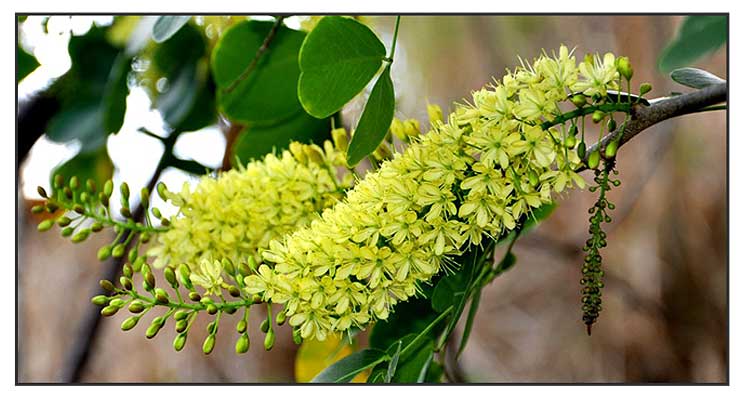
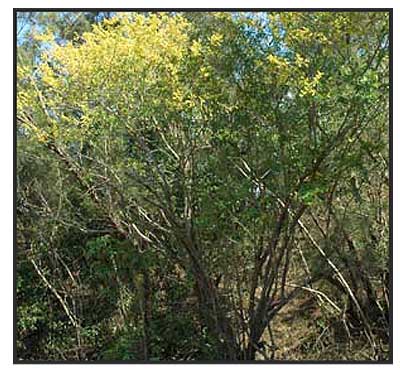
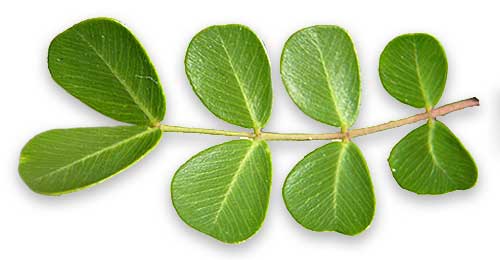
Logwood is a small, bushy tree, growing up to 15 m tall, often smaller, thorny and gnarled; trunk irregularly fluted and contorted,, 2-3 meters long with a diameter of 60 cm, prolonged into large and long straight branches. Bark is gray to brown, rather smooth, peeling in flakes. Leaves are alternate, parapinnate, distichous or fascicled on very short branches; stipules partly small and caducous, partly spine-like; leaflets in 2-4 pairs, obcordate or obovate, 10-35 mm x 5-25 mm, acute at the base, emarginate at the apex, closely veined and glabrous. Flowers in 5-20 cm long racemes in the axils of present or fallen leaves, 5-merous, sweet-scented; calyx 4-5 mm long, deeply lobed; petals 5-7 mm long, bright yellow; stamens 10, free; ovary superior, shortly stalked, glabrous; style filiform. Fruit a lanceolate, extremely flattened pod, 3-5 cm long, pointed at both ends, dehiscent not along the sutures but along the median of the sides, usually 2-seeded. (5)
Distribution
- Introduced; not naturalized. (20)
- Cultivated
for its foliage and fragrant flowers or as a hedge plant.
- Native to Belize, Guatemala, Honduras, Mexico. Gulf, Mexico Southeast. (1)
- Introduced and has been naturalized in many tropical regions and countries including West Africa, Australia, the West Indies, South America, Southeastern Asia, and several Pacific Islands.
- Exotic in Fiji, Indonesia, Malaysia, Singapore.
- Although not a fast-growing species, plants can form dense monocultures over extensive areas of land displacing and completely replacing native vegetation. (2)
 Constituents Constituents
- Bio-guided chemical fractionation of methanolic extract isolated five compounds: two chalcones, sappanchalcone (1) and 3-deoxysappanchalcone (2); three homoisoflavonoids, hematoxylol A (3), 4-O-methylhematoxylol (4), and hematoxin (5). (see study below) (7)
- Study of heartwood yielded three new homoisoflavonoids, epihematoxylol B (2), 10-O-methylhematoxylol B (3), and 10-O-methylepihematoxylol B (4), along with 15 known compounds, including three homoisoflavonoids, three flavonoids, six lignans, and three unsaturated fatty acids. (15)
- Chemical composition includes: hematoxylin, hematein, tannins, flavonoids, alkaloids, terpenoids, resins, proteins, essential oils, carbohydrates, lignans, and quinones.
Properties
- Considered mild astringent and tonic.
- Studies have suggested tyrosine kinase inhibitory, anti-tumor, anti-mycobacterial, neuroprotective, spasmolytic, hair-dyeing, anti-inflammatory, anxiolytic, sedative properties.
Parts used
Stem bark, wood, flowers.
 Uses Uses
Edibility
- No information on edibility.
Folkloric
- In the Philippines, used for fever and inflammations.
-
Used for diarrhea, dysentery, atonic dyspepsia, and leucorrhea. Ointment prepared from the wound used for cancer and hospital gangrene. (6)
- In Jamaica, chipped bark is used to make a sugared drink. Wood bark used as astringent for diarrhea and dysentery.
(14)
- In French Guiana, stem bark and wood is astringent, used to treat chronic diarrhea. (11)
- Gargle of diluted extract used to reduce gingival bleeding.
Others
- Dye: Used for a long time as a natural source of dye. Woodchips still used as source of haematoxylin, used in histology for staining. A versatile dye, it was also widely used on textiles and paper. (3) Wood yields a series of dyes in darker tints of gray, brown, violet, blue, and black, and provide a fairly permanent color to certain natural fabrics like silk, wool and cotton, and natural fabrics like nylon and rayon. It is also used on leather, furs, feathers, paper, bone and inks. Alcoholic solutions are used as indicators for alkaloid titrations. (5) Study has shown heartwood yields dyes for use in hair coloring. (see study below) (17) Also used as ceremonial body paint.
- Oil: Essential oil from flowers used in perfumery. (4)
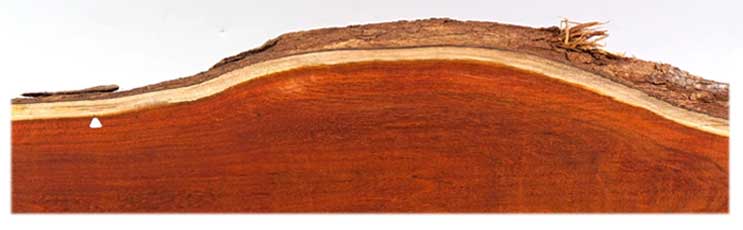
- Wood: The main product of the tree is the heartwood--it is considered the logwood of commerce. Irregular trunk limits its use. Wood is hard, heavy, strong but brittle. Sometimes used for furniture and fancy articles for its smooth surface and high polish. (4)
- Apiculture: Flowers is a ready source of good honey. (6)
- Agroforestry: Used as boundary, barrier, or support. is a rea
Studies
• Homoisoflavonoids and Chalcones / Spasmolytic: Bio-guided chemical fractionation of methanolic extract isolated five compounds: two chalcones, sappanchalcone (1) and 3-deoxysappanchalcone (2); three homoisoflavonoids, hematoxylol A (3), 4-O-methylhematoxylol (4), and hematoxin (5). In an in vitro model of electrically induced contractions of guinea pig ileum, fractions F7 and F9 and compounds 1 and 2 exhibited significant relaxing activity as compared to positive control papaverine. (7)
• Dyeing Performance / Antibacterial Activity / Dye: Study showed dyeing of plasma treated polyester fiber with a bio-based logwood dye without addition of metallic mordant while imparting antibacterial properties, showed to be a promising strategy for opening up a suitable eco-option for replacing some of the hazardous dyes and intermediates used in textile dyeing. (8)
• Anti-Mycobacterium tuberculosis / Ethyl Gallate / Leaves: In a 1953 study screening 1,700 tropical plant samples, alcohol extracts of H. campechianum strongly inhibited Mycobacterial tuberculosis. Extraction of the of leaves for the responsible substance yielded ethyl gallate. The substance showed no activity outside the genus. The concentration of ethyl gallate inhibiting the growth of tubercle bacilli under favorable conditions was 75 µg/mL. (9)
• Hematoxylin: Hematoxylin is the most commonly used nuclear stain for histopathology diagnostics in the world. The financial and ecological cost of hematoxylin protocols is substantial and not well appreciated, even by pathologists and histologists. The origin of hematoxylin is the Logwood tree (Haematoxylum campechianum), indigenous to the tropical rainforests of Central and South America, which provides for the worldwide demand for the nuclear stain in medicine and raw material for other industrial applications. The increasing consumption of logwood trees deteriorated rainforest ecology with negative global ecologic consequences for at least a 100-year period. (10)
• Neuroprotective / Anti-Inflammatory / Amelioration of Neuropathic Pain / Chronic Constriction Injury / Flowers: Study evaluated the possible prophylactic effects of an aqueous ethanol extract of H. campechianum flowers on peripheral neuropathic pain in chronic constriction injury rat model. Results showed the extract exhibited both peripheral and central analgesic properties in addition to antipyretic effects targeting COX, LOX, and PGE. Treatment significantly improved cold and thermal withdrawal latency, mechanical sensibility and ameliorated deleterious changes of the sciatic nerve and brain stem at different dose levels. Extract also ameliorated oxidative stress and inflammatory markers in the brain stem and sciatic nerve, suppressed apoptotic marker p53, and restored myelin sheath integrity. Effects were more potent than pregabalin. Fifteen secondary metabolites were characterized, mainly gallotannins and flavonoids. The phenolic constituents present potential for the treatment of neuropathic pain due to its biologic activities, anti-inflammatory and neuroprotective properties. (12)
• Anti-Tumor / DW532 Targeting Kinases and Tubulin: Hematoxylin is a natural product extracted from the heartwood of the logwood tree. DW532, 7,8-dihydroxy-4-(3-hydroxy-4-methoxyphenyl)-2H-chromen-s-one, is one of the simplified analogues of hematoxylin that has shown broad-spectrum inhibition on tyrosine kinases and in-vitro anti-cancer activities. Study evaluated DW532 for anti-cancer and anti-angiogenesis activities. Results showed DW532 is a dual inhibitor against tubulin and tyrosine kinases, and present potential as a novel anti-cancer agent. (13)
• Protein Tyrosine Kinase (PTK) Inhibitors / Hematoxylin / Cancer Chemopreventive: Protein tyrosine kinase (PTK) inhibitors represent emerging therapeutics for cancer chemoprevention. Study identified hematoxylin as one of the most remarkable c-Src inhibitors in an orthogonal compound-mixing library of 32300 compounds by using an ELISA-based screening strategy. Hematoxylin was found to be an ATP competitive broad-spectrum PTK inhibitor in vitro, with IC50s ranging from nanomolar to micromolar level. Inhibition was associated with PTK phosphorylation and downstreaming of signaling pathways. Study substantially validated hematoxylin and its natural analogues to function as a new class of PTK inhibitors. (16)
• Natural Hair Dye / Heartwood: The heartwood of Haematoxylon campechianum yielded natural dyes as propylene glycol and menthol. Studies showed that henna mixed with heartwood wood dyes propylene glycol and menthol can withstand more than 8 times shampooing and can effectively cover white hair and strengthen hair. The hair dye increases the tensile strength of bleached hair by 53.68%. (17)
• Eco-Friendly Dyeing using Hematoxylin Natural Dye: Study reports on an environmentally benign bioactive dyeing and finishing of bio-mordanting cotton fabric via hematoxylin dye extracted fro Haematoxylon campechianum. The dyed bio-mordanting fabrics in the study showed great potential value-adding applications in terms of excellent UV protection, antioxidant activity, and high antibacterial activity. Results suggest potential for eco-textile green dyeing for healthy and sustainable environment applications/ (18)
• Anxiolytic / Sedative / Heartwood: Study evaluated the anxiolytic effect of methanolic and hydroalcoholic extracts from H. campechianum heartwood and sappanchalchone (Sapp) in an invivo mice model. A new compound, 4-hydroxy-hematoxylol (2) was characterized from the hydroalcoholic extract. Anxiolytic effect of extracts and Sapp were evaluated using EPM (Elevated Plus Maze) and sedative effect by OFT (Open Field Test). Results showed polar extracts from heartwood exhibitied both anxiolytic and sedative effect and the chalcone-type compound Sapp from the methanol extract is partially responsible for the activities. (21)
• Adsorbent Removal of Acetaminophen / Biochar: Rising occurrence of pharmaceutical pollutants in water sources prompts the need for efficient and sustainible treatment technologies. Study evaluated the absorption of acetaminophen on carbonaceous material using experimental methods. The adsorbent derived from Haematoxylum campechianum exhibits a competitive adsorption for acetaminophen removal. AD-HC exhibited maximum adsorption capacity of 84.5 mg/g for acetaminophen removal, maintaining an efficiency over three reuse cycles. (22)
Availability
Wild-crafted.
Cultivated.
Available as dried heartwood chips, tinctures, powders and extracts in the cybermarket. |