Gen info
- Crinum is a genus of about 180 species of perennial plants that have large showy flowers on leafless stems, developing from bulbs, and found in seasonally moist areas, including marshes, swamps, depressions, and along sides of streams and lakes in tropical and subtropical ares worldwide.
- The genus was established by Carl Linnaeus in 1753. The lectotype is Crinum americanum L., designated in 1923.
- Etymology: The genus name Crinum derives from Ancient Greek krinon, meaning lily, via the Latin crinum.
- Crinum latifolium is a herbaceous perennial flowering plant in the amaryllis family, Amaryllidaceae. It arises from an underground bulb.
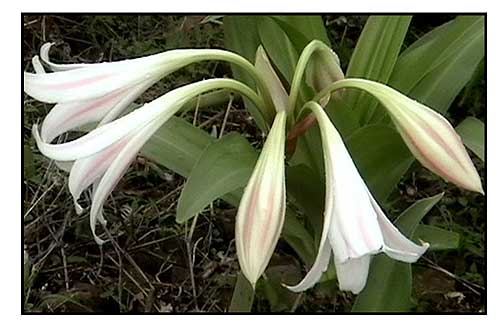 Botany
• Lirio is a lily plant, with subglobose bulbs up to 10 centimeters in diameter. Leaves are many, oblong-linear, 30 to 100 centimeters long, 5 to 8
centimeters wide. Scape is inserted on neck of the bulb,
about as long as the leaves, stout and tinged with purple. Flowers are about 10 in each umbel, fragrant, about 8 centimeters long. Perianth tube is curved, 10 to 12 centimeters long. Segments are oblong-lanceolate, 7.5 to 10 centimeters long, 2.5 to 3 centimeters wide, white but flushed with pale purple in the median part. Filaments are white. Fruit is somewhat rounded, 4 to 5 centimeters in diameter. The cultivated hybrid
forms give a variety of colors, some with white stripes running from
the center of red segments.
Distribution
- Naturalized.
- Cultivated for ornamental
purposes.
- Native to Andaman Is., Assam, Bangladesh, China South-Central, China Southeast, India, Laos, Myanmar, Nicobar Is., Sri Lanka, Thailand, Vietnam.
(18)
 Constituents
- Chemical analysis of bulbs yield alkaloids. Water extract of leaves also yielded alkaloids, especially of the crinane type, e.g., crinamine, crinamidine, crinafoline, and crinafolidine.
- Study isolated four alkaloids by spectroscopic method: Augustamine, undulatine, 6-hydroxy undulatine, 6-hydroxy buphanidrine.
-
Phytochemical analysis of leaves yielded a vast array of compounds, viz., alkaloids, phenolic compounds, tannins, flavonoids, terpenoids, amino acids, steroid saponins, and antioxidants. Plant has yielded hippadine, pratorinine, ambelline and lycorine, 2-epilyocorine and 2-epipancrassidine, among others. (15)
- Methanolic extract yielded six compounds viz., cycloartenol (1), 4-senecioyloxymethyl-3,4-dimethoxycoumarin (2), 4′,7-dihydroxy-3′-methoxyflavan (3), 4′,7-dihydroxyflavan (4), 2′,4′,7-trihydroxydihydrochalcone (5), and 5,6,3′-trihydroxy-7,8,4′-trimethoxyflavone (6). Compounds 2 and 6 were new metabolites. (see study below) (22)
- GC-MS analysis of leaves yielded 15 alkaloids: dihydro-oxo-demethoxyhaemanthamine (2), augustamine (3), oxoassoanine (4), crinane-3α-ol (5), buphanidrine (6), powelline (7), undulatine (8), ambelline (9), 6-hydroxy-buphanidrine (10),
6-hydroxypowelline (11), crinamidine (12), 6-hydroxyundulatine (13), 1β,2β-epoxyambelline (14), epoxy-3,7-dimeth-oxycrinane-11-one (tentative) (15), 6-hydroxycrinamidine (16). (24)
- Medicinal properties have been attributed to the presence of secondary metabolites e.g., alkaloids. In bulbs, lycorine, hemanthamine, tazettine, and crinine-type alkaloids have been identified; in leaves, crinine, hemanthamine and tazettine-type alkaloids are most abundant.
(32)
Properties
- Caution: Bulbs are extremely acrid and the juice reported to cause inflammation of the skin and mucous membranes. (37)
-
Studies have suggested anticancer,
antiviral, analgesic, and immune stimulant properties.
- Bulbs considered rubifacient.
- Studies have suggested immunomodulatory, T-lymphocyte stimulating, mast-cell stabilizing, antioxidant, anti-inflammatory, anthelmintic, antidiabetic, anti-tumor, antiviral, anti-BPH, antimicrobial, analgesic, catalytic, thrombolytic, estrogenic properties.
Parts
used
- Leaves, bulb, fruits.
Uses
Edibility
- In Vietnam, leaves used for tea.
Folkloric
- Bulbs, extremely acrid,
when roasted, used as a rubefacient for rheumatism.
- Juice of leaves used for earaches.
- Crushed and toasted bulbs used for piles and abscesses to hasten
suppuration.
- In Vietnam and Cambodia, used in treatment
of prostate and ovarian cancer. Also for prostatitis, uterine fibroids.
- In India,
leaf juice used for earaches; roasted bulbs applied on skin to relieve rheumatic pains. Warmed leaves smeared with castor oil applied to abscesses of toes and fingers.
- Tribals of Harda District of Madhya Pradesh, India use the bulb juice as antisterility.
(26)
- In Chinese traditional medicine, used for its antiviral and antitumor properties.
- In Ayurveda, used
for piles, fever and earaches.
- In Sri Lanka, plant used as bandage against snake bites. Decoction used for treatment of hydrocoele. (22)
Others
- Crila: Crila is a natural herb formulation from leaves of Vietnamese Crinum latifolium promoted for use in reducing menopausal hot flashes, promoting uterine health, and relieving menstrual cramps and discomfort in younger women. (see 27 & 28)
Studies
• Immunomodulatory: Study
showed extract of C latifolium slightly enhanced neopterin production
in unstimulated peripheral mononuclear cells with an effective reduction
of neopterin formation in stimulated cells. (1)
• T-Lymphocyte
Activating: A novel in vitro and in vivo T-lymphocyte activating factor in Crinum
latifolium (L.) aqueous extracts. The study suggests potential use
of C. latifolium for treatment of cases of immunodeficiency as cancer, leukemia and
AIDS. (3)
• Mast Cell Stabilizing:
Mast cell stabilizing effect of glucan A and phosphatidyllycorine
isolated from Crinum latifolium – Effect of glucan A and phosphatidyllycorine
from CL in vitro produced significant protection against mass cell
degranulation as well as to sensitized mast cells challenged with
a horse serum antigen. In vivo, it also provided protection against
degranulation of mast cells. Results support is use in Ayurvedic medicine
in the treatment of allergic disorders. (4)
• Benign Prostatic Hypertrophy:
A study in the International Hospital in Vietnam using extract cycles
of 21 days-on/7 days-off reported a 92.6 % benefit measured by prostate
size and clinical urologic evaluation. (5)
• Anti-Viral / Lectin from Bulbs:
A monocot mannose-binding amaryllidaceae lectin from the bulbs of
CL, specific for methyl-a-D-mannopyranoside, was found to be non-toxic towards African green monkey kidney epithelial
cells and exhibited a significant antiviral potential against a strain
of vaccinia virus in vitro. (7)
• Anti-Tumor:
A study on cold-hot aqueous extracts from Vietnamese CL showed inhibition
of carcinogenesis in rats probably due to the influence of immunomodulating
and anti-tumour plant alkaloids and other biologically active components
in the plant decoctions. (8)
• NF-kB Inhibitory Activity:
87 methanol extracts from Vietnamese oriental medicinal plants were screened for NF-kB inhibitory activity. NF-kB is an inducible and ubiquitous transcriptional factor needed for gene expression of many inflammatory mediators. Seven of the extracts, including C. latifolium showed strong to moderate inhibitory activity. (9)
• Benign Prostatic Hypertrophy / Soft Gel Formulation: Study was done of soft gel transformed from the dry glue of Crinum latifolium alkaloid for therapeutic effect in benign prostatic hypertrophy. Results concluded (1) soft gels of CL are effective for treatment of BPH, and (2) the drug is safe, with little side effects. (10)
• Antiproliferative / Prostate Tumors: Treatment of human prostate carcinoma PC3 and LNCaP cells, and benign prostate hyperplasia BPH-1 cells with water extracts of C. latifolium showed a significant dose-dependent inhibition of cell growth. The inhibition of tumor cell growth and recovery of immune functions may contribute to its beneficial effects in the treatment of prostate tumors. (12)
• Antioxidant: Crinum latifolium showed potent peroxyl-radical scavenging activity in vitro.
• Anti-Inflammatory: An aqueous extract of C. latifolium exhibited strong anti-inflammatory effect on mitogen stimulated PBMC by counteracting mitogen-induced activation of IDO enzyme activity and secretion of neopterin.
• Anthelmintic / Total Phenolic Content / Cytotoxicity: Study of a methanolic extract of Crinum latifolium leaves showed significant activity against Pheretima posthuma. Cytotoxicity testing using brine shrimp lethality test method showed positive result (LC50 15.652 µg/ml) compared to vincristine sulfate (0.839 µg/ml) as positive control. Crude methanolic extract exhibited lower amount of total phenolic content (17.50 ± 2.64 mg/ml). (14)
• Hemagglutination Activity / Lectin / Bulbs: Study evaluated the biologic activity of a lectin isolated from the bulbs of C. latifolium with carbohydrate specificity towards methyl-α-D-mannopyranoside. Study showed humagglutination activity, and was virtually non-mitogenic towards peripheral blood mononuclear cells. (16)
• Anti-Tumor Activity / Inhibition of Lymphoma Cells Proliferation: Study evaluated the CL leaf extracts on anti-tumor activity of peritoneal murine macrophages. Results showed CL extracts and alkaloid fraction inhibit the proliferation of lymphoma cells in multiple pathways. (17)
• Thrombolytic / Leaves: Study investigated the thombolytic potential of crude methanolic extract of leaves of C. latifolium. Results showed significant thrombolytic activity (p<0.001). Plant showed moderate clot lysis activity of 14.64 ± 0.540%, 18.01 ± 0.766%, 21.78 ± 1.039%, 28.43 ± 0.982%, and 33.84 ± 1.749% at 2, 4, 6, 8, and 20 mg/ml concentrations, respectively, while standard streptokinase showed 47.27 ± 1.998% clot lysis. Results suggest good thrombolytic activity of the leaves in vitro; however, in vivo thrombolytic potential s yet to be determined. (20)
•
Inhibitory Effect against Tube-like Formation of Human Umbilical Venous Endothelial Cells: Study of methanol extract yielded six compounds. Compound 2 (4-senecioyloxymethyl-3,4-dimethoxycoumarin) was found to be strongly inhibitory against in vitro tube-like formation of human umbilical venous endothelial cells (HUVECs) without cytotoxicity to tumor cell lines (B16F10, HCT116), with still significant inhibitory activity (53.5%) at concentrations as low as 1 µg.mL. Compound 6 showed modest inhibitory activity on tube-like formation of human venous endothelial cells (HUVECs). Other compounds i.e., 1, 3, 4, and 5 were found nearly inactive. (see constituents above) (22)
• Antitumor / Suppression of Immune Activation Cascades in Peripheral Blood and Proliferation of Prostate Tumor Cells: Study demonstrated the potent in vivo antioxidant activity of aqueous extract of C. latifolum extract by an oxygen radical absorbance capacity (ORAC) value of 1610 ± 150 µmol Trolox equivalents/g. Study showed dose-dependent inhibitory effects of an aqueous extract on cell proliferation of highly metastatic human prostate carcinoma PC3 cells,, androgen-sensitive prostate adenocarcinoma, and benign prostatic hyperplasia BPH-1 cells. Results showed inhibition of tumor cell growth and recovery of immune functions, both important antitumor properties of C. latifolium. (23)
• Alkaloids / Leaves: GC-MS analysis of leaves yielded 15 alkaloids, 9 of which were found for the first time; almost all were of the crinane type. Main alkaloids were undulatine (8) and crinamidine (12). Other important alkaloids were 6-hydroxybuphanidrine (10), ambelline (9), and 6-hydrxyundulatine (13). (see constituents above) (24)
• Analgesic / Anti-Inflammatory / Leaves: Study evaluated dried leaves of C. latifolium for analgesic and anti-inflammatory activity. An aqueous extract exhibited dose-related acute anti-inflammatory activity (carrageenan, histamine, dextran, and formalin), chronic anti-inflammatory activity (cotton pellet) and analgesic activity (acetic acid and formalin). (25)
• Uterine Fibroids: C. latifolium has been part of Vietnamese medicinal folklore for the treatment of uterine fibroids. Of the 12 varieties of C. latifolium, the Crila variety has been studied in women with uterine fibroids. A 3-month study in 195 women reported a decrease in size or stoppage in growth of fibroids in 79.5%. In 20.5%, tumor growth continues at a very slow rate. Whereas heavy menstrual flow was reported by 36% before Crila, this decreased to only 1% after treatment. (27) (28)
• Antimicrobial / Cytotoxic / Anti-Inflammatory / Leaves: Crude methanolic extract of leaves were evaluated for antimicrobial, cytotoxic, and anti-inflammatory properties. Extracts showed significant antimicrobial activity against gram negative bacteria E. coli with only slight activity against gram-positive bacteria. It showed significant (p<0.05) anti-inflammatory properties for hypotonic and heat induced conditions, 16.21 and 20.55% 10mg/ml, respectively. In contrast t vincristine sulfate, crude methanolic, n-hexane, petroleum ether, and chloroform extracts showed slight to moderate cytotoxic properties with LC50 of 7.06, 48.978, 242.83 and 153.93 µg/ml, respectively. (29)
• Silver and Gold Nanoparticles / Antibacterial / Catalytic / Leaves: Study reports on the biosynthesis of silver and gold nanoparticles using aqueous extract of C. latifolium leaves. Four bacterial strains were strongly inhibited by the AgNPs. The biosynthesized metallic NPs exhibited excellent catalytic degradation performance of pollutants. (30)
• Antidiabetic / Antioxidant / Leaves: Study evaluated the invitro antioxidant and antidiabetic activity of ethanolic extract of leaves. Phytochemical screening showed leaves to be rich in alkaloids, glycosides, tannin, flavonoids, gums, and mucilage. Hydrogen peroxide assay showed significant inhibitory potential against H2O2 free radicals. On glucose-uptake in yeast cells, there was significant uptake of glucose across the plasma membrane. At 1.2 mg/ml,the ethanol extract showed 83.07% of glucose uptake, equivalent to 87.98% of metronidazole. Study suggests invivo studies to confirm the results. (33)
• Anti-Inflammatory / Antioxidant / Leaves: Study evaluated the effect of C. latifolium extract on pro-inflammatory cytokine production and maturation of early and late endosomes in the lipo-polysaccharide (LPS)-induced human macrophages. Results showed C. latifolium decreases proinflammatory cytokine IL-6 expression and increases early and late endosomes possibly via activation of autophagy in the LPS-induced human macrophages. Findings suggest C. latifolum is involved in immune responses. C. latifolium has potential as therapeutic plant to regulate production of proinflammatory cytokine and maturations of early and late endosome in inflammatory diseases. (34)
• Anti-BPH Activity / Alkaloids / Leaves: Study aimed to standardize and evaluate the anti-proliferative activity of ethanol extract of C. latifolium leaves. Study of ethanolic leaf extract isolated two alkaloids, lycorine (1) and 6α-hydroxybuphanidrine (2). The crude extract was more potent than either compounds alone against TGF-ß-treated WPMY-1 cell proliferation. The drug combination showed greatest synergistic effect of (1) and (2) at 1:1 ratio. Results support the anti-BP)H activity of C. latifolium in traditional medicine and suggests both alkaloids may promote efficacy of C. latifolium extract. Both may also be used as bioactive markers for standardization of C. latifolium extracts. (35)
• Estrogenic / Fruits: Study evaluated the ethanolic extract of C. latifolium fruits using bilaterally ovariectomized immature albino rats, measuring parameters of vaginal cornification, uterine wet weight, vaginal opening, uterine glycogen content and uterine histopathology. Results showed notable effects: increase in uterine weight, dose-related rise in vaginal opening. Histopathologically, uterine tissue showed proliferative changes in the uterine endometrium, suggested by increased height of luminal epithelium, loosening of stromal tissue and increased number of glands. Results suggest potential estrogenic properties of the fruit extract, and possible applications for hormonal health and natural source of estrogenic compounds. (36)
Availability
- Wild-crafted.
- Dried tea leaves,
capsules, powders, extracts, supplements in the cybermarket.


