Gen info
- Campanulaceae, the bellflower family, contains nearly 2400 species in 84 genera of herbaceous plants, shrubs, and rarely small trees, often with milky sap. (11)
-
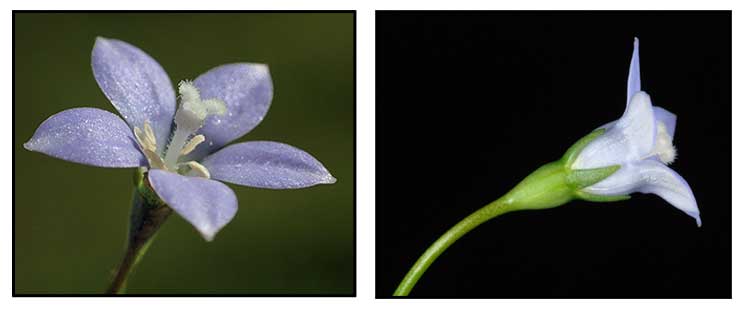
Wahlenbergia is a genus of around 260 species of flowering plants in the family Campanulaceae. Species are perennial or annual herbs with simple leaves and blue to purple bell-shaped flowers, usually with five petals.
- Taxonomical journey: In 1814, Heinrich Schrader first used the name Wahlenbergia elongata, but the name was a nomen nudum (unpublished). The genus was first formally described in 1821 by Albrecht Wilhelm Roth and the description published in Roth's Novae Plantarum Species prasertim Indiae Orientalis. Roth kept Schrader's name Wahlenbergia, which honors Göran Wahlenberg, a Swedish botanist. (3)
 - Etymology: Genus name Wahlenbergia honors the Swedish naturalist, Göran Wahlenberg
. The species epithet 'marginata' derives from Latin 'marg(in)' meaning 'border, edge', referring to where the plant is grows as it is commonly found along roadsides and disturbed areas. (8)
- Historical snippets: In 17th-century Cape Dutch texts, W. marginata was referred to as the "{Blue Carpet Herb," valued by Khoisan healers for treatment of minor wounds and joint discomfort. Early colonial botanists used poultices for bruises and infusions for mild febrile conditions among indigenous communities. Zulu medicine used leaf extracts to soothe skin rashes. Early settlers use the plant to make cordial-like tonics for "blood purification." British Army medics diaries during the Anglo-Zulu war records the use of poultices for sprains and muscle aches.
Botany
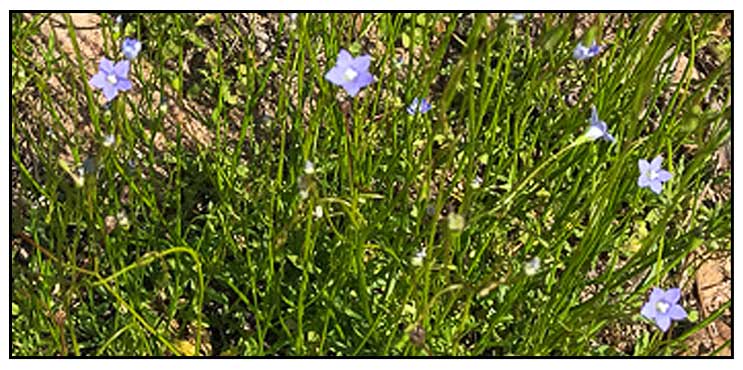
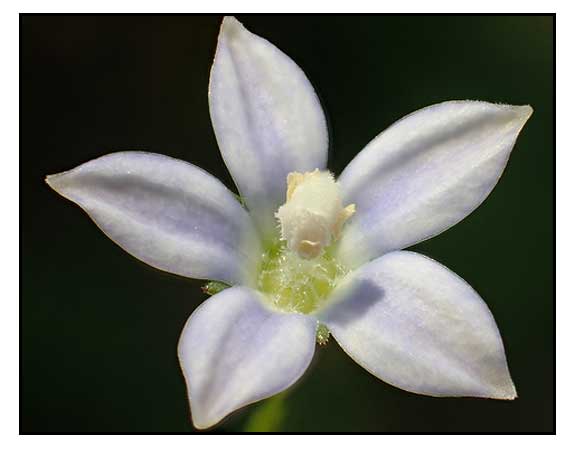
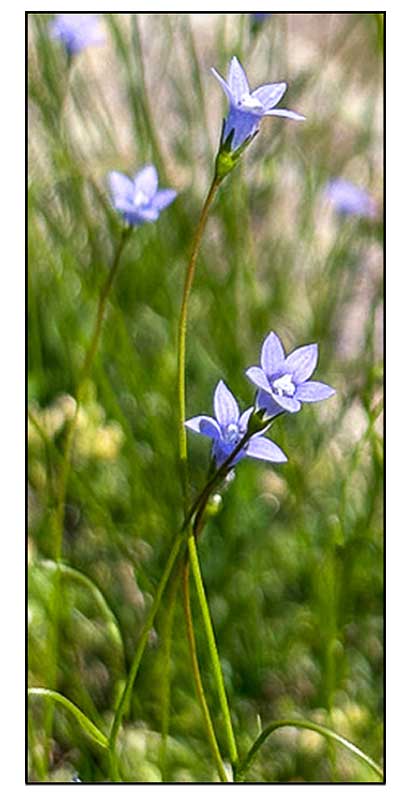
• Wahlenbergia marginata is a perennial herb 3-60 cm tall, glabrous or hairy, woody at base. Leaves arranged spirally, simple, linear to elliptical, 1.5-5.5 cm × 0.1-0.5 cm, decreasing in size upwards, serrate to almost entire, mostly sessile; stipules absent. Inflorescence a 1-few-flowered, terminal or axillary raceme, with small bracts. Flowers bisexual, regular, 3-5-merous, distinctly protandrous; pedicel 1-15 cm long; calyx lobes 0.8-4 mm long; corolla tube 1-5 mm long, lobes ovate or elliptical, 1-7 mm long, acute or acuminate, violet-blue or white; stamens alternating with corolla lobes, free; ovary inferior, obconical to bell-shaped, 1-5 mm long, 2-3-celled, style 1.5-5 mm long, stigma 2-3-lobed. Fruit an obconical to bell-shaped capsule 1.5-10 mm × 1-5 mm, 2-3-valved, many-seeded. Seeds ellipsoid to triangular, up to 1 mm long, shining. (1)
 Distribution
- Native to the Philippines. (2) (10)
- In Luzon: Benguet, Ifugao, Mountain Province, Nueva Vizcaya, Quezon. In montane grasslands; 100-3500 m. (10)
- Also native to Assam, Bangladesh, China, Himalaya, India, Japan, Jawa, Kazan-retto, Korea, Laos, Lesser Sunda Is., Maluku, Myanmar, Nansei-shoto, Nepal, New Guinea, Ogasawara-shoto, Sri-Lanka, Sulawesi, Taiwan, Thailand, Vietnam.
(2)
Constituents
- Study of methanol extract isolated wahlengergioside, a new hydroxymethylglutaroyl phenylpropanoid glucoside, and a known compound, lobetyolin. (4)
- Repeated column chromatography of aqueous methanol extract of whole plant isolated five compounds: Wahlenoside, a new natural product (1), demethyl syringin (2), 3,5-dihydroxyphenethyl alcohol 3-O-β-D-glucopyranoside (3), rutin (4), and isovitexin (5). (see study below) (9)
\Properties
- Due to small size, plant is difficult to locate. Without flowers blooming, it is easily overlooked. (8)
-
Studies have suggest hepatoprotective and potential antidiabetic properties.
Parts used
Roots, whole plant.
 Uses
Edibility
- While rated as "generallly not toxic", along with Ayurvedic preparations of decoctions drunk for various complaints, there is no information on culinary use of the plant.
Folkloric
- Used for pulmonary infections.
- In Indonesia, used to treat skin eruptions.
- In Cambodia, Laos, and Vietnam, used to treat pulmonary infection.
-
In Java, used to treat skin diseases.
- In China, used for treatment of hepatitis.
- In China and Indo-China, roots used for cough and hemoptysis and for treatment of gastralgia.
- In Uttar Pradesh, India, paste prepared from whole plant used for skin troubles.
- In India, roots used for pulmonary infections. Herb used externally for skin diseases and strengthening loose teeth. (7)
- Ayurvedic formulations include: (1) Decoction (Kasaya): 5-10 g dried herb in 250 ml water, reduced to 50-75 ml, taken 2x daily before meals. (2) Powder (Churna): 1-2 g in warm water or honey, 2x daily. (3) Capsules: Standardized to 10% flavonoids, 300-500 mg 2x daily. (4) Poultice: Fresh leaves crushed and applied directly to minor cuts or joint areas, secured with cloth for 2 hours. (13)
- In traditional Chinese medicine, Herba Wahlenbergiae, Lanhuashen (LHS), made from dried herba has been used in TCM for over 600 years, for enriching consumptive disease and relieving deficient heat, consistent with therapy for T2 diabetes in TCM. (see study below) (14)
Studies
• Biotechnology and Secondary Metabolites / Roots: Wahlenbergia marginata hairy roots were induced by infection with Agrobacterium rhizogenes ATCC 15834 and MAFF 03-01724 strains. The hairy roots produced high content of polyacetylenes, particularly the monoglucoside, lobetyolin. Agrobacterium-mediated gene transformation is an applicable method for getting useful transgenic W. marginata plantlets. (5)
• Hepatoprotective / Whole Plant: Study evaluated the hepatoprotective effect of aqueous methanol extract of whole plant of W. marginata against acute liver injury induced by Concanavalin A in mice. marginata. The extracts of W. marginata reduced the ALT/AST in blood serum of mice with acute liver injury, and relieved the damage in liver tissue. In search of active compounds, repeated column chromatography isolated five compounds: Wahlenoside, a new natural product (1), demethyl syringin (2), 3,5-dihydroxyphenethyl alcohol 3-O-β-D-glucopyranoside (3), rutin (4), and isovitexin (5). (9)
• Intersection with Sex Hormone-Microbiota Axia / A Hypothesis: Gut microbiota, sex hormones, and phyto-chemicals affect processes associated with cancer onset independently. Study evaluated the pairwise associations and whether plant phytochemicals can intersect with the sex hormone-microbiota axis. The estrobolome includes gut microbes' genes responsible for estrogen metabolism and deconjugation of estrogen metabolites by enzymes such as ß-glucuronidases. Researchers regard the proposed association as a testable hypothesis rather than a proven mechanism. Further studies are needed to confirm the chemical composition of the plant, evaluate its pharmacological potential, and interaction with anti-cancer drugs. (12)
• Langhuashen (LHS) / Potential for T2DM: Langhuasen (LHS) derived from dried herba of W. marginata has been used in traditional Chinese medicine (TCM) for over 600 years. Study evaluated the regulation of glucolipid metabolism using LHS extracts and its potential in T2DM. Chemical profile analysis of LHS identified 76 components. As indicated by decreased trehalose, glucose and triglyceride levels and increased total protein levels, LHS extracts were perceived to alleviate disorder of glucolipid metabolism in HSD (high sucrose diet)-induced T2DM fruit flies. LHS extracts broadly modulated TF-dependent gene expression and stimulated positive cross-regulation mediated by the S1P axis to ameliorate glucolipid metabolism. Results provide evidence for LHS as a potential drug for T2DM. (14)
Availability
Wild-crafted. |