HOME      •      SEARCH      •      EMAIL    •     ABOUT


Family Apocynaceae
Lagaylay
Parsonsia alboflavescens (Dennst.) Mabb..
SPIRAL-VINED SILKPOD
Hai nan tong xin jie

Scientific names Common names
Aganosma concanensis Hook. Lagaylay (Tag.)
Aganosma laevigata (Moon) J.Graham Spiral-vined silkpod (Engl.)
Apocynum reticulatum L.  
Apocynum vincifolim Burm.f.  
Chaetosus volubilis Benth.  
Cudicia trichotoma Buch.-Ham. ex Dillwyn  
Echites laevigatus Moon  
Echites spiralis Blanco  
Helicandra sinensis Hook. & Arn.  
Heligme javanica (Blume) Blume  
Heligme korthalsiana Miq.  
Heligme minahassae Teijsm. & Binn.  
Heligme rheedei Wight  
Heligme spiralis (Wall. ex G.Don) Thwaites  
Helyga javanica Blume  
Helygia javanica (Blume) Blume  
Lyonsia sumatrana Ridl.  
Lyonsia viridiflora F.M.Bailey  
Parsonsia acuminata Wall.  
Parsonsia alboflavescens (Dennst.) Mabb.  
Parsonsia aterinervia Elmer  
Parsonsia confusa Merr.  
Parsonsia cumingiana A.DC.  
Parsonsia helicandra Hook. & Arn.  
Parsonsia howii Tsiang  
Parsonsia javanica (Blume) K.Schum.  
Parsonsia korthalsiana (Miq.) Boerl.  
Parsonsia kunstleri King & Gamble  
Parsonsia laevigata (Moon) Alston  
Parsonsia longipedunculata Merr.  
Parsonsia magnifolia Elmer  
Parsonsia minahassae (Teijsm. & Binn.) Koord.  
Parsonsia momiensis Kaneh. & Hatus.  
Parsonsia oblancifolia Merr.  
Parsonsia oblonga Wall. ex G.Don  
Parsonsia oblangifolia Merr.  
Parsonsia panniculata Pichon  
Parsonsia pauciflora Wall.  
Parsonsia rheedei Fern.-Vill.  
Parsonsia spiralis Wall. ex G.Don  
Parsonsia spiralis Vidal  
Spirostemon spiralis Griff.  
Parsonsia alboflavescens is an accepted species. KEW: Plants of the World Online

Other vernacular names
CHINA : Pa sen teng, Hai nan tong xin jie.
INDIA: Ezhuthani, Kudici-kodi, Penalivalli, Wallia-palvalli (Malayalam); Nagalkuda (Marathi).
JAPAN: Hourai-kagami.
SRI LANKA: Wal anguna (Sinhala).

Gen info
- Parsonsia alboflavescens is a woody vine of the family Apocynaceae. It was first described in 1818 as Periploca alboflavescens, and described many times thereafter. The current name was given by Mabberley in 1977, who found Dennstedt's publication preceded all others, and also took the species epithet alboflavescens. (3)
- Etymology: The genus name Parsonsia was given by Scottish botanist Robert Brown in 1810 to honor James Parsons (1705-1770), an English physician, natural historian, and author of botanical works including Philosophical Transactions. The species epithet derives from Latin words albus, meaning "white" and flavescens, meaning "turning yellow", referring to the flower color habit that transitions from white to yellowish. (9)

Botany
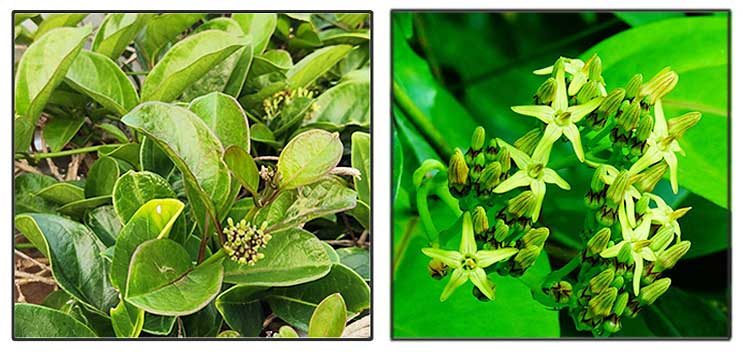
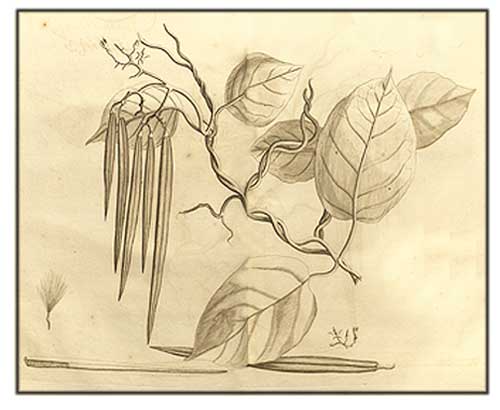
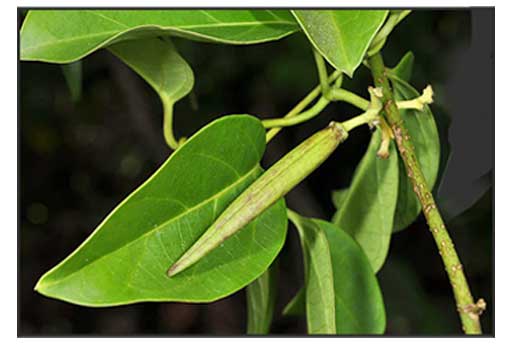
Spiral-Vined Silkpod is a woody lianas, up to 10 m long, hairless except for inflorescences. Branches are pale gray. Leaf-stalk is 2-4 cm. Leaves are ovate or subelliptic, 4-12 X 3-7.5 cm, base wedge-shaped to shallowly heart-shaped, lateral veins 5-7 pairs. Flowers are borne in cymes 8-15 X 8-11 cm, which are carried on stalks 3-9 cm long. Sepals are 2 mm, glands broadly triangular, membranous. Flowers white or greenish, tube about 5 mm, limb 1-2 cm wide, petals about 6 mm. Anthers are about 3.5 0.6 mm, inserted at middle of corolla tube. Ovary as long as or slightly shorter than disc, glabrous. Seed-pods are 2, linear-cylindric, parallel, 7-16 X 1-2 cm. Seeds are oblong 1.5-1.8 cm X 2 mm. Flowering: April-October. (Flowers of India)

• Climber with twining stems, glabrous except for inflorescence; latex clear. Leaves thin, soft, pale green; petiole slender, 12–30 mm long; lamina elliptic, 8–15 cm long, 3.4–8.2 cm wide, cuneate, attenuate or occasionally rounded at base, shortly acuminate or mucronate; secondary veins 6 or 7 pairs, curving, slightly raised below, with some fine tertiary veins visible. Inflorescence of axillary, open panicles, with 13–30 flowers, usually longer than leaves; axes finely hairy; pedicels 4–9 mm long. Calyx lobes 2 mm long, finely hairy. Corolla yellowish or green, abruptly expanded above apex of tube, glabrous externally or very minutely puberulous; tube 2.5–4 mm long, with a ring of very short, flattened hairs in throat; lobes widely spreading, narrowly oblong-lanceolate, 5–6.3 mm long, 1.5–1.8 mm wide, obtuse, glabrous internally. Anther cone 3.3–4 mm long, ± fully exserted; filaments spirally twisted; anther tails convergent. Nectary scales free, ovate-deltoid, c. 1.2 mm long. Capsules slender, narrowly fusiform, 10–18 cm long, 0.5–0.9 cm diam. (Flora of Australia)

Distribution
- Native to the Philippines. (1) (2)
- In thickets and secondary forests; also near the seashore. 0-1500 m.
- Also native Andaman Is., Assam, Bangladesh, Bismarck Archipelago, Borneo, Cambodia, China Southeast, Hainan, India, Jawa, Laos, Malaya, Maluku, Myanmar, Nansei-shoto, New Guinea, Nicobar Is., Northern Territory, Solomon Is., Sri Lanka, Sulawesi, Sumatera, Taiwan, Thailand, Vietnam. (1)
- Listed as lower risk or near-threatened by IUCN-UK 1996.

Constituents
- Unusual macrocyclic pyrrolizidine alkaloids (PAs) were detected in archived samples up to 13-yr old nectar, leaves, sap, and seeds, which demonstrate the longevity and persistence of PAs that protect against herbivores (Bruzynski et al., 2015). PAs also play an important role in chemical defence mechanisms of plants against certain insect herbivores (Hartmann, 1999). (see study below) (8)

Properties
- Studies have suggested wound healing properties.

Parts used
Leaves.

Uses

Edibility
- No information found on edibility.
Folkloric
- In the Mindoro, Philippines, heated leaves are applied as poultice for treatment of hernia. (6) In Marindugue, juice from pounded leaves drunk for treatment of asthma. (7)
- In India, used as febrigue, vulnerary, and disinfectant. Used for treatment of leg swellings tuberculosis, rheumatism, and kidney problems. (4)
- Used for treatment of epistaxis, boils, insanity, leg swellings, wound healing, fever, and to enhance immunity in AIDS patients.
Others

- Host plant: Plant is a larval and major nectar host plant of the malabar tree nymph butterfly, Idea malabarica (Lepidoptera: Nymphalidae). (3)

Studies
Wound Healing / Leaves:
Study evaluated the efficacy of ethanol leaf extract gel P. alboflavescens on incision wound model and the efficacy of the extract gel to cure a scar on male rats. Results showed homogeneous results, normal pH, stability, dissemination and good viscosity, less irritating and with good adhesion. The optimum dose for incision wound healing is 5%. (5)
Macrocyclic Pyrrolizidine Alkaloids (PAs): Unusual macrocyclic pyrrolizidine alkaloids (PAs) present in P. alboflavescens are known for curing many kinds of human disease and defense against herbivore. PAs were detected in archived samples up to 13-yr old nectar, leaves, sap, and seeds, which demonstrate the longevity and persistence of PAs that protect against herbivores (Bruzynski et al., 2015). PAs also play an important role in chemical defense mechanisms of plants against certain insect herbivores (Hartmann, 1999). Reports have confirmed therapeutic properties of the alkaloids in curing nose bleeds, boils, insanity, leg swellings, tuberculosis, rheumatism, immunity enhancement in AIDS, among others. (8)

Availability
- Wild-crafted.
- Seeds in the cybermarket.
(BGS)

August 2018

                                                 PHOTOS / ILLUSTRATIONS
IMAGE SOURCE: Parsonsia alboflavescens / Vengolis / CC BY-SA 3.0 / Image modified / Click on image or link to go to source page / Wikimedia Commons
OTHER IMAGE SOURCE: Illustration: Parsonsia alboflavescens / Rheede tot Drakestein (1689) / Public Domain / Click on image or link to go to source page / Wikimedia Commons
OTHER IMAGE SOURCE: Spiral-vined Silkpod tea / © deerjacksonhu / Some rights reserved / CC BY 4.0 International / Image modified / Click on image or link to go to source page / iNaturalist
OTHER IMAGE SOURCE: Parsonsia alboflavescens / © Butterfly Garden Seeds / Non-commercial use / Image modified / Click on image or link to go to source page / Butterfly Garden Seeds

Additional Sources and Suggested Readings
(1)
Parsonsia alboflavescens / KEW: Plants of the World Online
(2)
Apocynaceae: Parsonsia alboflavescens / Co's Digital Flora of the Philippines
(3)
Parsonsia alboflavescens / Wikipedia
(4)
Prospects of Traditionally important Apocynaceae plants of India in Cancer Remediation / Nirmala Devi, Ajay Kumar Gupta, Sunil K Prajapati / JJDDT: ournal of Drug Delivery and Therapeutics, 2019; 9(1): pp 293-302 / DOI: 10.22270/jddt.v9i1.2208
(5)
Incision Wound Healing Test of Ethanolic Extract Gel from Salaon (Parsonsia alboflavescens [Dennst.] Mabb.) Leaves in Male Rats / N Zebua, Muharni Saputri, Aula Firsa et al / Open Access Macedonian Journal of Medical Sciences, 2021 / DOI:10.5530/pj.2017.6s.163 / Corpus ID: 55572496
(6)
Lagaylay / Philippine Traditional Knowledge Digital Library of Health
(7)
Lagaylay / Philippine Traditional Knowledge Digital Library of Health
(8)
Rare and endemic medicinal plant, Parsonsia alboflavescens (Dennst.) Mabb. and malabar tree nymph butterfly, Idea malabarica in Western Ghats of Karnataka / B Aishwarya, Revanna Revannavar / Journal of Pharmacognosy and Phytochemistry, 2018; SP3: pp 201-203 / eISSN: 2278-4136 / pISSN: 2349-8234
(9)
Parsonsia alboflavescens / Grokipedia

DOI: It is not uncommon for links on studies/sources to change. Copying and pasting the information on the search window or using the DOI (if available) will often redirect to the new link page. (Citing and Using a (DOI) Digital Object Identifier)

                                                            List of Understudied Philippine Medicinal Plants
                                          New plant names needed
The compilation now numbers over 1,720 medicinal plants. While I believe there are hundreds more that can be added to the collection, they are becoming more difficult to find. If you have a plant to suggest for inclusion, native or introduced, please email the info: scientific name (most helpful), local plant name (if known), any known folkloric medicinal use, and, if possible, a photo. Your help will be greatly appreciated.

HOME      •      SEARCH      •      EMAIL    •     ABOUT