HOME      •      SEARCH      •      EMAIL    •     ABOUT


Family Apocynaceae
Kuyon-kuyon
Lepiniopsis ternatensis Valeton
KOLINOS / LEPINIOPSIS

Scientific names Common names
Lepiniopsis philippinensis Elmer Kolinos (Tag.)
Lepiniopsis ternatensis Valeton Kuyon-kuyon (Tagalog)
  Magpanias (Bisaya)
Lepiniopsis ternatensis Valeton is an accepted species. KEW: Plants of the World Online

Other vernacular names
INDONESIA: Pulasari pohon, Tokupoa (Moluccas).

Gen info
- Lepiniopsis is a genus of plants in the family Apocynaceae.
- It was first described as a genus in 1895 by Theodoric Valeton,
- The genus comprises two accepted species of trees native to primary lowland tropical forests in Central Malesia and the northern Pacific, from sea level to 300 m elevation.
- The two species are Lepiniopsis ternatensis, which ranges from the Philippines through New Guinea, the Bismarck Archipelago, Maluku, and Sulawesi and L. trilocularis, endemic to Palau in Micronesia.   (7)

Botany
• A shrub or tree, 6-17 m tall, rich in white latex, with 3-whorled branches. Leaves alternate; petiole 1-3.5 cm long; blade elliptical to obovate, 9-26 cm × 3-8 cm, fleshy to coriaceous, glabrous. Inflorescence dichasial, in alternating ternate groups. Calyx lobes 5; corolla salverform, 5-lobed, tube orange, lobes white. Fruit syncarpous, drupaceous, ellipsoid, 2.5-5 cm × 1.5-2 cm, red, 5-locular. Seed usually 2-3 per fruit, 2-3 cm long, bony. (PROSEA)

• Tree to 36 m tall, to 46 cm dbh; Bark grey, yellowish grey, grey-brown or brown, smooth or vertically finely fissured or pustular; Branchlets glabrous, not lenti-cellate. Leaves: Inflorescence 1.5-24 cm long; Sepals ovate, 0.9-1.8 by 1.1-1.4 mm, 0.7-1 times as long as wide, apex rounded, glabrous, not ciliate. Stamens inserted at 4.7-7 mm from corolla base which is 0.5-0.7 of tube length; Ovary 0.7-0.9 mm high, glabrous; Fruit red or black, 2.1-7 by 0.9-1.9 cm, ellipsoid, often somewhat curved.Seeds 17-21 by 4-7 by 4.5-5 mm. (Flora Malesiana)

Distribution
- Native to the Philippines. (1)
- Also native to
Bismarck Archipelago, Maluku, New Guinea, Sulawesi. (1)
- Rare and scattered in the undergrowth of lowland rain forest, growing along rivers, on sandy beaches of elevations up to 900 m. (3)

Constituents
- The leaves and bark of L. ternatensis afforded a high yield of unsubstituted coumarin. Not unprecedented, it has been reported to occur in the leaves of Macrosiphonia velame and leaves and bark of Alyxia stellata. Extraction of dried leaves (20kg) yielded a crude "alkaloidal" fraction (80g), which contained a little alkaloid, but became partly crystalline on standing. (6)

Properties
- Studies have suggested fibroblast stimulatory, wound healing properties.

Parts used
Sap.

Uses

Edibility
- No information on edibility.
Folkloric
- No reported folkloric medicinal use in the Philippines.
- In Papua, New Guinea, sap of the tree used as topical treatment for cutaneous leg ulcers. (5)
Others

- Fragrance: Roots are fragrant, like the rhizomes. Used to perfume clothes. Scent is best preserved by first soaking the roots in seawater, then drying them. (3)
- Latex: Plant yields a rich amount of white latex.

Studies
Wound Healing / Stimulation of Fibroblast Proliferation / Sap:
In Papua, New Guinea, tree sap used for treatment of cutaneous leg ulcers. Study evaluated the effect of the sap on wound healing biology using human-derived primary cell lines. Analysis revealed the sap to contain a single major component, a polyphenol, trifucol. The sap significantly increase the proliferation of dermal fibroblasts at a mere 1.3 µg/mL, without influencing kertinocytes, suggesting a fibroblast-specific mechanism of stimulation. It also significantly inhibited TNF-α secretion by pro-inflammatory M1 macrophages, but not neutrophils, at 130 µg/ml. The low sap toxicity towards dermal cells along with its fibroblast stimulatory activity and downregulation of TNF-α suggests potential for a dermal wound-healing agent for chronic non-healing ulcers. (5)

Availability
- Wild-crafted.

May 2026

                                                 PHOTOS / ILLUSTRATIONS
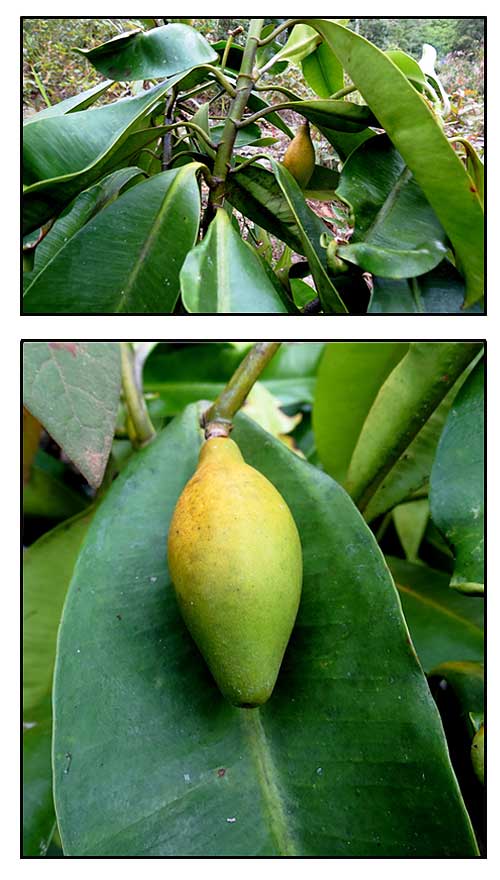
IMAGE SOURCE: Lepiniopsis ternatensis - leaf and fruit / earth.com / Non-commercial use / click on image or link to go to source page / earth.com
OTHER IMAGE SOURCE: Lepiniopsis ternatensis - ripening fruit / by Iska Gushilman / CC BY-NC-ND / click on image or link to go to source page / Useful Tropical Plants
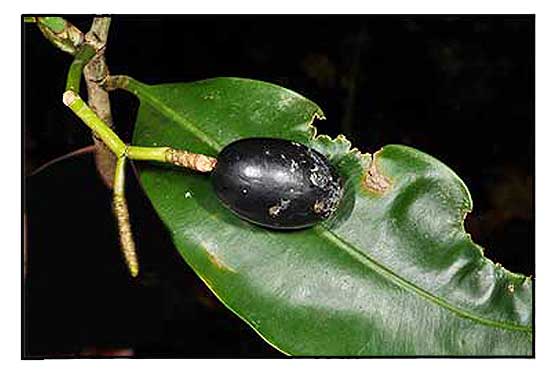
OTHER IMAGE SOURCE: Lepiniopsis ternatensis - developing fruit / by Iska Gushilman / CC BY-NC-ND / click on image or link to go to source page / Useful Tropical Plants

Additional Sources and Suggested Readings
(1)
Lepiniopsis ternatensis Valeton / KEW: Plants of the World Online
(2)
Apocynaceae: Lepiniopsis ternatensis / Co's Digital Flora of the Philippines
(3)
Lepiniopsis ternatensis / PCM Jansen / PROSEA
(4)
Lepiniopsis / Wikipedia
(5)
Lepiniopsis ternatensis sap stimulates fibroblast proliferation and down regulates macrophage TNF-α secretion / Rachael L Moses, Jordanna Dally, Fionnula T Lunday et al / Fitoterapia, 2020; 141: 104478 /
DOI: 10.1016/j.fitote.2020.104478
(6)
IDENTIFICATION OF COUlMARINS ISOLATED FROM LEPINIOPSIE! TERNATENSIS (APOCYNACEAE), PTER OCA ULON SPHA CELAT UM (COMPOSITAE), AND MELICOPE MELANOPHLOIA (RUTACEAE) / SR Johns, JA Lamberton, JR Price, AA Sioumis / Aust J Chem., 1968; 21: pp 3079-80.
(7)
Lepiniopsis / Grokipedia

DOI: It is not uncommon for links on studies/sources to change. Copying and pasting the information on the search window or using the DOI (if available) will often redirect to the new link page. (Citing and Using a (DOI) Digital Object Identifier)

                                                            List of Understudied Philippine Medicinal Plants
                                          New plant names needed
The compilation now numbers over 1,750 medicinal plants. While I believe there are hundreds more that can be added to the collection, they are becoming more difficult to find. If you have a plant to suggest for inclusion, native or introduced, please email the info: scientific name (most helpful), local plant name (if known), any known folkloric medicinal use, and, if possible, a photo. Your help will be greatly appreciated.

HOME      •      SEARCH      •      EMAIL    •     ABOUT