HOME      •      SEARCH      •      EMAIL    •     ABOUT


Family Hypoxidaceae
Kitkitli
Hypoxis aurea Lour.
GOLDEN STAR GRASS

Xiao jin mei cao

Scientific names Common names
Curculigo graminifolia Nimmo Kitkitli (Ig.)
Hypoxis aurea Lour. Golden star grass (Engl.)
Hypoxis frankquevillei Miq. Star grass (Engl.)
Hypoxis minor D. Don. Yellow star grass (Engl.)
Hypoxis aurea Lour. is an accepted species. KEW: Plants of the World Online

Other vernacular names
CHINESE: Hsien-mao, P'o-lo men sheu, Xiao jin mei cao.
HINDI: Bhui khajur, Golkya.
JAPANESE: Ko-kinbai-zasa.
MARATHI: Sontara.
NEPALESE: Ban siru, Karsul.
SANSKRIT: Ho-lun-lei-t'o.
VIETNAMESE: H[aj] tr[aa]m.

Gen info
- Hypoxidaceae is a family of flowering plants, in the order Asparagales of the monocots.
The APGIV system of 2016 (unchanged from 1998, 2003, and 2009 versions) accepts the family. It consists of 5 genera and around 160 species.
(12)
- Hypoxis is a genus of flowering plants of the family Hypoxidaceae. It has a cosmo-politan distribution, occurring in Africa, the Americas, Asia, and Australia. The genus is the largest of the Hypoxidaceae.
- Common names for the species include star grass, star lily, yellow stars, African potata, and stars.

Botany
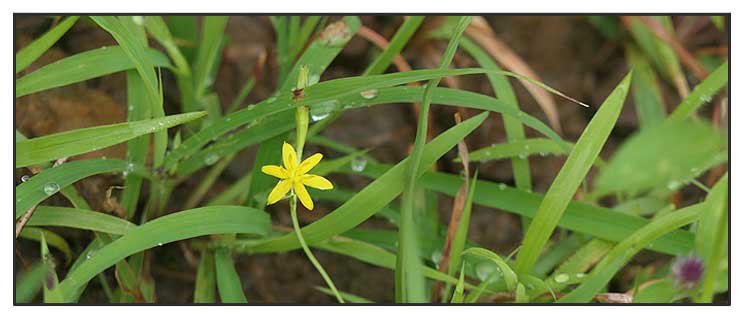
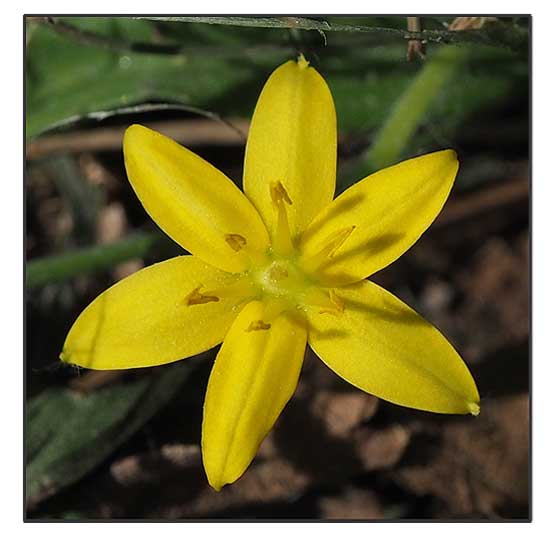
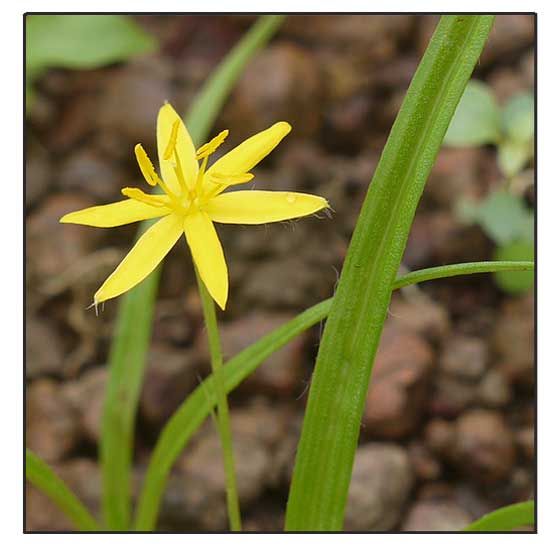
• Kitkitli is a small hairy tuberous plant. Rootstock is rounded or cylindrical, erect, 2.5 centimeters long or more, and crowned with the fibrous remains of old leaves. Leaves are slender and grasslike, narrowly linear, 10 to 30 centimeters long and 2 to 3 millimeters wide. Flowers are solitary or paired, golden-yellow. Scape is 2.5 to 10 centimeters long, slender, filiform, and hairy. Perianth-lobes are elliptic-lanceolate, 8 to 12 millimeters long, yellow, and green on the back. Capsules are 6 to 12 millimeters long, clavate, at length 3-valved, crowned with the erect perianth-lobes. Seeds are black, and tuberculate.

• Golden Star Grass is a small hairy tuberous plant, found in the Himalayas, from Pakistan to Bhutan, SE Asia and Japan, at altitudes of 1500-2800 m. It is also found in the Sahyadri Hills, at high elevations. It has slender grass-like leaves, and solitary or paired golden yellow flowers. The flowers are 1.3-2 cm across, tepals oblong, 6--8 mm, brown pilose, persistent. petals which are green and hairy on the undersides. The flowers are borne on stems, 3-5 cm long, much shorter than the leaves. Leaves are 5-30 cm long, 2-5 mm broad, strongly veined, with long sparse hairs. Fruit is cylindrical, topped by persistent petals. (Flowers of India)

Distribution
- Native to the Philippines. (9) (11)
-
In grassland and other sunny places, medium and higher elevation, 870-2300 m.
- In Luzon: Benguet, Mountain Province, Nueva Ecija; in Mindanao: Bukidnon, Lanao; Mindoro, Palawan. (11)
- Also native to
Assam, Bangladesh, Cambodia, China South-Central, China Southeast, East Himalaya, India, Japan, Jawa, Korea, Laos, Lesser Sunda Is., Malaya, Myanmar, Nansei-shoto, Nepal, New Guinea, Pakistan, Sulawesi, Sumatera, Thailand, Vietnam, West Himalaya. (9)

Constituents
- Ethanol extract yielded twelve compounds: quercetin-3-O-β-D-glucoside,kaemferol-3-O-β-D-glucoside, apigenin-5-O-β-D- glucopyranoside, α-spinasterol, 2,6-dimethoxy-benzoic acid, 1H-indole-3-carboxylic acid, ( 2S,3R,4E,8E) -1 - (β-D-glucopyranosyloxy) -3 -hydroxy-2 [ ( R ) -2′ -hydroxyeicosanoly ) amino ] -9-methy-4,8-octadecadiene, n-dotriacontanol,14,15-eicosenicacid, lignoceric acid, β-sitoster-ol, daucosterol.
- Study of rhizomes isolated two new phenolic glycosides, aureaside A and B, together with seven known compounds, curculigoside I,5 orcinol glucoside ,6 curcapital,7 cimifugin prim-O-β- D-glucopyranoside, 8 2-O-β-D-apiofuranosyl (1→6)-O-β- D-glucopyranoside, 9 (2R,5S)-bornane-2,5-diol-2-O-β-D- glucopyranoside, 9 and bornyl 7-O-β-D-apio-D-furanosyl (1→6)-O-β-D-glucopyranoside. (1)
- Study of methanolic extract of tubers isolated and identified 12 target-compounds, chlorinated aromatic glycosides: Hypoxichlorosides A-F (3, 6, 9-12), curculigine A (1), curculigine E (4), curculijine J (5), 2,4,6-trichloro-3-methoxy-5-methylphenyl 1-O-ß-d-glucopyranosyl-(1 ->6)-ß-d-glucopyranoside (7), and curculigine C (8). (15)

Properties
- Properties similar to ginseng.
- Rootstock swell in water and is mucilaginous.
- It has small starch grains and bundles of raphides.
- Considered reconstructive, rejuvenating, aphrodisiac and tonic.
- Studies have suggested free radical scavenging, tyrosinase inhibitory, anti-melanogenesis, collagen biosynthesis stimulating properties.


Uses

Edibility
- No reports found on edibility.
Folkloric

- Similar to ginseng, used as reconstructive, rejuvenating, aphrodisiac and tonic.
- Used in wasting diseases, dyspepsia, lassitude, impotence, wounds, and diseases of the eyes and ears.
- In China, used to treat hernias, and to warm the kidney.
- In northwestern Himalaya, roots used as aphrodisiac.
- In China and
Malaysia, used as tonic and aphrodisiac.
- In Thai traditional medicine, used for treatment of acne, dark spots and skin blemishes.

Others
- Cosmetics:
Extract of leaves used as ingredient in commercial cosmetic preparations as skin conditioner and bleaching agent. (14)

Studies

Radical Scavenging Activity / Tyrosinase Inhibitory Activity: Study showed a tuberous extract of H. aurea extracted by distilled water at room temperature gave high free radical scavenging activity and tyrosinase inhibition activity which was comparable to vitamin C as antioxidant and tyrosinase inhibitor agent. Results suggest potential for development of whitening cosmetic products. (7)
Anti-Melanogenesis / Collagen Biosynthesis Stimulating Activity Scavenging Activity: Study of H. aurea extracts for anti-melanogenesis and collagen biosynthesis stimulating activity. Results showed the leaves from H. aurea extracted by 95% ethanol can be applied as whitening and anti-aging agents for cosmetic pharmaceuticals. (8)
Antioxidant / Tyrosinase Inhibitory: Study compared maceration with microwave-assisted extraction (MAE) in evaluating total phenolic content (TPC), antioxidant activity, and tyrosinase inhibitory activity. MAE consistently produced extracts with superior bioactive properties compared to conventional maceration. MAE significantly enhanced TPC. Antioxidant potency did not correlate with TPC. MAE with 70% ethanol at 90°C yielded highest TPC (150.36 mg GAE/g extract). MAE with 95% ethanol at 50°C produced highest cellular antityrosinase activity. MAE extracts demonstrated superior TPC, antioxidant, and anti-tyrosinase activities compared to maceration, and present a promising method for enhancing phytochemical content and bioactivity of H. aurea extracts. (16)

Availability
- Wild-crafted.
- Powders, extracts in the cybermarket.

  Abuse and Plagiarism of the Compilation on Philippine Medicinal Plants Under the Guise of Fair Use

Updated June 2026 / December 2019 / May 2015

PHOTOS / ILLUSTRATIONS
IMAGE SOURCE: Hypoxis aurea / ©  Dinesh Valke / Some rights reserved / CC BY-SA 4.0 International / Image modified / Click on image or link to go to source page / iNaturalist
OTHER IMAGE SOURCE: Hypoxis aurea - flower close-up / by  葉子 / No rights reserved / PUBLIC DOMAIN / Click on image or link to go to source page / granted for non-commercial use / Click on image or link to go to source page / iNaturalist
IMAGE SOURCE: Hypoxis aurea / ©  Dinesh Valke / Some rights reserved / CC BY-SA 4.0 International / Image modified / Click on image or link to go to source page / iNaturalist

Additional Sources and Suggested Readings
(1)
Two New Phenolic Glycosides from Hypoxis aurea Lour / Zhong-Quan Cheng, Dan Yang et al / Bull. Korean Chem. Soc. 2009, Vol. 30, No. 10
(2)
Hypoxis aurea Lour. / Chinese name / Catalogue of Life, China
(3)
Hypoxis aurea / Common names / Flowers of India
(4)
Chemical Constituents from Hypoxis aurea Lour / Cheng Zhong-Quan; Yang Dan; Ma Qing-Yun; Liu Yu-Qing; Zhou Jun; Zhao You-Xing/ Natural Product Research and Development, Volume 23, Issue 06, 2011
(5)
Hypoxis aurea / Chinese Medicinal Herbs: A Modern Edition of a Classic Sixteenth-century Manual /
edited by Shih-chen Li, F. Porter Smith, George Arthur Stuart
(6)
Diversity, indigenous uses and conservation status of medicinal plants in Manali wildlife sanctuary, North western Himalaya / Rana Man S & Samant*SS / Indian Journal of Traditional Knowledge Vol. 10 (3), July 2011, pp. 439-459
(7)
Free Radical Scavenging and Tyrosinase Inhibition Activities of Hypoxis aurea Lour. Tuberous Extracts / Korawinwich Boonpisuttinant; Supanida Winitchai; Supassorn Keawklin; Janyaporn Yuenying; Pakawadee Srisanga; Khanitta Meepradit; Usa Sodamook / Journal of Applied Sciences Research;Special Issue Nov 2013, Vol 9, Issue 12: pp 6039
(8)
In Vitro Anti-melanogenesis and Collagen Biosynthesis Stimulating Activities of Star Grass (Hypoxis aurea Lour.) Extracts / Korawinwich Boonpisuttinant, Usa Sodamook, Warintorn Ruksiriwanich, Supanida Winitchai / ASIAN JOURNAL OF APPLIED SCIENCES,2014; Vol 2, No 4: pp 405-413
(9)
Hypoxis aurea / KEW: Plants of the World Online
(10)
“Whan Tan Diaw” or Hypoxis Aurea Lou (Star Grass), the research products from Rajamangala University of Technology Thanyaburi has determined that has whitening feature as well as Glutathione / RMUTT
(11)
Hypoxidaceae: Hypoxis aurea / Co's Digital Flora Database
(12)
Hypoxidaceae / Wikipedia
(13)
Hypoxis / Wikipedia
(14)
Hypoxis aurea / Ken Fern: Tropical Plants Database / Useful Tropical Plants
(15)
Mass spectrometry guided isolation of chlorinated aromatic glycosides from the tubers of Hypoxis aurea / Tripetch Kanchanapoom, Nitirat Chimnoi, Somsak Ruchirawat et al / Phytochemistry Letters, 2021 /
DOI: 10.1016/j.phytol.2021.05.005
(16)
Enhancement of Phytochemical Content, Antioxidant, and Tyrosinase Inhibitory Activities in Hypoxis aurea Lour. by Microwave-Assisted Extraction / Jringjai Areemit, Nisachon Jangpromma, Sakda Daduang / Jringjai Areemit, Nisachon Jangpromma, Sakda Daduang / Journal of Pharmaceutical Innovation, 2026; 21(5) / DOI: 10.1007/s12247-026-10754-0

DOI: It is not uncommon for links on studies/sources to change. Copying and pasting the information on the search window or using the DOI (if available) will often redirect to the new link page. (Citing and Using a (DOI) Digital Object Identifier)

                                                            List of Understudied Philippine Medicinal Plants
                                          New plant names needed
The compilation now numbers over 1,750 medicinal plants. While I believe there are hundreds more that can be added to the collection, they are becoming more difficult to find. If you have a plant to suggest for inclusion, native or introduced, please email the info: scientific name (most helpful), local plant name (if known), any known folkloric medicinal use, and, if possible, a photo. Your help will be greatly appreciated.

HOME      •      SEARCH      •      EMAIL    •     ABOUT