HOME    •    SEARCH      •      EMAIL    •     ABOUT  •     DONATE


Family • Fabaceae
Karikut-ritkut
Codariocalyx gyroides (Roxb.ex Link) Hassk.
FALSE TICK TREFOIL / CODARRIO / TELEGRAPH PLANT
Yuan ye wu cao

Scientific names Common names
Codariocalyx gyroides (Roxb. ex Link) Codarrio (Engl.)
Desmodium bracteatum Micheli Karikut-ritkut (Tagalog)
Desmodium gyroides Roxb. ex Link False tick trefoil (Engl.)
Desmodium papuanum C.T.White Telegraph plant (Engl.) •
Desmodium pseudogyrans Miq.  
Desmodium pseudogyroides Miq.  
Desmodium trichocaulum Zoll. ex Miq.  
Hedysarum gyroides Roxb. ex Link  
Meibomia bracteata (Micheli) Hoehne  
Meibomia gyroides (Roxb. ex Link) Kuntze  
Meibomia pseudogyroides (Miq.) Kuntze  
Pseudarthria polycarpa Hassk.  
Codariocalyx gyroides is an accepted species. KEW: Plants of the World Online
Note: Telegraph plant is a shared common name with and more commonly applied to C. motorius.
https://www.inaturalist.org/photos/53829384
Other vernacular names
BENGAL: Nageswar.
CAMBODIA: Kam phe:m.
CHINA: Yuan ye wu cao.
COLOMBIA: Cora-cora.
INDONESIA: Sanagori, Kadatuwa (Sundanese); Julukan (Javanese).
MALAYSIA: Leguni.
SPANISH: Planta telegrafo.
THAILAND: Thua desmodium.

Gen info
- Fabaceae or Leguminosae, commonly known as the legume pea, or bean family, is a large and agriculturally important family of flowering plants that includes trees, shrubs, and perennial or annual herbaceous plants. It is widely distributed and is the third largest land plant family, behind only Orchidaceae and Asteraceae, with about 765 genera and nearly 20,000 known species.
- Codariocalyx is a genus of flowering plants in the legume family, Fabaceae. It contains 2 species: Codarocalyx gyroides and C. motorius. The genus has been largely debated with the genus Desmodium on whether they are the same or separate genus.

Botany
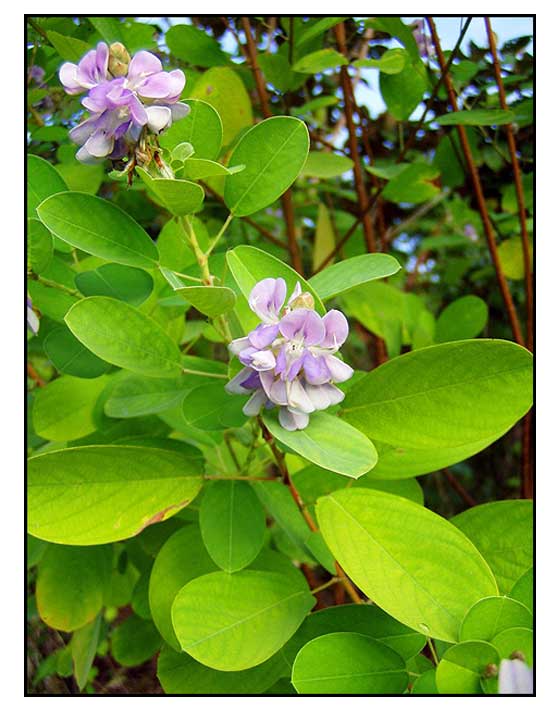
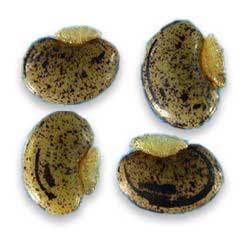
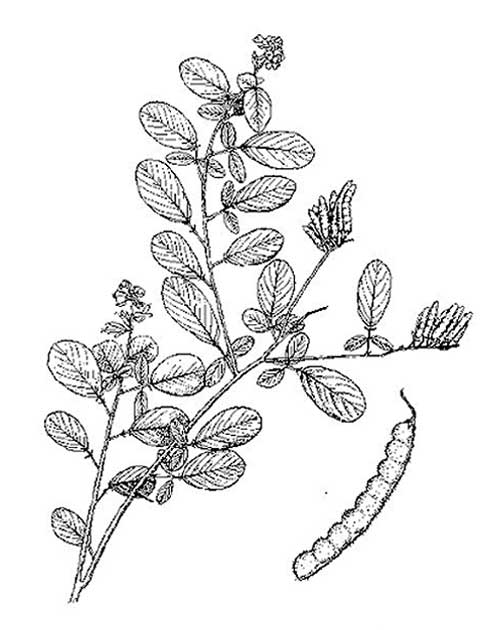
• A short-lived erect, leafy shrub with multiple stems growing 1–3 m tall.  Old stems can reach 4 cm in diameter.  Tops of  stems and inflorescences usually covered with long hairs.  Leaves with 1 or 3 ovate to elliptic, obtuse leaflets, up to 8 cm long and 5 cm wide, on petioles 1–3 cm long.  Flowers usually double, on terminal or axillary dense inflorescences, 5–15 cm long.  Flower color starts light pink and then becomes darker, turning to violet-blue.  Pods 2.5–5 cm long, 4–6 mm wide, densely covered with yellowish hairs; 5–12 segments/pod. Seeds 2.5 × 4.0 × 1.5 mm, light brown with dark brown mottles. About 190,000 seeds/kg. (Tropical Forages)

Distribution
- Native to the Philippines. (1)
- Also native to Assam, Bangladesh, Borneo, Cambodia, China South-Central, China Southeast, East Himalaya, Hainan, India, Jawa, Malaya, Myanmar, Nepal, New Guinea, Puerto Rico, Sulawesi, Sumatera, Thailand, Vietnam. (1)

Constituents
- Nutritive value: Generally good crude protein (18-24%) and mineral concentrations (P 0.22%, Ca 051%, and K 1.96%) but low nutritional value due to high concentration of extractable condensed tannins in the foliage (8.4-18.1%). IVDMD 32.45% irrespective of leaf maturity. (3)
- Complementary in silico analysis of methanolic extract identified stigmasterol and lanosterol as key bioactive compounds. (see study below) (4)
- Nutrient analysis of fresh aerial parts:

Properties
- Studies have suggested hypoglycemic, analgesic properties (Avg % DM): Crude protein 16.3%,k crude fiber 32.5%, NDF 51.3, ADF 32.8%, lignin 10.1%, ether extract 1.8%, ash 7.0%, gross energy 18.9 MJ/kg; Minerals (g/kg): calcium 9.7, phosphorus 4.9 19.8, sodium 0.3, magnesium 3.6; secondary metabolites: tannins (condensed, eg. catechin) 77.0 g/kg DM. (6)

Parts used
Whole plant or aerial parts.

Uses

Edibility
- Valued as edible forage for livestock.
- No reports on human consumption.
Folkloric
- No reported folkloric medicinal use in the Philippines.
Others

- Agroforestry: Used as hedgerow as cover crop and green manure in tea and rubber plantations. Sometimes used for shade in establishing plantations for coffee and cocoa. (3)
- Forage: Conflicting reports on palatability. Reports from Belize indicated high acceptability by Brahman cows and calves when mixed with Urochloa mutica. In the Columbia humid tropics, dairy cattle accepted it only when sufficient grass was available, but rejected it as test sole feed. Columbia, farmers strip the leaves off twigs for cut-and-carry feed. Very poor acceptability and rejection under grazing with planted grasses, but better with low-quality native grasses. Palatability problems reported are attributed to high tannin concentration. (3) Codarrio can be grazed, but in Australia more damage to plants was observed than to grazed leucaena. Reports from Belize and Australia suggest poor persistence of codarrio may be caused partly by damage from insect larva burrowing in stems, fungal diseases and root-knot nematodes, the latter particularly on sandy, well-drained soils. (7)

Studies
• Hypoglycemic / Analgesic:
Study evaluated the potential hypoglycemic and analgesic properties of methanolic extract of Codariocalyx gyroides (MECG) in Swiss albino mice. Acetic acid-induced writhing assay for analgesic activity demonstrated dose-dependent efficacy, significantly reducing writhing counts at 200 mg/kg (45.66) and 400 mg (55.11). Hypoglycemic potential of MECG in STZ-induced diabetic murine model at 200 mg/kg dose elicited substantial reduction in plasma glucose levels. In silico analysis identified stigmasterol and lanosterol as key bioactive compounds. Stigmasterol exhibited superior docking score against COX-2 relative to diclofenac. Lanosterol demonstrated enhanced affinity for sulfonylurea receptor, better than standard hypoglycemic agent Glibencladmide. Results highlight the therapeutic potential of MEWCG as a dual-acting pharmacologic agent for clinical applicability in management of pain and diabetes. (4)
• Forage Option in the Tropics: Souteast Asia shrub legume, Codariocalyx gyroides is adapted to acid, low-fertility soils with poor draining. Data from 19 RIEPT (International Netword for Evaluation of Tropical Pastures) trial sites conducted in American humid and subhumid tropics were used to define the range of adaptation of C. gyroides. Results show C. gyroides performs better under hihg rainfall conditons of the humid tropics with hardly any dry season, and responds to doil fertility (Ca, P). (5)

Availability
- Wild-crafted.

November 2026

                                                 PHOTOS / ILLUSTRATIONS
IMAGE SOURCE: Codaruicalyx gyroides / © Jan Meerman / CC BY-NC 4.0 International / Image modified / Click on image or link to go to source page / iNaturalist
OTHER IMAGE SOURCE: Codaruicalyx gyroides seeds / © Tropical Forages / Click on image or link to go to source page / Tropical Forages
OTHER IMAGE SOURCE: Illlustration: Codaruicalyx gyroides / © Tropical Forages / Click on image or link to go to source page / Tropical Forages
 
IMAGE SOURCE: Kalak kambing (Finlaysonia obovata) / © Ron Yeo / Non-commercial use / Image modified / Click on image or link to go to source page / The Tide Chaser
OTHER IMAGE SOURCE: Finlaysonia obovata Leaf and splitting fruit / © uforest.org / Non-commercial use / Images modified / Click on images or link to go to source page / URBANFOREST
OTHER IMAGE SOURCE: Finlaysonia obovata splitting fruit and seeds / © Teo Siyang / Non-commercial use / Images modified / Click on images or link to go to source page / FloraofSingapore
 
IMAGE SOURCE: Hedyotis costata / Subject Database of China Plant <http://www.naturemuseum.net/album/ShowPhoto.aspx?photoid=2671c974-77ca-44f9-b304-0f16660a06f7> Helixcn
OTHER IMAGE SOURCE: /Gliricidia sepium (JacqBarcelona Kunth ex Walp. - quickstick GLSE2 / Steve Hurst @ USDA-NRCS PLANTS Database / USDA
OTHER IMAGE SOURCE: / File:Fruit of Syzygium samarangense / Wax apple / Plate from book / Flora de Filipinas / Francisco Manuel Blanco (OSA) / Public Domain / Wikimedia Commons
IMAGE SOURCE: / Photos (2) / Pterocaulon redolens (Willd.) F.-Vill. / © Collected by www.plant.ac.cn / ZHIWUTONG / CLICK ON IMAGE TO GO TO SOURCE PAGE
IMAGE SOURCE: / Line drawing / Pterocaulon redolens (Willd.) F.-Vill. / © Collected by www.plant.ac.cn / ZHIWUTONG / CLICK ON IMAGE TO GO TO SOURCE PAGE
IMAGE SOURCE:Phyllantaceae : Flueggea flexuosa / Leaf / Copyright © 2018 by P B Pelser & J F Barcelona (contact: pieter.pelser@canterbury.ac.nz) [ref. DOL131909] / Non-Commercial Use  / Image modified / Click on image or link to go to source page / Phytoimages.siu.edu
OTHER IMAGE SOURCE: / Flower close-up / dracobotanicus -- Wayne Dumbleton / Creative Commons Attribution / flickr / Click on graphic to see original image / flickr
OTHER IMAGE SOURCE: Mexican tea / Dysphania ambrosioides / © J Richard Abbott / Some rights reserved / NC BY-NC / Click on image or link to go to source page / iNaturalist
OTHER IMAGE SOURCE: / Illustration / Cissampelos pareira L. [5809-247450-161657] / Indian medicinal plants, vol. 1: t. 42 / PlantIllustrations.org
ebay
IMAGE SOURCE: Pterocaulon redolens (Willd.) F.-Vill. / © Collected by www.plant.ac.cn / ZHIWUTONG / CLICK ON IMAGE TO GO TO SOURCE PAGE / iNaturalist
flickr
iNaturalistUK
 

Additional Sources and Suggested Readings
(1)
Codariocalyx gyroides (Roxb. ex Link) Hassk / KEW: Plants of the World Online
(2)
Codariocalyx / Wikipedia
(3)
Codariocalyx gyroides / Tropical Forages
(4)
In Vivo and In Silico Evaluation of Analgesic and Hypoglycemic Activities of Methanolic Extract of Codariocalyx gyroides / Nilufar Sultana, Mahmudul Hasan, Ishmam Ibnul Arabi, Zobayed Islam, Abdullah Ripon et al / Food Science & Nutrition, 2025; 3(7): e70485 / DOI: 10.1002/fsn3.70485
(5)
Codariocalyx gyroides - a new forage option for the humid tropics / Brigette L Maass, Luis H Franco, Gerardo Ramirez et al / Conference: XVIII International Grassland Congress, 1997
(6)
Telegraph plant (Codariocalyx gyroides) - aerial part, fresh / Feedipedia
(7)
Codariocalyx gyroides / R Soedomo / PROSEA

•

DOI: It is not uncommon for links on studies/sources to change. Copying and pasting the information on the search window or using the DOI (if available) will often redirect to the new link page. (Citing and Using a (DOI) Digital Object Identifier)

                                                            List of Understudied Philippine Medicinal Plants
                                          New plant names needed
The compilation now numbers over 1,830 medicinal plants. While I believe there are hundreds more that can be added to the collection, they are becoming more difficult to find. If you have a plant to suggest for inclusion, native or introduced, please email the info: scientific name (most helpful), local plant name (if known), any known folkloric medicinal use, and, if possible, a photo. Your help will be greatly appreciated.
•

•
HOME      •      SEARCH      •      EMAIL    •     ABOUT