HOME      •      SEARCH      •      EMAIL    •     ABOUT


Family Convolvulaceae
Hewitiya
Hewittia malabarica (L.) Suresh
MALABAR HEWITTIA / MALABAR BINDWEED
Zhu cai teng

Scientific names Common names
Aniseia afzelii G.Don Hewitiya (Tag.)
Aniseia bracteata Hassk. Hewittia (Engl.)
Argyreia malabarica (L.) Choisy Hewitt's dwarf morning glory (Engl.)
Bonamia volkensii Dammer Malabar bindweed (Engl.)
Calystegia keriana Sweet.  
Convolvulus bicolor Vahl  
Convolvulus bracteatus Vahl  
Convolvulus hederaceus Blanco  
Convolvulus involucratus Willd.  
Convolvulus involucratus Ker Gawl.  
Convolvulus malabaricus L.  
Convolvulus rottleri Spreng.  
Convolvulus scandens Milne  
Convolvulus schultesii Weinw. ex Steud.  
Convolvulus sublobatus L.f.  
Convolvulus timorensis D.Dietr.  
Eremosperma puccionianum Chiov.  
Hewittia asarifolia Klotzsch  
Hewittia barbeyana Chod. & Roulet  
Hewittia bicolor (Choisy) Wight & Arn.  
Hewittia bicolor f. minor De.Wild.  
Hewittia hirta Klotzsch  
Hewittia malabarica (L.) Suresh  
Hewittia puccioniana (Chiov.) Verdc.  
Hewittia scandens (Milne) Mabb.  
Hewittia sublobata (L.f.) Kuntze  
Ipomoea benguelensis Baker  
Ipomoea bicolor (Choisy) Sweet  
Ipomoea bracteata Roem. & Schult.  
Ipomoea malabarica (L.) Roem. & Schult.  
Ipomoea pandurifolia E.Mey.  
Ipomoea phyllosepala Baker  
Ipomoea schultesii Weinm. ex Choisy  
Ipomoea teretistigma Choisy  
Ipomoea weinmannii Roem. & Schult.  
Kethosia involucrata (Willd.) Raf.  
Palmia bicolor (Choisy) Endl. ex Dalzell & Gibson  
Sanilum bicolor Raf.  
Sanilum bracteatum Raf.  
Shutereia bicolor Choisy  
Shutereia sublobata (L.f.) House  
Hewittia malabarica (L.) Suresh is an accepted species. KEW: Plants of the World Online
Note: Hewittia is a monotypic genus. I am using Hewitiya as phonetically Tagalized common name for page title. Stuart

Other vernacular names
BENGALI: Hiwet; Tallun-payn (Chak.)
CHINA: Zhu cai teng.
INDIA: Kattukilangu (Malayalam);
KZN: Ihlanzandulo (KwaZulu Natal).

Gen info
- Hewitttia barbarically is a flowering plant in the monotonicity genus Hewitt, belonging to the family Convalescence. It is widespread throughout tropical Africa, Asia, and Polynesia.
- Etymology: The genus name Hewitt honors Hewett Watson (1804-1881), an English phrenologist, botanist and evolutionary theorist. The specific epithet malarious derives from Latin, meaning "coming from or related to Malabar, India". (3)

Botany
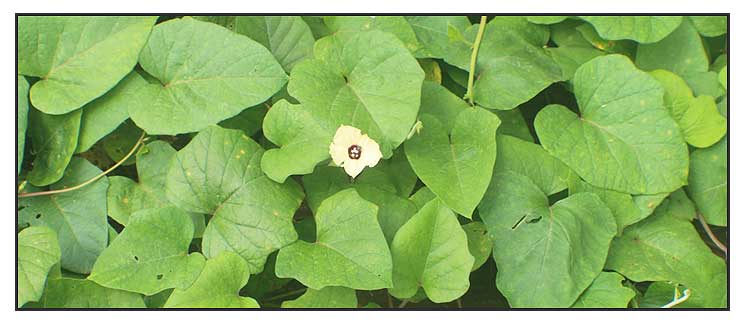
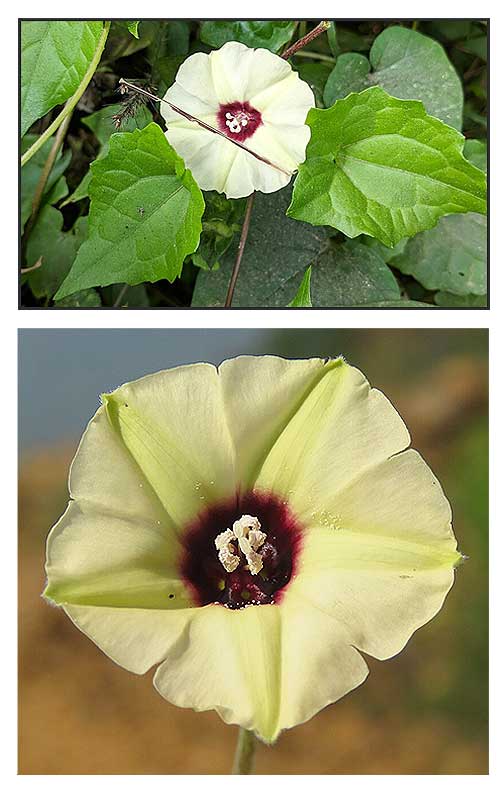
Growth form: It is a climber with slender stem, up to 2 m high. Foliage: Leaf is egg-shaped to triangular (2 – 14 cm long and 1 – 10 cm wide) and in alternate arrangement. Leaves are hairy, and upper surface is sparsely bumpy. Leaf tip is very short while leaf base is uncreate to ha state. Leaf margin is smooth or toothed, and petiole is 1 – 9 cm long. Flowers: Inflorescence consists of 1 – 3 flowers, borne on flowering stalk which can be up to 10 cm long. Sepals are unequal, where the 3 outer sepals are much larger than the inner 2.  Flower is funnel shaped (2 – 3.5 cm long), cream colored with a purple star-shaped center. The purple center is hairy on the outside. Stamens are 0.9 cm long, stigmas are ovate to oblong, and ovary is superior. Fruit: Fruit is almost round (1 cm diameter) and ripens brown.  Once matured, it splits open into 4 parts, while still connect at the apex. Split fruit reveals 2 – 4 seeds within each valves. Seeds are almost round (0.3 – 0.6 cm diameter), black and covered with small scales. (Flora & Fauna Web)

• Herbs perennial. Stems herbaceous; axial parts ± densely pubescent, twining or prostrate, 1-2 m, occasionally rooting at nodes. Petiole 1-6 cm; leaf blade ovate, 3-10 X 3-8 cm, oppressed pi lose or subgroups, sometimes yellow glandular ?dotted, margin ciliate, base chordate, ha state., or truncate, margin entire or 3-lobed, apex culminate, acute, or coronate. Inflorescences often 1-flowered; peduncle 1.5-10 cm; bracts blonde-lanceolate, 0.7-1.5 cm, pubescent, culminate Pedicure 2-4 mm. Sepals unequal, pubescent ab axially; outer 3 broadly ovate, 0.9-1.5 cm X 6-9 mm, to 1.7 cm in fruit; inner 2 blonde-lanceolate, smaller. Corolla pale yellow or whitish, with a purple center, 2-2.5 cm, amphetamine bands densely pi lose Stamens ca. 9 mm; filaments minutely papillae basally; anthers ovoid-deltoid. Ovary villus. Capsule enclosed by persistent calyx, depressed globule, 8-10 mm in diam., pi lose Seeds dull black, ovoid-trigonometry, 4-6 mm, glamorous except for pubescent illume.
(Flora of China)

Distribution
- Native to the Philippines. (2)
- Throughout the Philippines in open grasslands and waste places, low and medium elevation, often common; 0-1400 m. (2)
- Also native to Andaman Is., Angola, Assam, Bangladesh, Benin, Borneo, Burundi, Cambodia, Cameroon, Cape Provinces, Central African Republic, Chad, China South-Central, China Southeast, DR Congo, Sweatiness, Ethiopia, Gabon, Gambia, Ghana, Guinea, Hanan, India, Ivory Coast, Jana, Kenya, Kwakiutl-Natal, Laos, Lesser Sundas Is., Liberia, Madagascar, Malawi, Malaya, Mali, Mameluke, Mozambique, Myanmar, New Guinea, Nigeria, Northern Provinces, Rwanda, Senegal, Sierra Leone, Somalia, South China Sea, Sir Lanka, Sudan-South Sudan, Sumatra, Taiwan, Tanzania, Thailand, Togo, Uganda, Vietnam, Zambia, Zimbabwe. (1)

Constituents.
- ADME properties of compounds obtained by GC-MS ire., cyclohexanol, sulfurous acid hex octal ester, 2,-4-ditert-butylphenol and 1,2-benzenedicarboxylic acid had favorable physio-chemical and drug likeness characteristics. (see study below) (4)
- Photochemical screening of leaf extracts for bio active components revealed alkaloids, tannins, onionskins, and flavoring, with tract anthracites and absence of free anthracites and cyanogen triglycerides. (5)
- Proximate analysis revealed: moisture content 0.65%, total ash 6.54%, crude fiber 8.33%, crude protein 12.71%, lipid 3.52%, carbohydrate 67.22%, and caloric value of 352.42 Kcal. Anti-nutrients were hydrogen cyanide (201 mg/100g, physic acid 1.10 mg, oxalic acid 0,05, tannin 5.0 mg/100g; non0volatile ether extract was 0.90% and volatile ether extract was 99.10%. (5)

Properties
- Studies have suggested anticancer properties.

Parts used
Leaves, seeds, roots.

Uses

Edibility
- Leaves are collected from the wild, cooked as vegetable. Chopped, boiled, drained, and the vegetable is mixed with pounded groundnuts or coconut milk and eaten with gallium or rice. Leaves also cooked with Amaranths of bides, coconut milk or groundnut paste and served with a staple such as rice. (3)
- In Uganda,the Lang people use it for a traditional dish, ebony. (3)
Folkloric
- No reported folkloric medicinal use in the Philippines.
- Leaves are rubbed on sores.
- In China, leaf decoration used in baths. Root decoction drunk to rid of Oxyuris or "threadworms". (3)
- In the Udon Thani Province in Thailand, seeds, leaves, and roots used to treatment of wounds and stomach problems. (6)
- In Odisha, leaf paste applied to cuts and wounds. (7)
- Leaf paste applied to cuts, wounds, boils, and abscesses. Leaves rubbed on sores. Decoction of roots drunk on an empty stomach, 50 cc 3x daily for seven days for treatment of threadworm infestation. Root powder in water taken 2x daily (5gm) for syphilis, until cured. Leaf paste applied to snakebites, tied and held tightly with cloth. (7)
- In Kenya, roots used for treatment of stomach swellings, constipation, and pain. (8)
Others

- Agroforestry: Grown as ornamental or ground cover in plantations.(3)
- Fodder: In Benin, used as cattle fodder. (3)
- Rope: The fiber from the inner bark and stems used for making rope. (3)


Studies
Anticancer:
Study of evaluated the anticancer properties of various solvent extracts (petroleum ether, chloroform, ethyl acetate, acetone, methanol, and water) of H. malabarica. Of the various extracts, the chloroform extract showed highest cytotoxicity with IC50 of 31.97 µg/mL towards HT29 cell line, followed by PE with IC50 of 76.58 µg/mL. Cytomorphological changes and AO/EB dual staining indicated apoptotic cell death. ADME properties of compounds obtained by GC-MS i.e., cyclododecanol, sulfurous acid hexyl octyl ester, 2,-4-ditert-butylphenol and 1,2-benzenedicarboxylic acid had favorable phyrsio-chemical and drug likeness characteristics. Results suggest the cytotoxicity may be mediated via induction of apoptosis in cancer cell lines. The extract components showed non-toxicity towards normal cell line. (4)

Availability
- Wild-crafted.
- Seeds in the cybermarket.

February 2026

                                                 PHOTOS / ILLUSTRATIONS
IMAGE SOURCE: Hewittia malabarica / by Vengolis / CC BY 4.0 / Image modified / Click on image or link to go to source page / Wikipedia
OTHER IMAGE SOURCE: Hewittia malabarica - Flower close-up / by Vinayaraj / CC BY 4.0 / Image modified / Click on image or link to go to source page / Wikipedia
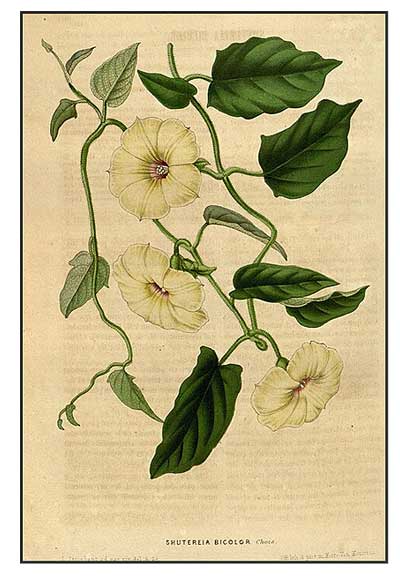
OTHER IMAGE SOURCE: Illustration: Hewittia malabarica - 1848 / Van Houtte, Louis / Public Domain / Click on image or link to go to source page / Wikipedia
OTHER IMAGE SOURCE: Hewittia malabarica / © Flora of Sri Lanka / FlowerSL (ID-PMR) / Non-commercial use / Image modified / Click on image or link to go to source page / floraofsrilanka
OTHER IMAGE SOURCE: Hewittia malabarica / by Dinesh Valke / CC BY SA 4.0 International Deed / Image modified / Click on image or link to go to source page / Wikipedia

Additional Sources and Suggested Readings
(1)
Hewittia malabarica / KEW: Plants of the World Online
(2)
C:onvolvulaceae: Hewittia malabarica
/ Co's Digital Flora of the Philippines
(3)
Hewittia malabarica / Wikipedia
(4)
Exploring the anticancer potential of Hewittia malabarica through phytochemical analysis and molecular docking study / Shiji Thozhukkad Moosaripparambil, Kannan Vadakkadath Meethal / Sci Rep., 2025; 15(1): 4088 / DOI: 10.1038/s41598-025-88572-6
(5)
Phytochemical And Physicochemical Properties Of Leaves Of Hewittia Malabarica L. Suresh
/ Sunday Etuk, Essiett U A / IJR: International Journal of Research, 2014; 1(11) / ISSN: 2348-6848
(6)
Diversity and Local Uses of the Convolvulaceae Family in Udon Thani Province, Thailand, with Notes on Its Potential Horticultural Significance / Plyaporn Saensouk, Surapon Saensouk et al / Horticulturae, 2025; 11(3): 312 / DOI: 10.3390/horticulturae11030312
(7)
Hewittia malabarica / Md Salah Uddin / Nature Info: electronic Database
(8)
Important Medicinal and Food Taxa (Orders and Families) in Kenya, Based on Three Quantitative Approaches / Fredrick Munyao Mutie, Qing-Feng Wang et al / Plants (Basel), 2023; 12(5): 1145 /
DOI: 10.3390/plants12051145

DOI: It is not uncommon for links on studies/sources to change. Copying and pasting the information on the search window or using the DOI (if available) will often redirect to the new link page. (Citing and Using a (DOI) Digital Object Identifier)

                                                            List of Understudied Philippine Medicinal Plants
                                          New plant names needed
The compilation now numbers over 1,720 medicinal plants. While I believe there are hundreds more that can be added to the collection, they are becoming more difficult to find. If you have a plant to suggest for inclusion, native or introduced, please email the info: scientific name (most helpful), local plant name (if known), any known folkloric medicinal use, and, if possible, a photo. Your help will be greatly appreciated.

HOME      •      SEARCH      •      EMAIL    •     ABOUT