HOME    •    SEARCH      •      EMAIL    •     ABOUT  •     DONATE


Family • Euphobiaceae
Gubas
Endospermum peltatum Merr.
SESENDOK

Scientific names Common names
Endospermum peltatum Merr. Amiang (Tag.)
Endospermum philippinense Elmer ex Merr. Baubau (Ibn.)
  Bayang (Mbo., Mand.)
  Biluang (Bik.)
  Binoang (Tag.)
  Binuang (Tag.)
  Ginabang (Ig.)
  Gubas (Tag.)
  Indang (Tag.)
  Kabal (Tag.)
  Magabong (Mag.)
  Malasabon (Tag.)
  Malibubuk (Mbo.)
  Mulang (Zambales)
  New Guinea basswood (Engl.)
  Sesendok (Engl.)
Endospermum peltatum Merr. is an accepted species. KEW: Plants of the World Online

Other vernacular names
BRUNEI: Takaliu.
INDONESIA: Bunkul tekaya, Kejo luk long (Kalamintan), Mapoopo (Sulawesi), Sendok-sendok.
MALAYSIA: TAKALIU (Sarawak); Buah icras, Maram pangi (Sabah).


Gen info
- Euphorbiaceae, the spurge family, is a large family is a family of flowering plants, consisting of herbs, shrubs, or trees. The family is the 5th-largest flowering plant family organized into 300 genera, 37 tribes, and three subfamiles. They are cammonly called euphorbias, which is also the type genus of the family. (6)
- Endospermum is a genus of plants in the family Euphorbiaceae and the monotypic subtribe Endosperminae. The genus was first described in 1861 by George Bentham.
- As of July 2026, POWO recognise 11 species; two of which are native to the Philippines: Endospermum peltatum abd E. ovatum (endemic).

- Endospermum peltatum was first described by botanist Elmer Drew Merrill in 1906.

Botany
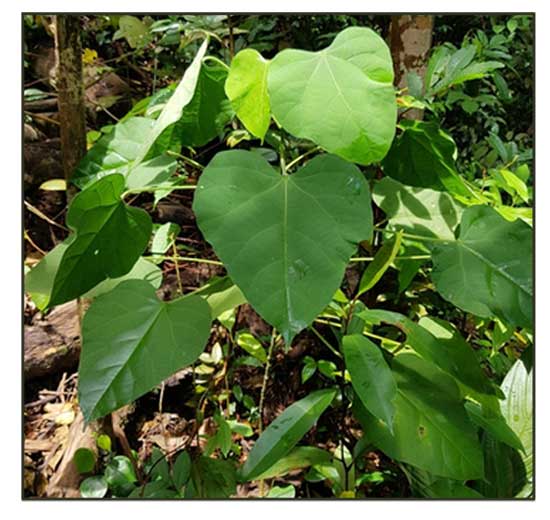
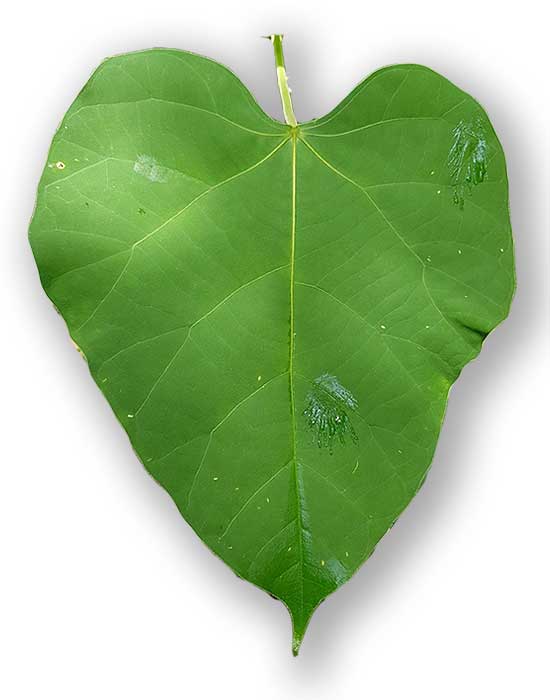
• Gubas is a large forest tree, 10 to 25 meters high. Leaves are crowded at the ends of the twigs, elliptic or broadly ovate to somewhat rounded, 15 to 20 centimeters long, 10 to 18 centimeters wide, entire, and deeply cordate at the base. Inflorescence is axillary, nearly as long as the petioles, and densely hairy. Male flowers are whitish and densely clustered along the short paniculate branches. Female flowers are borne in spicate racemes. Fruits is smooth, ovoid, fleshy, about 1 centimeter thick and containing 1 to 4 seeds.

• A medium-sized to fairly large tree of up to 35(-45) m tall, bole branchless for up to 20 m, up to 60 cm in diameter, bark surface smooth, grey-brown with an orange tinge and an unpleasant odour, inner bark hard, yellow-brown; leaves sometimes peltate, elliptical to ovate-oblong, 11-25 cm 9-18 cm, rounded to cordate at base, palmately 7-9-veined, the midrib with 4-9 pairs of lateral veins often carrying a gland beneath, petiole with 2 cylindrical glands at the apex; inflorescence paniculiform, long; male flowers with about 11 stamens, female flowers with a 2-3-celled ovary.

Distribution
- Native to the Philippines.
- In primary forests at low altitudes in Cagayan, Benguet, Bataan, Rizal, Laguna, Quezon, Camarines, Albay, and Sorsogon Provinces in Luzon; in Mindoro; and in Mindanao.
- Also native to
Andaman Is., Borneo, Malaya, Thailand.

Properties
Alternative, depurative, antidiarrheal.

Parts used
Bark, leaves, sap.

Uses

Edibility
- Seeds reported to be edible.
- Edible oil obtained from seeds.
Folkloric
- Poultice of fresh leaves applied directly to abdomen for relief of diarrhea.
- Decoction of bark taken internally; considered an effective depurative (to purify the blood) and alterative (restore body health).
- In Albay, sap and latex locally applied to bruises and wounds as antiseptics due to their antibacterial properties. (7)
Others
- Wood: Heartwood is creamy white to bright yellow, not demarcated from the sapwood. Wood is very soft, light, not durable; susceptible to fungi, dry wood borers, and termites.
- Crafts / Products: It is an important source of the timber sesendok. A favorite timber for making clogs, trays, furniture parts, phywood chests, low grade coffins, disposable chopsticks, matchboxes, black boards, toys, etc. (4) In Polillo, the soft wood used for making furniture, boxes, splints, matches and shoes. (•) Spiral shavings of the wood used as core material in the manufacture of wood panels, referred to as placarol in the Philippines, known for its resistance to compression perpendicular to the direction of the spiral. (4) Whole trunks sometimes used as masts for local vessels.
-
Seeds: Seeds are edible. Also yield seed oil.
- Agrofrestry: Tree used for reforestation projects.

Studies
• No studies found.

Availability
Wild-crafted.


Updated October 2026 / October 2018 / September 2013


IMAGE SOURCE: / Photo / Euphorbiaceae : Endospermum peltatum det. John Rey Callado/ Habit / Copyright © 2012 by P.B. Pelser & J.F. Barcelona (contact: pieter.pelser@canterbury.ac.nz) [ref. DOL51889] / Non-Commercial Use / Click on image to go to source page / Phytoimages.siu.edu
IMAGE SOURCE: Endospermum peltatum / © pbsg (plantbrosg) / CC BY 4.0 International / Image modified / Click on image or link to go to source page / iNaturalist
OTHER IMAGE SOURCE: Endospermum peltatum - Leaf close-up / © pbsg (plantbrosg) / CC BY 4.0 International / Image modified / Click on image or link to go to source page / iNaturalist

Additional Sources and Suggested Readings
(1)
Uses of trees and plants in the Polillo Islands / polillo.mampam
(2)
Endospermum peltatum / AgroForestryTree Database
(3)
Endospermum peltatum / KEW: Plants of the World Online
(4)
Endospermum peltatum / Ken Fern: Tropical Plants Database / Useful Tropical Plants
(5)
Euphorbiaceae: Endospermum peltatum / Co's Digital Flora Database
(6)
Euphorbiaceae / Wikipedia
(7)
Mount Malinao (Albay, Philippines) Revisited: Diversity and Ethnomedicinal Studies / Gerard Q de Guzman, Alma E Nacua, Grecebio Jonathan D Alejandro et al / Research Journal of Pharmacology and Toxicology, 2015; 1(1)
(8)
Endospermum peltatum / PROSEA: Plant Resources of South-East Asia

•

DOI: It is not uncommon for links on studies/sources to change. Copying and pasting the information on the search window or using the DOI (if available) will often redirect to the new link page. (Citing and Using a (DOI) Digital Object Identifier)

                                                            List of Understudied Philippine Medicinal Plants
                                          New plant names needed
The compilation now numbers over 1,830 medicinal plants. While I believe there are hundreds more that can be added to the collection, they are becoming more difficult to find. If you have a plant to suggest for inclusion, native or introduced, please email the info: scientific name (most helpful), local plant name (if known), any known folkloric medicinal use, and, if possible, a photo. Your help will be greatly appreciated.
•

•
HOME      •      SEARCH      •      EMAIL    •     ABOUT