 Gen info Gen info
- Asteraceae is a large family of flowering plants consisting of over 32,000 known species in over 1,900 genera within the order Asterales. The number is rivaled only by Orchidaceae. (19)
- Asteraceae was first described in 1740 under the name Compositae.
- The family is commonly known as aster, daisy, composite, or sunflower family. Most species are herbaceous plants, which may be annual, biennial, or perennial, but also shrubs, vines, and trees. (19)
- Asteraceae is an economically important family, which provide food staples, garden plants, and herbal medicines.
(19)
-
Etymology: The genus name derives from Ignacio Mariano Martinez Galinsoga, an 18th century Spanish physician who identified the plant and transported it from the Andean regions of Peru to the Madrid Botanical Gardens. The specific epithet parviflora derives from Latin, translates to "having small flowers."
-
It has been suggested the English name 'Gallant Soldier' could be a corruption or mispronounciation of the 'galinsoga.'
Botany
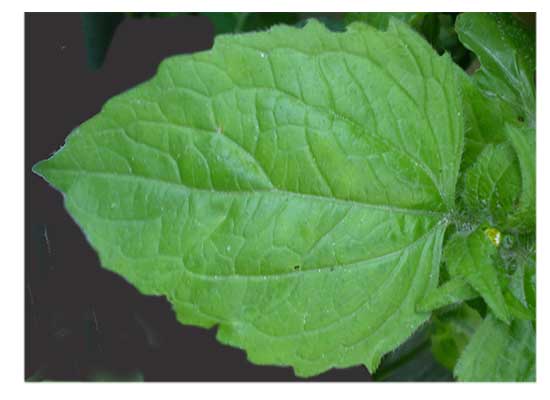
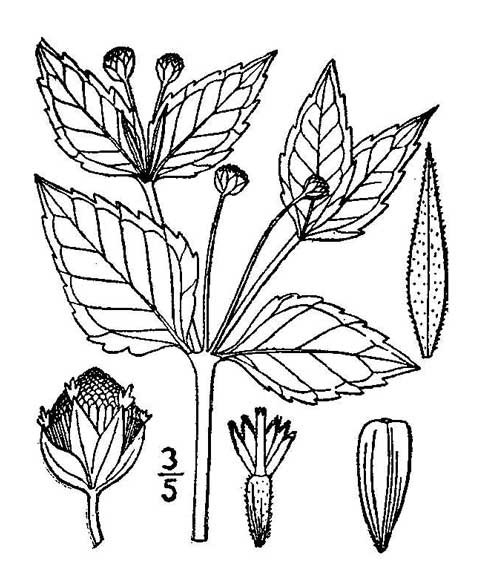
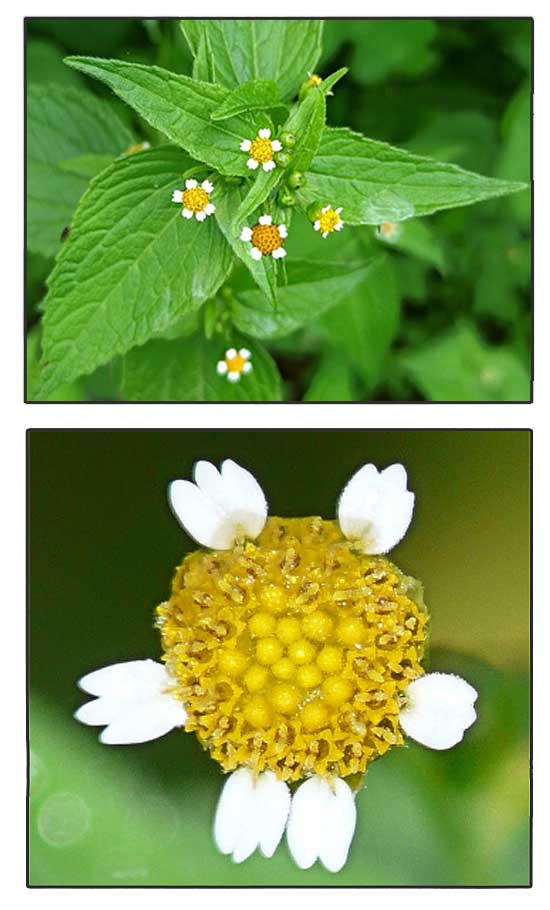
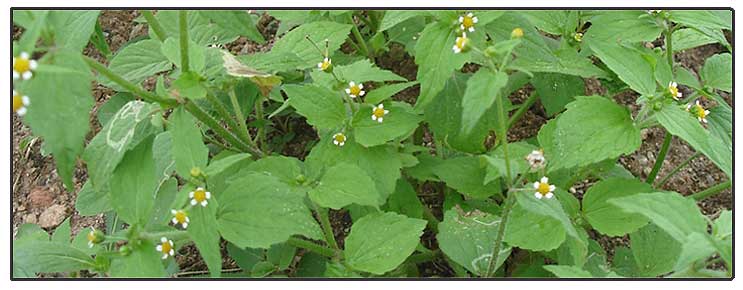
• Galinsoga is a leafy, upright annual. Leaves are oval yellowish-greenish, pointed, opposite and toothed with hairs on the leaf margins and stems. Flowers are small with five white petals, three-lobed at the tips, with yellow central disc florets.
• Galinsoga parviflora is a branched herb that grows to a height of 75 cm (30 in). Leaves are stalked, opposite, and toothed at the margins. Flowers are in small heads. The 3–8 white ray-florets are about 10 mm (1⁄2 in) long and 3-lobed. Central disc florets are yellow and tubular. (20)
 Distribution Distribution
- Introduced.
- Naturalized.
- In Luzon: Benguet, Mountain Province; in Mindanao: Cotobato. 1200-2400 m. (21)
-
An invasive weed in waste places, arable land, pavements, etc.
- Native to Argentina Northeast, Argentina Northwest, Argentina South, Arizona, Bolivia, Brazil South, Brazil Southeast, Chile Central, Chile North, Chile South, Colombia, Costa Rica, Dominican Republic, Ecuador, El Salvador, Haiti, Jamaica, Juan Fernández Is., Leeward Is., Mexico Central, Mexico Gulf, Mexico Northeast, Mexico Northwest, Mexico Southeast, Mexico Southwest, New Mexico, Paraguay, Peru, Puerto Rico, Texas, Uruguay, Venezuela, Windward Is. (3)
 Constituents Constituents
- Nutritional analysis yield per 100 gm of plant: 3.2 g protein, 1.1 g fiber. It is high in calcium (284 mg/100 g compared to fresh parsley with 140 mg), vitamin A, beta carotene, magnesium, potassium, zinc, thiamine, riboflavin, niacin, and ascorbic acid.
- Extracts yielded flavonoids (patulitrin, quercimeritrin, quercitagetrin) and phenolic acids (caffeic and chlorogenic acids). In the tested extracts, the dominant compounds were caffeoylglucaric acids.
(2)
- Study
of n-hexane fraction of methanol extract isolated three new aromatic esters galinosoate A, B, and C. (7)
- Phytochemical studies have yielded 38 compounds consisting of flavonoids, aromatic esters, diterpenoids, caffeic acid derivatives, steroids, phenolic acid derivatives, and other compounds.
(see study below) (7)
- UPLC analysis of hydroalcoholic extracts revealed presence of protocatechuic, chlorogenic, 4-hydroxybenzoic, caffeic, and isovanilic acids. Highest content was chlorogenic acid (2.00 mg/g of dry herb). (see study below) (8)
- Study of aqueous ethanolic extract isolated 11 compounds namely: triacontanol (1), phytol (2), β-sitosterol (3), stigmasterol (4), 7-hydroxy-β-sitosterol (5), 7-hydroxystigmasterol (6), β-sitosterol-3-O-β-D-glucoside (7), 3,4-dimethoxycinnamic acid (8), protocatechuic acid (9), fumaric acid (10), and uracil (11). The hydrodistilled oil of aerial parts yielded 48 volatile constituents. (see study below) (9)
- Study
isolated seven compounds from G. parvilfora for the first time, namely: β-sitosterol (1), octacosanoic acid (2), ursolic acid (3), 4-hydroxybenzoic acid (4), 3,4-dihydroxybenzoic acid (5), gallic acid (6) and β-sitosterol 3-O-β-d-glucopyranoside (7), respectively. (10)
- Proximate composition of G. parviflora per 100 g fresh weight yielded
41 kcal energy, 89 g moisture, 4 g protein, 0.5 g fat, 1.24 g fiber, 1.74 g ash, and 5.29 g carbohydrate. Mineral content in mg/100 g dry weight yielded 62 mg calcium, 38 mg phosphorus, 36 mg sodium, 44 mg manganese, 3 mg copper, 14 mg zinc, 681 mg magnesium, and 27 mg iron. (17)
- Phytochemical screening of leaf extracts of G. parviflora (petroleum ether, PE; ethanol, E; and methanolic, M) yielded: Alkaloids (PE, E++, M+), flavonoid (E, M), phenol (PE, E.M), steroid (M), terpenoids (PE++. E, M), carbohydrates (PE, E, M), protein (PE, E, M), and tannin (M). (25)
Properties
- A prolific seed producer, a single plant capable of producing thousands of seeds per plant and competing a life cycle in about 50 days. Plant produces viable seeds when plant is only a few centimeters high.
-
Concern: There is an isolated report on being poisonous to goats. However, many others report the plant as non-toxic to humans and animals, and its use as fodder for cattle. The shoots including leaves, stem and flower are used as traditional vegetable in Zimbabwe and South America. (see toxicological study below: 22)
- Considered astringent, anti-inflammatory and vulnerary.
- Studies have shown
wound healing, antioxidant, anti-inflammatory, nematicidal, antihypertensive, ACE-inhibitory, anticancer, hypoglycemic, antidiabetic, antimicrobial, nutrient, anxiolytic, UV-protective, urease and alpha-glucosidase inhibitory, neuroprotective properties.
Parts used
Leaves, flowers, roots, stems.
 Uses Uses
Edibility
- Used as pot herb in some parts of the world.
- An essential ingredient in Bogota chicken and potato stew/soup called ajiaco. (1)
- Young leaves, stems and flowers used as ingredient in smoothies, salads, stews or juices. (1)
- Can be dried into powder to be used as soup flavoring.
- Guacas is the indispensable herb flavoring in the traditional Colombian stew, ajiaco Bogotano. (13)
- In Tanzania and Uganda, the leaves and stems are eaten as leafy vegetable. (13)
Folkloric
- No reported folkloric medicinal use in the Philippines.
- In various traditional medical systems, used for treatment of malaria, flu, colds, colorectal cancer, liver problems, and inflammation.
-
Used for neutralizing sting of nettles. Used to coagulate bleeding from cuts and wounds. (1)
- In Manipur, India, salted extract of leaves given for diarrhea, fever, and vomiting; also, for boils and small pox. Leaves mixed with those of Ageratum conyzoides, Drynaria cordata, and ginger and made into a paste and used as remedy for snake bites.
- Extracts applied topically to treat eczema, lichens, and poorly-healing wounds.
- Taken orally for colds and flu, toothache.
- In Columbia, decoction of leaves used for excess stomach acids.
- In China, whole plant used as hemostatic and anti-inflammatory.
- In the Kakamega county of Kenya, used for colorectal cancer: leaves of Ocimum gratissium are usually mixed by Galinga parviflora leaves, Senna didymobotyra and Triumfetta rhomboidea leaves, taken as decoction twice daily for two weeks. Leaves and stems of G. parviflora are chew to cure colds and sores; applied locally for wound healing. (18)
- In Pakistan, roots used for treatment of beetle bites. In Africa, stems used for treatment of colds and sores; flowers for toothache and to enhance memory. In America, Java, and Asia, aerial parts used for mitigation of lichens, acne, wounds, eye problems, eczema, rosacea, fever, toothache, liver problems, insect bites, and protection against UV irradiation-induced damage. In India, Java, America, and Ecuador, whole plant used for treatment of cold, sores, flu, yellow fever, joint pains, scorpion bites, among others.
- In Ethiopia, extract of fresh leaves and inflorescences used to dress new wounds and cuts, rawness and saddle sores. In Indonesia, leaves rubbed on skin as anodyne for nettlle stings. In Taganyika, pulped foliage applied externally for backache.
(27)
Others
- Fodder: In Colombia, while leaves and stems are used as vegetables, flower heads and buds are reportedly discarded or used as cattle fodder. (17)
Studies
• Wound Healing: Study evaluated n-hexanic and ethanolic extracts of 12 plants used in traditional South Brazilian medicine for wound healing using NF-kappaB DNA binding, p38alpha MAPK, TNF-alpha release, direct elastase inhibition and release. Fibroblasts migration to and proliferation into the wounded monolayers were evaluated in the scratch assay, the agar diffusion test for antibacterial and the MTT assay for cytotoxic effects. The hydrophylic extracts from Galinsoga parviflora along with four other plants showed the most active wound healing activity.(4)
• Antioxidant / Anti-Inflammatory: Study investigated the antioxidant activities of extracts and fractions from Galinsoga parviflora and G. quadriradiata. Results showed both plants possess dose-dependent free radical scavenging activity against DPPH and superoxide radicals, as well as inhibitory effects on linoleic acid peroxidation comparable to gallic acid. Active fractions yielded flavonoids, patulitrin, quercimeritrin, quercitagetrin and caffeoyl derivatives. Results suggest potential for use in inflammatory diseases due to their ability to prevent free radical-induced deleterious effects. (5)
• Antihypertensive / ACE Inhibition Activity: In a South African study entitled ACE Inhibitory Activity of Nutritive Plants in Kwa-Zulu Natal, ACE inhibitor activity of 16 plants was evaluated using organic and aqueous extracts from dried leaves. An !C50 of the conventional ACE inhibitor captopril was used to determine the test the sensitivity of the assay. Galinsoga parviflora was one of 8 of 16 plants that demonstrated significant ACE inhibition activity in both extract forms. (6)
• Antibacterial / Phytoconstituents / Aerial Parts: Phytoconsituents analysis yielded 38 compounds. Study evaluated hexane, methanol, and water extract for antibacterial activity. The hexane extract showed antibacterial activity against B. subtilis and M. luteus and S. aureus, while the methanol and aqueous extract showed no antibacterial effects. Compound 8, 3,5,7,8,4′-pentahydroxy-3′-methoxyflavone-3-O-α-L- rhamnopyranosyl-7-O-β-D-glucopyranosyl-(1→4)-O-β-D- xylopyranoside, showed good activity against E. coli, while compound 11, 3,5,3′,5′-tetrahydroxy-7,4′-dimethoxyflavone-3-O-α-L- rhamnopyranosyl-(1→3)-O-α-L-arabinopyranosyl-3′-O-β-D- galactopyranoside, showed highest activity against S. aureus. (see constituents above) (7)
• Antifungal: Study of light petroleum, ethyl acetate fractions and ethanolic extracts of G. parviflora exhibited significant antifungal activities against A. niger and C. albicans when compared to standard drug nystatin. (Mostafa et al, 2013) (7)
• Antioxidant: An EA fraction showed strong antioxidant activity at 150 mg/mL concentration relative to 0.1 M ascorbic acid. A 20% methanol extract fraction exhibited highest antioxidant activity against DPPH radicals, while a 50% methanol fraction showed maximum scavenging activity against superoxide. The water fraction of the ME showed highest activity with IC50 of 6.80 ± 1.31 µg/ml against linoleic acid peroxidation. Compound 2, Galinsoside A, showed strong antioxidant activity, while compound 3, Galinsoside B, showed moderate activity. (7)
• Nematicidal: Study of various extracts, fractions, and compounds were evaluated for matricidal activity against Melioigyne incognita and Cephalobus litoralis. The EA fractions showed highest mortality against MI. Compounds 27, 32, and 38 showed significant activity against one or both species. (Akhtar et al, 2011) (7)
• Anti-Inflammatory Activity / Wound Healing: Study evaluated a hydroalcoholic extract of G. parviflora for anti-inflammatory and wound healing activity . Results showed the GP extract caused a dose-dependent reduction of IL-6 secretion on IL-1å-stimulated endothelial cells. The GP extract also showed anti-hyaluronisdase activity (IC50 0.47 mg/mL), stronger than kaempferol control (IC50 0.78 mg/mL). Scratch assay showed completely healing of exposed endothelial cells. The main compound of the GP extract was chlorogenic acid (2.00 ± 0.01 mg/g UPLC). Total polyphenol content was 98.30 ± 0.14 mg QE / g of dry herb. Results showed wound healing effects attributed to antioxidant, anti-inflammatory, and hyaluronidase-inhibiting activities of the herb extract. (see constituents above) (8)
• Hypoglycemic, Antioxidant, Antimicrobial / Cytotoxic: Study of aqueous ethanolic extract yielded 11 compounds. Results on various extracts and fractions exhibited 87% reduction of ALT enzymes in cirrhotic rats, a reduction in blood glucose equivalent to glibenclamide (5 mg/kbw), antimicrobial activity against B. subtilis, P. aeruginosa, E. coli, A niger, and C. albicans, and strong antioxidant activity compared to ascorbic acid, and a weak cytotoxic effect against MCF-7 cell line. (9)
• Terpenes and Sterols / Anticancer / HL60 Cell Line: Study by column chromatography isolated seven compounds, namely: ent-kaur-16-en19-oic acid (1), ent-15-angeloyloxy-16-kauren-19-oic-acid (2), ent-15-angeloyloxy-16,17-epoxy-19-kauranoicacid (3), stigmasterol (5), α-spinasterol (5), α-spinasteryl-qocta-decanate (6), and β-sitosterol (7). On cytotoxicity screening of the extracts using HL60 cell line, two extractive fractions obtained with chloroform and ethyl acetate showed anticancer activity with IC50 of 8.5a and 10.5 µg/mL, respectively. (11)
• Functional Modification of Adhesive Bandages Using Herbs: The bandage is a standard biomaterial used to cure wound or protect them from infections. Study evaluated a 50%:50% bamboo cotton web for construction of bandage functional part. Study results showed that the 50:50 bamboo cotton finished with Galinsoga parviflora and Azadirachta indica has excellent wound curing property. (12)
• Galinsosides A and B / Flavone Glucosides / Antioxidant / Urease and Alpha-Glucosidase Inhibitory Activities: Study isolated galinsosides A (1) and B (2), along with two known flavanones, 7,3',4'-trihydroxyflavanone (3) and 3,5,7,3',4'-pentahydroxyflavanone (4) from an ethyl acetate fraction of G. parviflora. Compounds 1 showed significant antioxidant and urease inhibitory activity, while compound 2 showed moderate activity. Compound 2 also showed inhibitory potential against alpha-glucosidase. (13)
• Antidiabetic: Study evaluated the antidiabetic and safety of aqueous extracts of G. parviflora, B. hostii, P. capense, V. lasiopus and S. asper in alloxan induced diabetic mice. Results showed dose independent glucose lowering effect. Of the five plants, P. capense and G. parviflora at various doses demonstrated the highest hypoglycemic activity in diabetic mice. The blood glucose lowering effect of the five plants may be attributed to the presence of total phenols, flavonoids, alkaloids, tannins and saponins associated with hypoglycemic activity. (14)
• Antioxidant / UV-Protecting Activity: Study evaluated the in-vitro antioxidant and UV-protecting activity of aqueous and ethanolic extracts from G. parviflora and G. quadriradiata. The herbs were examined as potential photoprotectors in relation to the role of ROS in skin damage. Results showed the ethanol extracts from the herbs have cytotoxic effects, while the aqueous extracts showed protective activity, in part, due to inhibition of ROS generation. Study suggests both species may be effective as photoprotectors. (15)
• Antimicrobial Herbal Gel Formulation: Study evaluated the antimicrobial potential of a combination herbal gel formulation of Galinsoga parviflora and Tridax procumbens. The highest activity was shown on Pseudomonas aeruginosa with zone of inhibition of 31.1 mm. A potentiation of antimicrobial activity was seen in combination with significant activity (p<0.01) compared with standard drugs. Results conclude the ethosomal gel formulations of the herbal drugs exhibited a suitable transdermal drug delivery system with the two herbal extracts showing synergized antimicrobial potential. (16)
• Toxicological Study: Acute toxicity study showed no toxicological response or death on male and female rats given single doses of aqueous extract. Oral dose up to 5000 mg/kg was considered relatively safe. (22)
• Potential as Vegetable: Significant amount of proteins, fat acids, minerals, and carbohydrates have been reported in G. parviflora. Studies have demonstrated the significance and potential of G. parviflora as indigenous vegetable in human nutrition and health. (22)
• Anxiolytic / Aerial Parts: Study evaluated the anxiolytic property of ethanolic extract of aerial parts of G. parviflora using adult mice by hold board test, light-dark box test and motor coordination with the rotarod test. Extract doses of 100, 200 and 400 mg/kg were used with anxiolytic drug diazepam as standard (1 mg/kg). Results showed anxiolytic activity evidenced by increased time spent in light/dark box, significantly increased head-dip counts and duration in hole board test. In contrast to diazepam, GP had not effect on locomotion. Results provide support for anxiolytic activity of GP, and, to boot, a better side effect profile relative to diazepam. (23)
• Comparative Anti-Inflammatory Activity / Phenolic Extract and Dapsone / Aerial Parts: Study compared the anti-inflammatory activity of G. parviflora phenolic extract of aerial parts (leaves, stems, flowers) with synthetic sulfone drug Dapsone. Dapsone has both antibacterial and anti-inflammatory properties used for the treatment of leprosy, dermatitis herpetiformis and acne. Due to strong phenolic and flavonoid chemical makeup, G. parviflora has pharmacological effects comparable to dapsone via suppression of microbial growth, neutralization of free radicals, and alteration of inflammation pathways. Although dapsone is a scientifically validated synthetic medication, side effects like hemolysis and hypersensitivity reactions limit its use. G. parviflora has potential as a safe, natural, and multi-targeted substitute with extra antioxidant advantages. (24)
• Potential as Source of Natural Fibers: Study evaluated the potential of natural fibers extracted from G. parviflora as sustainable alternatives to synthetic materials. Analysis showed 36.3% crystallinity and cellulose 1 dominance ensuring strong mechanical properties. A 17.92 MPa tensile strength and 11.3 GPa modulus suit structural applications. Antibacterial testing showed 19mm inhibition zone against S. aureus. EDX showed 53% carbon, 41.3% oxygen, with potential effects on material interactions. Overall results suggest significant potential as bio-based alternatives for sustainable material development, offering both mechanical strength and biological functionality for future eco-friendly technologies. (26)
Neuroprotective against 3-NP Induced Neurotoxicity / Whole Plant: Study evaluated the neuroprotective efficacy of ethanolic whole plant extracts of G. parviflora against neurodegeneration in 3-Nitropropionic acid (3-NP)-induced neurotoxicity in rats. Doses of 200 and 400 mg/kg were administered orally to neurotoxic rats. 3-NP treated caused significant decrease in brain antioxidant enzymes, SOD, GSH, and total protein, and increase in LPO. E-NP cause mitochondrial dysfunction, which led to ROS production and neuronal damage. Extract treatment significantly prevented rise in levels of LPO and significantly increased GSH, SOD and total protein. High dose of 400 mg/kg protected cells from damage and helped recover damaged cells. Results suggest potential therapeutic value for treatment of neurological disorders probably via anti-inflammatory and antioxidant properties. (28)
Availability
- Wild-crafted.
- Herbal teas and supplements in the cybermarket. |




.jpg)