Gen info
- Asparagaceae, the asparagus family, is a family of flowering plants in the order Asparagales of the monocots. The family name is based on the edible garden asparagus, Asparagus officinalis. The family includes common garden plants (asparagus, yucca, bluebell, lily of the valley, agave, and hosta) and house plants (snake plant, corn cane, spider plant, and plumosus fern).
- Taxonomical journey: Asparagaceae was first named, described, and published in Genera Plantarum in 1789 by the French botanist Antoine Laurent de Jussieu, noted for his work in developing the concept of plant families. From introduction until the 21st century, Asparagaceae was a monotypic family, containing only a single genus, Asparagus. In 2003, the AP)G II plant classification system expanded the family to include genera and species previously listed in seven plant families. (3)
- Ledebouria is a genus of African perennial bulbous herbs in the
Asparagaceae family.
-
As of September 2026, POWO lists 70 accepted species.
- Etymology: The genus name Ledebouria honors Carl Freidrich von Ledebour (1786-1851), a German-Estonian botanist, who published the first complete Russian flora. The specific epithet socialis means "growing in pure stands", "dominant", or "growing in colonies."
- The common names "Forever rich plant" or "millionaire plant"
relates to folk beliefs, Feng Shui symbolism, and popular houseplant naming traditions that associate the plant with wealth, luck, and prosperity.
 Botany
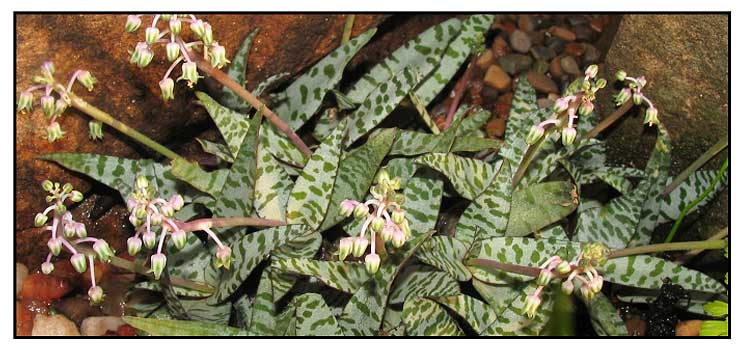
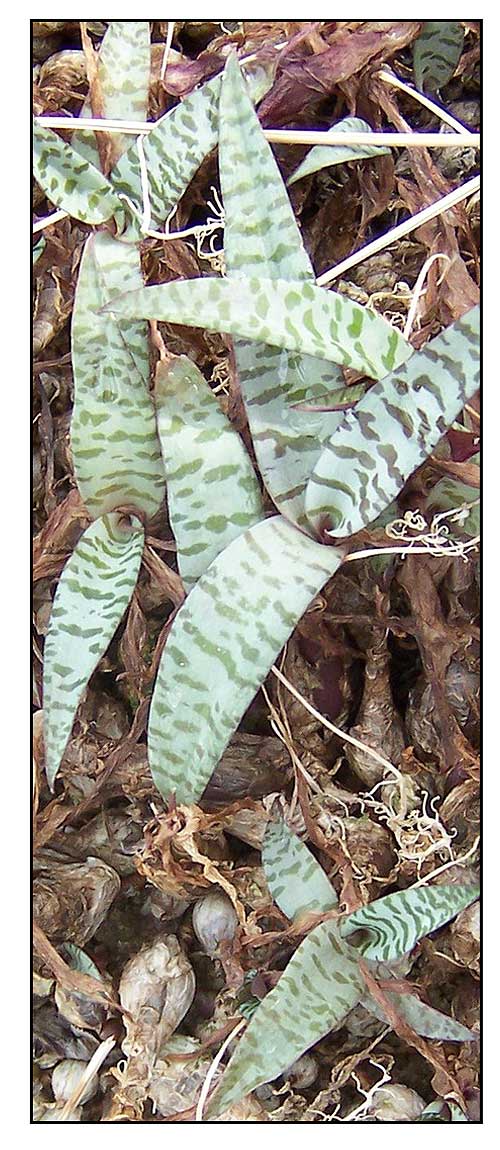
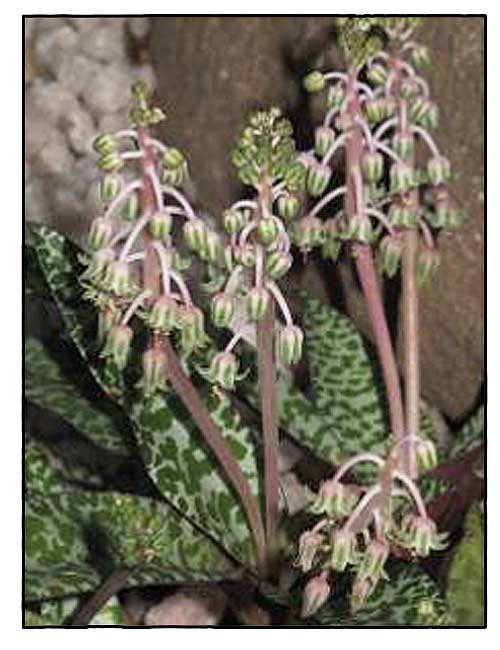
• Densely gregarious, dwarf, bulbous plant, with red above ground bulbs, which proliferate to form dense colonies. Leaves (3–5), triangular to lanceolate, usually 50–70 mm long and 10–15 mm wide, with a silvery background color, adorned with green to brown spots on the upper side; underside variable, from green to purple; leaf color and markings tremendously variable. Infloresence: Solitary, sparsely flowered inflorescences are produced per bulb, usually in early summer (October to November) in the wild, but more sporadically in cultivation from July to December (in South Africa). The erect flower spikes are relatively few-flowered, producing between 10–30 individual florets; each floret is attached to the peduncle via a short stalk (pedicel). Florets mainly green, white with a flush of pink; each with conspicuous purple stamens that extend beyond the sharply recurved petals (tepals), bearing small, pale yellow anthers at their tips, followed by green seed capsules, which open to release small, blackish, glossy seeds. (4)
• Growth Habit. An evergreen, bulbous perennial plant. The bulbs are epigeal (usually located entirely above the soil level) and grow in thick clusters. The fleshy, lance-shaped, strap-like leaves are olive green with dark blotches on the top and the undersides are a dark violet. The plant may reach a height of 6-10 inches. In our area plants grown in shade are much taller than those grown in full sun as shown in the reference photo below. Flowers. Dense clusters of very small, bell-shaped green to purple-pink flowers on short flower stalks may be produced in the spring or summer. Plants grown in our area seldom bloom. (5)
 Distribution
- Naturalized in the Philippines. (1)
- Naturalized on exposed hills on basaltic rocks. (2)
- Native to the Cape Provinces. (1)
Constituents
- Study of dichloromethane and methanol extracts of bulbs yielded five compounds: the scillascillin-type homoisoflavanones (1,2), phytol (3), stigmasterol (4) and the polyhydroxylated difuran derivative, poly-botrin (5). An aqueous extract of bulbs yielded 11 hyacinthacines, along with 2 pyrrolidines and 3 piperidines. (6)
- Study of bulbs of Scilla socialis isolated 11 hyacinthacines, two pyrrolidines, three piperidines. (see study below) (8)
- Study of bulbs of L. socialis yielded the benzocyclobutene homosoflavonoid, (R)-2',5-hydroxy-3',4',7-trimethoxyspirol{2H-1-benzopyran-3-(4H)-9-bicyclo[4.2.0]octal[1,3,5]triene}-4-one, socialinone (1). (10)
Properties
- Plant requires minimal care.
- Studies suggested anti-inflammatory, glycosidase inhibitory properties.
Toxicity / Poisonous
- All plant parts (flowers, fruits, leaves, roots, sap, seeds, stems) may be toxic.
- Toxic poison principle: Oxalic acid.
- Other toxic components: calcium oxalate and hyacinthacines (polyhydroxylated alkaloids).
- Poison severity: low.
- Poisonous to humans, cats, and dogs.
- Ingestion may cause nausea, vomiting, and loss of appetite. Sap may cause skin irritation. Toxicity in cats may manifest as vomiting, diarrhea, lethargy, and renal failure. In dogs, vomiting, diarrhea, lethargy, excessive droolling, and loss of appetite.
Parts used
Bulbs.
Uses
Edibility
- Not edible.
- See toxicity above.
Folkloric
- No reported folkloric medicinal use in the Philippines.
Others
- Xeriscaping: A drought-tolerant plant; used as groundcover, requiring little or no irrigation. (3)
-
In Philippine folklore and feng shui traditions, plant is believed to attract wealth and good luck.
Studies
• Anti-Inflammatory against COX-1 and Cox-2 / Bulbs: Study evaluated the anti-inflammatory activities of four isolated phytochemicals from bulbs of Southern African Ledobouria socialis and L. ovatifolia against cyclooxygenase-1 and -2 isoenzymes. All the compounds exhibited significant activity against COX-2 at < 10 µM. Among all compounds, compound 2 exhibited higher COX-2 inhibitory activity (IC50=2.87 µM) supported by highest docking score of 139.079 in molecular docking studies. (7)
• Glucosidase-Inhibiting Hyacinthacines / Bulbs: Study of bulbs of Scilla socialis isolated 11 hyacinthacines, two pyrrolidines, three piperidines. Alkaloid 11 (c2) was found to be a good inhibitor of ß-glucosidase and human placenta α-L-fucosidase, with IC50s of 13 and 17 µM, respectively, while alkaloid 12 (C3) showed to be a more potent inhibitor of bovine liver ß-galactosidase (IC50 = 52 µM) than 11. Alkaloids 13 and 14 showed inhibitory activity toward mammalian α-glucsidase (IC50= 45 and 77 µM, respectively), and alkaloid 14 showed moderate inhibition of bacterial ß-glucosidase (IC50=48 µM). (8)
Availability
- Wild-crafted.
- Ornamental cultivation.
|