HOME    •    SEARCH      •      EMAIL    •     ABOUT  •     DONATE


Family • Hydrocharitaceae
Dugong grass
Lusay
Halophila ovalis
(R.Br.) Hook.f.
PADDLE WEED / SEA WRACK
Xi yan cao

Scientific names Common names
Caulinia ovalis R.Br.

Lusay (Tag.)

Halophila ovalis (R.Br.) Hook.f. Dugong grass (Engl.)
Kernera ovalis (R.Br.) Schult. & Schult.f. Johnson's seagrass (Engl.)
Accepted infraspecifics (4) Oval-leaf salt algae (Engl.)
Halophila ovalis subsp. bullosa (Setch.) Hartog Oval leaf seagrass (Engl.)
Halophila ovalis var. bullosa Setch. Paddle weed (Engl.)
Halophila ovalis subsp. linearis (Setch.) Hartog Sea leech algae (Engl.)
Halophila linearis Hartog Sea wrack (Engl.)
Halophila ovalis subsp. ovalis Spoon seagrass (Engl.)
Barkania punctata Ehrenb.  
Halophila johnsonii Eiseman  
Halophila kotschyana Fenzl ex Asch.  
Halophila kotschyanae Fenzl ex Zanardini  
Halophila ovalis subsp. ramamurthiana K.Ravik & R.Ganesan  
Halophila ovalis is an accepted species. KEW: Plants of the World Online
Note: Common name Lusay is shared broadly with other native seagrass species like Halophila ovalis, Halophila decipiens, Enhalus acoroides.

Other vernacular names
ARABIC: A'shab bahriya.
CHINESE: Xi yan cao.
INDONESIAN: Ramput duyung, Lamun sendok.

Gen info
- Hydrocharitaceae is a flowering plant family with 14 accepted genera and about 135 known species. It holds a number of aquatic plant species, including tape-grass, the well-known Canadian waterweed, and frogbit.
- Halophila is a genus of seagrasses in the family Hydrocharitaceae, the tape-seagrasses. It was described as a genus in 1806.
- Halophila ovalis is a species of seagrass in the family Hydrocharitaceae. It was first described by Robert Brown as Caulinia ovalis, and transferred to the genus Halophilia by Joseph Dalton Hooker in Flora Tasmaniae in 1858.
- Etymology: The common name Dugong grass refers to the shape of the leaves and its role as a primary food source for dugongs (a marine mammal). The genus name ovalis derives from Latin, meaning "salt loving."
- Clone: A clone of Halophila ovalis known as Johnson's seagrass occurs only on the southeastern coast of Florida.
- Biodiversity contribution: This seagrass if among the favorite food of dugongs, ergo, the name Dugong grass. The leaf provides surface for small algae to grow on, which tiny snails graze on, which in turn are eaten by larger creatures. As such, seagrasses contribute to the rich biodiversity on the shores. (WildSingapore)

Botany
• Creeping stems elongated, internodes 1-5 cm; scales orbicular to obovate, keeled, 4-5.5 × 3-3.5 mm, membranous, transparent; lateral shoots scarcely developed. Leaves 1-paired at each node; petiole 1-4.5 cm; leaf blade transparent, oblong-elliptic or ovate, 1-4 × 0.5-2 cm, entire, with 12-16(-25) pairs of cross veins running from midvein to intramarginal veins and diverging from midvein at an angle of 45-60°. Male spathes broadly lanceolate, ca. 4 mm; perianth segments elliptic, ca. 4 mm. Female spathes broadly lanceolate, with a neck at apex, inner one enclosed within outer one; ovary slightly triangular; styles long, slender; stigmas 3, 2-3 cm. Fruit ellipsoid-globose, 3-4 mm in diam.; beak 4-5 mm. Seeds numerous, ca. 1 mm. (Flora of China)

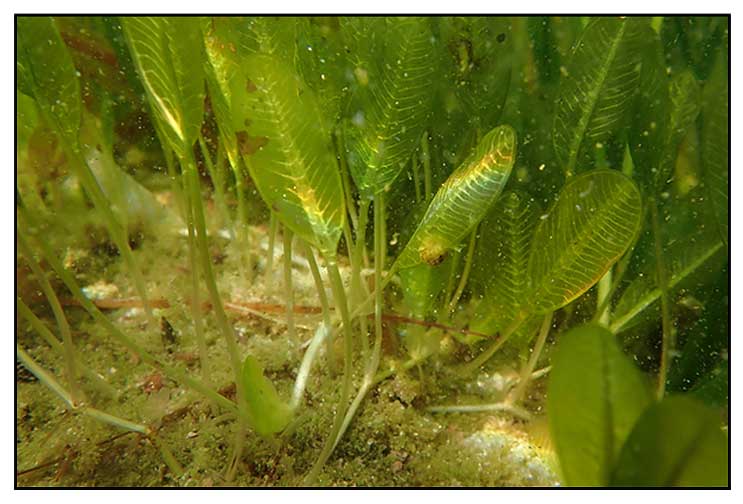
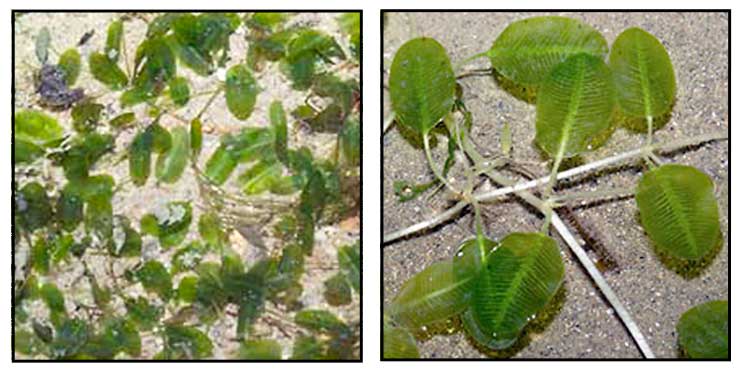
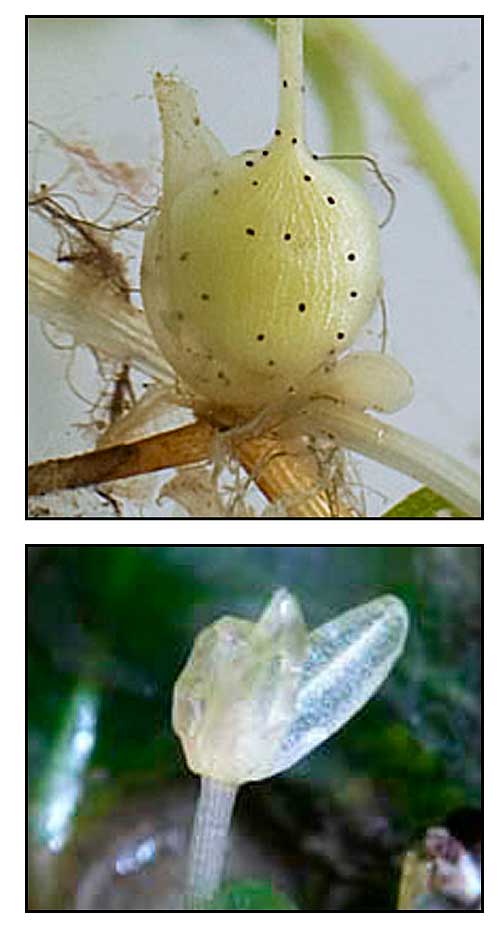
• The seagrass has oval, spoon-shaped leaves and is sometimes also called 'paddleweed' or fan seagrass. It comes in a wide range of sizes (0.5-1.5cm wide and 0.5-2.5cm long) and shapes from oval, to nearly oblong or spoon-shaped. The leaf edge is smooth with no serrations, there is a vein just within the leaf margin (intramarginal vein). The leaf has obvious cross veins (4-25) and is held on a long thin stalk. It has thin, smooth, white rhizomes (underground stems) about 2mm in diameter. The leaves emerge in pairs from these rhizomes. The emerging shoot is encased in a pair of transparent scales. Spoon seagrass has separate male and female plants. Flowers form at the base of the shoot but may extend to above the height of the leaves. Male flower remains low. Round fruits are tiny. (WildSingapore)

• Sometimes confused with other spoon-shaped seaweeds such as Coin seaweed (Halimeda sp.) and Fan seaweed (Avrainvillia sp.) that do not have veins like the spoon seagrass. Unlike hard coin sea-weeds that incorporate calcium in their body structure, spoon seagrass blades are soft and flexible. (5)

Distribution
- Native to the Philippines. (1) (2)
- Also native to
Andaman Is., Borneo, Cape Provinces, Caroline Is., China Southeast, Comoros, Egypt, Eritrea, Fiji, Gulf States, Hainan, India, Iran, Japan, Jawa, Kenya, Kuwait, KwaZulu-Natal, Lesser Sunda Is., Madagascar, Malaya, Maluku, Mauritius, Mozambique, Myanmar, Nansei-shoto, New Caledonia, New Guinea, New South Wales, Nicobar Is., Norfolk Is., Northern Territory, Oman, Pakistan, Palestine, Queensland, Rodrigues, Samoa, Saudi Arabia, Seychelles, Society Is., Solomon Is., Somalia, South China Sea, Sri Lanka, Sudan-South Sudan, Sulawesi, Taiwan, Tanzania, Thailand, Tonga, Vietnam, Western Australia, Yemen. (2)
• Occurs around reefs, estuaries, islands, inter-tidal areas, on soft sand or mud substrates. Often found in meadows that dominate a sand bank or other patch of sea floor. The arrangement of the plant, above and below ground, provides stability to the sea floor and habitat for other species. (5)

Constituents
- GC-MS analysis of methanol extract revealed presence of triacylglycerols as major component in purified fractions. Quantitative analysis showed rich phenol content. (see study below) (6)
- GC/MS quantitative analysis of dried powdered H. ovalis yielded: phenols, most abundant (9.44 mg/g), saponins (9.07 mg/g), flavonoids (5.59 mg/g), proteins 5.19 mg/g), carbohydrates (4.82 mg/g), alkaloids (1.06 mg/g) and tannins (0.26 mg/g) (Yuvaraj et al, 2012) (9)
- Phytochemical analysis revealed presence of steroid in hexane, ethanol, and aqueous extracts; alkaloids only in the chloroform extract. Flavonoids, terpenoids, tannins, and phenols were present in the ethyl acetate extract; and steroids, glycosides, saponins, terpenoids, and phenols in the hexane extract. (see study below) (12)

Properties
- Studies have suggest antibacterial, antioxidant, anti-inflammatory, anti-nociceptive, bioremediation properties.

Parts used
Roots, leaves.

Uses

Edibility
- While noted as primary food source for dugongs and green sea turtles, it has a history of traditional human consumption, and recent interest as food supplement. In parts of he Ilocos and Palawan regions, the seagrass is reportedly gathered, pickled, or comsumed fresh as salad vegetable. (8)
- Compared to other seagrasses, its fragile and tender leaf structure make it easy to chew.
Folkloric
- No reported folkloric medicinal use in the Philippines.
- Leaves toasted with drops of sesame oil consume for 3 days to treat iron deficiency. Leaf paste mixed with tumeric applied for various skin ailments, including burns and boils. (9)
Others

- Crafts: Seagrass blades have been utilized as component of accent parts of furniture, handicrafts, and various other household items. (3)

Studies
• Antioxidant / Antibacterial / Anti-Inflammatory:
Study of evaluated methanol extract of H. ovalis for antibacterial, antioxidant, and anti-inflammatory activities. The ME inhibited Bacillus cereus growth at MIC 50 µg/mL and other Gm(-) pathogens at 75 µg/ml, except for Vibrio vulnificus. Reducing power and total antioxidant level increased with increased extract concentration. H. ovalis showed strong radical scavenging on DPPH and superoxide radicals with IC50s of 0.13 and 0.65 mg/mL respectively. Me showed noticeable anti-inflammatory activity at IC50 of 78.72 µg/mL. (see constituents above) (6)
• Antinociceptive / Anti-Inflammatory / Sulfated Polysaccharides: Study of evaluated the antinociceptive and anti-inflammatory effects of sulfated polysaccharides from seagrass H. ovalis (Ho-SP) and Sargassum wightii (Sw-SP). In the formalinn test, Ho-SP significantly reduced licking time in both phases at dose of 10 mg/kg. In hot plate test antinociceptive effect was observed in doses of 5, 10 mg/kg, suggesting analgesic effect via central mechanism at higher dose. Ho-SP inhibited paw edema induced by carrageenan and potentially decreased neutrophil migration by 52%. In Freund's adjuvant-induced arthritic rats, Ho-SP treatment (10 mg/kg) significantly reduced paw volume, along with normal gain in body weight. Results suggest potential for development of anti-nociceptive and anti-inflammatory agents. (7)
• Antioxidant: In a study screening 5 species of seagrasses and 6 species of seaweeds for antioxidant activity by inn vitro methods, methanol and water extracts of seagrass H. ovalis showed highest antioxidant activity with IC50s of 78.95 and 85.40 µg/ml, using NO radical scavenging assays. (10)
• Anticancer / MCF-7 Breast Cancer Cells / Apoptosis Pathway: Study evaluated the anticancer potential of phenolic extract of H. ovalis and characterized the possible molecular mechanism. DAPI staining indicated the phenolic extract induces apoptosis in MCF-cells, evidenced by increased chromatin condensation in treated cells. The phenolic extract also blocked the antioxidant defense system in MCF-7 cells by down-regulating the protein expression of a major transcription factor, Nrf-2 and regulatory antioxidant enzymes, SOD-2 and HO-1. Study suggests the presence of chemo-
preventive compounds in the extract provides a platform studies to identify active principles. (11)
• Stigmasterol / Effect against Ocular Pathogenic Bacteria: Study focused on isolating bioactive compounds from H. ovalis and fractions and its activity against four ocular pathogenic bacteria viz. Corynebacterium xerosis, Bacillus subtilis, Escherichia coli, and Enterococcus faecalis. Gentamycin was used as control. Based on antimicrobial activity and MIC, the chloroform extract showed maximum activity against C. xerosis and E. coli. Ethyl acetate extract showed moderate activity against B. subtilis. Stigmasterol was isolated from the extract. (see constituents above) (12)
• Mercury Bioremediation Potential: Seagrass has a remarkable metal bioaccumulation capacity via direct interaction with both water column and pore water through leaves and roots by ionic uptake. Study in Malita, Davao Occidental, evaluated five species of seagrass for potential in absorbing mercury. In New Argao, H. ovalis showed highest mean percent cover (4.3%) and shoot density (197.l87 shoots/m2), and lowest mean percent cover (1.9%) and shoot density (197.87 shoots/m2) in Culiman. With limited data, conclusions about relations between mercury concentration and shoot density were not drawn. (13)

Availability
- Wild-crafted.

October 2026

                                                 PHOTOS / ILLUSTRATIONS
IMAGE SOURCE: Sea Wrack (Halophyla ovalis) / ©  蘇昱 / CC BY NC / Some rights reserved / Image modified / Click on image or link to go to source page / iNaturalist
IMAGE SOURCE: Spoon seagrass (Halophyla ovalis 'complex') / © WILD FACTsheets / 4 images / Non-commercial use / Images modified / Click on images or link to go to source page / WildSingapore
 
 
IMAGE SOURCE: Hedyotis costata / Subject Database of China Plant <http://www.naturemuseum.net/album/ShowPhoto.aspx?photoid=2671c974-77ca-44f9-b304-0f16660a06f7> Helixcn
OTHER IMAGE SOURCE: /Gliricidia sepium (JacqBarcelona Kunth ex Walp. - quickstick GLSE2 / Steve Hurst @ USDA-NRCS PLANTS Database / USDA
OTHER IMAGE SOURCE: / File:Fruit of Syzygium samarangense / Wax apple / Plate from book / Flora de Filipinas / Francisco Manuel Blanco (OSA) / Public Domain / Wikimedia Commons
IMAGE SOURCE: / Photos (2) / Pterocaulon redolens (Willd.) F.-Vill. / © Collected by www.plant.ac.cn / ZHIWUTONG / CLICK ON IMAGE TO GO TO SOURCE PAGE
IMAGE SOURCE: / Line drawing / Pterocaulon redolens (Willd.) F.-Vill. / © Collected by www.plant.ac.cn / ZHIWUTONG / CLICK ON IMAGE TO GO TO SOURCE PAGE
IMAGE SOURCE:Phyllantaceae : Flueggea flexuosa / Leaf / Copyright © 2018 by P B Pelser & J F Barcelona (contact: pieter.pelser@canterbury.ac.nz) [ref. DOL131909] / Non-Commercial Use  / Image modified / Click on image or link to go to source page / Phytoimages.siu.edu
OTHER IMAGE SOURCE: / Flower close-up / dracobotanicus -- Wayne Dumbleton / Creative Commons Attribution / flickr / Click on graphic to see original image / flickr
OTHER IMAGE SOURCE: Mexican tea / Dysphania ambrosioides / © J Richard Abbott / Some rights reserved / NC BY-NC / Click on image or link to go to source page / iNaturalist
OTHER IMAGE SOURCE: / Illustration / Cissampelos pareira L. [5809-247450-161657] / Indian medicinal plants, vol. 1: t. 42 / PlantIllustrations.org
ebay
IMAGE SOURCE: Pterocaulon redolens (Willd.) F.-Vill. / © Collected by www.plant.ac.cn / ZHIWUTONG / CLICK ON IMAGE TO GO TO SOURCE PAGE / iNaturalist
flickr
iNaturalistUK
IMAGE SOURCE:   Erythrina fusca (Ngatae fisi) / Tau'olunga / CC BY-SA 3.0 / Click on image or link to go to source page / Wikipedia
Pacific Island Ecosystems at Risk (PIER)
Photos ©Godofredo Stuart / StuartXchange
Content © Godofredo Stuart / StuartXchange
Content / Photos © Godofredo Stuart / StuartXchange
Photos © Godofredo Stuart / StuartXchange
 

Additional Sources and Suggested Readings
(1)

Hydrocharitaceae: Halophila ovalis / Co's Digital Flora Database
(2)
Halophila ovalis / KEW: Plants of the World Online
(3)
Hydrocharitaceae / Wikipedia
(4)
Halophila ovalis / Wikipedia
(5)
Spoon seagrass: Halophila ovalis 'complex' / WILD FACT SHEETS / WildSingapore
(6)
Seagrass as a potential source of natural antioxidant and anti-inflammatory agents / N Yuvaraj, P Kanmani, R Satishkumar, A Paari, V Pattukumar, V Arul / Pharm Biol. 2012; 50(4): pp 458-467 /
DOI: 10.3109/13880209.2011.611948
(7)
Antinociceptive and Anti-Inflammatory Activities of Sargassum wightii and Halophila ovalis Sulfated Polysaccharides in Experimental Animal Models / N Yuvaraj, P Kanmani, P Satishkumar, A Paari et al / Journal of Medicinal Food, 2013; 16(8): pp 740-748 / DOI: 10.1089/jmf.2012.2719
(8)
Seagrass-Watch in the Philippines / SeagrassWatch
(9)
Nutritional and bioactive potential of seagrasses: A review
/ Doo Hwan Kim, Mohamad Fawzi Mahomoodaloly, Nabeelah Bibi Sadeer, Park Gyun Seok et al / South African Journal of Botany, 2021; Vol 137: pp 216-227 / DOI: 10.1016/j.sajb.2020.10.018
(10)
Antioxidant Activity of Seagrasses and Seaweeds / T Athiperumalsami, VD Rajeswari, SH Poorna, V Kumar, LL Jesudass / Botanica Marina, 2010; 53(3) / DOI: 10.1515/BOT.2010.032
(11)
Phenolic Extract of Seagrass, Halophila ovalis Activates Intrinsic Pathway of Apoptosis in Human Breast Cancer (MCF-7) Cells / Harshita Sharma, Nimish Mol Stephen, Sowmya Shree Gopal, Ganesan Ponesakki et al / Nutr Cancer, 2021; 73(2): pp 307-317 / DOI: 10.1080/01635581.2020.1743874
(12)
ISOLATION AND CHARACTERIZATION OF STIGMASTEROL FROM THE SEA GRASS HALOPHILA OVALIS / J Sangeetha, S Asokan / European Journal of Biomedical and Pharmaceutical Sciences, 2018; 5(5): pp 500-505 / ISSN: 2349-8870
(13)
Preliminary Study on the Bioaccumulation Potential ff Seagrass (H. Ovalis) for Mercury in Selected Coastal Barangays in Malta, Davao Occidental / Junarie Joy M Tuba, Pedro Avenido / SPAMST Research Journal, 2018; 1(1): pp 35-43 / DOI: 10.64656/spamastrj.v1i1.3


α•(5)
PHOTOS / ILLUSTRATIONS

DOI: It is not uncommon for links on studies/sources to change. Copying and pasting the information on the search window or using the DOI (if available) will often redirect to the new link page. (Citing and Using a (DOI) Digital Object Identifier)

                                                            List of Understudied Philippine Medicinal Plants
                                          New plant names needed
The compilation now numbers over 1,830 medicinal plants. While I believe there are hundreds more that can be added to the collection, they are becoming more difficult to find. If you have a plant to suggest for inclusion, native or introduced, please email the info: scientific name (most helpful), local plant name (if known), any known folkloric medicinal use, and, if possible, a photo. Your help will be greatly appreciated.
α•(5)

•
HOME      •      SEARCH      •      EMAIL    •     ABOUT