HOME    •    SEARCH      •      EMAIL    •     ABOUT  •     DONATE


Family • Araceae
Damping-banal
Aglaonema simplex Blume
CHINESE EVERGREEN / MALAYAN SWORD
Yue nan wan nian qing

Scientific names Common names
Aglaonema alpinum Elmer Damping-banal (Tag.)
Aglaonema angustifolium N.E.Br. Luyao (General)
Aglaonema angustifolium var. undulatum Ridl. Tagabalid (Dumagat)
Aglaonema borneense Engl. Borneo sword (Engl.)
Aglaonema brevivaginatum Alderw. Chinese evergreen (Engl.)
Aglaonema elongatum Alderw. Malayan sword (Engl.)
Aglaonema emarginatum Alderw. Single-stemmed agaonema (Engl.)
Aglaonema fallax Schott ex Engl.  
Aglaonema grande Alderw.  
Aglaonema latius Alderw.  
Aglaonema longicuspidatum Schott  
Aglaonema malaccense Schott  
Aglaonema nicobaricum var. luteum Sasikala  
Aglaonema nieuwenhuisii Engl. ex Alderw.  
Aglaonema pierreanum Engl.  
Aglaonema propinquum Schott  
Aglaonema schottianum Miq.  
Aglaonema schottianum f. angustifolium (N.E.Br.) Engl.  
Aglaonema schottianum var. brownii Engl.  
Aglaonema schottianum var. genuinum Engl.  
Aglaonema schottianum var. malaccense (Schott) Engl.  
Aglaonema schottianum var. winkleri Engl.  
Aglaonema siamense Engl.  
Aglaonema simplex Blume  
Aglaonema simplex f. angustifolium (N.E.Br.) Jervis  
Aglaonema simplex f. inequale Alderw.  
Aglaonema simplex var. macrophyllum Engl.  
Aglaonema simplex f. nieuwenhuisii (Engl. ex Alderw.) Jervis  
Aglaonema simplex f. typicum Alderw.  
Aglaonema subarborescens Alderw.  
Aglaonema subfalcatum Engl.  
Aglaonema tenuipes Engl.  
Caladium princeps Kunth  
Caladium simplex Blume  
Scindapsus tonkinensis K.Krause  
Aglaonema simplex is an accepted species. KEW: Plants of the World Online

Other vernacular names
CHIneseL Yue nan wan nian qing.
INDONESIAN: Kering, Wetune (Javanese).
MALAY: Penggeheh, Sumpuh bulan, Sumpuh kering, Kayu ulat bulu.
THAI: Waan ngot hin (Trang), Wan khan mak.

Gen info
- Araceae is a family of monocotyledonous flowering plants in which flowers are borne on a type of inflorescence called a spadix. Also known as the arum family, members are colloquially known as aroids. The family contains 114 genera and about 3,750 known species. (5)
- Aglaonema is a genus of flowering plants in the arum family, Araceae; native to tropical and subtropical regions of Asia and New Guinea. They are commonly known as Chinese evergreens.
- Aglaonema simplex is a perennial species of flowering plant in the family Araceae.
- Etymology: The genus name Aglaonema derives from Greek words aglos, meaning "bright", and nema, meaning "thread", possibly referring to the shiny appearance of the stamens. The specific epithet simplex derives from Latin. meaning "single" or "unbranched", referring to the single-stemmed habit of the species. (3)

Botany
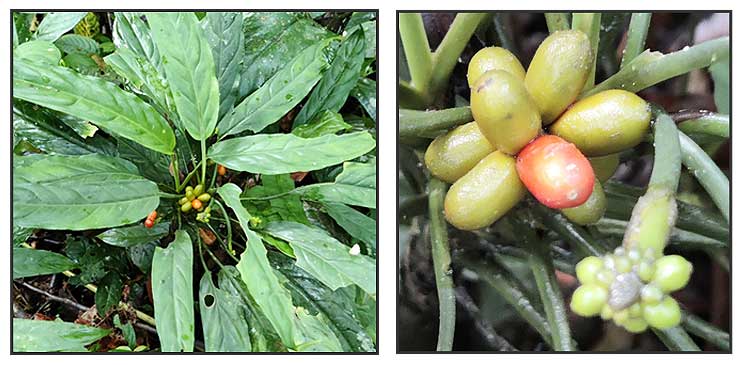
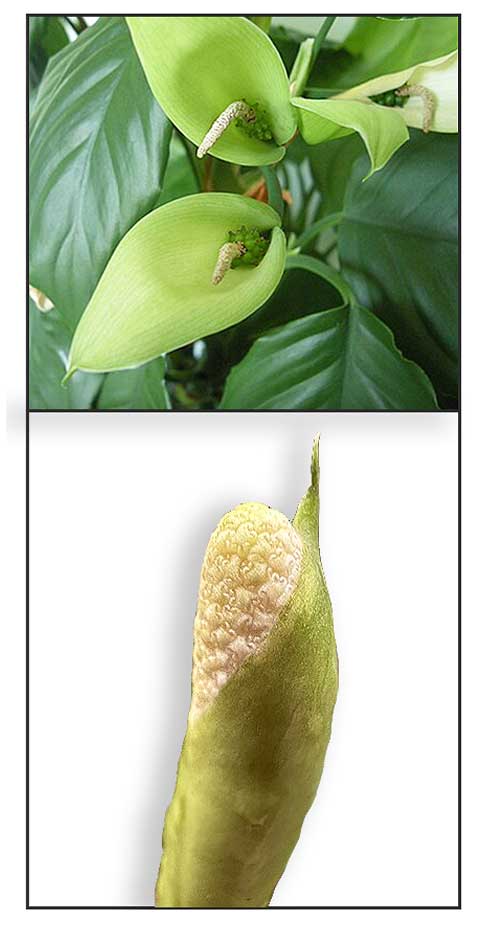
• Malayan sword is a shrubby plant that grows to about 0.2 to 1.2 m (7.9 in to 3 ft 11.2 in) tall with straight stems. Its dark-green leaves are arranged spirally. Leaves are oval-shaped, with a length between 10 – 35 cm and a width between 1.9 – 25 cm, and sunken veins. The fruits are red and ovoid. Seeds are possibly dispersed by mammals and birds. Flowers are enclosed in a very greenish-white leaf. (2)

• Growth form: A herb, 15–120 cm tall, with straight stems. It is easily recognized by its dense crown of narrowly oblong to linear lance shaped, green leaves with pointed tips. Foliage: Alternate, stalked, densely and spirally arranged leaves have leathery leaf blades that are green to dark green, veins sunken, narrowly oblong, narrowly oval to lance-shaped, occasionally linear, oval or egg-shaped, ending abruptly or gradually into a sharp tip, and 10–35 by 1.9–25 cm. Flowers: Erect flowering shoot is enclosed within a light green to whitish petal-like leaf that ends abruptly with a sharp tip, 2.3–6.5 cm long. Species is monoecious, with separate female and male flowers located on different parts of the spadix. Fruit: Fruits are oval, red in colour when ripe, and 1–1.7 by 0.5–0.8 cm.(Flora & Fauna Web)

Distribution
- Native to the Philippines. (1) (4)
- In Luzon: Batangas, Camarines Norte, Camarines Sur, Laguna, NCR, Quezon, Sorsogon; Biliran, Leyte, Mindoro, Negros, Samar; In Mindanao: Lanao, Misamis Oriental, Misamis Occidental, Surigao del Norte, Zamboanga Sibugay, Zamboanga del Norte.
- Also native to
Bangladesh, Borneo, Cambodia, China South-Central, Jawa, Laos, Lesser Sunda Is., Malaya, Maluku, Myanmar, Nicobar Is., Sulawesi, Sumatera, Thailand, Vietnam. (1)
- While the species iis abundant, its native habitat is threatened by deforestation for wood harvesting

Constituents
- Screening study of leaves and stems for new photosensitizers isolated 5 pheophorbide-related compounds. Compounds 1-3 and 5 are pheophorbide and hydroxy pheophorbide derivatives of chlorophyll a and b. Compound 4, hydroxypurpurin-7-lactone ethyl methyl diester, was isolated for the first time from the Araceae family. (see study below) (8)
- Study of rhizomes extract extract of A. simplex isolated a long-chain ester, butyl stearate (1) and a phytosterol, ß-sitosterol (2). (see study below) (10)

Properties
- Toxicity: Like other plants in the Araceae family, A. simplex contains calcium oxalate crystals, and is toxic to humans and animals on contact of ingestion. Wear gloves when handling, and keep out of the reach of children and pets.
- Studies suggested glycosidase inhibitory, tyrosinase inhibitory, anti-atherosclerosis, nticancer properties.


Parts used
Roots, stems, leaves, fruits.

Uses

Edibility
- Caution: Despite traditional applications, A. simplex is inedible and toxic if ingested raw.
- Study reports on ripe fruits used as longevity enhancer and as anti-asthma medicine.
Folkloric
- No reported folkloric medicinal use in the Philippines.
- Leaves pounded in coconut oil is rubbed on the body of women to facilitate delivery and for relief of pain. Root decoction used for treatment of fever and edema. (3)
- Root decoctions and leaf preparations used for treatment of fever and dropsy.
- Mashed green leaves applied to throat for sore throats or bound across the forehead to relieve headaches.
- In Malaysia, poultice of leaves and roots used for skin irritation caused by caterpillar / worms. (7)
-
Article reports on ripe fruits used as longevity enhancer and anti-asthma medicine. (•)
Others

- Horticulture: Used as indoor ornamental plant or pot plant.(3)

Studies
• Inducer of SR-B1 Ligand Expression / Glycosidase Inhibitor Activity / Stem and Root:
The genus Aglaonema contains polyhydroxy alkaloids with glycosidase inhibitor activity. (Glycosidease inhibitors are compounds that block activity of glycosidase enzymes slowing down breakdown of complex carbohydrates into simpler sugars.) Study screened in stem and root extracts of A. simplex plantlets for potential compounds as alternatives of SR-B1 ligand that plays a role in reducing atherosclerosis. Results showed extracts contained secondary metabolites of terpenoids, steroids, phenolics, alkaloids, and glycosides. Luciferase assay suggested stem and root extracts increased expression of SR-B1 at 1.61- and 1.72-fold higher than control, respectively. Results suggest a potential source of phytochemicals for treatment of atherosclerosis. (6)
• Anticancer / Photocytotoxic Pheophorbide-Related Compounds / Leave and Stems: In a screening program for new photosensitizers, study of leaves and stems isolated 5 pheophorbide-related compounds. MTT assay showed all five compounds exhibited moderate to strong photocytotoxic activities towards human leukemia (HL60) and two oral squamous carcinoma cell lines (HSC-2 and HSC-3). Compounds 4 and 5 showed strongest photocytotoxicities with IC50s of 0.30-0.41 µM. (see constituents above) (8)
• Anti-Tyrosinase Activity: / Photocytotoxic Pheophorbide-Related Compounds / Rhizomes: Ethanol extract of A. simplex rhizomes exhibited higher monophenolase inhibitory activity than arbutin, with IC50s of 53.65 and 138.15 µg/mL respectively, while diphenolase inhibitory activity were similar to arbutin at 6.35 and 7.11 µg/mL. Arbutin was used as binding ligand for screening tyrosinase inhibitors using HPLC-DAD. Five unknown tyrosinase inhibitor binding ligands were identified in the ethanol extract of A. simplex rhizomes with retention times from 13.95 to 43.90 min. Results suggest that the A.simplex rhizome extract could be a marker compound for the development of the extract in cosmeceuticals. (9)
• Mild Hyaluronidase Inhibitory Activity / Rhizomes: Study of rhizomes extract extract of A. simplex isolated a long-chain ester, butyl stearate (1) and a phytosterol, ß-sitosterol (2). Compound 2 exhibited mild hyaluronidase inhibitory activity with IC50 888.5 µg/mL compared to standard 8-O-palmitoylascorbic acid (IC50 186.1 µg/mL). (10)

Availability
- Wild-crafted.

March 2026

                                                 PHOTOS / ILLUSTRATIONS
IMAGE SOURCE: Aglaonema simples ;Flowers / by Connormah / CC BY SA 4.0 International / Image modified / Click on image or link to go to source page / Wikipedia
OTHER IMAGE SOURCE: Aglaonema simples / by ubahn–––verleih / CC0 / Public Domain / WTFPL / Image modified / Click on image or link to go to source page / Wikipedia
OTHER IMAGE SOURCE: Aglaonema simples / by Bret van Putten / 2 images / Some rights reserved / CC BY-SA 4.0 International / Images modified / Click on image or link to go to source page / iNaturalist
OTHER IMAGE SOURCE: Aglaonema simplex (Malayan Sword) / by Bret van Putten / Some rights reserved / CC BY-SA 4.0 International / Image modified / Click on image or link to go to source page / iNaturalist


Additional Sources and Suggested Readings
(1)

Aglaonema simplex / KEW: Plants of the World Online
(2)
Aglaonema simplex / Wikipedia
(3)
Aglaonema simplex / NATIONAL PARKS: Flora & Fauna Web
(4)
Araceae: Aglaonema simplex / Co's Digital Flora Database
(5)
Araceae / Wikipedia
(6)
Phytochemical screening of in vitro Aglaonema simplex plantlet extracts as inducers of SR-B1 ligand expression / Zuriah Ismail, Aziz Ahmad, Tengku Sifzizul Tengku Muhammad / Journal of Sustainability Science and Management, 2017; 12(2): 34
(7)
Aglaonema simplex / A Field Guide to Medicinal Plants of Tasek Bera
(8)
Photocytotoxic Pheophorbide-Related Compounds from Aglaonema simplex / Chin-Fei Chee, Hong Boon Lee, Hean Chooi Ong, Anthony Siong-Hock Ho / Chemistry & Biodiversity, 2005; 2(12): pp 1648-1655 /
DOI: 10.1002/cbdv.200590134
(9)
SCREENING ACTIVE NATURAL LIGANDS OF TYROSINASE FROM Aglaonema simplex BL. BY HPLC / Sutthiduean Chunhakant, Thongchai Khammee / Phranakhon Rajabath Research Journal, 2021; 16(2): pp 93-108 / eISSN: 3027-821X

•

DOI: It is not uncommon for links on studies/sources to change. Copying and pasting the information on the search window or using the DOI (if available) will often redirect to the new link page. (Citing and Using a (DOI) Digital Object Identifier)

                                                            List of Understudied Philippine Medicinal Plants
                                          New plant names needed
The compilation now numbers over 1,830 medicinal plants. While I believe there are hundreds more that can be added to the collection, they are becoming more difficult to find. If you have a plant to suggest for inclusion, native or introduced, please email the info: scientific name (most helpful), local plant name (if known), any known folkloric medicinal use, and, if possible, a photo. Your help will be greatly appreciated.
•

•
HOME      •      SEARCH      •      EMAIL    •     ABOUT