Gen info
- Acanthaceae is a family of dicotyledonous flowering plants containing almost 250 genera and about 2500 species. Most are tropical herbs, shrubs, or twining vines; some are epiphytes.
- Thunbergia is a genus of flowering plants in the family Acanthaceae. It includes 150 species native to tropical and subtropical regions of sub-Saharan Africa, Madagascar, southern Asia, New Guinea, and Australia.
- Etymology: The genus name Thunbergia honors the Swedish physician and botanist, Carl Peter Thunberg, 1743-1828. The specific epithet mysorensis refers to the city of Mysore in Karnataka, India.
- Clock Vine: One of the plants curious trait is that it always twines clockwise; ergo, the common name, Clock Vine.
- Award: Considered one of the most beautiful vines in the world and has received the prestigious Royal Horticultural Society Away of Garden Merit in 1993.
- The variety of common names refer to the shape of the flowers and the clockwise twinning of the vine.
 Botany Botany
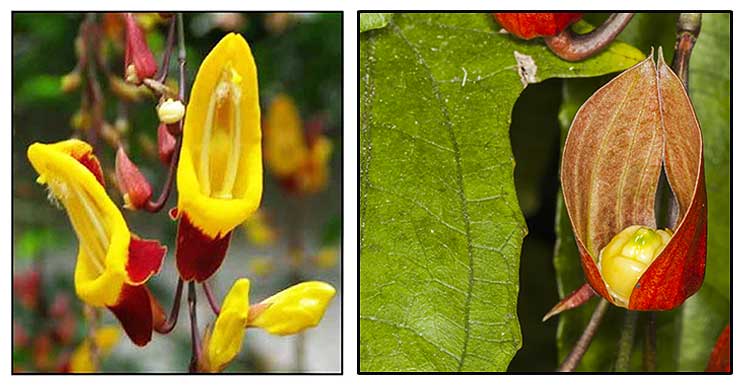
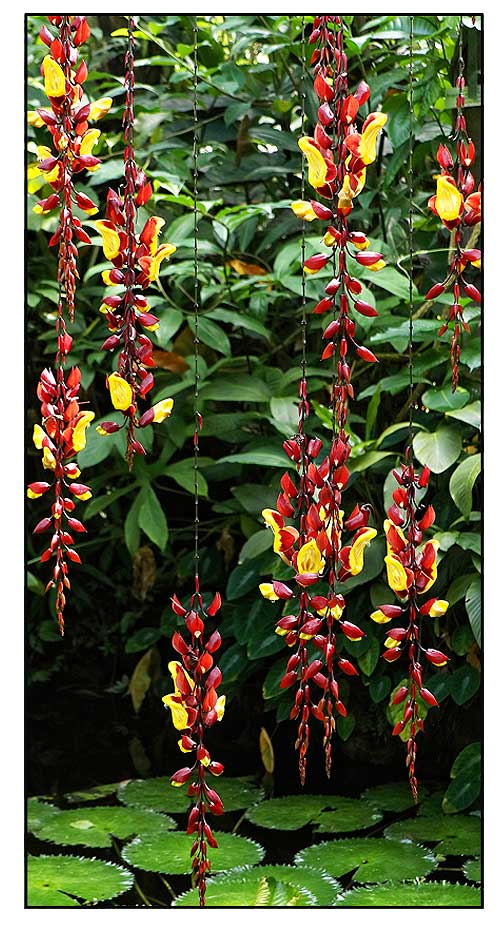
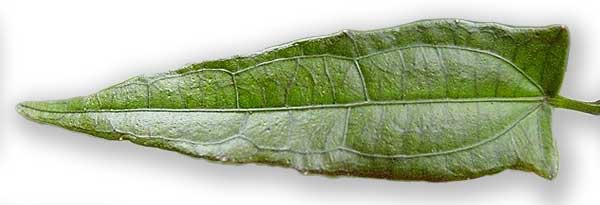
• Thunbergia mysorensis is an evergreen twinning vine that grows 16-25 feet tall and at least as wide, with a dense covering of dark green, opposite, lanceolate, acuminate, dentate leaves, 4 to 6 inches long, prominently three-nerved.. Stems twine clockwise as they mature. Inflorescence is an elongated pendant raceme, slender, three feet or longer. Flowers dangling from inflorescences are two-lipped, arising from the leaf axils, with red calyces and a floral tube with a 3-inch gaping mouth, yellow along the edges and down the throat, with red reflexed petals.
• Stems - woody, bare, twisted clockwise. Leaves - arranged opposite, dark green, shiny, narrow, lanceolate, pointed leaf tip (acuminate), toothed leaf edge, there are 3 clear leaf bones, glabrous.
Flowers - Bilateral symmetrical tubular shape with a wide open mouth, consisting of five fused petals (crown). The tips of the red petals which are reflected to reveal the throat are yellow (along the edge and down the throat), and bloom from summer to fall. Large stamens and hairy pistil. Each flower is up to 5 cm long with striking red bracts. The inflorescence is an elongated pendant raceme, dangling, slender, emerging from the leaf axils. (SOCFINDO Conservation)
Distribution
- Introduced.
- Naturalized in secondary forest in Mt. Makiling. (5)
- Cultivated in Laguna and Baguio City as an ornamental plant.
- Native to southern tropical India.
- Naturalized in Mediterranean climates.
Constituents
- Phytochemical screening yielded protein, alkaloid, amino acid, carbohydrate, flavonoids, tannin, and phenolics. (see study below) (3)
- Activity-guided repeated fractionation of ME of T. mysorensis leaves extracted two compounds: 3,4-dimethoxy benzoic acid (DMBA) (101 mg) and 3,4-dimethoxy cinnamic acid (DMCA) (87 mg) with potent anti-diabetic activity. (see study below) (8)
- HRLC-MS/MS analysis of bark methanol extract identified presence of corylin, daurioxoisoporphine B and prunasine and major phytochemicals. (see study below) (9)
- GC-MS study of alcoholic leaf extract
revealed presence of different molecules, such as: Glycerol, tris (trimethylsilyl) ether, 3,7,11,15-tetramethyl-2-hexadecen-1-ol, Undecanoic acid, Ethyl ester, and Phytol.
 Properties Properties
- Sweet nectar is attractive to birds.
- Studies have suggested antioxidant, anticancer, antibacterial, α-amylase inhibitory, antidiabetic, anti-inflammatory, antiproliferative properties.
Parts used
Flowers, stems, leaves.
Uses
Edibility
- No reports on edibility.
- No culinary history.
Folkloric
- No reported folkloric medicinal use in the Philippines.
-
In India, used to treat coughs, jaundice, liver disease, fever.
- Used for treatment of snakebites.
Others
- Nectar: Sweet nectar attracts sunbirds, a very small passerine bird, and hummingbirds. (2)
Studies
• Antioxidant: Study evaluated an ethanol extract for antioxidant potential. Phenol and flavonoid concentration were 0.264 µg/ml and 0.259 µg/ml, respectively. Reducing power was 0.311 µg/ml. The IC50 was 125 µg/ml, compared to standard vitamin C at 237.5 µg/ml. Results suggest a good source of natural antioxidants. (see constituent above) (3)
• Antibacterial / Flowers: Study of aqueous extract of flowers showed antibacterial activity against E. coli, S. aureus, and P. aeruginosa with 7-10 mm zone of inhibition. (4)
• Silver Oxide Nanoparticles / Antibacterial / Anticancer / Antioxidant / Stem and Flowers: Study reports on the green synthesis of silver oxide nanoparticles (Ag2ONPs) using stem and flower extracts. Antioxidant activity by DPPH, ABTS and ferric ion reduction showed enhanced activity with flower Ag2ONPs compared to stem Ag2ONPs. Hemolytic assay showed 1.4% and 1.0% hemolysis with SAg2ONPs and FAg2ONPs respectively. FAg2ONPs showed potent antibacterial activity against Gram(-) and Gram+) bacteria compared to SAg2ONPs, and were also effective against human MDA-MB-468-triple negative breast cancer cell lines with IC50 of 480µM. Results suggest a promising strategy owing to accessibility, non-toxicity, viability, and essential reducing potential. (7)
• Antidiabetic / α-Amylase Inhibitory /
Leaves: Study evaluated the antidiabetic potential of methanolic extract of Thunbergia mysorensis leaves. Activity-guided repeated fractionation of ME of T. mysorensis leaves extracted two compounds: 3,4-dimethoxy benzoic acid (DMBA) (101 mg) and 3,4-dimethoxy cinnamic acid (DMCA) (87 mg) with potent anti-diabetic activity. Both compounds significantly inhibited
α-amylase and showed antioxidant potential (DPPH EC50s 30.50 and 31.00, ABTS EC50 27.86 and 28.00, superoxide EC50 36.10 and 36.25 µg/mL). α-Amylase was most significantly inhibited, compared to aldose reductase and α-glucosidase. Both DMBA and DMCA is more likely associated with the methanol extract anti-hyperglycemic activity. Both compounds have potential as lead inhibitors of AM and as effective antidiabetic drugs. (8)
• Anti-Inflammatory / Antioxidant / Antiproliferative / Bark: Study evaluated the anti-inflammatory, antioxidant, and antiproliferative properties of T. mysorensis bark and leaf samples. Methanol extract of bark showed significant (p<0.01) anti-inflammatory activity with highest % of protein denaturation inhibition (97.5%) and proteinase (86.83%) activities, along with strong DPPH (SC50=0.406 mg/mL( and hydroxyl (SC50=0.072 mg/mL) radical scavenging activity, and high FRAP value (242.08 mg/mL). Extract showed mild antiproliferative activities against breast cancer (MCF7) cells. Flavonoids (6.25 mg QE/g) and phenolics (4.27 mg GAE/g) in leaf and bark samples showed positive correlation with antioxidant activity. (see constituents above) (9)
• Antihyperglycemic / Enzyme Inhibitory / Flowers: Study evaluated the antihyperglycemic properties of methanol extract of flowers of T. mysorensis (MeT) against α-glucosidase, α-amylase, and aldose reductase enzymes for effective management of postprandial hyperglycemia. MeT inhibited both carbohydrate digestive enzymes (α-glucosidase and α-amylase) and aldose reductase. MeT showed significant antioxidant activity. Gallic acid was the primary active component found in MeT. With low Ki values, gallic acid significantly inhibited α-glucosidase and α-amylase. Both MeT and gallic acid significantly inhibited aldose reductase with IC50s of 3.31 and 3.05 mg/mL. Results suggest the gallic acid derived from MeT via bioassay-guided isolation emerges as a potential natural antidiabetic drug. (10)
Availability
- Wild-crafted.
- Ornamental cultivation.
- Plants in the cybermarket. |