Gen info
- Holmskioldia is a genus of flowering plants in the mint family Lamiaceae. It contains only one known species, Holmskioldia sanguinea.
- Etymology: The genus name Holmskioldia commemorates Johan Theodor Holmskiold (1731-1793), a Danish physician and botanist. Specific epithet sanguinea means "blood red", referring to the red flowers.
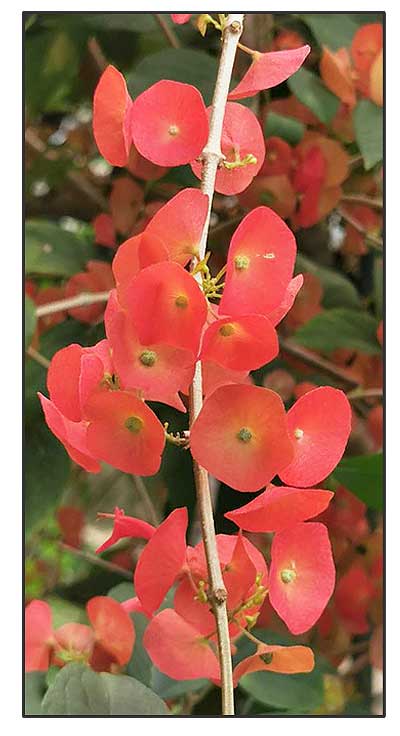 Botany Botany
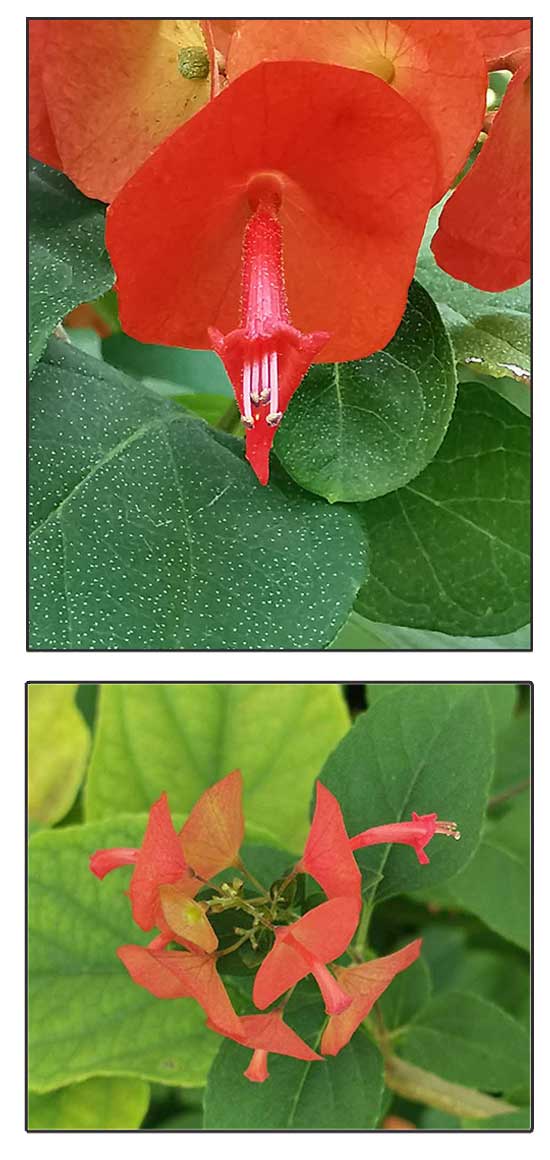
• A large, evergreen, scandent shrub with slightly pubescent, quadrangular, young branches. Leaves ovate or elliptic-ovate, 5-12 cm long, 2.5-8 cm broad, entire to coarsely dentate, shortly acuminate, pubescent to glabrous; petiole 1.5-3 cm long; bracts lanceolate, 4-5 mm long. Cymes axillary, pedunculate. Flowers brick-red to orange, c. 6 mm across; pedicels c. 5 mm long. Calyx petaloid, c. 1.5 cm across. Corolla-tube curved, broadening upwards; limb sub-bilabiate unequally 5-lobed. Drupe 5-8 mm long, obovoid, 4-lobed, subfleshy, enclosed by persistent, enlarged, colored calyx.
(Flora of Pakistan)
• Growth form: A scandent shrub to climber. Foliage: Leaves are ovate to elliptic-ovate with a dentate edge, arranged oppositely along the stem. Leaf blade has truncate base and acuminate leaf tip. Leaf texture is smooth to pubescent (covered in fine, short hair). Flowers: Showy flower has deep red petals and calyx. The calyx is enlarged to form a broad umbrella-like 'hat'. The flowers are trumpet-shaped with curved corolla tube, widening outwards to form 5 unequal lobes. The flowers are borne on axillary cymes. Fruit: Drupe, deeply 4-lobed but not seen in local cultivation. (Flora & Fauna Web)
Distribution
- Introduced.
-
Widely cultivated in the
Philippines.
- Naturalized in secondary forest, plantation forest, thickets and open field. (1)
- In Luzon: Benguet, Camarines Sur, Rizal; Cebu; in Mindanao: Bukidnon, Zamboanga del Sur. (1)
- Native to Assam, East Himalaya, India, Myanmar, Nepal, West Himalaya. (2)
Constituents
- Alcoholic extract of leaves reported presence of alkaloids, carbohydrate, tannins, terpenoids, flavonoids, phenols, and glycosides (Pal et al.) (5)
-
A pigment was isolated and identified as axillarin - 3,6-dimethoxy-5,7,3',4'-tetrahudroxyflavone (Bhardwaj et al). (5)
- Study of aerial parts isolated four new iridoids, 6-O-α-l-(2″-O-trans-cinnamoyl)rhamnopyranosylcatalpol, 6-O-α-l-(3″-O-trans-cinnamoyl)rhamnopyrano sylcatalpol, 6-O-α-l-(4″-O-trans-cinnamoyl)rhamnopyranosylcatalpol and 6-O-α-l-(4″-O-cis-feruloyl)rhamnopyranosyl-catalpol, along with 3 known monoacyl rhamnopyranosylcatalpol derivatives. Three known phenolic glycosides were isolated in small amounts: methyl salicylate glucoside, osmanthuside H, and icariside F2. (6)
- Study isolated betulinic acid (1), wogonin (2) and oroxindin (3) from aerial parts Holmskioldia sanguinea and Bacopa monnieri. (see study below) (9)
- Phytochemical screening of methanolic leaf extract detected alkaloids, glycosides, carbohydrate, tannins, terpenoids, flavonoids, and phenols. (see study below) (10)
 Properties Properties
- Studies have suggested antimicrobial, phytotoxic, anti-inflammatory, anticancer, antidiabetic, antioxidant, antibacterial properties.
Parts used
Stems, leaves, bark, flowers.
Uses
Edibility
- Although various plant parts reportedly used in herbal medicinal preparations, there are no reports on culinary use.
Folkloric
- No reported medicinal use in the Philippines.
- Freshly crushed leaves and roots used for treatment of rheumatism and rheumatoid arthritis, dysentery, headaches, hypertension, boils, blain, ulcers, gynecological problems. (5)
- Stem and stem bark extracts used for treatment of dysentery, headaches, and hypertension. Concoction with boiled leaves used for blood purifying. (6)
- In India, the Ao-Naga tribes of Nagaland take the juice of leaves orally for hypertension, body aches, and fever. Flowers and leaves used as ingredients for preparation of indigenous hair lotion. (7)
- In Manipur, India, boiled extract of young shoots used by the Chiru tribes
as antidepressantt. (8)
- In India, leaves and bark are used as tonic and wound healer. (12)
Others
- Magico-ritual: Leaves and flowers believed to have magical effects and ritual significance in treatment of children's diseases. Also reported used in magic or vashikaran rituals by tantrics. (6)
Studies
• Antimicrobial / Phytotoxic / Aerial Parts: Study isolated betulinic acid (1), wogonin (2) and oroxindin (3) from aerial parts Holmskioldia sanguinea and Bacopa monnieri. The compounds showed significant antifungal activity against two fungi Alternaria alternata and Fusarium fusiformis. All 3 compounds showed 100% inhibition of root growth germination of wheat seeds at 10 µg/ml. Compounds 1 and 2 showed potent inhibition of Alternaria alternata compared to oroxindin at 4 µg/ml, while compound 2 showed effective inhibition of both fungi. (9)
• Antifungal Wogonin: Study evaluated the antifungal activity of wogonin, which was isolated from H. sanguinea against four different fungal organisms. Wogonin significantly inhibited the growth of Aspergillus niger, Penicillum frequentance, P. notatum and Botrytis cinerea in a concentration-dependent manner. Effects were compared to standard antifungal agent Griseofulvin. (8)
• Anti-Inflammatory / Aerial Parts: Study evaluated the anti-inflammatory effects of three fractions (CHCl3, n-BuOH and H2O) from aerial parts of H. sanguinea using a carrageenan-induced edema model. The H2O (20 and 40 mg) and n-BuOH (200 mg) fractions were found effective compared to standard hydrocortisone. Effective and lethal dose (LD50) indicated extract was non-toxic. (10)
• Antihepatotoxic / CCl4-Toxicity / Aerial Parts: Study evaluated the anti-hepatotoxic effect of alcoholic extract of H. sanguinea aerial parts on rats with carbon tetrachloride-induced hepatic damage. The extract exhibited significant hepatoprotective activity, which may be due to flavonoids and terpenoids found in the plant. (5)
• Anticancer / Andrographolide / Ehrlich Ascites Carcinoma (EAC) and Dalton's Ascites Lymphoma (DAL): Study evaluated the protective effects of H. sanguinea extract on EAC and DAL in Swiss albino mice and their potential mechanisms of action. Andrographolide, the isolated bioactive molecule, showed potential for significant free radical scavenging activity, as well as significant tumor regression and prolonged survival time. Cellular defense system, which is catalyzed by superoxide dismutase, was enhanced, resulting in greater restriction of lipid peroxidation. (5)
• Antidiabetic / Leaves: Study evaluated a methanolic leaf extract of H. sanguinea (MLEHS) for antidiabetic effect against streptozotocin-nicotinamide induced type2 diabetic models in albino wistar rats. Graded doses of 100, 200, and 400 mg/kg were administered for 21 days. Significantly altered parameters viz., blood glucose levels, lipid, renal, and liver markers,were significantly ameliorated by oral administration of MLEHS. The 400 mg/kg was the more effective dose. (see constituents above) (11)
• Antioxidant / Antimicrobial / Fresh Whole Plants: Study evaluated various extracts from fresh whole plants for antioxidant and antimicrobial activities. Antioxidant potential was evaluated by four methods: DPPH scavenging assay, total antioxidant activity, FRAP, and ferric thiocyanate assay. The methanol and chloroform extracts showed good antioxidant potential with IC50s of 18.12 and 32.52 µg/ml respectively, compared to BHT standard of 12.52. The ME showed highest total antioxidant activity, along with good FRAP and highest total phenolic content (78.83 GAE mg/g) The ME also showed highest zone of inhibition of 47 mm against E. coli, and more resistance against E. coli with MIC of 0.010 µg/ml. (12)
Availability
- Wild-crafted.
- Ornamental cultivation.
- Plants in the cybermarket.
|


