 Gen info Gen info
- Zingiber is a genus of flowering plants in the family Zingiberaceae. It contains true gingers and grown worldwide for their culinary value. As of January 2026, POWO lists 212 species. (3)
- Zingiber purpureum was first scientifically described by Roscoe in 1907.
- Synonym conflicts: Baker (1892) and Schumann (1904) argued that Z. cassumunar has Z. montanum as synonym. However, other authors consider Z. purpureum and Z. cassumunar to be distinct from Z. montanum.
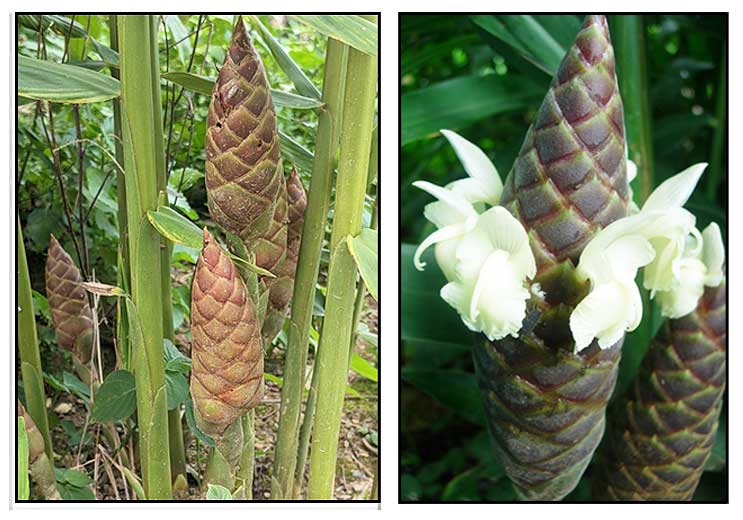
- Etymology: The genus name Zingiber is deeply rooted in ancient Sanskrit shringevera, transitioning through Greek zingiberis and Latin, meaning "horn-shaped" or "horn-body", referring to the rhizome's appearance. The specific epithet purpureum means purple, and refers to the color of the bracts of the inflorescence of the species.
 Botany Botany
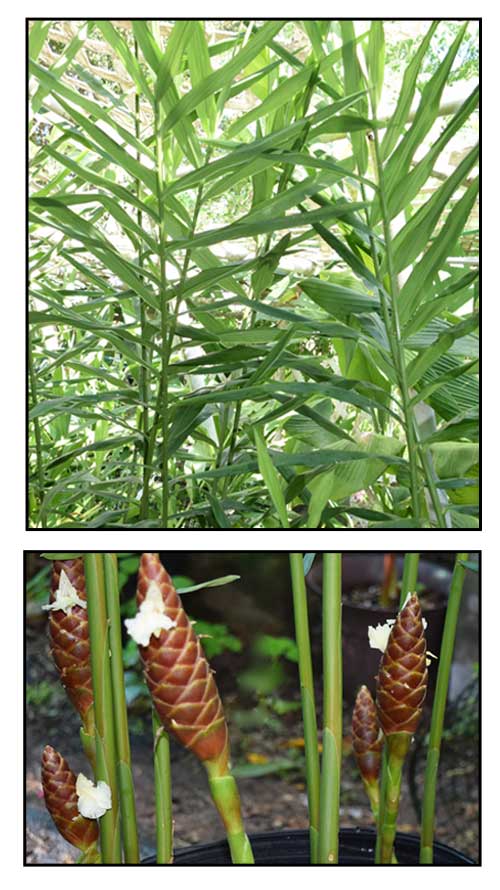
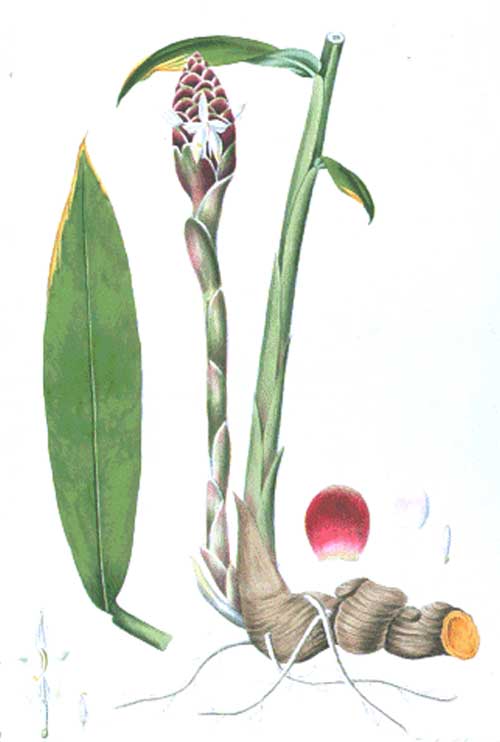
• Cassumunar Ginger is a rhizome forming perennial herb, with rather stout, leafy stem, up to 2 m high. Rhizome is yellow inside, strongly aromatic. Leaves are lance-shaped, 30-45 cm long, stalkless, velvet-hairy or velvet-hairy along midrib only on the lower surface. Ligule 1 mm or less. Flowering stem arises from the root, spikes purplish brown, 7-15 cm long, ovate to oblong on 15-30 cm long flower-cluster-stalk. Flower are pale yellow, tube about 2.5 cm long. Lip 3-lobed, pale yellow, mid-lobe nearly round, bifid. (Flowers of India)
Distribution
- Introduced to the
Philippines.
- Naturalized. (1)
- In cogon grasslands.
- In Mindanao: Lanao del Sur; Mindoro.
- Native to Assam, Bangladesh, East Himalaya, India, Myanmar. (2)
Constituents
- GC-MS analysis of ethyl acetate extracts from rhizomes idetected 30 major peaks and identified 21 compounds, including 15 phenylbutenoids and one phenylbutanoid. (5)
- GC-MS study of essential o8il revealed main components of sabinene (48.1%), terpinen-4-ol (25.1%), and
γ-terpinene (6.7%), followed by
α--terpinene (4.3%), ß-thujene (3.4%), and
α-phellandrene (2.7%). (see study below) (12)
Properties
- Studies have suggest antibacterial, anti-inflammatory, glucose-uptake reducing, insecticidal, repellent, nootropic, neurotrophic, anticancer, insulin-resistance attenuating properties.
Parts used
Rhizomes, essential oil.
 Uses Uses
Edibility
- In Thailand, the aromatic rhizome used to flavor food.
Folkloric
- In the Philippines, (2)
- In Thailand, traditionally used for treatment of inflammation, pain, and asthma.
- In Indonesia, bangle is used for treatment of fever, headache, colic in children, abdominal obesity in postpartum women, and as vermifuge and uterine analeptix. (5) Also used for treatment of joint pains, common cold, and jaundice. (6)
- Used for abdominal pain, bloating, indigestion and nausea, coughs and cold, wound healing, and as generall tonic.
- Also used for treatment of diarrhea, malaria, asthma.
- In traditional Vietnamese medicine, used for treatment of chronic diarrhea. In other Asian countries, used for cholera, diarrhea, dysentery, stomach ailments, and to stimulate digestion.
(21)
Others
- Oil: In Thailand, it is the main component in massage oil. In Thai Herbal Pharmacopoeia, plai is listed as anti-inflammatory, counter-irritant, and mosquito repellent. (3)
Studies
• Toxicity Study / Rhizomes: Study evaluated the acute and chronic oral toxicities of Bangle rhizome extract (BRE) in Sprague-Dawley rats. BRE powder was estimated higher than 2000 mg/kg containing BRE 534 mg/kg as minimum lethal dose in a single-dose oral toxicity study. The NOAEL no-observed-adverse-effect-level) for BRE powder was 1000 mg/kg/day (BRE267mg/kg) in the 90-day oral toxicity study. Four-week clinical studies of BRE tablets in humans suggested ingestion of BRE tablets (227 mg/man/day) was safe for at least one month. (6)
• Antibacterial Study / Essential Oil: Study evaluated the essential oil from rhizomes of Z. purpureum for antibacterial activity against Gram(+) and Gram(-) bacteria. All tested bacteria showed inhibition at concentration range from 2.5% to 10%, with inhibition of E. coli, P. aeruginosa and E. cloacae at lowest concentration (0.63%), with inhibition zones ranging from 6.7 mm to 8.0 mm. Widest ZOI of 13.3 mm was reported against E. cloacae at 10% concentration. (7)
• Antibacterial Against Propionibacterium acnes / Essential Oil: Study of rhizome essential oil for Phlai identified 17 constituents, with sabinene (50.83% as major component. Agar disc diffusion and broth microdilution methods showed antibacterial efficacy against Propionibacterium acnes DMST 14916, with MIC of 6.25% v/v and MBC of 25.0% v/v. EO inhibition zone was 13.67 mm compared to clindamycin 50 µg/ml 6.00 mm. (8)
• Amelioration of Colonic Inflammation and Upregulation of Autophagy: Study evaluated the effects of Bangle extract (BaE) on inflammation and autophagy in colons of mice with dextran sulfate sodium (DSS)-induced colitis. Results showed BaE may ameliorate colonic inflammation and upregulate autophagy via modulation of the AMPK/mTOR/NFkB pathway in DSS-induced colitis. (9)
• No Antidiabetic Effect / Rhizome: Study evaluated the antidiabetic potential of bangle rhizome in vivo using alloxan-induced hyperglycemic mice, using extract doses of 100, 200, and 400 mg/kbw. Results from invivo testing showed no significant effect on reducing blood sugar in hyperglycemic male mice. The PASS Online results did not show any activity related to insulin sensitivity or alpha-glucosidase inhibitory activity. (10)
• cis-Banglene / Effect on Mitrochondrial Biogenesis and Glucose Uptake: Bangle intake has been reported to promote exercise-induced effects such as reducing insulin resistance and non-esterified fatty acid levels and ameliorating loss of autophagy function in rats fed high-fat diets. Study evaluated the physiological effects of cis-banglene on C2C12 skeletal muscle. cis-Banglene promoted glucose uptake and mitochondrial biogenesis like exercise. cis-Banglene activated IL-6/AMPK signaling pathway and increased mRNA expression levels similar to exercise and AICAR. Results suggest potential for cis-banglene as candidate exercise mimetic. (11)
• Insecticidal / Repellent / Rhizomes Essential Oil: Study evaluated the insecticidal and repellent activities of essential oil from Zingiber purpureum rhizomes against Tribolium castaneum and Lasioderma serricorne adults. Results showed strong contact toxicity with LD50s of 39.0 and 16.3 µg per adult, respectively, and also showed strong fumigant toxicity against the two grain storage insects with LC50s of 13.6 and 9.3 mg/liter of air/respectively. Of the EO components, terpinen-4-ol showed strongest contact toxicity against Tc and Ls, with LD50s 19.7 and 5.4 µg per adult, and also showed strongest fumigant with LC50s of 3.7 and 1.3 mg/L of air, respectively. (see constituents above) (12)
• Neurotrophic Effects / Nootropic Banglenes / Functional Food Additive: Phenylbutenoid dimers isolated from Bangle have exhibited neurotrophic effects in primary rat cortical neurons and PC12 cells. Study evaluated the effects of Bangle extract on behavior and hippocampal neurogenesis in vivo in SAMP8 mice. Results showed the diet improved spatial learning and memory deficits in the Morris water maze and significantly increased the numbers of Ki67-positive cells in the dentate gyrus of SAMP8 mice. The extract also exhibited neurotrophin-like activity as suggested by induction of neurite sprouting in PC12 cells. Results suggest Bangle is beneficial for prevention of age-related progression of cognitive impairment. (13)
• Neuroprotective / Banglenes / Functional Food Additive: The Javanese ginger Bangle contains neurotrophic phenylbutenoid compounds, banglenes 1 and 2. Study evaluated the conversion method of the banglenes as functional food additives for protection of neurodegenerative disease. Dimerization of compound 3 refluxing in the presence of ubiquinone gave rise to 1 and 2 in 54% yield. Applied on 70% EtOH bangle extract, content for 1 and 2 increased 2-fold. (14)
• Anti-Inflammatory / Rhizomes: Study evaluated the anti-inflammatory activity of ethanol extract of Bangle rhizome using carrageenan-induced paw edema and UVB-induced erythema method. Anti-inflammatory activity was observed at doses of 5, 10, and 20 mg/200 g BW in the carrageenan model and at doses of 10 and 20 mg/;200 g in the erythema model. Most potent anti-inflammatory activity was recorded at 20 mg/200 g body weight. Extract flavonoids and steroids may contribute to the observed anti-inflammatory activity. (15)
• Anticancer / WIDR Colon Adenocarcinoma Cell Line-Inflammatory / Rhizomes: Bioassay-guided fractionation examined the anticancer activity of n-hexane, ethyl acetate, and methanol fractions of ethanolic extract of bangle plant rhizome to colon cancer cell type WiDr and Vero cells. Study isolated 2,3-dihydro-5-hydroxy-7-methoxy-2-phenylchromen-4-one compound of ethyl acetate fraction No 21, with a CC50 of 11.24 µg/mL for WiDr cell and 341.22 µg/mL to Vero cells. (16)
• Anti-Inflammatory / Nanochitosan-Coated Z. cassumunar: Study evaluated a nanochitosan-coated formulation incorporating Zingiber cassumunar (Plai) extracts for inflammatory activity. GC-MS study showed enrichment of lipophilic, volatile compounds such as lidocaine, benzyl benzoate, and squalene. Anti-inflammatory activity assessed by BSA protein denaturation assay revealed all formulations, including crude extract, chitosan, and nanochitosan-Plai, exhibited h8igh inhibition across tested concentrations. The nanochitosan-Plai formulation showed significant superior activity at highest concentration. The nanochitosan encapsulation significantly enhanced therapeutic efficacy of Plai, supporting potential for development as an advanced topical delivery system for management of localized inflammatory conditions. (17)
• Attenuation of Insulin Resistance and Inflammation in Skeletal Muscle: Study evaluated the effects of Bangle extract (Ba) on insulin resistance and inflammation in the gastrocnemius muscle (GM) of high-fat diet fed SAMP8 mice. Results showed Ba may attenuated HFD-induced insulin resistance and inflammation by modulating the AMPK/Akt/mTOR pathway in the GMs of HFD-fed young SAMP8 mice. Bangle treatment can be a useful strategy for obesity-related insulin resistance and may also improve hyperlipidemic and hyperglycolytic conditions in skeletal muscles. (18)
• Antibacterial / Rhizome Essential Oil: Study evaluated the antibacterial activity of Z. purpureum rhizome essential oil against Cutibacterium acnes and Staphylococcusd epidermis. Study used four concentrations of rhizome oil EO (25, 50, 75 and 100%) and Chloramphenicol as positive control. Results showed the rhizome essestial oil has antibacterial activity inhibiting both C. acnes and S. epidermis with optimal concentration at 100%. (19)
Availability
- Wild-crafted. |


